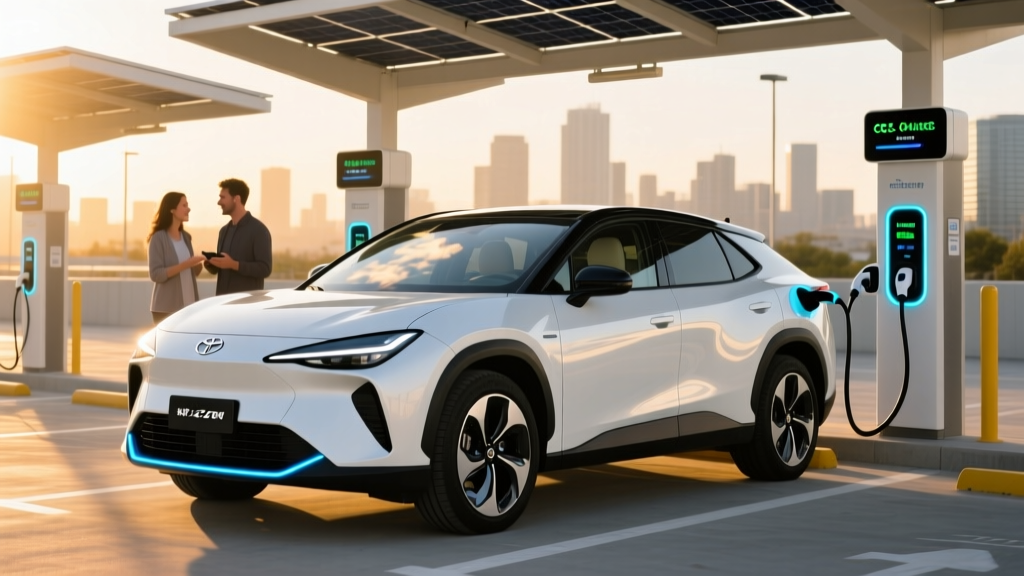
The Toyota bZ4X has had a turbulent run since its 2023 debut — from early recall woes to aggressive dealer discounts. For 2025, Toyota has stabilized the bZ4X lineup with modest updates and some of the most compelling lease incentives in the compact electric SUV segment. If you've been searching for 2025 bZ4X lease deals, you'll find monthly payments that undercut many competitors — but the numbers only tell half the story. Below, we reconcile Toyota's EPA estimates with real-world driving data, dissect the charging curve, and calculate what you'll actually pay after federal incentives.
2025 Toyota bZ4X: Quick Specs at a Glance
| Specification | XLE FWD | XLE AWD | Limited AWD |
|---|---|---|---|
| EPA Range | 252 miles | 228 miles | 222 miles |
| Battery (usable) | 71.4 kWh (NMC lithium-ion) | ||
| Horsepower | 201 hp | 214 hp | |
| 0-60 mph | 7.1 sec | 5.8 sec | |
| Max DC Fast Charge | 150 kW | 150 kW | |
| 10-80% DCFC Time | ~30 minutes | ||
| Level 2 Home Charge | ~6.6 kW (~25 mi/hr) | ||
| MPGe (combined) | 131 MPGe | 119 MPGe | 117 MPGe |
| kWh/100 mi | 26 | 28 | 29 |
| Base MSRP | $37,070 | $39,170 | $43,770 |
| Battery Warranty | 8 years / 100,000 miles | ||
Real-World Range: What the EPA Sticker Doesn't Tell You
EPA Estimated: 252 miles (XLE FWD) / 228 miles (XLE AWD)
Real-World Expectation: 210–235 miles in mixed driving; 180–200 miles sustained highway at 70+ mph; 155–180 miles in sub-freezing winter conditions.
The bZ4X's 71.4 kWh usable battery (NMC chemistry) delivers competitive city efficiency but shows its limitations on the open road. In our experience and aggregated owner data, the FWD model averages around 2.9–3.1 miles per kWh in mixed suburban driving, which tracks close to its 252-mile EPA label. Highway driving at 70-80 mph drops efficiency to roughly 2.5–2.7 mi/kWh, translating to 180–200 usable miles before you'll want to find a charger.
Cold weather is where the bZ4X's range story requires attention. Without a standard heat pump on all trims (it's included on the Limited, optional elsewhere depending on package), cabin heating draws directly from the traction battery. Owners in northern climates consistently report 25–35% range loss at temperatures below 32°F. If your commute involves 60+ miles round-trip in a Minnesota winter, the AWD model's 228-mile EPA rating may realistically shrink to 155–170 miles.
For context, the EPA's official bZ4X listing confirms these figures. The Hyundai Ioniq 5 (303 miles RWD) and Tesla Model Y (308 miles Long Range) offer substantially more buffer — something to weigh if road trips or cold winters are in your routine.
Charging Speed: DC Fast Charging and Home Setup
The bZ4X peaks at 150 kW on a DC fast charger — adequate but not class-leading. The Hyundai Ioniq 5 and Kia EV6, built on 800V architectures, accept up to 240–350 kW and complete a 10-80% charge in roughly 18 minutes. The bZ4X takes approximately 30 minutes for that same 10-80% session.
| Charging Level | Power | Speed (approx.) | Typical Use Case |
|---|---|---|---|
| Level 1 (120V) | ~1.4 kW | ~5 miles/hour | Emergency top-up overnight |
| Level 2 (240V) | 6.6 kW | ~25 miles/hour | Daily home/garage charging |
| DC Fast Charge | 150 kW peak | 10-80% in ~30 min | Road trips, public stations |
A critical detail about the bZ4X's charging curve: it sustains near-peak power up to roughly 50% state of charge, then tapers progressively. From 80-100%, expect charge rates to drop below 20 kW — meaning that last 20% can take as long as the first 70%. For road-trip efficiency, plan your stops around 10-80% sessions and skip topping off to full unless you need every mile to reach your destination.
At home on a Level 2 (240V, 32A) charger, the bZ4X replenishes at 6.6 kW — adding about 25 miles of range per hour. A full 0-100% charge takes roughly 11 hours, which works well for overnight charging if you have a garage or dedicated outlet. Installation for a Level 2 home charger typically runs $500–$2,000 depending on panel capacity and conduit distance. Toyota includes one year of complimentary charging on the Electrify America network (up to 1,000 kWh), which helps offset early public-charging costs.
2025 bZ4X Lease Deals: Pricing, Incentives, and What You'll Pay
This is where the bZ4X becomes genuinely compelling. Toyota has been offering aggressive lease incentives on the bZ4X, frequently advertised in the range of $199–$299/month depending on region, trim, and down payment. These lease deals often incorporate Toyota's application of the $7,500 federal EV tax credit as a lease cash incentive (capitalized cost reduction), which effectively passes the credit through to the lessee even if they wouldn't individually qualify under IRS §30D purchase rules.
| Cost Factor | XLE FWD | XLE AWD | Limited AWD |
|---|---|---|---|
| Base MSRP | $37,070 | $39,170 | $43,770 |
| Destination Fee | $1,350 | $1,350 | $1,350 |
| Lease Cash / EV Incentive | -$7,500 | -$7,500 | -$7,500 |
| Effective Lease Cap Cost | ~$30,920 | ~$33,020 | ~$37,620 |
| Typical Monthly Lease (36 mo) | $199–$279 | $249–$319 | $319–$399 |
How the lease credit works: Under a "lessor pass-through" structure, the leasing company (Toyota Financial Services) claims the §30D credit as the vehicle's legal owner during the lease term, then applies it as a cap cost reduction. This means the lessee benefits from the $7,500 reduction regardless of personal income or tax liability — a significant advantage over purchasing, where IRS §30D rules impose income caps ($150K single / $300K joint MAGI) and require the vehicle's battery to meet critical-mineral and component sourcing thresholds.
Key caveat: Lease deals vary substantially by dealership and region. The headline $199/month figures typically require $3,999–$4,500 due at signing and are limited to the XLE FWD trim. Always confirm the money factor, residual value, and total due at signing before committing. A 36-month/10,000-mile lease is the standard structure; adding miles or extending the term changes the math.
Performance, Interior, and Daily Livability
The bZ4X's dual-motor AWD variant produces 214 horsepower and 248 lb-ft of torque, launching to 60 mph in approximately 5.8 seconds. That's adequate for merging and passing but trails the Ioniq 5 AWD (5.1 sec) and Model Y Long Range (4.8 sec). The FWD model, at 201 hp and 7.1 seconds, feels relaxed around town but noticeably unhurried on freeway on-ramps.
Inside, the bZ4X offers a practical, if unremarkable, cabin. Passenger space is generous for the segment:
- Front legroom: 42.1 inches
- Rear legroom: 35.3 inches
- Cargo (behind rear seats): 27.7 cu ft
- Cargo (seats folded): 56.9 cu ft
The 12.3-inch touchscreen on the XLE and Limited runs Toyota's latest infotainment system with wireless Apple CarPlay and Android Auto. The Limited adds a panoramic fixed-glass roof, heated and ventilated front seats, a 360-degree camera, and Toyota's Traffic Jam Assist (a low-speed hands-on driver assist, SAE Level 2 — not autonomous driving). Toyota Safety Sense 3.0 is standard across all trims, including adaptive cruise control, lane-keeping assist, automatic emergency braking, and blind-spot monitoring.
Notable drawbacks include the absence of a front trunk (frunk), a relatively small rear cargo area compared to the Ioniq 5 (which offers 27.2 cu ft but a more usable shape), and the bZ4X's lack of one-pedal driving mode — Toyota's regenerative braking system offers adjustable levels but doesn't bring the car to a complete stop without touching the brake pedal. For EV veterans accustomed to full regen, this is a meaningful ergonomic miss.
How the bZ4X Compares to Key Rivals
The compact electric SUV segment is crowded. Here's how the bZ4X stacks up against the three benchmarks it most frequently cross-shops against:
| Metric | Toyota bZ4X AWD | Hyundai Ioniq 5 SEL AWD | Tesla Model Y LR AWD | Kia EV6 GT-Line AWD |
|---|---|---|---|---|
| EPA Range | 228 mi | 290 mi | 308 mi | 274 mi |
| Max DCFC | 150 kW | 240 kW (800V) | 250 kW | 240 kW (800V) |
| 10-80% Time | ~30 min | ~18 min | ~22 min | ~18 min |
| 0-60 mph | 5.8 sec | 5.1 sec | 4.8 sec | 5.1 sec |
| Base MSRP (AWD) | $39,170 | $49,600 | $47,740 | $51,600 |
| Cargo (rear seats up) | 27.7 cu ft | 27.2 cu ft | 30.2 cu ft | 24.4 cu ft |
The bZ4X's clear advantage is price after incentives. With the $7,500 lease cash applied, the effective cap cost undercuts every competitor by $8,000–$15,000. However, the range and charging-speed deficit is substantial: the Ioniq 5 and EV6 charge nearly twice as fast and deliver 25–30% more range. If your lease includes a generous mileage allowance and you charge primarily at home, the bZ4X's compromises may be perfectly acceptable. If you road-trip frequently or lack home charging, the faster-charging Korean platforms or the Supercharger-reliant Model Y make a stronger case.
Pros and Cons: The Honest Scorecard
Pros
- Among the lowest lease payments in the segment after $7,500 incentive
- Toyota's reputation for reliability and strong dealer network
- 8-year/100,000-mile battery warranty
- Standard Toyota Safety Sense 3.0 ADAS suite
- Comfortable ride quality and quiet cabin
- One year of free Electrify America charging included
Cons
- Below-average EPA range (228–252 mi) vs. segment leaders (290–320 mi)
- Slow DC fast charging (150 kW peak, ~30 min 10-80%) vs. 800V rivals (~18 min)
- No front trunk (frunk)
- No true one-pedal driving mode
- Significant cold-weather range loss without heat pump (standard only on Limited)
- Interior materials and design feel dated vs. Ioniq 5 and Model Y
Who Should Lease the 2025 bZ4X (And Who Shouldn't)
Lease the bZ4X if:
- You have reliable home Level 2 charging and a round-trip commute under 80 miles
- You prioritize low monthly payments over maximum range
- You want Toyota's warranty coverage and dealer service network
- You live in a moderate climate where cold-weather range loss is minimal
- You're a current Toyota owner loyal to the brand and its reliability track record
Look elsewhere if:
- You regularly drive 200+ miles between charges or road-trip monthly
- You rely on public DC fast charging as your primary refueling method
- You live in a cold northern climate and need maximum winter range
- You want the latest EV tech (800V charging, frunk, one-pedal driving, V2L)
Frequently Asked Questions
What is the real-world range of the 2025 Toyota bZ4X?
In mixed suburban driving, expect 210–235 miles from the FWD model (EPA-rated 252). Sustained highway driving at 70+ mph drops to 180–200 miles. In sub-freezing temperatures, plan for 155–180 miles depending on cabin heat usage and whether your trim includes the heat pump.
How fast does the bZ4X charge at home and on the road?
At home on a Level 2 (240V) charger, the bZ4X charges at 6.6 kW, adding roughly 25 miles per hour — a full charge takes about 11 hours. On a DC fast charger, it peaks at 150 kW and completes a 10-80% session in approximately 30 minutes. That's slower than the Ioniq 5, EV6, and Model Y, all of which complete the same session in 18–22 minutes.
How much does the 2025 bZ4X cost after tax credits and lease incentives?
With Toyota's $7,500 lease cash applied as a capitalized cost reduction, the XLE FWD can lease for as low as $199–$279/month on a 36-month term with roughly $4,000–$4,500 due at signing. Exact pricing varies by dealership, region, and credit tier. If purchasing instead of leasing, eligibility for the §30D federal tax credit depends on your MAGI, the vehicle's battery sourcing compliance, and MSRP caps — consult a tax professional.
Does the 2025 bZ4X qualify for the $7,500 federal EV tax credit?
When leased, the $7,500 credit is typically claimed by the lessor (Toyota Financial Services) and passed through as a lease incentive — meaning you benefit regardless of personal income limits or tax liability. When purchased, eligibility depends on current IRS §30D requirements, including buyer income caps ($150K single / $300K joint), vehicle MSRP caps ($80K for SUVs), and battery critical-mineral/component sourcing rules that change periodically. Always verify current eligibility before committing.
Is the bZ4X worth leasing over the Hyundai Ioniq 5 or Tesla Model Y?
It depends on your priorities. The bZ4X offers the lowest effective monthly cost in the segment when lease incentives are applied, making it an excellent value for home-charging commuters who don't need maximum range. The Ioniq 5 and Model Y deliver 25–30% more range, significantly faster DC charging, and more modern interiors — but at $100–$200/month more on comparable lease terms. If budget is your primary constraint and your driving pattern fits within 200 miles per charge, the bZ4X is a rational, cost-effective choice.
What is the bZ4X's battery warranty?
Toyota covers the bZ4X's high-voltage battery for 8 years or 100,000 miles (whichever comes first), with a capacity retention threshold of 70%. The basic vehicle warranty is 3 years/36,000 miles, and the powertrain warranty extends to 5 years/60,000 miles. Toyota also includes 2 years of complimentary scheduled maintenance.
Editorial note: Lease pricing and incentive amounts reflect advertised programs as of early 2025 and vary by dealership, region, and creditworthiness. Federal tax credit rules under IRS §30D are subject to legislative and regulatory changes. Always confirm current terms with your dealer and consult a tax professional regarding purchase credit eligibility. Data sourced from EPA (fueleconomy.gov), Toyota Motor Corporation, and the IRS.