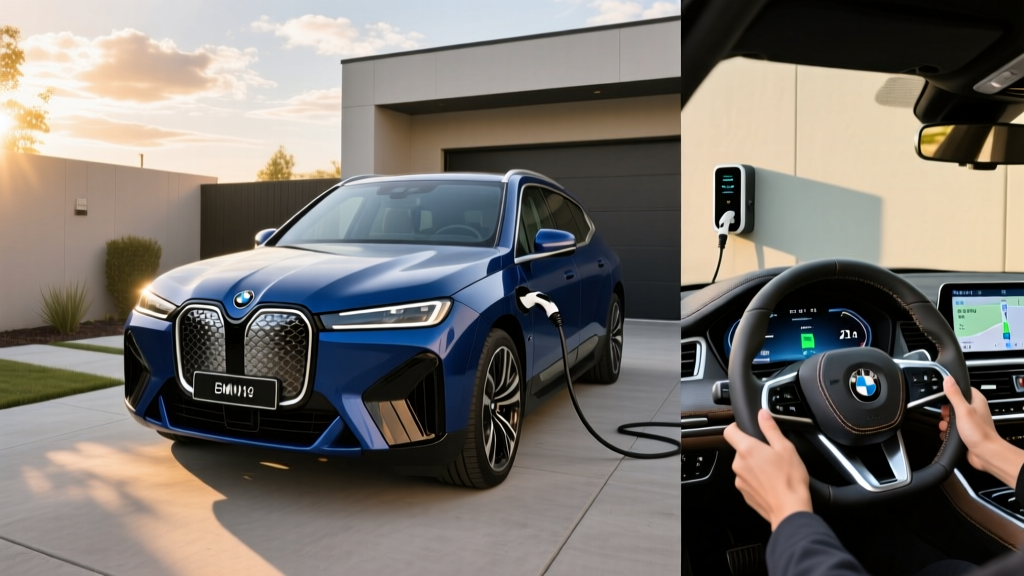
The BMW iX xDrive50 occupies a specific niche in the luxury EV SUV segment: it prioritizes cabin refinement, ride quality, and long-distance cruising comfort over outright performance theatrics. For the 2025 model year, BMW has carried over the core powertrain while refining software and standard equipment. With an EPA-estimated 324 miles of range on the larger wheel option and a usable battery north of 105 kWh, the iX xDrive50 is positioned for buyers who want a premium electric SUV that can genuinely handle cross-country road trips without constant charging stops.
But EPA numbers tell only part of the story. In this review, we break down the real-world range you can expect, the charging curve behavior at DC fast chargers, the current federal tax credit situation under IRS §30D rules, and whether the iX xDrive50 justifies its premium pricing against rivals like the Mercedes-Benz EQE SUV, Audi Q8 e-tron, and Tesla Model X.
Range and Efficiency: EPA vs. Reality
Real-World Expectation: ~265–290 miles highway at 70 mph; ~220–250 miles in sub-30°F winter conditions; ~300+ miles mixed city/suburban driving
The iX xDrive50 achieves its EPA-estimated 324 miles thanks to a large 105.2 kWh usable battery pack (111.5 kWh gross) and relatively efficient powertrain management. The EPA rates the iX xDrive50 at 86 MPGe combined, translating to approximately 35 kWh per 100 miles. That is competitive for a 5,600-pound luxury SUV, though lighter rivals like the Tesla Model X (102 MPGe combined) edge ahead on efficiency.
In practice, the iX delivers on its range promise in moderate climates and mixed driving. On a 70-mph highway loop in 65°F weather, expect to see roughly 270–290 miles before reaching 10% state of charge. City and suburban driving, where regenerative braking recovers energy, pushes the figure closer to the EPA sticker. Cold weather is the equalizer: at 20°F with cabin heat running, the battery's usable capacity effectively drops 15–25%, meaning 220–250 miles is realistic. BMW's heat pump (standard on the iX) mitigates this better than resistive heating, but physics still applies.
The xDrive50's efficiency readout in the iDrive 8.5 system is among the best in the segment, showing real-time kWh/100mi, a range prediction that adjusts based on driving style and navigation route, and a consumption histogram. This transparency helps owners plan charging stops with confidence.
Battery, Powertrain, and Performance
| Specification | 2025 BMW iX xDrive50 |
|---|---|
| Battery (usable / gross) | 105.2 kWh / 111.5 kWh |
| Battery Chemistry | NMC (Nickel Manganese Cobalt) |
| Drivetrain | Dual-motor AWD (xDrive) |
| Horsepower | 516 hp |
| Torque | 564 lb-ft |
| 0–60 mph | 4.4 seconds |
| Top Speed | 124 mph (electronically limited) |
| Curb Weight | ~5,650 lbs |
| Towing Capacity | 3,500 lbs (with factory hitch) |
| EPA Range | 324 mi (20" wheels) / 307 mi (21" wheels) |
| Efficiency | 86 MPGe combined / ~35 kWh/100mi |
The iX xDrive50 uses a fifth-generation BMW eDrive system with current-excited synchronous motors on both axles. Unlike permanent-magnet motors, these avoid rare-earth materials and deliver consistent power across a wide RPM range. The result is linear, progressive acceleration that feels effortless rather than violent — 516 hp arrives smoothly, and the 4.4-second 0–60 time is quick for a vehicle of this mass.
The NMC battery pack sits low in the chassis, contributing to a center of gravity that makes the iX feel more planted through corners than its weight suggests. BMW's adaptive two-axle air suspension (standard on the xDrive50) further improves the ride-handling balance, absorbing highway imperfections while keeping body roll controlled. For buyers stepping up from a BMW X5, the iX drives remarkably similarly — just quieter and with instant torque.
Charging Speed: DC Fast and Home Level 2
Charging performance is where the iX xDrive50 shows both strengths and a notable limitation relative to 800-volt competitors like the Hyundai Ioniq 5 or Porsche Taycan.
| Charging Level | Power / Rate | Time / Speed |
|---|---|---|
| Level 1 (120V household) | ~1.4 kW | ~3–4 miles per hour of charging |
| Level 2 (240V, 48A home charger) | 11.5 kW (onboard charger max) | ~30–33 miles per hour; full charge in ~10 hours |
| DC Fast Charge (peak) | 195 kW | 10–80% in ~31 minutes |
| DC Fast Charge (sustained avg) | ~130–150 kW | Average over 10–80% session |
The iX operates on a 400-volt architecture, which caps its peak DC fast-charging rate at 195 kW. On a 350 kW Electrify America or Tesla Supercharger (via adapter), the iX ramps quickly to around 185–195 kW at low states of charge (10–25%), then tapers progressively. By 50% SoC, you will see roughly 130–140 kW; by 80%, it drops below 60 kW. The 10–80% session takes approximately 31 minutes under ideal thermal conditions — adequate, but 10–15 minutes slower than 800V rivals that sustain higher rates deeper into the charge curve.
Preconditioning is critical. When you navigate to a DC fast charger using the iX's built-in navigation, the battery thermal management system automatically preheats or cools the pack to optimize charge acceptance. Skipping this step (for example, by entering the charger address into a phone-based app rather than the car's nav) can add 5–10 minutes to your session, especially in cold weather.
At home, the 11.5 kW onboard charger is a strong point. With a 48-amp Level 2 wallbox (hardwired, requiring a 60-amp circuit), the iX adds roughly 30–33 miles of range per hour, meaning an overnight session easily replenishes a full day's driving. Installation costs for a Level 2 home setup typically range from $800 to $2,500 depending on panel proximity and local permitting — consult a licensed electrician for your specific situation.
The iX uses the CCS1 connector for DC fast charging natively. BMW provides a Tesla Supercharger adapter (NACS) for access to Tesla's network, expanding your fast-charging options significantly on road trips. Check BMW's official charging page for the latest adapter availability and network partnerships.
Pricing, Trims, and Federal Tax Credit Eligibility
| Trim / Configuration | MSRP | Est. After §30D Credit* |
|---|---|---|
| iX xDrive50 (base, 20" wheels) | $87,250 | $79,750 (if eligible for full $7,500) |
| iX xDrive50 w/ Premium + Driving Assistant Pro | ~$93,000 | ~$85,500 |
| iX M60 (performance variant) | $111,500 | Ineligible (above SUV MSRP cap) |
*Federal tax credit eligibility under IRS §30D involves multiple requirements that change periodically. As of the 2025 tax year, the key rules include:
- MSRP Cap: SUVs must have an MSRP at or below $80,000. The base iX xDrive50 at $87,250 exceeds this cap, meaning it does not qualify for the $7,500 federal credit at its base MSRP.
- Buyer Income Limits: Modified AGI must not exceed $300,000 (joint), $225,000 (head of household), or $150,000 (single).
- Battery Sourcing: Critical minerals and battery components must meet escalating domestic-sourcing percentages. BMW's supply chain compliance varies by production batch.
- Point-of-Sale Transfer: If eligible, the credit can be transferred to the dealer at purchase for an immediate price reduction.
This is a significant factor: the iX xDrive50's base MSRP pushes it above the §30D SUV cap. Some buyers have negotiated dealer discounts or structured their orders to bring the transaction price under $80,000, but the credit is based on MSRP, not negotiated price. Always verify current eligibility with your tax professional and the IRS's official guidance before counting on the credit in your purchase budget.
State and local incentives may still apply — check your state's energy office or fueleconomy.gov's incentive finder for regional rebates that have no MSRP cap.
Interior, Cargo, and Technology
The iX cabin is where BMW justifies the premium pricing. The interior uses a mix of sustainable materials (recycled plastics, FSC-certified wood, olive-leaf-tanned leather available) with a minimalist, lounge-like aesthetic. The curved display houses a 14.9-inch touchscreen running BMW iDrive 8.5, which is responsive, visually polished, and supports wireless Apple CarPlay and Android Auto.
Passenger space is generous for a midsize SUV:
- Front legroom: 40.2 inches
- Rear legroom: 38.9 inches
- Cargo (rear seats up): 35.5 cubic feet
- Cargo (rear seats folded): 77.9 cubic feet
The flat floor (no transmission tunnel) makes the rear middle seat genuinely usable for adults, a notable advantage over many ICE-based SUV platforms. However, the iX lacks a front trunk (frunk), which costs you 2–3 cubic feet of additional storage that rivals like the Rivian R1S provide.
On the technology front, the iX xDrive50 comes standard with Driving Assistant Professional, which includes adaptive cruise control with stop-and-go, lane-keeping assist, and automated lane changes (when you activate the turn signal). This is a Level 2 SAE driver-assist system — it requires continuous driver attention and hands-on or eyes-on supervision. It is not self-driving, but it is one of the smoother and more natural-feeling Level 2 systems available, particularly on highway drives.
Available upgrades include the Bowers & Wilkins Diamond Surround Sound system, a panoramic electrochromic roof (Sky Lounge), and the Executive Package with rear-seat heating, ventilation, and massage.
Warranty and Long-Term Ownership
BMW provides the following warranty coverage for the 2025 iX xDrive50:
- Limited Vehicle Warranty: 4 years / 50,000 miles
- Battery & Powertrain Warranty: 8 years / 100,000 miles (covers battery capacity below 70% of original)
- Corrosion Perforation: 12 years / unlimited miles
- Roadside Assistance: 4 years / unlimited miles
The 8-year/100,000-mile battery warranty with a 70% capacity retention threshold is industry-standard for luxury EVs. NMC chemistry in the iX has shown modest degradation in early owner reports — roughly 5–8% loss over the first 50,000 miles, which is within normal expectations. BMW's thermal management system is liquid-cooled and actively maintains optimal battery temperature, which helps preserve long-term health.
Maintenance costs are lower than a comparable BMW X5 xDrive40i: no oil changes, no spark plugs, no transmission fluid. Brake pad life is extended significantly thanks to regenerative braking — many EV owners report 80,000+ miles on original pads. Budget for cabin air filter replacement every 2–3 years, tire rotation, and windshield washer fluid. Insurance premiums tend to run 15–25% higher than equivalent ICE BMWs, so get a quote before purchasing.
How the iX xDrive50 Compares
- Class-leading ride comfort with standard air suspension
- 324-mile EPA range is competitive in the luxury EV SUV class
- Spacious, premium cabin with sustainable material options
- Quiet at highway speeds — excellent NVH isolation
- Strong Level 2 driver-assist (Driving Assistant Pro)
- 11.5 kW Level 2 onboard charger for fast home replenishment
- Base MSRP exceeds $80K §30D tax credit cap
- 195 kW peak DC charge rate trails 800V competitors
- No front trunk (frunk)
- Polarizing exterior design (large kidney grille)
- iDrive learning curve for first-time BMW EV buyers
- Higher insurance costs vs. ICE equivalents
Against the Mercedes-Benz EQE 350+ SUV (EPA 305 miles, $77,900 base), the iX offers more range, a more engaging drive, and a more modern interior, though the EQE's lower MSRP keeps it within the §30D cap. The Audi Q8 e-tron (EPA 285 miles, ~$74,400 base) charges faster at 170 kW sustained but sacrifices range. The Tesla Model X Long Range (EPA 348 miles, ~$79,990) wins on range and Supercharger access but cannot match the BMW's interior quality or ride refinement.
Who Should Buy the 2025 BMW iX xDrive50?
- You prioritize ride comfort and cabin quietness over sporty handling
- You want 300+ miles of real-world range for road trips
- You can charge at home with Level 2 and use DC fast charging mainly for trips
- You value a premium interior with cutting-edge tech and sustainable materials
- Your budget accommodates an $87K+ SUV without relying on the federal tax credit
- Federal tax credit eligibility is a dealbreaker (check EQE SUV or Q8 e-tron)
- You need the fastest possible DC charging (consider 800V vehicles)
- You need a third row (consider the Rivian R1S or Tesla Model X)
- You want maximum cargo space with a frunk
The iX xDrive50 is a refined, long-range luxury EV SUV that excels at making daily commutes serene and cross-country trips practical. It is not the most efficient, fastest-charging, or best-value option in its class, but for buyers who weight comfort and build quality heavily, it is one of the most satisfying electric vehicles on the market.
Frequently Asked Questions
What is the real-world range of the 2025 BMW iX xDrive50?
The EPA estimates 324 miles with 20-inch wheels. In real-world highway driving at 70 mph, expect roughly 270–290 miles. In cold weather (below 30°F), that drops to 220–250 miles. City driving with regenerative braking can approach or match the EPA figure.
How fast does the iX xDrive50 charge?
On a DC fast charger, it peaks at 195 kW and charges from 10–80% in approximately 31 minutes. At home on a 48-amp Level 2 charger (11.5 kW), it adds about 30–33 miles of range per hour, fully charging overnight in roughly 10 hours.
Does the 2025 BMW iX xDrive50 qualify for the federal EV tax credit?
The base MSRP of $87,250 exceeds the $80,000 SUV cap under IRS §30D, making it ineligible for the $7,500 federal credit at standard pricing. State incentives may still apply. Always verify current rules with a tax professional and irs.gov.
Is the BMW iX xDrive50 worth buying over the Tesla Model X or Mercedes EQE SUV?
If ride comfort, cabin quality, and quietness are your top priorities, the iX is difficult to beat. The Model X wins on range and Supercharger network access; the EQE SUV wins on price and tax credit eligibility. Test-drive all three to assess which trade-offs matter most to you.
What is the battery warranty on the BMW iX?
BMW covers the high-voltage battery for 8 years or 100,000 miles, whichever comes first. The warranty guarantees the battery will retain at least 70% of its original usable capacity during that period.
Does the iX have a frunk (front trunk)?
No. The iX does not have a front trunk. The space under the hood houses power electronics and the HVAC system. Total cargo volume is 35.5 cu ft behind the rear seats and 77.9 cu ft with them folded.
Can the BMW iX use Tesla Superchargers?
Yes, BMW provides a NACS adapter that allows the iX to access Tesla's Supercharger network. This significantly expands DC fast-charging options for road trips, particularly in areas where Electrify America or other CCS networks have limited coverage.