Quick Verdict: The Luxury EV That Refuses to Compromise on Charging
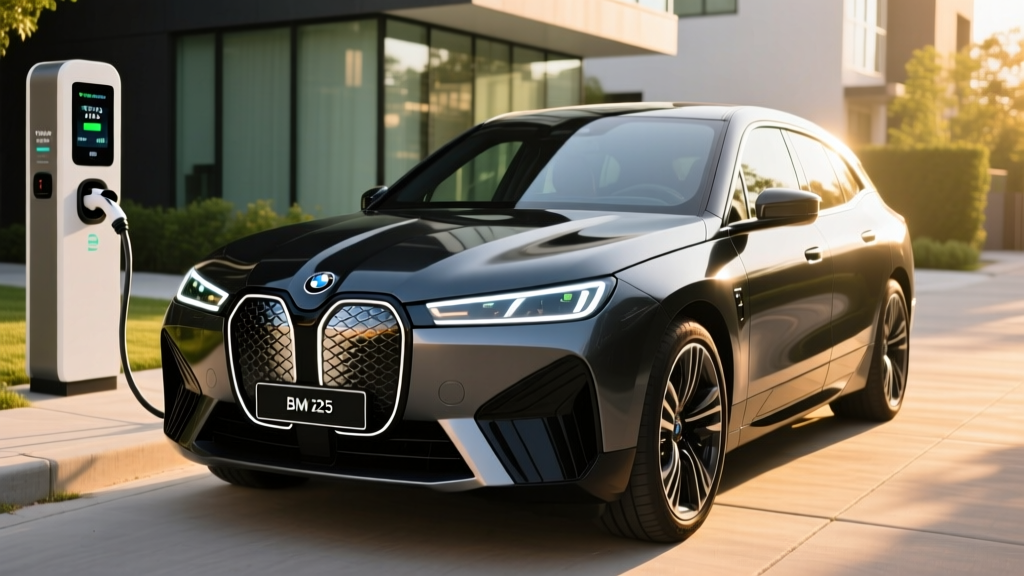
The 2025 BMW iX occupies a specific niche in the electric SUV market: a midsize luxury crossover that pairs genuine long-distance capability with one of the fastest DC fast-charging architectures in its class. With EPA range stretching to 324 miles in the xDrive50 and a peak charge rate of 195 kW that can replenish from 10-80% in roughly 31 minutes, the iX addresses the two concerns that most often derail luxury EV adoption — range anxiety and charging downtime.
But the iX isn't just a numbers game. BMW's fifth-generation eDrive powertrain delivers seamless dual-motor all-wheel drive, a cabin loaded with sustainable materials and curved-display tech, and a ride quality that reminds you this is still a BMW. The trade-offs? A starting price north of $87,000, a controversial exterior design that hasn't aged into universal acceptance, and a federal tax credit situation that requires careful navigation of IRS §30D sourcing rules.
| Specification | xDrive50 | M60 |
|---|---|---|
| EPA Range | 324 mi (20" wheels) | 296 mi (21" wheels) |
| Battery (usable) | 105.2 kWh (NMC) | 105.2 kWh (NMC) |
| Horsepower | 516 hp | 610 hp |
| 0-60 mph | 4.4 sec | 3.6 sec |
| Drivetrain | Dual-motor AWD | Dual-motor AWD |
| Max DC Fast Charge | 195 kW | 195 kW |
| 10-80% DC Charge Time | ~31 min | ~31 min |
| Level 2 Charge Rate | 11 kW (~35 mi/hr) | 11 kW (~35 mi/hr) |
| MPGe (combined) | 86 MPGe | 78 MPGe |
| Base MSRP | $87,250 | $111,500 |
| Battery Warranty | 8 yr / 100,000 mi | 8 yr / 100,000 mi |
Range and Efficiency: What the EPA Sticker Doesn't Tell You
The 2025 BMW iX xDrive50 carries an EPA-estimated range of 324 miles when equipped with the standard 20-inch Aero wheels. Opt for the 21- or 22-inch wheel packages, and that figure drops — the larger wheels and stickier tires increase rolling resistance, trimming range to approximately 307-310 miles depending on configuration. The performance-oriented M60, with its standard 21-inch wheels and more aggressive powertrain calibration, is rated at 296 miles EPA.
Real-World Range Expectations: The EPA 324-mile figure for the xDrive50 is achievable in mixed suburban driving at moderate speeds. On sustained highway trips at 70-80 mph, expect closer to 265-285 miles before you'll want to locate a charger. In freezing temperatures (below 30°F), plan for a 20-30% reduction, bringing effective range to 225-260 miles. The iX's heat pump (standard equipment) mitigates cold-weather cabin energy draw, but battery chemistry still loses efficiency in the cold.
Efficiency for the xDrive50 is rated at 86 MPGe combined, which translates to roughly 39 kWh per 100 miles. That's competitive with the Mercedes-Benz EQE SUV (87 MPGe combined) but trails the more aerodynamically optimized Tesla Model X Long Range (102 MPGe). The iX's boxy crossover silhouette and substantial curb weight (~5,660 lbs for the xDrive50) work against highway efficiency, even as the dual-motor system recovers energy aggressively through adjustable regenerative braking.
Charging Speed: 195 kW DC Fast Charging and Home Setup
BMW equips the iX with a 195 kW peak DC fast-charging capability via its CCS1 connector (a NACS adapter is available for Tesla Supercharger access). At a compatible 200+ kW DC fast charger — such as Electrify America's 350 kW stalls or Tesla Superchargers V3/V4 with an adapter — the iX can charge from 10% to 80% in approximately 31 minutes.
| Charging Level | Max Power | Speed (mi/hr added) | Typical Use Case |
|---|---|---|---|
| Level 1 (120V household) | ~1.4 kW | ~3-4 mi/hr | Emergency / overnight trickle |
| Level 2 (240V home/public) | 11 kW (48A) | ~35 mi/hr | Daily home charging (~9-10 hrs empty to full) |
| DC Fast Charge (CCS1) | 195 kW peak | ~550 mi/hr (peak) | Road trips (10-80% in ~31 min) |
A critical nuance for road-trippers: the iX, like most EVs, does not sustain its peak 195 kW rate throughout the entire charging session. The charge curve is strongest between roughly 10-40% State of Charge (SoC), where you'll see rates near 190-195 kW. Above 60%, the rate tapers progressively, and above 80%, charging slows dramatically to protect battery longevity. BMW's battery preconditioning feature — activated when you navigate to a DC fast charger in the iDrive system — warms the battery pack to optimal temperature, ensuring you hit peak charge rates upon arrival. Skip preconditioning on a cold day, and your peak rate may be cut in half for the first several minutes.
For home charging, the iX accepts up to 11 kW on Level 2 (48 amps on a 240V circuit). This means a full charge from near-empty takes roughly 10-11 hours. Most owners will plug in overnight and wake to a full battery. A 60-amp dedicated circuit with a hardwired Level 2 charger (such as a ChargePoint Home Flex or Wallbox Pulsar Plus) is the recommended home setup. Installation costs vary widely: expect $800-$2,500 for a standard install near your electrical panel, or $2,500-$5,000+ if a panel upgrade or long conduit run is required. Consult a licensed electrician for a site-specific quote.
Performance and Drivetrain: Dual-Motor AWD with M Division DNA
Every 2025 BMW iX comes with dual electric motors and xDrive all-wheel drive. The xDrive50 produces 516 horsepower and 564 lb-ft of torque, launching from 0-60 mph in a BMW-claimed 4.4 seconds. That's genuinely quick for a 5,600-pound luxury SUV, and the instantaneous torque delivery makes the iX feel even faster in real-world passing situations than the stopwatch suggests.
The M60 variant — tuned by BMW's M performance division — bumps output to 610 hp and 811 lb-ft (with Launch Control engaged), dropping the 0-60 time to 3.6 seconds. The M60 also receives an adaptive M suspension with sport-tuned air springs, M Sport brakes, and an electronically limited top speed of 155 mph. Both trims feature rear-axle steering (optional on xDrive50, standard on M60), which tightens the turning radius at low speeds and enhances stability at highway velocities.
Ride quality in the xDrive50 is a standout. The standard two-axle air suspension soaks up pavement imperfections with a suppleness that rivals the Mercedes EQS SUV, while maintaining composed body control through corners. The M60's firmer calibration sacrifices some of that plushness for sharper handling — a trade-off that will appeal to driving enthusiasts but may not suit buyers prioritizing ride comfort.
Interior, Cargo, and Technology: Sustainable Luxury with a Curved Display
The iX cabin represents BMW's vision of sustainable luxury. The dashboard is dominated by the BMW Curved Display — a single glass panel housing a 12.3-inch digital instrument cluster and a 14.9-inch central touchscreen running BMW iDrive 8.5. The system supports wireless Apple CarPlay and Android Auto, 5G connectivity, and over-the-air updates. A hexagonal steering wheel, crystal-embedded iDrive controller, and available open-pore wood trim give the cabin a distinct character that separates it from the minimalist Tesla aesthetic.
BMW uses recycled and sustainably sourced materials throughout: the available SensaTec synthetic leather, FSC-certified wood, and floor mats made from recycled fishing nets (Econyl) reinforce the eco-conscious positioning without sacrificing the tactile quality expected at this price point.
Cargo and passenger space are generous for a midsize crossover:
- Cargo volume (rear seats up): 35.5 cu ft
- Cargo volume (rear seats folded): 77.9 cu ft
- Rear legroom: 38.9 inches
- Front headroom: 40.2 inches (with panoramic roof)
The iX does not offer a front trunk (frunk) — the space under the hood houses electrical components and the cabin HVAC system. This is a notable omission versus the Tesla Model X, which provides a small frunk for additional storage.
On the technology front, the iX comes standard with BMW's Driving Assistant Professional, which includes adaptive cruise control with stop-and-go, lane-keeping assist, and automatic emergency braking. The available Highway Assistant adds hands-free driving at speeds up to 85 mph on divided highways — but this is a SAE Level 2 system. The driver must keep their eyes on the road at all times, monitored by an infrared camera on the instrument cluster. This is not autonomous driving; it is a sophisticated driver-assist feature, similar in concept to GM's Super Cruise or Ford's BlueCruise.
Pricing, Trims, and Federal Tax Credit Eligibility
The 2025 BMW iX is offered in two primary trims, with pricing that firmly positions it in the luxury EV segment:
| Trim | Base MSRP | As-Tested Range | §30D Credit Eligible? |
|---|---|---|---|
| xDrive50 | $87,250 | $92,000 - $102,000 | Subject to sourcing/income rules* |
| M60 | $111,500 | $115,000 - $130,000 | Subject to sourcing/income rules* |
Federal tax credit (§30D) — important caveats: The BMW iX is assembled in Dingolfing, Germany, which means it does not qualify for the new-vehicle §30D federal tax credit of up to $7,500 under current IRS rules, which require final assembly in North America. You can verify assembly location via the IRS qualified vehicles list on fueleconomy.gov. Some buyers may be eligible for the used-EV tax credit (up to $4,000 or 30% of the sale price, whichever is less) if they purchase a qualifying pre-owned iX from a dealer, subject to income caps ($75,000 single / $150,000 joint) and a sale price cap of $25,000. Always consult a tax professional and review current IRS guidance before making a purchase decision based on credit eligibility.
Warranty, Ownership Costs, and Long-Term Battery Outlook
BMW backs the iX with a competitive warranty package:
- Limited vehicle warranty: 4 years / 50,000 miles
- Battery and electric drivetrain warranty: 8 years / 100,000 miles (covers defects and capacity loss below 70% of original capacity)
- Corrosion perforation warranty: 12 years / unlimited miles
- Complimentary maintenance: 3 years / 36,000 miles
The iX uses an NMC (nickel-manganese-cobalt) lithium-ion battery pack with a usable capacity of 105.2 kWh. NMC chemistry offers high energy density — necessary to achieve 300+ miles in a heavy luxury SUV — but is more susceptible to long-term degradation than LFP (lithium iron phosphate) chemistry. BMW's thermal management system actively heats and cools the pack to minimize stress, and real-world data from earlier BMW EVs (i4, iX3) suggests 5-8% capacity loss over the first 100,000 miles is typical. The 70% retention threshold in the warranty means BMW will repair or replace the battery if it falls below ~73.6 kWh usable capacity within the warranty period.
Insurance costs for the iX run higher than average for the segment. Expect annual premiums in the range of $2,800-$4,200 depending on your state, driving history, and coverage level. This reflects the iX's high repair costs (specialized body panels, sensor arrays) and luxury-vehicle theft rates.
Pros, Cons, and Who Should Buy the 2025 BMW iX
Pros
- 324-mile EPA range (xDrive50) covers most road trips with a single charge stop
- 195 kW DC fast charging with excellent preconditioning — 10-80% in ~31 min
- Supple air suspension ride with composed handling for its size
- Quiet, premium cabin with sustainable materials and strong tech integration
- Generous rear legroom (38.9") and 77.9 cu ft max cargo space
- 8-year/100,000-mile battery warranty with 70% retention guarantee
Cons
- Does not qualify for the $7,500 new-vehicle §30D federal tax credit (foreign assembly)
- Base price of $87,250 is steep; options push well past $100K
- No front trunk (frunk) — lost cargo opportunity
- Highway efficiency trails sleeker rivals (39 kWh/100 mi vs Model X's ~33)
- Polarizing exterior design may affect resale demand
- Insurance premiums run 15-25% above segment average
Who the iX is for: The 2025 BMW iX best suits luxury-crossover buyers who prioritize ride comfort, cabin refinement, and genuine long-distance EV capability over tax-credit optimization or maximum efficiency. It's an excellent daily driver for suburban commuters with home Level 2 charging, and a competent road-tripper thanks to its 300+ mile range and fast DC charging. Families will appreciate the spacious rear seat and cargo area, though those who regularly haul bulky gear may miss the frunk. If the lack of a federal tax credit is a dealbreaker, consider the domestically assembled Tesla Model X or Rivian R1S, both of which may qualify for §30D depending on your income and the current battery-sourcing requirements.
Frequently Asked Questions
What is the real-world range of the 2025 BMW iX?
The EPA rates the iX xDrive50 at 324 miles with 20-inch wheels. In real-world highway driving at 70-80 mph, expect 265-285 miles. In freezing temperatures, plan for 225-260 miles of usable range before needing to charge. The M60 is rated at 296 miles EPA and will deliver roughly 240-265 miles in highway use.
How fast does the 2025 BMW iX charge?
On a DC fast charger, the iX peaks at 195 kW and charges from 10-80% in approximately 31 minutes when the battery is preconditioned. On a home Level 2 charger (11 kW / 48A), a full charge takes about 10-11 hours, adding roughly 35 miles of range per hour of charging.
Does the 2025 BMW iX qualify for the federal EV tax credit?
No — the iX is assembled in Germany and does not meet the North American final assembly requirement for the new-vehicle §30D credit of up to $7,500. However, buyers purchasing a qualifying used iX from a dealer may be eligible for the used-EV credit (up to $4,000), subject to income caps and a $25,000 sale price limit. Always verify current rules at IRS.gov.
Is the BMW iX worth buying vs the Tesla Model X or Mercedes EQE SUV?
The iX trades blows with both. Versus the Model X, the iX offers a more refined ride, quieter cabin, and higher-quality interior materials, but the Model X wins on efficiency, Supercharger network access, and available third-row seating. Versus the EQE SUV, the iX offers more cargo space and faster DC charging, while the EQE provides a more traditional luxury sedan-like driving position and slightly better efficiency. Test-drive all three — the decision often comes down to cabin feel and brand preference.
What battery chemistry does the 2025 BMW iX use?
The iX uses an NMC (nickel-manganese-cobalt) lithium-ion battery with a usable capacity of 105.2 kWh. NMC offers high energy density for maximum range but is more sensitive to long-term degradation than LFP chemistry. BMW's thermal management system and 8-year/100,000-mile warranty (70% capacity retention) provide long-term protection.
Can the BMW iX tow?
Yes — the iX is rated to tow up to 3,500 pounds when properly equipped with the factory tow package. Keep in mind that towing significantly reduces range (expect a 30-50% reduction depending on trailer weight and aerodynamics), so long-distance towing will require frequent charging stops.