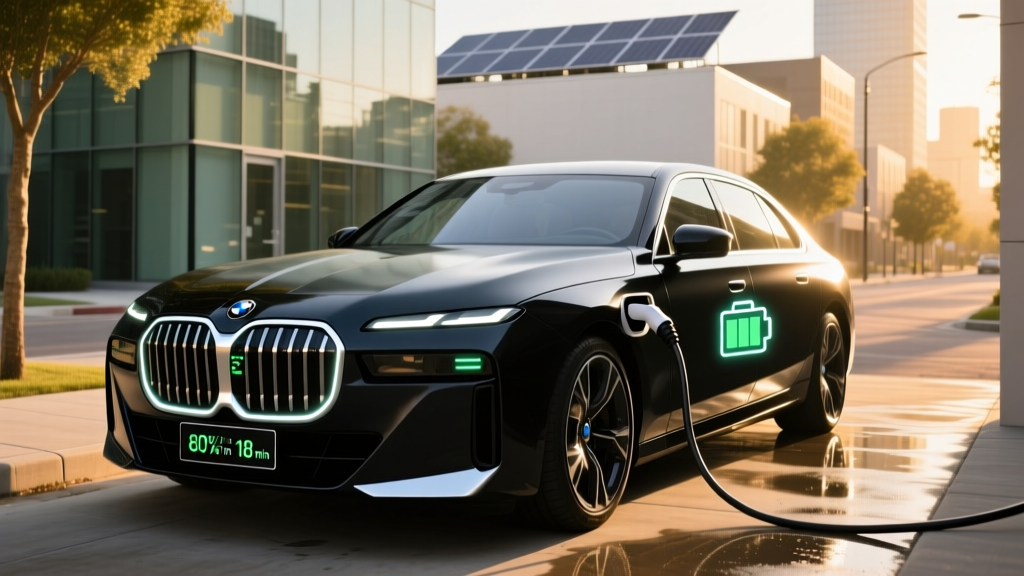
The 2025 BMW i7 is the electric flagship of the 7 Series lineup — a full-size luxury sedan that trades the V8 for a dual-motor electric powertrain without sacrificing the isolation, technology, and road presence buyers expect at this price point. But at over $100,000 and with a 5,400-pound curb weight, the i7 lives or dies on its real-world range, charging practicality, and whether its tech justifies the premium over rivals like the Mercedes-Benz EQS and Tesla Model S.
We've spent time analyzing the i7's EPA data, charging curves, ownership costs, and competitor positioning to give you the numbers that actually matter when you're writing a check.
2025 BMW i7 Quick Specs at a Glance
| Specification | i7 xDrive50 | i7 M70 xDrive |
|---|---|---|
| Base MSRP | $97,275 | $168,275 |
| EPA Range | 318 mi (20" wheels) / 291 mi (21") | 279 mi (21") |
| Battery (usable) | 101.7 kWh | 101.7 kWh |
| Chemistry | NMC (Nickel Manganese Cobalt) | NMC |
| Peak DC Fast Charge | 195 kW | 195 kW |
| 10–80% DC Charge Time | ~34 min | ~34 min |
| Level 2 Home Charge | 11 kW (~30 mi/hr) | 11 kW (~30 mi/hr) |
| Horsepower | 536 hp | 650 hp |
| 0–60 mph | 4.5 sec | 3.5 sec |
| Drivetrain | Dual-motor AWD | Dual-motor AWD |
| MPGe (combined) | 82 MPGe | 70 MPGe |
| Efficiency | 41 kWh/100 mi | 48 kWh/100 mi |
| Battery Warranty | 8 yr / 100,000 mi | 8 yr / 100,000 mi |
| Federal Tax Credit | Not eligible | Not eligible |
Real-World Range: What the EPA Number Doesn't Tell You
Real-World Expectation: 260–285 miles highway; 290–310 miles mixed city/highway; 220–250 miles in sustained cold weather (below 30°F)
Source: fueleconomy.gov — 2025 BMW i7 xDrive50
The i7 xDrive50's 318-mile EPA figure is respectable for a 5,400-pound luxury sedan, and it puts the car ahead of the Mercedes-Benz EQS 580 (330 mi EPA but with a smaller-feeling real-world delta) in practical terms when you factor in the i7's more conservative efficiency rating of 41 kWh/100 mi.
However, the physics of a large, heavy sedan work against it on the highway. At sustained 75–80 mph speeds, expect to see roughly 260–285 miles before the battery buffer warning. BMW's thermal management system is among the best in the industry — the i7 uses a sophisticated heat pump and liquid-cooling loop — which helps preserve range in moderate temperatures. But in sustained sub-30°F conditions, 20–25% range loss is typical, dropping your usable range to around 220–250 miles.
The M70 variant sacrifices range for performance, returning just 279 miles EPA with its standard 21-inch wheels. If you prioritize road-trip capability over 3.5-second sprints, the xDrive50 is the pragmatic choice.
Cargo space is generous for a full-size sedan: 17.7 cubic feet in the trunk. Rear legroom measures 42.5 inches, which is limousine-grade and one reason this car competes with the S-Class rather than the 5 Series. The i7 does not offer a frunk — the space is occupied by power electronics and the HVAC system.
Charging: 195 kW Peak, But Watch the Curve
| Charging Level | Power / Rate | Miles Added per Hour | Notes |
|---|---|---|---|
| Level 1 (120V) | ~1.4 kW | ~3–4 mi/hr | Emergency/trickle only; full charge in ~72+ hours |
| Level 2 (240V, 48A) | 11 kW (onboard max) | ~30 mi/hr | Full charge in ~10.5 hours; ideal for overnight |
| DC Fast Charge | Peak 195 kW | Up to ~150 mi in 10 min | 10–80% in ~34 min; tapers significantly above 80% |
The i7's 11 kW onboard AC charger is a strong point for home charging. With a properly installed 48-amp Level 2 wallbox (requiring a 60-amp circuit), you'll add roughly 30 miles of range per hour, meaning a depleted battery fully replenishes overnight in about 10.5 hours. This is adequate for daily use — most owners will plug in each evening and start every morning with a full battery.
On DC fast charging, the 195 kW peak rate is competitive but not class-leading. The Hyundai Ioniq 5 and Kia EV6 hit 240+ kW on 800V architectures. Here's where the charging curve matters more than the peak number:
The i7 sustains close to its 195 kW peak from roughly 10% to 40% state of charge, then begins a gradual taper. From 40–60%, expect around 140–160 kW. From 60–80%, the rate drops to roughly 80–100 kW. The 10–80% time of approximately 34 minutes is the figure that matters for road-trip planning, and it means a typical rest-stop charge adds 180–200 miles of range.
Above 80%, charging slows dramatically — this is normal for NMC chemistry protecting battery longevity. BMW recommends charging to 80% for daily use and reserving 100% charges for when you need the full range. The i7 includes a configurable charge-limit setting in the iDrive system.
The i7 uses the CCS1 connector for DC fast charging. BMW has not yet transitioned the i7 to NACS (Tesla's connector), though future model years may adopt it. For now, CCS1 gives you access to Electrify America, EVgo, and most non-Tesla networks.
Performance: 536 hp xDrive50 vs 650 hp M70
Both i7 variants use BMW's fifth-generation eDrive system with dual electric motors providing all-wheel drive. The xDrive50 produces 536 horsepower and 549 lb-ft of torque, hitting 0–60 mph in 4.5 seconds. That's quick enough to merge onto any freeway and pass without hesitation, and the instant torque delivery makes the car feel lighter than its 5,400-pound curb weight suggests.
The M70 xDrive bumps output to 650 hp and 748 lb-ft, dropping the 0–60 time to 3.5 seconds. The M70 also includes a rear-axle steering system, adaptive M suspension, and M Sport brakes. It's a performance sedan wearing a luxury suit, but the trade-off is 39 fewer miles of EPA range and a $71,000 price increase.
Ride quality in the xDrive50 is exceptional. The two-axle air suspension with adaptive dampers absorbs road imperfections with the composure expected of a six-figure BMW. Cabin noise at 70 mph is remarkably low — among the quietest in the EV segment — thanks to acoustic glass and extensive sound deadening.
Pricing, Trims, and the Federal Tax Credit Reality
| Trim | Base MSRP | As-Tested (typical) | Federal §30D Credit |
|---|---|---|---|
| i7 xDrive50 | $97,275 | $110,000–$125,000 | Not eligible |
| i7 M70 xDrive | $168,275 | $180,000+ | Not eligible |
Neither the i7 xDrive50 nor the M70 qualifies for the federal §30D clean vehicle tax credit. The reason is straightforward: the §30D credit has an MSRP cap of $55,000 for sedans, and the i7 starts at nearly double that threshold. This is not a sourcing or battery-mineral issue — it's simply a price-cap disqualification that applies to every luxury sedan in this segment.
Buyers should also be aware of the adjusted gross income caps under §30D ($150,000 single / $300,000 joint filers), though at the i7's price point, these are largely irrelevant since the MSRP cap already eliminates eligibility.
For a well-equipped xDrive50, expect to add $15,000–$25,000 in options: the Executive Package (rear-seat massage, heated armrests, automatic doors), the Premium Package (head-up display, Harman Kardon audio), and 21-inch wheels are common additions. Destination and delivery adds $995.
On the positive side, BMW includes four years of complimentary scheduled maintenance and the BMW Electric Charging Program, which provides complimentary charging sessions on partnered networks for a limited period after purchase.
Tech, Driver Assistance, and Interior Highlights
The i7's interior is dominated by the BMW Curved Display — a 12.3-inch instrument cluster merged with a 14.9-inch central touchscreen running iDrive 8.5. The system supports wireless Apple CarPlay and Android Auto, 5G connectivity, and over-the-air updates. The optional 31.3-inch BMW Theater Screen for rear passengers is a genuine differentiator in the luxury sedan segment, turning the back seat into a private cinema with Amazon Fire TV integration.
Driver-assistance technology includes BMW's Driving Assistant Professional, which provides adaptive cruise control with stop-and-go, lane-centering steering assist, and automatic lane-change functionality. This is an SAE Level 2 system — the driver must keep hands on or near the wheel and remain fully attentive. It is not autonomous driving.
The Highway Assistant feature (available in the Driving Assistant Professional package) allows hands-free driving at speeds up to 85 mph on divided highways, using a driver-monitoring camera to confirm attention. This is BMW's most advanced Level 2+ system and is comparable to GM's Super Cruise in capability, though Super Cruise has broader hands-free route coverage.
Notable drawbacks: the iDrive 8.5 interface, while feature-rich, has a steeper learning curve than some competitors. The removal of physical climate controls in favor of touchscreen operation is a common complaint. And the i7's sheer length (212.2 inches) makes it challenging in tight urban parking situations — the standard rear-axle steering helps but doesn't fully solve the physics.
How the i7 Stacks Up Against Rivals
| Spec | 2025 BMW i7 xDrive50 | 2025 Mercedes EQS 580 | 2025 Tesla Model S Plaid |
|---|---|---|---|
| EPA Range | 318 mi | 330 mi | 396 mi |
| Battery (usable) | 101.7 kWh | 107.8 kWh | ~95 kWh |
| Peak DC Charge | 195 kW | 200 kW | 250 kW |
| 0–60 mph | 4.5 sec | 4.1 sec | 1.99 sec |
| Base MSRP | $97,275 | $104,400 | $89,990 |
| Tax Credit | No (MSRP cap) | No (MSRP cap) | No (MSRP cap) |
| Rear Legroom | 42.5 in | 41.7 in | 35.4 in |
| Cargo Volume | 17.7 cu ft | 22.0 cu ft (hatchback) | 28.0 cu ft (hatchback) |
The i7 wins on rear-seat space and traditional luxury sedan presence. It loses on range (the Model S leads significantly), cargo versatility (both the EQS and Model S are hatchbacks), and charging speed (Tesla's 250 kW Supercharger network remains an advantage). The EQS sits between the two, offering more cargo space than the i7 but less rear legroom.
If rear-seat comfort and executive presence are your priorities, the i7 is the strongest choice. If range and road-trip charging infrastructure matter more, the Model S retains a practical edge despite its aging interior. The EQS is the compromise play — good at most things, exceptional at none.
Pros and Cons
- Class-leading rear-seat legroom (42.5 in)
- Exceptional ride quality with air suspension
- Strong 318-mi EPA range (xDrive50)
- 11 kW Level 2 onboard charger for fast home replenishment
- BMW Theater Screen is a genuine luxury differentiator
- Quiet cabin at highway speeds
- Hands-free Highway Assistant up to 85 mph
- No federal tax credit (MSRP exceeds $55K sedan cap)
- 195 kW peak DC charging trails Tesla and 800V competitors
- No frunk — all cargo in the trunk
- iDrive 8.5 learning curve; no physical climate controls
- 212-inch length is unwieldy in tight urban settings
- M70 sacrifices 39 miles of range for performance
- High starting price with expensive option packages
Who Should Buy the 2025 BMW i7?
Choose the i7 xDrive50 if: You want a chauffeur-grade rear seat, prioritize ride comfort over outright performance, commute 30–60 miles daily with home charging, and value traditional BMW build quality and dealer support.
Choose the i7 M70 if: You want M-car performance in a full-size electric sedan, range is secondary to acceleration, and budget is not a primary constraint.
Look elsewhere if: You need maximum range for frequent 400+ mile road trips (consider the Model S or Lucid Air), you want hatchback cargo versatility (EQS or Model S), or you're counting on the federal tax credit to offset purchase price.
Warranty and Long-Term Ownership
BMW backs the i7's high-voltage battery with an 8-year / 100,000-mile warranty covering defects and capacity loss below 70% of original capacity. The powertrain (electric motors, power electronics) carries the same 8-year/100,000-mile coverage. The basic vehicle warranty is 4 years / 50,000 miles, and BMW includes 4 years of complimentary scheduled maintenance.
NMC chemistry in the i7 has demonstrated solid degradation performance in BMW's other EVs using the same Gen5 eDrive platform. Based on iX and i4 data, expect roughly 5–8% capacity loss over the first 100,000 miles under normal use patterns — well within the warranty threshold. BMW's thermal management system, which includes battery preconditioning for DC fast charging, helps minimize degradation from repeated high-power charging sessions.
Frequently Asked Questions
What is the real-world range of the 2025 BMW i7?
The xDrive50 delivers an EPA-estimated 318 miles with 20-inch wheels. In real-world highway driving at 75 mph, expect 260–285 miles. In cold weather (below 30°F), range drops to approximately 220–250 miles. The M70 variant is rated at 279 miles EPA, with real-world highway figures around 230–250 miles.
How fast does the i7 charge at home and on the road?
At home on a Level 2 (240V, 48A) charger, the i7 accepts up to 11 kW, adding about 30 miles of range per hour and fully charging in roughly 10.5 hours. On DC fast chargers, it peaks at 195 kW, achieving a 10–80% charge in approximately 34 minutes. A 10-minute DC fast charge adds roughly 100–150 miles depending on state of charge.
Does the 2025 BMW i7 qualify for the federal EV tax credit?
No. The i7 does not qualify for the IRS §30D clean vehicle tax credit because its MSRP exceeds the $55,000 cap for sedans. This applies to all trims. State and local incentives may still apply — check your jurisdiction's EV rebate programs and consult a tax professional for personal eligibility.
How much does the i7 actually cost with options?
The xDrive50 starts at $97,275, but most buyers add $15,000–$25,000 in packages (Executive, Premium, wheels), bringing typical transaction prices to $110,000–$125,000. The M70 starts at $168,275 and can exceed $180,000 with options. No federal tax credit is available to offset these costs.
Is the i7 worth it vs. the Mercedes EQS or Tesla Model S?
The i7 is the best choice if rear-seat luxury, ride quality, and traditional sedan presence are your priorities. The Model S wins on range (396 mi EPA) and charging speed (250 kW) but has a less premium interior. The EQS offers more cargo space (hatchback design) and slightly more range (330 mi) but less rear legroom. None qualify for the federal tax credit.
What connector does the i7 use?
The 2025 i7 uses the CCS1 connector for DC fast charging and the J1772 connector for Level 1 and Level 2 AC charging. It has not yet adopted the NACS (Tesla) connector, though adapters may become available for Supercharger access in future model years.
Does the i7 have a frunk?
No. The i7 does not have a front trunk. The space under the hood houses power electronics, the HVAC system, and related components. All cargo goes in the 17.7-cubic-foot rear trunk.
Sources: EPA Fuel Economy — 2025 BMW i7, IRS §30D Clean Vehicle Credit, BMW USA — 7 Series.