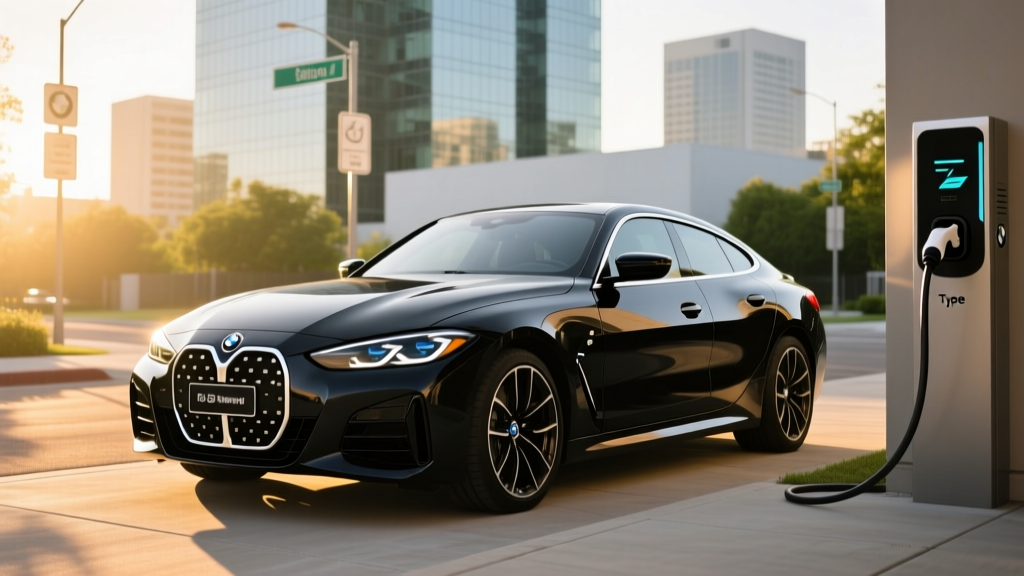
The BMW i4 has always occupied a specific niche: the electric gran coupe for buyers who want a BMW first and an EV second. For 2025, BMW refreshes the i4 with updated styling, the latest iDrive 8.5 infotainment, and subtle efficiency tweaks — while keeping the core formula intact. It's still a low-slung, rear-drive-biased electric sedan built on BMW's flexible CLAR platform, meaning it shares bones with the gas-powered 4 Series Gran Coupe.
That shared architecture is both the i4's greatest strength and its most common criticism. You get class-leading driving dynamics and build quality, but also a transmission tunnel hump in the rear seat and cargo space that trails dedicated EV platforms. Whether that trade-off matters depends entirely on your priorities. Here's everything you need to know — with exact numbers — to decide if the 2025 BMW i4 belongs on your shortlist.
2025 BMW i4 Spec Sheet: eDrive40, xDrive40, and M50 at a Glance
| Specification | eDrive40 | xDrive40 | M50 |
|---|---|---|---|
| Drivetrain | RWD (single motor) | AWD (dual motor) | AWD (dual motor) |
| Horsepower | 335 hp | 402 hp | 536 hp |
| Torque (lb-ft) | 317 | 443 | 586 |
| 0–60 mph | 5.5 sec | 4.6 sec | 3.7 sec |
| Battery (gross / usable) | 83.9 kWh / ~81 kWh | 83.9 kWh / ~81 kWh | 83.9 kWh / ~81 kWh |
| Battery Chemistry | NMC (Nickel Manganese Cobalt) | NMC | NMC |
| EPA Range | 307 mi (19" wheels) | 287 mi (19" wheels) | 271 mi (19" wheels) |
| EPA Efficiency | 99 MPGe / 34 kWh/100mi | 97 MPGe / 35 kWh/100mi | 87 MPGe / 39 kWh/100mi |
| Max DC Fast Charge | 205 kW | 205 kW | 205 kW |
| 10–80% DCFC Time | ~31 min | ~31 min | ~31 min |
| Level 2 Home Charging | 11 kW (~30 mi/hr) | 11 kW (~30 mi/hr) | 11 kW (~30 mi/hr) |
| Base MSRP | $52,200 | $55,900 | $69,700 |
Sources: EPA fueleconomy.gov, BMW USA product specifications. Destination charge ($995) not included in MSRP figures above.
Real-World Range: What the EPA Sticker Doesn't Tell You
eDrive40: EPA 307 miles — expect ~260–280 miles in mixed real-world driving, dropping to ~230–250 miles on sustained highway trips at 70+ mph, and ~200–230 miles in freezing temperatures with cabin heat.
M50: EPA 271 miles — expect ~225–245 miles in mixed driving, with highway and cold-weather losses proportionally similar. The M50's additional weight and dual-motor drag reduce baseline efficiency.
The i4 eDrive40's 307-mile EPA rating is genuinely competitive for this class, but the CLAR platform's compromise shows up at the margins. Because the battery pack is shaped around a transmission tunnel rather than laid flat in a skateboard chassis, total usable capacity (~81 kWh) is slightly less than what a similarly sized dedicated-EV platform might package.
In our experience with BMW's NMC cells, highway efficiency at 75 mph typically runs 3–4 MPGe below the EPA combined figure. The i4's excellent aerodynamic coefficient (Cd 0.25 for the eDrive40) helps on the highway, but the added mass of the M50 — roughly 4,800 lbs curb weight — erodes those gains. If your commute is primarily stop-and-go city driving, you'll actually see results close to or slightly above the EPA number thanks to regenerative braking recovery.
Cold-weather note: BMW's heat pump (standard on 2025 models) mitigates winter range loss compared to resistive heating, but expect a 15–25% reduction when temperatures drop below 32°F. Preconditioning the battery while plugged in is essential for preserving both range and DC charging speed in winter.
Charging Speed: DC Fast Charging and Home Setup
| Charging Level | Max Power | Speed (Approx.) | Notes |
|---|---|---|---|
| Level 1 (120V household) | ~1.4 kW | ~3–4 mi/hr | Emergency/trickle only; full charge takes days |
| Level 2 (240V home/public) | 11 kW (48A) | ~30 mi/hr | Full 0–100% in ~8.5 hours; ideal overnight |
| DC Fast Charging | 205 kW (peak) | ~170 mi in 10 min (at peak) | 10–80% in ~31 min; tapers significantly above 80% |
The i4's 205 kW peak DC fast-charge rate is respectable but no longer class-leading. Competitors on 800-volt architectures — like the Hyundai Ioniq 6 (up to 350 kW peak) and the Porsche Taycan (up to 270 kW sustained) — charge noticeably faster at compatible stations.
Here's what the charging curve actually looks like in practice: the i4 will sustain roughly 180–205 kW from about 10% to 35% state of charge, then gradually taper through the mid-range, dropping to around 100 kW by 60% and further to ~50 kW approaching 80%. The 10–80% time of approximately 31 minutes assumes a well-preconditioned battery at a 350 kW-capable CCS station. On Electrify America or EVgo chargers limited to 150 kW, expect 10–80% in roughly 38–42 minutes.
Connector note: The 2025 i4 uses a CCS1 port for DC fast charging. BMW has confirmed that future models will adopt the NACS (Tesla) connector, but for the 2025 model year, you'll need a CCS-to-NACS adapter to access Tesla Supercharger stalls. BMW has not yet included the adapter in-box; factor in ~$200–$250 for a quality third-party adapter if Supercharger access matters to your road-trip planning.
Driving Dynamics, Performance, and Daily Livability
The i4's CLAR-platform heritage reveals itself the moment you turn the wheel. Unlike many EVs that feel like they're pivoting around a heavy battery sled, the i4 communicates through its steering with a precision that's become rare in the luxury EV segment. The eDrive40's 335 hp and 5.5-second 0–60 time are adequate rather than thrilling, but the rear-drive chassis balance makes it genuinely engaging on back roads.
The M50 is a different animal entirely. With 536 hp and a 3.7-second 0–60, it trades blows with the Tesla Model 3 Performance and the Polestar 2 BST. BMW's M-tuned adaptive suspension, larger brakes, and the synthetic IconicSounds Electric soundtrack (love it or hate it) give the M50 a sporting character that's difficult to replicate in the EV space. The trade-off is ride firmness — on 20-inch wheels with the M Sport package, you will notice expansion joints and potholes more than in the eDrive40.
Interior Space and Cargo
This is where the shared-platform compromise becomes tangible:
- Rear legroom: 34.7 inches — adequate for adults on shorter trips, but noticeably tighter than a Tesla Model 3 (35.3 in) or Hyundai Ioniq 6 (37.4 in)
- Rear headroom: 36.6 inches — the sloping gran-coupe roofline cuts into headroom for passengers over 6 feet
- Cargo volume: 16.6 cu ft (rear seats up) / 45.6 cu ft (rear seats folded) — the liftback design provides a wide opening, but the transmission tunnel hump intrudes on flat-floor utility
- Frunk: None — the CLAR platform uses the front space for drivetrain components
For a couple or a solo commuter, the i4's cabin is luxurious, well-insulated, and beautifully finished. For a family regularly carrying rear-seat passengers or hauling cargo, the Hyundai Ioniq 5 or Tesla Model Y offer meaningfully more practicality.
Technology, Infotainment, and Driver Assistance
The 2025 i4 runs BMW's iDrive 8.5 on a curved display panel combining a 12.3-inch instrument cluster and a 14.9-inch central touchscreen. The system is responsive, supports wireless Apple CarPlay and Android Auto, and includes BMW's latest voice assistant. The QuickSelect menu structure introduced with 8.5 reduces the number of taps needed for climate and media adjustments — a genuine improvement over iDrive 8's deeper menu nesting.
Driver assistance (SAE Level 2): The standard Driving Assistant includes adaptive cruise control with stop-and-go, lane-keeping assist, blind-spot monitoring, and rear cross-traffic alert. The optional Driving Assistant Professional adds BMW's Highway Assistant (hands-off steering at speeds up to 85 mph on divided highways, with eye-monitoring via the instrument cluster camera). This is a strong SAE Level 2 system, but it is not autonomous — you must remain attentive and keep your eyes on the road at all times.
Pricing, Trims, and Federal Tax Credit Eligibility
| Trim | Base MSRP | As-Tested (Typical) | §30D Credit Eligibility |
|---|---|---|---|
| eDrive40 | $52,200 | $58,000–$62,000 | Likely $0–$3,750* |
| xDrive40 | $55,900 | $62,000–$67,000 | Likely $0–$3,750* |
| M50 | $69,700 | $75,000–$82,000 | $0 (exceeds MSRP cap) |
*Tax credit amounts depend on battery critical-mineral and component sourcing requirements per IRS §30D rules. The i4 is assembled in Munich, Germany, which affects eligibility. Verify current-year sourcing compliance with your dealer and a tax professional.
The 2025 BMW i4's federal tax credit situation is complex and, frankly, a disadvantage versus domestic and some Korean competitors:
- MSRP cap: Sedans must have an MSRP at or below $55,000 to qualify for any §30D credit. This means the M50 ($69,700) is ineligible. The eDrive40 ($52,200 base) clears the cap, but adding even modest options pushes it above.
- Buyer income cap: Modified adjusted gross income must not exceed $150,000 (single) / $300,000 (joint) / $225,000 (head of household).
- Battery sourcing: The credit is split into two halves ($3,750 each) — one for critical minerals and one for battery components, both with phased-in sourcing thresholds that tighten annually. BMW's supply chain has historically met the critical-minerals half but not always the battery-components half, meaning many i4 configurations qualify for $3,750 rather than the full $7,500.
- Assembly location: The i4 is built in Germany. While final assembly location is not a disqualifying factor for §30D (unlike the old credit), it does affect state-level incentives in some jurisdictions.
- Point-of-sale transfer: Under current rules, you can transfer the credit to the dealer at purchase, reducing your out-of-pocket cost directly rather than waiting to claim it on your tax return.
Bottom line: If the full $7,500 federal credit is a dealbreaker, the Tesla Model 3, Ford Mustang Mach-E (select trims), and certain Hyundai/Kia models currently qualify for more favorable credit amounts. Always verify with your dealer and consult IRS guidance or a tax professional before relying on credit eligibility in your purchase decision.
How the 2025 BMW i4 Stacks Up Against Rivals
| Metric | BMW i4 eDrive40 | Tesla Model 3 LR | Hyundai Ioniq 6 SEL | Polestar 2 LRSD |
|---|---|---|---|---|
| EPA Range | 307 mi | 363 mi | 361 mi | 320 mi |
| Base MSRP | $52,200 | $47,740 | $42,450 | $51,300 |
| Peak DC Charge | 205 kW | 250 kW | 350 kW | 205 kW |
| 0–60 mph | 5.5 sec | 4.2 sec | 6.1 sec | 5.9 sec |
| Cargo Volume | 16.6 cu ft | 23 cu ft | 12.3 cu ft | 14.4 cu ft |
| Max §30D Credit | $3,750* | $7,500* | $7,500* | $0 |
*Credit amounts subject to IRS sourcing rules and buyer eligibility. Verify current-year status.
The i4 wins on build quality, steering feel, and interior material quality — areas where BMW's decades of luxury-car experience show. It loses on range (Model 3 and Ioniq 6 stretch significantly farther), charging speed (Ioniq 6's 800V architecture is markedly faster), and price-to-range value. The Polestar 2 is the closest philosophical competitor but offers less range and no frunk either.
Battery Warranty, Degradation, and Long-Term Ownership
BMW covers the i4's high-voltage battery with an 8-year / 100,000-mile warranty, guaranteeing a minimum of 70% capacity retention during that period. This is industry-standard and matches Tesla, Hyundai, and most competitors.
The i4 uses NMC (nickel manganese cobalt) chemistry, which offers higher energy density than LFP (lithium iron phosphate) but is more sensitive to sustained high-state-of-charge storage. For maximum battery longevity:
- Set daily charge limit to 80% (easily configurable in the iDrive menu)
- Avoid leaving the car at 100% SoC for extended periods
- Use DC fast charging for road trips, not daily commuting
- Precondition the battery in cold weather before fast charging
BMW's battery replacement cost is estimated at $15,000–$20,000 out of warranty, though individual module replacement (rather than the full pack) may be possible for isolated cell failures. BMW has not published official module-level pricing.
Who Should Buy the 2025 BMW i4?
- You prioritize steering feel, ride quality, and interior craftsmanship over maximum range
- You're a commuter or couple without frequent rear-seat passenger needs
- You have access to reliable Level 2 home charging
- You value BMW's dealer network and service infrastructure
- You want M-car performance with zero emissions and don't need the federal tax credit
- You cross-shop the Tesla Model 3 Performance and want a more premium interior
- Maximum range is your top priority (Model 3 LR, Ioniq 6)
- You need a flat-load-floor cargo area or generous rear-seat space
- The full $7,500 federal tax credit is essential to your budget
- You want the fastest public charging speeds available (Ioniq 6, Taycan)
Pros and Cons
Pros
- Best-in-class steering feel and chassis balance
- Premium interior materials and build quality
- 307-mile EPA range (eDrive40) is competitive
- iDrive 8.5 is responsive and well-organized
- Highway Assistant is a strong Level 2 system
- Heat pump standard for cold-weather efficiency
Cons
- Rear seat and cargo space trail dedicated-EV rivals
- No frunk
- CCS1 port requires adapter for Tesla Superchargers
- 205 kW peak charge rate lags 800V competitors
- Limited federal tax credit vs. domestic/Korean rivals
- M50 exceeds $55K MSRP cap — no §30D credit
- Rear-floor transmission tunnel hump reduces practicality
Frequently Asked Questions
What is the real-world range of the 2025 BMW i4?
The eDrive40 is EPA-rated at 307 miles, but real-world mixed driving typically yields 260–280 miles. Sustained highway driving at 70+ mph drops this to roughly 230–250 miles, and freezing temperatures can reduce range to 200–230 miles. The M50's EPA rating of 271 miles translates to approximately 225–245 miles in mixed real-world use.
How fast does the 2025 BMW i4 charge?
On a DC fast charger, the i4 peaks at 205 kW and charges from 10–80% in approximately 31 minutes with a preconditioned battery. On a Level 2 home charger (11 kW / 48 amps), it adds roughly 30 miles of range per hour, fully charging in about 8.5 hours. Level 1 (120V) trickle charging adds only 3–4 miles per hour.
How much does the 2025 BMW i4 cost after tax credits?
The eDrive40 starts at $52,200 before destination. Federal §30D credit eligibility is limited — most configurations qualify for $0–$3,750 depending on battery-sourcing compliance, buyer income, and whether options push the MSRP above the $55,000 sedan cap. The M50 ($69,700 base) does not qualify for the federal credit. Always verify with your dealer and a tax professional.
Does the 2025 BMW i4 qualify for the federal EV tax credit?
Partially. The eDrive40 may qualify for up to $3,750 (half of the maximum $7,500) depending on current-year battery sourcing compliance under IRS §30D rules. The buyer must also meet income caps ($150K single / $300K joint). The M50 exceeds the $55,000 MSRP cap for sedans and is ineligible for any federal credit.
Is the 2025 BMW i4 worth buying vs. the Tesla Model 3 or Hyundai Ioniq 6?
If interior quality, driving dynamics, and BMW brand prestige are your top priorities, yes — the i4 delivers an experience neither Tesla nor Hyundai matches in refinement. If you prioritize maximum range (Model 3 LR: 363 mi), the fastest charging (Ioniq 6: 350 kW), or the lowest price with the highest tax credit, the competitors offer stronger value. The i4 is a luxury-first EV; its rivals are efficiency-first.
Can I use Tesla Superchargers with the 2025 BMW i4?
Yes, but you'll need a CCS-to-NACS adapter (sold separately, ~$200–$250). The 2025 i4 retains a CCS1 charge port. BMW has committed to adopting NACS natively on future models, but the 2025 i4 requires the adapter for Supercharger access. Ensure the adapter is UL-listed and rated for the i4's 205 kW peak charge rate.
What is the battery warranty on the 2025 BMW i4?
BMW provides an 8-year / 100,000-mile high-voltage battery warranty, guaranteeing at least 70% capacity retention during the coverage period. The general vehicle warranty is 4 years / 50,000 miles, and complimentary scheduled maintenance is included for 3 years / 36,000 miles.
For the latest EPA data, visit fueleconomy.gov. For current federal tax credit rules, consult IRS §30D guidance. Safety ratings: check NHTSA and IIHS for the most recent test results.