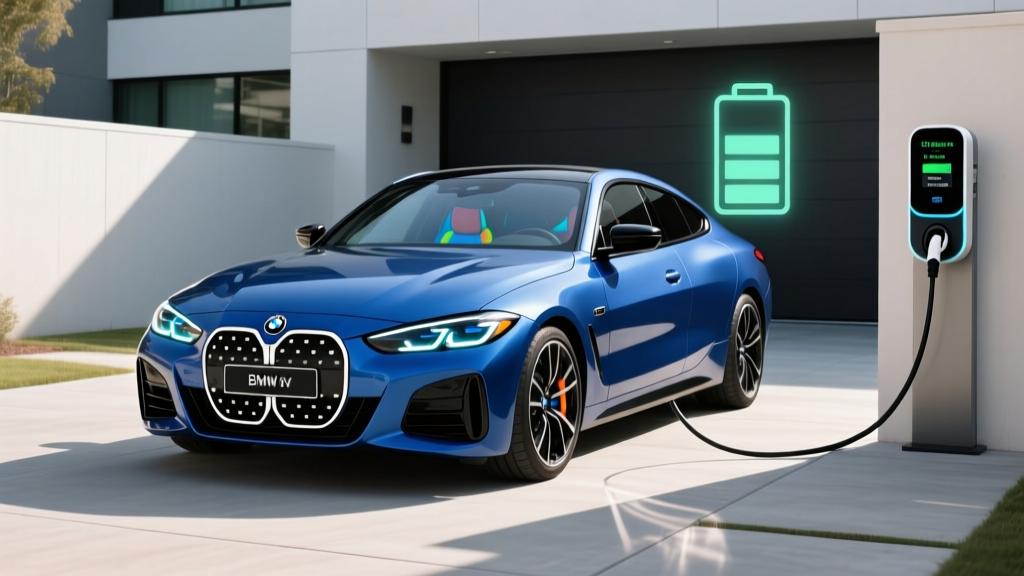
The BMW i4 remains one of the most compelling electric gran coupes on the market, blending BMW's trademark driving dynamics with a usable 81.5 kWh battery pack and competitive range. Whether you're researching a 2025 BMW i4 lease or considering a purchase, this profile breaks down every number that matters — from real-world range and charging curves to the tax-credit math that could save you thousands.
Quick Verdict: Who Should Lease the 2025 BMW i4?
The 2025 BMW i4 is best suited for driving enthusiasts who want a premium electric sedan with genuine sporting credentials, daily-commute practicality, and the flexibility of BMW's latest iDrive 8.5 infotainment. It's not a family hauler — rear headroom is tight thanks to the sloping roofline, and cargo space trails dedicated EV platforms. But if your priority is a driver-focused EV that charges quickly and handles like a proper BMW, the i4 eDrive40 and M50 hit the mark.
Leasing is particularly attractive for the i4 in 2025 because BMW frequently subsidizes lease deals through BMW Financial Services, and the federal §30D tax credit can sometimes be passed through as a lease incentive (since leases are structured as commercial purchases by the lessor). We break down the economics below.
Range, Efficiency & Real-World Expectations
| Trim | Drivetrain | EPA Range | MPGe (Combined) | kWh/100 mi |
|---|---|---|---|---|
| eDrive40 | RWD | 318 mi | 109 MPGe | 31 |
| xDrive40 | AWD (dual-motor) | 287 mi | 100 MPGe | 34 |
| M50 | AWD (dual-motor) | 271 mi | 91 MPGe | 37 |
Source: fueleconomy.gov
The eDrive40's 318-mile EPA rating is strong for the class, but real-world results vary significantly. In mixed highway driving at 70-75 mph, expect 260-285 miles from the eDrive40 and 225-250 miles from the M50. Cold weather (below 32°F) can reduce range by 20-30%, meaning an eDrive40 in a Midwest winter may deliver 200-230 miles before needing a charge. The i4's heat pump (standard on 2025 models) helps mitigate this loss compared to resistive cabin heating, but physics still wins in extreme cold.
The i4 rides on BMW's CLAR platform (shared with the 4 Series Gran Coupe), meaning the battery is a floor-mounted pack rather than a dedicated skateboard architecture. This yields a slightly higher floor and less interior volume than a ground-up EV, but it also gives the i4 its athletic proportions and low center of gravity.
Battery & Charging: Specs That Matter
The 2025 i4 uses an 81.5 kWh usable battery pack (gross capacity approximately 83.9 kWh). BMW employs NMC (nickel manganese cobalt) chemistry — specifically Gen5 eDrive battery modules — prioritizing energy density and performance over the cycle-life advantages of LFP chemistry. For a premium sport sedan, this is the right call; LFP's weight penalty would compromise the i4's handling balance.
| Charging Level | Max Rate | Speed / Notes |
|---|---|---|
| Level 1 (120V household) | ~1.4 kW | ~3-4 miles per hour of charging |
| Level 2 (240V home/public) | 11 kW (onboard charger) | ~25-28 miles per hour; full charge in ~8.5 hours |
| DC Fast Charge (CCS1) | 205 kW peak | 10-80% in ~31 minutes; tapers significantly above 80% |
The 205 kW peak DC charge rate is competitive but not class-leading. On a 350 kW Electrify America or Tesla Supercharger (via BMW's CCS adapter or NACS transition), the i4 will ramp quickly to ~190-205 kW between 10-40% SoC, then progressively taper. Expect the 10-80% session to take approximately 31 minutes under ideal conditions (preconditioned battery, warm ambient temperature). Above 80%, the charge rate drops sharply to protect the NMC cells — a 10-100% session can take 50+ minutes, so plan your road-trip stops around the 80% mark.
The 11 kW onboard Level 2 charger is a strong point. With a 48-amp home wall connector on a NEMA 14-50 circuit or hardwired installation, you'll add roughly 25-28 miles of range per hour — enough to fully replenish overnight, even after a near-empty battery.
Performance & Driving Dynamics
| Trim | Horsepower | Torque (lb-ft) | 0-60 mph | Drivetrain |
|---|---|---|---|---|
| eDrive40 | 335 hp | 317 | 5.5 sec | RWD (single rear motor) |
| xDrive40 | 396 hp | 435 | 4.6 sec | AWD (dual-motor) |
| M50 | 536 hp | 586 | 3.7 sec | AWD (dual-motor, M-tuned) |
The eDrive40 is the value sweet spot — 335 hp from a single rear motor delivers the classic BMW rear-drive feel with instant torque and a planted chassis. The M50 is genuinely fast (3.7 seconds to 60 mph puts it in M3 territory), but the added weight of the dual-motor setup and performance tuning costs you roughly 47 miles of EPA range versus the eDrive40.
All trims feature BMW's adaptive M suspension (optional on eDrive40, standard on M50), and the regenerative braking system offers multiple modes including an adaptive setting that uses navigation and radar data to modulate regen intensity. True one-pedal driving is available via the maximum regen setting, though BMW's implementation isn't quite as aggressive as Nissan's e-Pedal or Tesla's Hold mode.
Interior, Cargo & Technology
The i4's cabin is built around BMW's Curved Display — a 12.3-inch digital instrument cluster merged with a 14.9-inch touchscreen running iDrive 8.5. The system supports wireless Apple CarPlay and Android Auto, over-the-air updates, and BMW's Intelligent Personal Assistant voice control. The 2025 model year adds improved navigation-based preconditioning for DC fast charging and expanded Plug & Charge compatibility on networks like Electrify America.
Cargo and passenger space reflect the Gran Coupe body style:
- Cargo volume: 16.6 cu ft (rear seats up) / 45.6 cu ft (rear seats folded)
- Rear legroom: 34.0 inches (tight for adults over 6 feet)
- Rear headroom: 36.0 inches (the sloping roofline cuts into headroom noticeably)
- Front legroom: 41.5 inches
- No frunk: The CLAR platform's front architecture houses HVAC and power electronics — there is no front trunk
The lack of a frunk and the relatively modest 16.6 cu ft cargo area are genuine drawbacks for road-trip-heavy buyers. A Tesla Model 3 offers 23 cu ft (plus a frunk), and the Hyundai Ioniq 6 provides 12.3 cu ft but with a more usable trunk shape. If you regularly carry four adults and luggage, the i4's rear quarters will feel confining.
Pricing, Lease Economics & Tax Credit Eligibility
| Trim | Base MSRP | As-Tested (Typical Options) |
|---|---|---|
| eDrive40 | $52,200 | $58,000-$63,000 |
| xDrive40 | $56,200 | $62,000-$68,000 |
| M50 | $67,300 | $74,000-$82,000 |
All prices include $995 destination charge. Prices per BMW USA.
Does the 2025 BMW i4 Qualify for the Federal EV Tax Credit?
Under current IRS §30D rules, the 2025 BMW i4 faces a complex eligibility picture:
- MSRP cap: The i4 qualifies as a sedan (not an SUV/truck), so the MSRP cap is $55,000. Only the base eDrive40 at $52,200 clears this threshold — once you add options packages (Premium, M Sport, etc.), most configurations exceed $55,000 and lose eligibility.
- Buyer income caps: Adjusted gross income must not exceed $150,000 (single), $225,000 (head of household), or $300,000 (joint filing).
- Battery sourcing requirements: The i4's battery cells are manufactured by CATL and Samsung SDI, and critical-mineral sourcing must meet escalating annual thresholds. For 2025, 80% of critical minerals must be sourced from the US or FTA partners, and 100% of battery components must be manufactured/assembled in North America to qualify for the full $7,500. BMW's supply chain compliance varies by build date — confirm with your dealer and cross-reference the IRS qualified vehicles list.
- Point-of-sale transfer: If eligible, you can transfer the credit to the dealer at purchase, reducing your out-of-pocket cost immediately rather than waiting for tax filing.
The Lease Loophole
Here's where leasing becomes strategic: under the commercial vehicle tax credit (§45W), vehicles leased through a financing entity (like BMW Financial Services) are classified as commercial purchases. The lessor (BMW) claims the credit and can pass it through as a lease capital cost reduction — effectively lowering your monthly payment. This bypasses the MSRP cap, income cap, and battery-sourcing requirements that apply to §30D purchase credits. Many BMW dealers advertise a "$7,500 lease credit" on the i4 — this is the mechanism behind it. Always confirm with the dealer that the credit is being applied to your specific lease agreement.
Warranty & Ownership Costs
BMW provides solid coverage for the i4's high-voltage components:
- Basic vehicle warranty: 4 years / 50,000 miles
- Battery & powertrain warranty: 8 years / 100,000 miles (covers battery capacity below 70% of original)
- Complimentary maintenance: 3 years / 36,000 miles (includes brake fluid, cabin filters, wiper inserts)
- Roadside assistance: 4 years / unlimited miles
The 70% battery-capacity retention threshold is standard for the industry. Real-world degradation data from BMW's Gen5 eDrive platform suggests most i4 owners will see approximately 5-8% capacity loss over the first 100,000 miles with normal charging habits (avoiding frequent 100% charges and DC fast-charging in extreme heat). BMW's battery replacement cost, should it be needed out of warranty, is estimated at $15,000-$20,000 based on current parts pricing — though module-level repairs can reduce this significantly.
Driver Assistance & Safety
The i4 comes standard with BMW's Active Driving Assistant, which includes:
- Forward collision warning with automatic emergency braking
- Lane departure warning
- Blind-spot detection
- Rear cross-traffic alert
- Speed limit information
The optional Driving Assistance Professional Package adds Highway Assistant (a hands-on, eyes-on Level 2 system allowing extended hands-off steering on divided highways at speeds up to 85 mph, with driver monitoring via interior camera). This is a competitive Level 2 system, though it requires continuous driver supervision and does not constitute autonomous driving. The i4 earned a 2024 IIHS Top Safety Pick+ rating with acceptable headlight ratings on equipped trims.
BMW's Highway Assistant is an SAE Level 2 driver-assistance system. You must remain attentive, keep hands available, and be prepared to take over at any moment. It is not self-driving. Only Level 4 services (like Waymo in designated geofenced areas) operate without a human driver.
How the i4 Stacks Up Against Competitors
| Spec | BMW i4 eDrive40 | Tesla Model 3 LR | Hyundai Ioniq 6 SEL | Polestar 2 LR SM |
|---|---|---|---|---|
| EPA Range | 318 mi | 363 mi | 361 mi | 320 mi |
| 0-60 mph | 5.5 sec | 4.2 sec | 6.1 sec | 5.9 sec |
| Peak DC Charge | 205 kW | 250 kW | 233 kW | 205 kW |
| Base MSRP | $52,200 | $42,490 | $42,450 | $49,900 |
| Cargo (cu ft) | 16.6 | 23.0 | 12.3 | 14.4 |
The i4 trades range-per-dollar leadership to the Model 3 and Ioniq 6 in exchange for superior build quality, a more refined cabin, and genuinely engaging driving dynamics. If you value interior materials, chassis balance, and brand cachet, the i4 justifies its premium. If you prioritize maximum range and cargo space per dollar, the Model 3 Long Range is the pragmatic choice.
Pros
- Genuine BMW driving dynamics — steering feel, chassis balance
- Premium interior materials and build quality
- 318-mile EPA range (eDrive40) is class-competitive
- 11 kW Level 2 onboard charger enables fast home charging
- Lease credit pathway can bypass §30D purchase restrictions
- iDrive 8.5 is responsive with wireless CarPlay/Android Auto
Cons
- No frunk; cargo space (16.6 cu ft) trails Tesla Model 3
- Rear headroom and legroom are tight for adults
- Base MSRP starts at $52,200 — options push most builds above $55K
- 205 kW peak DC charge rate trails Tesla's 250 kW
- CLAR platform limits interior packaging vs. skateboard EVs
- §30D purchase credit eligibility is narrow (sedan MSRP cap)
Is a 2025 BMW i4 Lease Worth It?
If you can secure a lease with the $7,500 commercial credit applied as a capital cost reduction, the i4 eDrive40 becomes a compelling premium EV at an effective monthly cost competitive with a loaded Model 3. The lease structure also protects you from long-term battery-degradation concerns and positions you to upgrade as BMW's next-generation Neue Klasse platform arrives (expected 2027+).
Choose the i4 eDrive40 if you want the best balance of range, price, and driving refinement. Choose the M50 if performance is non-negotiable and you accept the range and price penalties. Skip the i4 if you need rear-seat practicality, maximum cargo volume, or the lowest cost-per-mile-of-range — the Model 3 and Ioniq 6 serve those needs better.
Frequently Asked Questions
What is the real-world range of the 2025 BMW i4?
The eDrive40's 318-mile EPA rating translates to roughly 260-285 miles in real-world highway driving and as low as 200-230 miles in freezing temperatures. The M50 delivers approximately 225-250 miles highway and 175-200 miles in cold weather.
How fast does the 2025 BMW i4 charge?
On a DC fast charger, the i4 peaks at 205 kW and charges from 10-80% in approximately 31 minutes. At home on a Level 2 (240V, 48-amp) charger, the 11 kW onboard charger adds about 25-28 miles per hour, fully replenishing the battery in roughly 8.5 hours.
Does the 2025 BMW i4 qualify for the $7,500 federal tax credit?
For outright purchase, only a base eDrive40 under the $55,000 sedan MSRP cap may qualify, subject to buyer income limits and battery-sourcing requirements. For leases, the commercial credit (§45W) can often be passed through by BMW Financial Services regardless of MSRP cap — confirm with your dealer.
Is the BMW i4 better than the Tesla Model 3?
It depends on priorities. The Model 3 Long Range offers more range (363 vs. 318 miles), faster DC charging (250 vs. 205 kW), more cargo space (23 vs. 16.6 cu ft), and a lower starting price. The i4 delivers superior interior quality, better steering feel, and a more traditional luxury ownership experience.
What is the battery warranty on the 2025 BMW i4?
BMW covers the high-voltage battery for 8 years or 100,000 miles, whichever comes first. The warranty applies if battery capacity drops below 70% of its original rated capacity during that period.