Quick Verdict: The Driver's EV Sedan
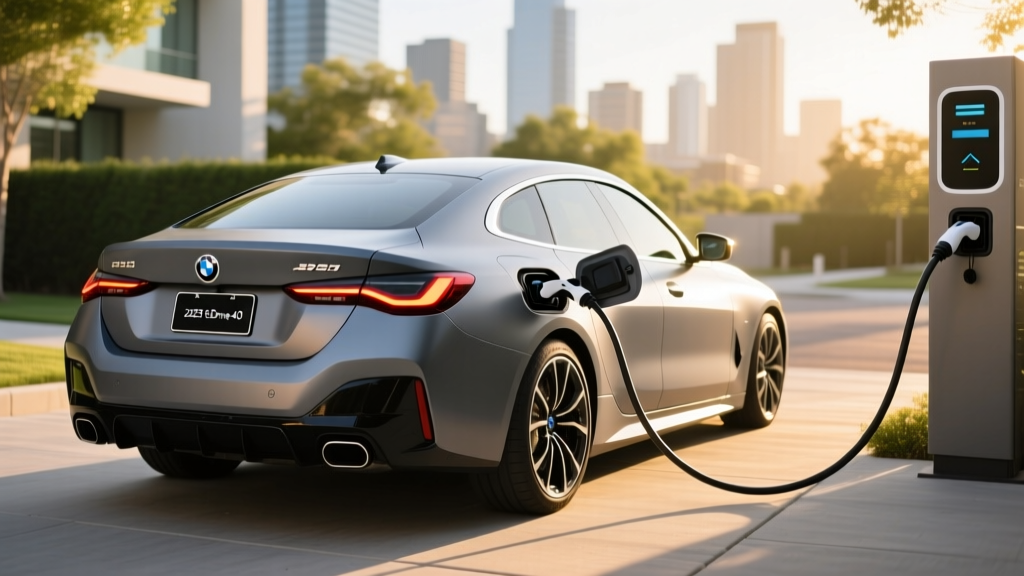
The 2025 BMW i4 eDrive40 occupies a rare position in the electric-vehicle market: it's a premium sport sedan that happens to be electric, rather than an EV that happens to be a sedan. Built on BMW's CLAR platform (shared with the 4 Series Gran Coupe), the i4 delivers the chassis balance and steering feel that BMW loyalists expect, wrapped in a practical liftback body with 301 miles of EPA-estimated range. For buyers cross-shopping the Tesla Model 3, Hyundai Ioniq 6, and Mercedes-Benz EQB, the i4 eDrive40 makes its case through build quality, ride refinement, and one of the best infotainment systems in the business — even if its charging architecture isn't class-leading.
After spending time with the eDrive40 trim on highway loops, suburban commutes, and DC fast-charging stops, here's the data-driven breakdown of what ownership actually looks like in 2026.
Range and Efficiency: 301 Miles on Paper, Less in Practice
EPA Estimated Range: 301 miles (with 18-inch wheels)
Real-World Expectation: Plan for 250–275 miles on mixed highway driving at 70–75 mph. In cold weather (below 35°F), expect a 20–30% reduction, dropping effective range to roughly 210–240 miles. City driving with regenerative braking can push closer to or slightly above the EPA figure.
The i4 eDrive40 carries an 81.5 kWh usable battery pack (83.9 kWh gross) using NMC (nickel-manganese-cobalt) chemistry. BMW's thermal management system includes a heat pump — standard, not optional — which helps preserve range in cold climates compared to resistive heating. On the EPA combined cycle, the eDrive40 achieves 109 MPGe combined, which translates to roughly 31 kWh per 100 miles.
That efficiency figure places the i4 behind the Tesla Model 3 Long Range (132 MPGe) and Hyundai Ioniq 6 (140 MPGe for the SEL RWD). The i4's heavier curb weight (~4,770 lbs) and less aerodynamic liftback shape account for the gap. In practical terms, you'll use about $0.10–$0.13 per mile charging at home (at $0.13/kWh national average), versus $0.14–$0.17 per mile for a comparable gas sedan at 30 MPG and $3.50/gallon.
| Spec | Value |
|---|---|
| EPA Range (18" wheels) | 301 miles |
| EPA Range (19" wheels) | 282 miles |
| Battery (usable / gross) | 81.5 kWh / 83.9 kWh |
| Battery Chemistry | NMC (Nickel-Manganese-Cobalt) |
| MPGe (combined) | 109 MPGe |
| Efficiency | 31 kWh / 100 mi |
| Motor | Single rear motor (RWD) |
| Horsepower | 335 hp |
| Torque | 317 lb-ft |
| 0–60 mph | 5.5 seconds |
| Curb Weight | ~4,770 lbs |
| Base MSRP | $57,900 (+ $995 destination) |
Charging Speed: Adequate but Not Class-Leading
The i4 eDrive40 supports DC fast charging at a peak rate of 205 kW on a CCS1 connector. BMW quotes a 10–80% charge time of approximately 31 minutes under optimal conditions (battery preconditioned, charger capable of 205+ kW).
Here's what that looks like in practice: the i4 sustains close to its peak rate from roughly 10–40% State of Charge, then begins tapering. From 50–80%, you'll see rates drop to 100–130 kW. The final 10% (80–90%) slows dramatically, as is typical with NMC packs protecting cell longevity. If you're road-tripping, plan your stops around the 10–80% window for the best time-to-miles ratio.
| Charging Level | Power | Speed / Time |
|---|---|---|
| Level 1 (120V household) | ~1.4 kW | ~4 miles per hour |
| Level 2 (240V home, 48A) | 11 kW (onboard max) | ~30 miles per hour; full charge in ~8.5 hrs |
| DC Fast Charge (CCS1) | Up to 205 kW peak | 10–80% in ~31 min; ~145 miles in 10 min (optimal) |
For home charging, the i4's 11 kW onboard charger is a strong point — it fills the pack in a single overnight session even from near-empty. Most buyers will install a Level 2 wallbox rated at 48 amps (hardwired, requiring a 60A breaker). Expect $500–$800 for the charger hardware and $800–$2,500 for professional installation depending on panel proximity and local permit costs. If your home has a 200-amp panel with spare capacity, installation is straightforward; older 100-amp panels may require a $2,000–$4,000 service upgrade.
One limitation worth noting: the i4 uses the CCS1 connector standard. BMW has committed to adopting Tesla's NACS connector for future models, but the 2025 i4 ships with CCS1. This means you'll need a NACS-to-CCS adapter (available from BMW and third parties, typically $200–$300) to access Tesla Superchargers, which remain the most reliable DC fast-charging network in the U.S.
Performance and Driving Dynamics
The eDrive40 sends 335 horsepower and 317 lb-ft of torque to the rear wheels through a single electric motor. The 0–60 mph sprint takes 5.5 seconds — brisk but not thrilling by EV standards (the dual-motor M50 drops that to 3.7 seconds). Where the eDrive40 earns its BMW badge is in the corners.
The CLAR platform gives the i4 a near-50/50 weight distribution, and the low-slung battery pack keeps the center of gravity down. Steering is precise and well-weighted in Sport mode, and the adaptive M suspension (optional, part of the Premium package at $1,900) manages the 4,770-lb curb weight admirably over broken pavement. Regenerative braking offers three levels of regen plus an adaptive mode that uses radar and navigation data to modulate coasting and braking — one of the smarter implementations in the segment.
For buyers who want all-weather capability, the xDrive40 trim adds a front motor for dual-motor AWD, bumping output to 396 hp and cutting the 0–60 to 4.9 seconds, at the cost of roughly 20 miles of range and a $3,000 price bump.
Interior, Tech, and Cargo Practicality
The i4's cabin is where BMW's investment in the CLAR platform pays dividends over Tesla's minimalist approach. Materials are genuinely premium — SensaTec synthetic leather is standard, with Vernasca leather available in the Premium package ($2,450). Fit and finish are tight, and the cabin is remarkably quiet at highway speed thanks to acoustic glazing and extensive sound deadening.
The centerpiece is BMW's iDrive 8.5 infotainment system running on a curved display that merges a 12.3-inch instrument cluster with a 14.9-inch touchscreen. The system supports wireless Apple CarPlay and Android Auto, over-the-air updates, and natural-language voice control. The BMW Digital Key Plus feature lets you use your smartphone or Apple Watch as a key fob — one of the most seamless implementations in the industry.
Driver Assistance: The i4 includes BMW's Active Driving Assistant as standard, which provides SAE Level 2 features including adaptive cruise control with stop-and-go, lane-keeping assist, and automatic emergency braking. The optional Driving Assistance Professional package ($1,700) adds hands-off driving up to 85 mph on divided highways (with eyes-on supervision required via cabin camera). This is competitive with Tesla's Autopilot and Ford's BlueCruise in capability, though Tesla's FSD (Supervised) offers broader surface-street functionality — with the caveat that all of these remain Level 2 systems requiring active driver engagement.
Cargo and Passenger Space:
- Cargo (behind rear seats): 16.6 cu ft
- Cargo (rear seats folded): 45.6 cu ft
- Front legroom: 42.3 inches
- Rear legroom: 35.2 inches
- Rear headroom: 37.0 inches (tight for passengers over 6'0" due to the sloping roofline)
The liftback design gives the i4 a wide cargo opening that's more practical than a traditional sedan trunk, but total volume trails the Tesla Model 3 (23 cu ft trunk + 3.1 cu ft frunk) and Hyundai Ioniq 6 (12.3 cu ft trunk + 0.5 cu ft frunk — though the Ioniq's frunk is tiny). Notably, the i4 has no front trunk (frunk) — the space under the hood houses HVAC and power electronics. For a couple or small family, the i4 is practical enough; for regular hauling of bulky cargo, an SUV-format EV is a better fit.
Pricing, Trims, and Federal Tax Credit Eligibility
The 2025 BMW i4 eDrive40 starts at $57,900 plus $995 destination, landing at $58,895 before options. Our as-tested vehicle, equipped with the Premium package ($2,450), Driving Assistance Professional ($1,700), 19-inch wheels ($600), and Metallic paint ($550), came to $64,195.
| Item | Amount |
|---|---|
| Base MSRP (eDrive40) | $57,900 |
| Destination | $995 |
| As-Tested (with options) | $64,195 |
| Federal §30D Tax Credit (if eligible) | Up to $7,500 |
| Effective Price (max credit applied) | ~$56,695 |
Federal EV Tax Credit (§30D) Eligibility — Key Requirements:
- MSRP Cap: Sedans must have an MSRP at or below $55,000. The i4 eDrive40 at $57,900 exceeds this cap, making it ineligible for the new-vehicle §30D credit.
- Buyer Income Cap: AGI must not exceed $150,000 (single), $225,000 (head of household), or $300,000 (joint) — but this is moot since the i4 fails the MSRP test.
- Battery Sourcing: Critical minerals and battery components must meet phased-in domestic/FRTA content thresholds per IRS guidelines.
- Point-of-Sale Transfer: Eligible credits can be transferred to the dealer at purchase for an instant price reduction — but again, the i4 does not qualify as new.
The hard truth: The 2025 BMW i4 eDrive40 does not qualify for the $7,500 federal new-vehicle tax credit because its MSRP exceeds the $55,000 sedan cap. This is a significant disadvantage versus the Tesla Model 3 Long Range ($47,740 MSRP, eligible for the full credit, bringing effective price to ~$40,240). Buyers set on the i4 should investigate their state's own EV incentives — some states offer rebates regardless of MSRP — and consider the used-EV tax credit (up to $4,000) when purchasing a pre-owned i4 in future years, as that credit has a $25,000 price cap that a used i4 may meet.
Warranty and Long-Term Ownership
BMW backs the i4 with a competitive warranty package:
- New Vehicle Limited Warranty: 4 years / 50,000 miles
- High-Voltage Battery Warranty: 8 years / 100,000 miles (covers capacity loss below 70% of original)
- Corrosion Perforation Warranty: 12 years / unlimited miles
- Roadside Assistance: 4 years / unlimited miles
- Complimentary Maintenance: 3 years / 36,000 miles (covers brake fluid, cabin filters, wiper inserts)
The 70% capacity retention threshold over 8 years is industry-standard and matches Tesla, Hyundai, and Ford. NMC batteries in BMW's thermal management system have shown strong longevity in early i4 owner data, with most vehicles reporting less than 5% degradation at 30,000 miles. Long-term, expect 10–15% degradation over 8 years and 100,000 miles under normal use patterns (avoiding frequent 100% charges and DC fast-charging exclusively).
Insurance costs for the i4 run higher than average for the segment. Expect annual premiums of $2,200–$3,000 depending on your profile, roughly 15–25% more than a comparable gas-powered 4 Series due to higher repair costs for EV-specific components.
Pros and Cons
What We Like
- Genuine BMW driving dynamics — steering, chassis balance, and ride quality rival the gas 4 Series
- iDrive 8.5 is one of the best infotainment systems available: fast, intuitive, and feature-rich
- Heat pump standard, preserving cold-weather range better than many competitors
- 11 kW onboard AC charging fills the pack overnight from any Level 2 source
- Liftback cargo opening is more practical than a traditional sedan trunk
- Premium cabin materials and excellent NVH (noise, vibration, harshness)
Where It Falls Short
- $57,900 MSRP exceeds the $55,000 federal tax credit cap for sedans — no $7,500 credit
- 205 kW peak DC charging trails Hyundai Ioniq 6 (240 kW) and Porsche Taycan (270 kW)
- CCS1 connector requires an adapter for Tesla Supercharger access
- Rear headroom is tight for tall passengers due to the sloping roofline
- No front trunk (frunk) — lost cargo utility
- Efficiency (109 MPGe) lags behind Tesla Model 3 and Ioniq 6
Who Should Buy the 2025 BMW i4 eDrive40?
Choose the i4 eDrive40 if:
- You prioritize driving feel and cabin refinement over maximum range-per-dollar
- You have reliable home Level 2 charging and don't depend on frequent DC fast charging
- You want a premium sedan that doesn't look or feel like a "tech appliance"
- Your daily commute is under 80 miles round-trip, keeping you well within range
- You value BMW's dealer network and complimentary maintenance program
Look elsewhere if:
- You want to maximize federal tax credits — the Tesla Model 3 Long Range saves you ~$17,000 after the credit
- You frequently road-trip 300+ miles and need the fastest possible charging (consider the Ioniq 6 or a NACS-equipped vehicle)
- You regularly carry rear-seat passengers over 6 feet tall
- Cargo volume is a priority — an SUV-format EV like the BMW iX or Tesla Model Y offers significantly more space
Frequently Asked Questions
What is the real-world range of the 2025 BMW i4 eDrive40?
The EPA rates the eDrive40 at 301 miles with 18-inch wheels (282 with 19-inch). In real-world mixed driving at highway speeds, expect 250–275 miles. In cold weather below 35°F, plan for 210–240 miles. The heat pump helps, but NMC chemistry and cold temperatures always reduce effective capacity.
How fast does the i4 eDrive40 charge?
On a DC fast charger, the i4 peaks at 205 kW and charges from 10–80% in approximately 31 minutes under ideal conditions. At home on a Level 2 (240V, 48A) charger, the 11 kW onboard charger adds about 30 miles per hour, filling the battery from empty in roughly 8.5 hours. Level 1 (120V) trickle charging adds about 4 miles per hour — useful only for emergencies or very low daily mileage.
Does the 2025 BMW i4 qualify for the federal EV tax credit?
No. The i4 eDrive40's MSRP of $57,900 exceeds the $55,000 sedan cap set by the IRS under §30D. This means buyers cannot claim the $7,500 new-vehicle credit. Check IRS.gov for current rules, and investigate state-level incentives that may not have MSRP caps.
Is the BMW i4 eDrive40 worth buying over the Tesla Model 3?
It depends on your priorities. The Model 3 Long Range costs ~$10,000 less, qualifies for the full $7,500 federal credit (widening the gap to ~$17,500), and offers superior range (341 mi EPA) and efficiency (132 MPGe). The i4 counters with better build quality, a more refined ride, a superior infotainment system for traditional luxury-car buyers, and BMW's dealer service network. If price sensitivity is high, the Model 3 wins on value. If cabin refinement and driving feel matter more, the i4 is compelling — just accept the price premium.
What are the biggest drawbacks of the i4 eDrive40?
The top three complaints from owners and reviewers: (1) ineligibility for the federal tax credit due to MSRP, (2) charging speed that trails Korean and Porsche competitors, and (3) the CCS1 connector requiring an adapter for the growing NACS/Supercharger network. Rear headroom for tall passengers is also a common gripe.
How long will the i4's battery last?
BMW warranties the high-voltage battery for 8 years or 100,000 miles against capacity loss below 70%. Based on NMC degradation data from early i4 owners and BMW's thermal management track record, expect roughly 85–90% state of health at the 8-year mark under normal use. Avoiding routine 100% charges and exclusive reliance on DC fast charging will extend battery life. Full battery replacement (if out of warranty) currently runs $15,000–$20,000 at a BMW dealer, though prices are expected to decline as cell costs fall.
Can I charge the BMW i4 at Tesla Superchargers?
Yes, but only with a NACS-to-CCS adapter. BMW offers an official adapter, and third-party options (such as the Lectron or A2Z adapter) are also available for $200–$300. Once equipped, the i4 can access Tesla's V3 and V4 Supercharger stalls, though charging will be limited to the i4's 205 kW peak — well within V3's 250 kW capability. Tesla's app or an adapter-specific RFID card may be required for session authentication depending on the adapter brand.