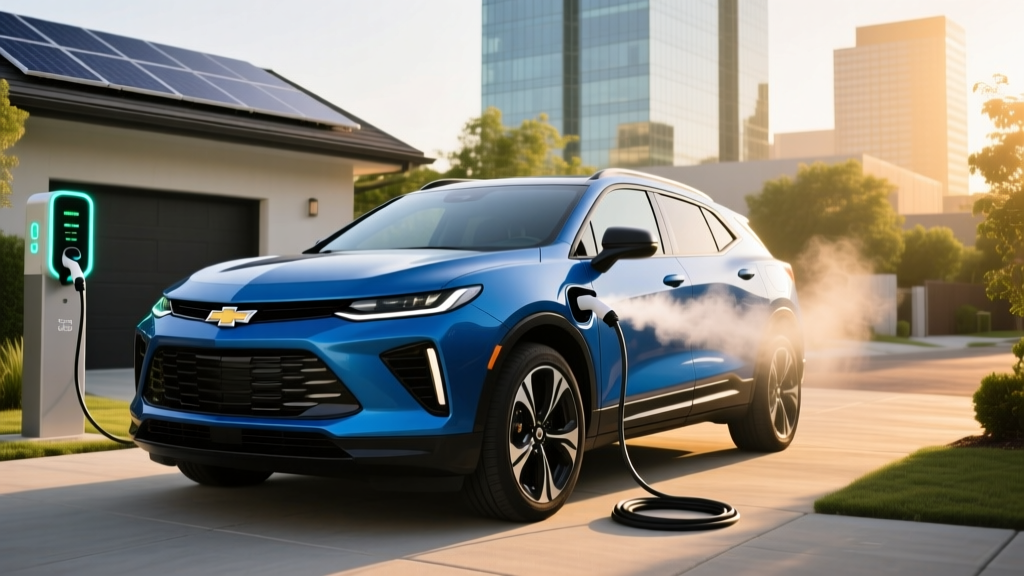
The Chevrolet Blazer EV sits in one of the most competitive segments in the electric-vehicle market, and aggressive lease offers have made it an appealing entry point for buyers who want a midsize electric crossover without committing to long-term depreciation risk. But a low monthly payment is only one variable in the ownership equation. Before you sign a 2025 Blazer EV lease deal, you need to understand the full five-year cost picture — from federal tax credit eligibility to real-world charging costs, insurance premiums, and resale value trends.
This guide dissects the numbers behind the 2025 Chevrolet Blazer EV using current EPA data, IRS §30D tax credit rules, and real ownership cost variables. Whether you're comparing it against a Hyundai Ioniq 5, Ford Mustang Mach-E, or Tesla Model Y, these are the figures that determine whether a Blazer EV lease actually saves you money.
2025 Blazer EV: Lease Pricing and Trim Overview
The 2025 Blazer EV is offered in multiple trims with distinct battery sizes, drivetrains, and price points. Lease deals typically center on the 2LT and RS trims, where manufacturer incentives and federal tax credit pass-through (via the point-of-sale lease credit mechanism) produce the most aggressive monthly payments.
| Spec | 2LT (FWD) | RS (AWD) | SS (AWD) |
|---|---|---|---|
| Battery (usable) | 85 kWh (NMC) | 102 kWh (NMC) | 102 kWh (NMC) |
| EPA Range | 279 mi | 279 mi | 294 mi |
| Horsepower | 220 hp | 288 hp | 557 hp |
| 0–60 mph | ~8.0 sec | ~6.2 sec | ~4.0 sec |
| Peak DC Fast Charge | 190 kW | 190 kW | 190 kW |
| 10–80% DC Charge | ~32 min | ~34 min | ~34 min |
| Level 2 (240V) Rate | 11.5 kW | 11.5 kW | 11.5 kW |
| Base MSRP | $44,600 | $50,400 | $60,900 |
| Battery/Powertrain Warranty | 8 yr / 100,000 mi | 8 yr / 100,000 mi | 8 yr / 100,000 mi |
Federal Tax Credit on a Blazer EV Lease: What You Actually Qualify For
Federal EV tax credits have become significantly more complex since the Inflation Reduction Act restructured §30D rules. When you lease a vehicle, the credit technically goes to the lessor (the financing company), but most manufacturers pass the full amount to the lessee as a capitalized-cost reduction — effectively lowering your monthly payment. This is sometimes called the "lease loophole," and it has a key advantage: it bypasses the buyer income caps and MSRP caps that apply to purchases.
However, battery sourcing and critical mineral requirements still apply to the vehicle itself. Here is the current eligibility framework:
- Credit amount: Up to $7,500 ($3,750 for critical minerals + $3,750 for battery components)
- Lease vs. purchase: On a lease (§45W commercial credit), income caps and MSRP caps generally do not apply — the lessor claims the credit and passes savings to you
- Purchase income caps (if buying instead): AGI ≤ $150,000 (single), $225,000 (head of household), $300,000 (married filing jointly)
- Purchase MSRP caps (if buying): ≤ $80,000 for SUVs/trucks/vans, ≤ $55,000 for sedans
- Battery sourcing: Qualifying percentages of critical minerals and battery components must be sourced from the U.S. or free-trade-agreement partners — these thresholds increase annually
- Point-of-sale transfer: For purchases, the credit can be applied at the dealer as an immediate price reduction (effective 2024+)
- FEOC restriction: Vehicles with battery components from a "foreign entity of concern" (e.g., certain Chinese suppliers) may be disqualified
Source: IRS.gov — Clean Vehicle Credits. Rules are subject to change. Consult a tax professional for your specific situation.
For the 2025 Blazer EV, the lease structure is often the most reliable path to capturing the full $7,500 benefit, because the 2LT's $44,600 MSRP clears the purchase MSRP cap easily, but higher trims and option packages can push close to limits. More importantly, buyers with AGI above the income caps can still benefit through a lease. Confirm with your dealer that the $7,500 is being applied as a cap-cost reduction in the lease paperwork — it should appear explicitly on the deal sheet.
Five-Year Total Cost of Ownership: Blazer EV vs. Gas Midsize SUV
The monthly lease payment is just the beginning. To evaluate whether 2025 Blazer EV lease deals make financial sense, we need a full five-year TCO model. Below, we compare the Blazer EV 2LT (FWD) against a comparable gas-powered midsize SUV (e.g., Chevrolet Blazer 2.0T AWD, EPA 24 MPG combined) over 60 months and 75,000 miles.
| Cost Category | Blazer EV 2LT (FWD) | Gas Midsize SUV (24 MPG) |
|---|---|---|
| Vehicle acquisition (lease total or purchase net of credit) | $24,600 (lease w/ $7,500 credit applied) | $28,500 (purchase after incentives) |
| Energy/fuel (75,000 mi) | $4,500 (home + public charging) | $9,375 (gasoline at $3.50/gal) |
| Maintenance | $1,200 | $3,800 |
| Insurance (5-year total) | $9,750 | $7,500 |
| Depreciation / residual value loss | Included in lease | ~$12,000 |
| Estimated 5-Year Total | ~$40,050 | ~$61,175 |
Several caveats apply. The EV figures assume predominantly home Level 2 charging at $0.14/kWh with occasional DC fast charging at $0.35–$0.48/kWh. If you rely entirely on public DC fast charging, your energy cost could rise to $6,000–$7,500 over five years. The gas SUV's depreciation is estimated based on current midsize ICE SUV residual trends; the Blazer EV's depreciation is absorbed into the lease payment structure.
Charging Cost vs. Gasoline: The Per-Mile Math
This is where EV ownership economics either shine or disappoint, depending entirely on your charging setup. The Blazer EV 2LT achieves approximately 2.9–3.2 miles per kWh in mixed driving (roughly 87 MPGe combined per fueleconomy.gov).
| Scenario | Cost/kWh or Cost/Gal | Cost Per Mile | Annual Cost (15,000 mi) |
|---|---|---|---|
| Home Level 2 (avg U.S. electricity) | $0.14/kWh | $0.045 | $675 |
| Home Level 2 (high-cost state, e.g., CA) | $0.28/kWh | $0.090 | $1,350 |
| Public DC fast charging (avg) | $0.42/kWh | $0.135 | $2,025 |
| Gas SUV (24 MPG combined) | $3.50/gal | $0.146 | $2,188 |
| Gas SUV (24 MPG, $4.00/gal) | $4.00/gal | $0.167 | $2,500 |
The takeaway is clear: home charging is where the savings materialize. At the national average electricity rate, the Blazer EV costs roughly $0.045 per mile to "fuel" — about one-third the cost of gasoline. But if you live in an apartment without charging access and rely solely on public DC fast chargers, the per-mile cost nearly triples and can approach gas-car territory. Before leasing, confirm your home electrical panel can support a Level 2 charger (typically a 240V/40A circuit, requiring a 50A breaker).
Maintenance Savings: Where EVs Genuinely Cost Less
Electric vehicles eliminate several routine maintenance items that gas-car owners take for granted. The Blazer EV has no engine oil, no transmission fluid, no spark plugs, no exhaust system, and no timing belt. Regenerative braking significantly reduces brake pad wear — many EV owners report original brake pads lasting 80,000+ miles.
| Service Item | Blazer EV | Gas Midsize SUV |
|---|---|---|
| Oil changes (synthetic, ~$60 each) | $0 | $600–$900 (10–15 changes) |
| Brake pads (front + rear) | $0–$200 (regen extends life) | $600–$1,000 |
| Transmission fluid / service | $0 | $200–$400 |
| Air filters (engine + cabin) | $50–$100 (cabin only) | $150–$300 |
| Coolant / other fluids | $100–$200 | $200–$400 |
| Tire rotation / replacement | $800–$1,200 (EV tires wear faster due to weight + torque) | $600–$900 |
| Total Estimated Maintenance | $950–$1,700 | $2,350–$3,900 |
One honest caveat: EV tires tend to wear faster than those on equivalent gas vehicles due to the Blazer EV's ~4,800 lb curb weight and instant torque delivery. Budget for a tire replacement around 35,000–45,000 miles. EV-specific tires (like the Michelin Pilot Sport EV or Hankook iON) can mitigate this but cost $250–$350 per tire.
Insurance Reality: The Cost Most EV Buyers Underestimate
Insurance is consistently the ownership category where EVs cost more than comparable gas vehicles. Industry data from major carriers shows EV insurance premiums running 15–30% higher than equivalent ICE models. For the Blazer EV, expect annual premiums in the range of $1,800–$2,200 for a typical driver (clean record, 35+ years old, garaged), compared to $1,400–$1,700 for a gas Blazer.
Several factors drive this gap:
- Higher repair costs: EV battery packs and power electronics are expensive to replace after collision damage. Even minor rear-end impacts can trigger battery safety inspections costing thousands.
- Specialized labor: Fewer body shops have high-voltage certification, limiting repair network options and raising labor rates.
- Vehicle MSRP: Insurers base premiums partly on replacement cost. The Blazer EV's starting price is higher than many gas alternatives in its class.
- Parts availability: EV-specific components (battery modules, inverters, charge ports) can have longer lead times, increasing rental-car and storage costs during claims.
Before committing to a lease, get quotes from at least three insurers. Some carriers (Geico, Progressive, State Farm) now offer specific EV discounts or bundled home-charger coverage that can partially offset the premium gap.
Depreciation and Resale Value: Why Leasing Makes Sense for the Blazer EV
EV depreciation has been volatile since 2022. Tesla's aggressive price cuts in 2023–2024 cascaded through the used-EV market, depressing resale values across all brands. The Blazer EV, as a relatively new nameplate, doesn't yet have a long track record, but early indicators suggest it will follow the broader midsize EV trend: steeper first-year depreciation than established gas models, stabilizing in years three through five.
Current estimates for midsize electric SUVs project 45–55% value retention after three years and 35–45% after five years, compared to 50–60% and 40–50% for popular gas crossovers. This gap is narrowing as EV adoption grows and battery confidence improves, but it remains a real factor.
This depreciation reality is precisely why leasing the Blazer EV is strategically sound. When you lease, the residual value risk belongs to the lessor, not you. If EV resale values continue to soften, you simply return the vehicle at lease-end and walk away. If they recover, you have the option to purchase at the predetermined residual price. For a vehicle in a rapidly evolving segment, this risk-transfer has genuine financial value.
State, Local, and Utility Incentives: Stacking Savings Beyond Federal Credits
Federal tax credits are only one layer of the incentive stack. Depending on your location, additional savings may be available:
- California: Up to $2,000 via the Clean Fuel Rebate (income-dependent); additional CVRP incentives for qualifying buyers; some utilities (PG&E, SCE) offer $500–$1,500 EV rebates or reduced time-of-use rates
- Colorado: State tax credit up to $5,000 for EVs with MSRP under $80,000 (phase-out thresholds apply)
- New York: Drive Clean Rebate up to $2,000 (point-of-sale); some utilities offer $500 charger rebates
- Maryland: Up to $3,000 state excise tax credit (first 20,000 EVs per year)
- Utility programs (nationwide): Many electric utilities offer Level 2 charger rebates ($250–$1,000), off-peak charging discounts, or free charger installation programs
Incentive amounts, eligibility, and availability vary significantly by jurisdiction and change frequently. Check your state energy office and local utility for current programs. The Alternative Fuels Data Center maintains a state-by-state incentive database.
A buyer in Colorado, for example, could potentially stack the $7,500 federal lease credit with a $5,000 state credit and a $500 utility charger rebate — reducing effective acquisition cost by $13,000. These combinations are location-specific but worth investigating before signing.
Charging Speed and Infrastructure: What Blazer EV Owners Actually Experience
The Blazer EV's 190 kW peak DC fast-charge rate is competitive but not class-leading. For context, the Hyundai Ioniq 5 peaks at 240 kW and the Tesla Model Y at 250 kW on V3 Superchargers. In practice, the Blazer EV's charge curve holds near peak rate from roughly 10–40% state of charge, then tapers progressively. Expect a 10–80% session to take approximately 32–34 minutes at a properly rated 190+ kW station.
On Level 2 home charging at 11.5 kW (48A), a full 0–100% charge of the 102 kWh battery takes about 9.5 hours — practical for overnight replenishment. The smaller 85 kWh pack in the 2LT charges fully in roughly 7.5 hours. A quality Level 2 home charger (ChargePoint Home Flex, Emporia Vue, or Tesla Wall Connector) costs $400–$700 for the unit, with professional installation ranging from $500–$2,000 depending on panel proximity and whether a service upgrade is needed.
The Blazer EV uses the CCS1 connector for DC fast charging. With GM's commitment to the NACS (Tesla-style) connector for future models, current Blazer EV owners may eventually need an adapter for Tesla Supercharger access — GM has indicated adapter availability, but confirm current compatibility before relying on the Supercharger network.
Frequently Asked Questions
How much does it really cost to own a 2025 Blazer EV over 5 years?
Based on our TCO model with 75,000 miles driven, predominantly home charging, and the $7,500 federal lease credit applied, the estimated five-year cost is approximately $40,000–$42,000. This includes lease payments, energy, insurance, and maintenance. Without the tax credit, add $7,500. With exclusive public DC fast charging, add $1,500–$3,000 in additional energy costs.
Do I qualify for the $7,500 federal tax credit on a Blazer EV lease?
On a lease, the credit is claimed by the lessor under §45W (commercial clean vehicle credit), which generally does not impose the buyer income caps or MSRP caps that apply to purchases. The lessor typically passes the credit to you as a cap-cost reduction. Confirm this explicitly in your lease agreement. Battery sourcing requirements still apply to the vehicle. See IRS guidance for current rules.
How much do I save on fuel and maintenance vs. a gas SUV?
With home charging at the national average electricity rate ($0.14/kWh), the Blazer EV costs roughly $675 per year to fuel vs. $2,188 for a 24 MPG gas SUV — a savings of about $1,500/year or $7,500 over five years. Maintenance savings add another $1,400–$2,200 over the same period. Combined, fuel and maintenance savings total roughly $9,000–$9,700 over five years, partially offset by $2,000–$2,500 in higher insurance costs.
Are EVs more expensive to insure than gas cars?
Yes, typically 15–30% more. For the Blazer EV, expect annual premiums of $1,800–$2,200 vs. $1,400–$1,700 for a comparable gas Blazer. Higher repair costs, specialized labor, and elevated MSRP drive the difference. Shop multiple carriers and ask about EV-specific discounts.
How well does the Blazer EV hold its value?
Midsize EVs currently retain an estimated 35–45% of value after five years, below the 40–50% typical for popular gas crossovers. This gap makes leasing particularly attractive — you transfer the residual-value risk to the lessor. If you plan to buy and hold for 8+ years, depreciation matters less since you'll use the vehicle through its highest-value period.
What happens if the battery degrades during or after the lease?
GM covers the Blazer EV battery for 8 years or 100,000 miles against defects and excessive capacity loss (typically defined as dropping below 60–70% of original capacity). During a standard 36-month lease, battery degradation is negligible — most NMC batteries lose only 5–8% capacity over 75,000 miles of normal use. If you purchase the vehicle at lease-end, the remaining 5 years of battery warranty transfers to you.
Can I charge the Blazer EV at Tesla Superchargers?
The 2025 Blazer EV uses the CCS1 connector. GM has committed to providing NACS adapter access for Supercharger compatibility, but availability and terms vary. Confirm adapter availability and any associated costs with your dealer before relying on the Tesla network for travel planning.