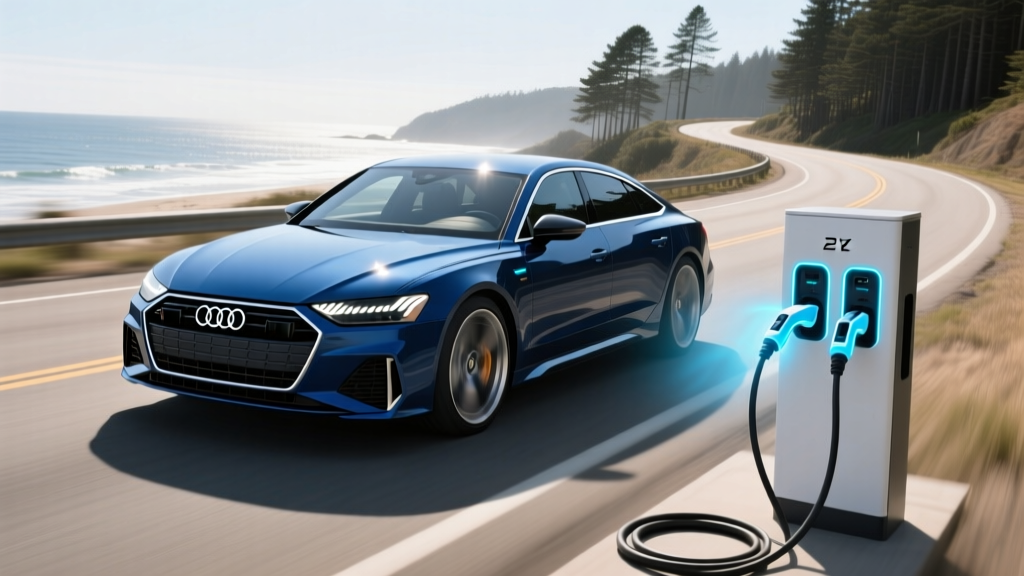
The 2025 Audi S6 e-tron arrives as the performance-oriented variant of Audi's all-new PPE (Premium Platform Electric) sedan family. Built on the same 800-volt architecture co-developed with Porsche, the S6 e-tron promises sports-sedan acceleration without sacrificing the daily-driver practicality that luxury EV buyers demand. We've analyzed the specs, run the numbers, and compared it against the Tesla Model S, BMW i5 M60, and Mercedes-AMG EQE to see if Audi's electric sport sedan earns its premium price tag.
EPA Estimated: 321 miles (Prestige trim w/ 20" wheels)
Real-World Expectation: ~270–290 miles highway (70–75 mph); ~230–250 miles in sub-freezing temperatures. The 800V architecture's heat pump helps mitigate cold-weather losses, but expect 15–20% range reduction in winter conditions typical of the Northeast or Midwest.
Specs at a Glance: 2025 Audi S6 e-tron
| Specification | Value |
|---|---|
| EPA Range | 321 miles (Prestige, 20" wheels) |
| Battery Capacity | 100 kWh gross / ~94.9 kWh usable (NMC lithium-ion) |
| Drivetrain | Dual-motor AWD (quattro) |
| Horsepower | 543 hp (405 kW) with Launch Control |
| Torque | 568 lb-ft |
| 0–60 mph | 3.4 seconds |
| Top Speed | 155 mph (electronically limited) |
| Max DC Fast Charge | 270 kW (peak) |
| 10–80% DC Charge Time | ~21 minutes |
| Level 2 Home Charging | 11 kW (AC, ~33 miles/hour) |
| Efficiency | 97 MPGe combined / 35 kWh/100 mi |
| Cargo Volume | 17.3 cu ft (trunk) + 1.8 cu ft (frunk) |
| Rear Legroom | 36.2 inches |
| Curb Weight | ~5,200 lbs |
| Battery Warranty | 8 years / 100,000 miles (70% capacity retention) |
| Vehicle Warranty | 4 years / 50,000 miles bumper-to-bumper |
| Base MSRP | $97,295 (Premium Plus) |
| As-Tested (Prestige) | ~$110,000 |
Battery, Platform, and Efficiency
The S6 e-tron rides on the Volkswagen Group's PPE platform, shared with the Porsche Macan Electric and upcoming Audi Q6 e-tron. The battery pack uses NMC (nickel manganese cobalt) chemistry — the standard choice for performance-oriented EVs prioritizing energy density over the cycle-life advantages of LFP (lithium iron phosphate). With approximately 94.9 kWh usable from a 100 kWh gross pack, Audi reserves a ~5% buffer top and bottom to protect long-term battery health.
Efficiency is rated at 97 MPGe combined (35 kWh/100 miles) according to fueleconomy.gov. That's competitive for a 5,200-pound performance sedan, though the lighter Tesla Model S (at ~124 MPGe combined) extracts more miles per kilowatt-hour. In mixed driving, expect to consume roughly 34–38 kWh/100 mi depending on speed and climate use.
Charging Speed: DC Fast and Home Level 2
The 800-volt electrical architecture is the S6 e-tron's charging superpower. At a compatible 350 kW DC fast charger (Electrify America, EVgo, or similar), the S6 e-tron can accept up to 270 kW peak. In practice, the charge curve is aggressive in the 10–40% SoC window, sustaining above 200 kW before tapering progressively past 60%. A 10–80% session takes approximately 21 minutes — among the fastest in the luxury sedan segment.
| Charging Level | Max Power | Speed (Miles Added) | Notes |
|---|---|---|---|
| Level 1 (120V) | 1.4 kW | ~4 miles/hour | Emergency/trickle only |
| Level 2 (240V, 48A) | 11 kW | ~33 miles/hour | Full overnight charge in ~9 hrs |
| DC Fast (800V) | 270 kW peak | ~190 miles in 10 min | 10–80% in ~21 min; taper above 80% |
At home on a Level 2 wall connector (240V, 48 amps), the 11 kW onboard charger adds roughly 33 miles of range per hour — meaning a full 10–100% charge takes about 9 hours. Preconditioning is available via the myAudi app: schedule your departure time and the car will warm or cool the battery to optimize charging speed and efficiency before you leave.
Real-world charging note: Peak 270 kW is only achievable at chargers capable of 350 kW+ output and when the battery is preconditioned and between roughly 10–30% SoC. Most public 150 kW stations will cap your session well below peak. Always precondition before a DC fast-charge stop — skipping it can add 5–8 minutes to your session in cold weather.
Performance and Driving Dynamics
The dual-motor quattro drivetrain produces 543 hp and 568 lb-ft of torque when Launch Control is engaged (standard output is approximately 496 hp). The result is a 3.4-second 0–60 mph sprint — firmly in sports-sedan territory and quicker than the BMW i5 M60 (3.7 sec) while trailing the Tesla Model S Plaid by a wide margin (1.99 sec, though at a much higher price).
Adaptive air suspension is standard, offering comfort, auto, and dynamic modes with ride-height adjustment. The S6 e-tron also features rear-axle steering (up to 5 degrees), which tightens the turning radius at low speeds and enhances stability at highway speeds. Regenerative braking offers multiple levels selectable via steering-wheel paddles, though Audi does not offer true one-pedal driving to a full stop like some competitors — you'll still use the brake pedal at low speeds.
Interior, Tech, and Cargo
The S6 e-tron cabin showcases Audi's latest "digital stage" dashboard: a curved 14.5-inch OLED infotainment display paired with an 11.9-inch digital instrument cluster and an optional 10.9-inch front-passenger screen. The MMI infotainment system runs on Audi's latest software with wireless Apple CarPlay and Android Auto, over-the-air updates, and natural-language voice control.
Driver assistance comes via Audi's Adaptive Drive Assist (Level 2 SAE automation), which bundles adaptive cruise control with stop-and-go, lane-centering, and traffic-jam assist. The driver must remain engaged at all times — this is not a hands-free system like GM's Super Cruise or Ford's BlueCruise. A head-up display with augmented-reality navigation overlays is included on Prestige trims.
Cargo space measures 17.3 cubic feet in the trunk — generous for a sport sedan — plus a 1.8 cu ft frunk suitable for charging cables. Rear legroom at 36.2 inches accommodates adults comfortably, though the sloping roofline cuts into headroom for passengers over 6 feet tall.
Pricing, Trims, and Federal Tax Credit Eligibility
| Trim | Base MSRP | Federal Tax Credit (§30D) | Effective Price |
|---|---|---|---|
| Premium Plus | $97,295 | Up to $7,500* | ~$89,795 |
| Prestige | $105,595 | Up to $7,500* | ~$98,095 |
| Prestige (As-Tested w/ options) | ~$110,000 | Up to $7,500* | ~$102,500 |
*Federal tax credit caveats: Under current IRS §30D rules, the $7,500 credit is subject to multiple eligibility gates:
- MSRP cap: Sedans must have an MSRP at or below $55,000. The S6 e-tron exceeds this cap — meaning it does NOT qualify for the §30D new-vehicle credit.
- Buyer income cap: AGI limits of $150,000 (single) / $300,000 (joint) apply, though moot here due to MSRP.
- Battery sourcing: Critical-mineral and battery-component requirements must be met — irrelevant given the MSRP disqualification.
- Point-of-sale transfer: Available for eligible vehicles, but again not applicable to the S6 e-tron.
This is a critical ownership-cost reality: at a starting price of $97,295, the S6 e-tron is well above the $55,000 sedan MSRP cap. Buyers should not factor the federal credit into their purchase math. Some state-level incentives (such as California's CVRP or Colorado's state credit) may still apply — check your state's energy office for current programs.
Audi S6 e-tron vs. the Competition
| Spec | 2025 Audi S6 e-tron | 2025 BMW i5 M60 | 2025 Tesla Model S (Dual Motor) | 2025 Mercedes-AMG EQE |
|---|---|---|---|---|
| EPA Range | 321 mi | 295 mi | 402 mi | 230 mi |
| Horsepower | 543 hp | 593 hp | 670 hp | 617 hp |
| 0–60 mph | 3.4 sec | 3.7 sec | 3.1 sec | 3.2 sec |
| Battery (usable) | ~94.9 kWh | 81.2 kWh | ~95 kWh | 90.6 kWh |
| Max DC Charge | 270 kW | 205 kW | 250 kW | 170 kW |
| 10–80% Time | ~21 min | ~30 min | ~25 min | ~32 min |
| Base MSRP | $97,295 | $84,100 | $79,990 | $106,900 |
| Federal Credit | No (MSRP cap) | No (MSRP cap) | No (MSRP cap) | No (MSRP cap) |
The S6 e-tron occupies a distinct middle ground: faster charging than any rival here, more range than the BMW and Mercedes, but priced above both the Tesla and BMW. The Tesla Model S wins on range and price, but can't match Audi's interior quality or charging speed. The BMW i5 M60 offers similar luxury at a lower entry price but with less range and slower charging. The AMG EQE is more powerful but sacrifices substantial range and charges more slowly.
Choose the BMW i5 M60 if: You want similar luxury at a lower price point and don't mind ~25 fewer miles of range and slower charging.
Choose the Tesla Model S if: Maximum range (402 mi), Supercharger network access, and lower price are your top priorities, and you can accept a sparser interior.
Choose the Mercedes-AMG EQE if: Raw power and AMG brand cachet outweigh range and charging considerations.
Who the S6 e-tron Suits Best
The S6 e-tron is ideal for the luxury commuter who takes occasional road trips and values charging speed as much as acceleration. Its 321-mile range handles a 250-mile round-trip commute with margin, and the 270 kW charging means a 15-minute stop adds meaningful range on longer drives. It's not a family hauler (cargo is sedan-typical, not SUV-level), and it's not a towing platform. Think of it as the electric successor to the S6/S7 sportback buyer who wants German build quality, a refined ride, and the ability to fast-charge faster than almost anything else on the road.
Pros and Cons
- Class-leading 270 kW DC fast charging (10–80% in ~21 min)
- 321-mile EPA range balances performance and efficiency
- Exceptional interior quality with triple-screen "digital stage"
- Adaptive air suspension with rear-axle steering
- 800V architecture future-proofs charging compatibility
- Standard heat pump for cold-weather efficiency
- $97,295 starting price — no federal §30D tax credit (exceeds $55K sedan cap)
- No hands-free driving mode (Adaptive Drive Assist requires hands-on-wheel)
- No true one-pedal driving to a full stop
- Frunk is small (1.8 cu ft) — cable storage only
- Rear headroom tight for tall passengers due to roofline
- Charging network: relies on Electrify America / third-party (no proprietary network like Tesla)
Frequently Asked Questions
What is the real-world range of the 2025 Audi S6 e-tron?
The EPA rates the S6 e-tron at 321 miles (Prestige trim with 20" wheels). In real-world highway driving at 70–75 mph, expect approximately 270–290 miles. In freezing temperatures, that drops to roughly 230–250 miles. The standard heat pump helps but cannot eliminate cold-weather range loss entirely.
How fast does the S6 e-tron charge at home and on the road?
On a Level 2 home charger (240V, 48A), the S6 e-tron charges at up to 11 kW, adding about 33 miles per hour — a full charge takes roughly 9 hours. On a 350 kW DC fast charger, it peaks at 270 kW and charges from 10–80% in approximately 21 minutes, though speeds taper significantly above 80% SoC.
Does the 2025 Audi S6 e-tron qualify for the federal EV tax credit?
No. Under current IRS §30D rules, new sedans must have an MSRP at or below $55,000 to qualify. The S6 e-tron starts at $97,295, well above the cap. State-level incentives may still apply — consult your state energy office or a tax professional for specifics.
Is the Audi S6 e-tron worth buying over the Tesla Model S or BMW i5?
It depends on priorities. The S6 e-tron charges faster than both and offers a more premium interior than the Tesla, but costs significantly more than either. If fast-charging speed and cabin quality are paramount, the S6 e-tron is compelling. If range-per-dollar or lowest total cost is your metric, the Model S or i5 M60 may be smarter buys.
What is the battery warranty?
Audi covers the high-voltage battery for 8 years or 100,000 miles (whichever comes first), guaranteeing at least 70% capacity retention over that period. The general vehicle warranty is 4 years / 50,000 miles.
Can the S6 e-tron use Tesla Superchargers?
Audi has announced NACS (Tesla connector) adoption for future models. The 2025 S6 e-tron ships with a CCS1 port. Tesla Supercharger access may be available via adapter — check with Audi for the latest compatibility updates, as network access agreements continue to evolve.