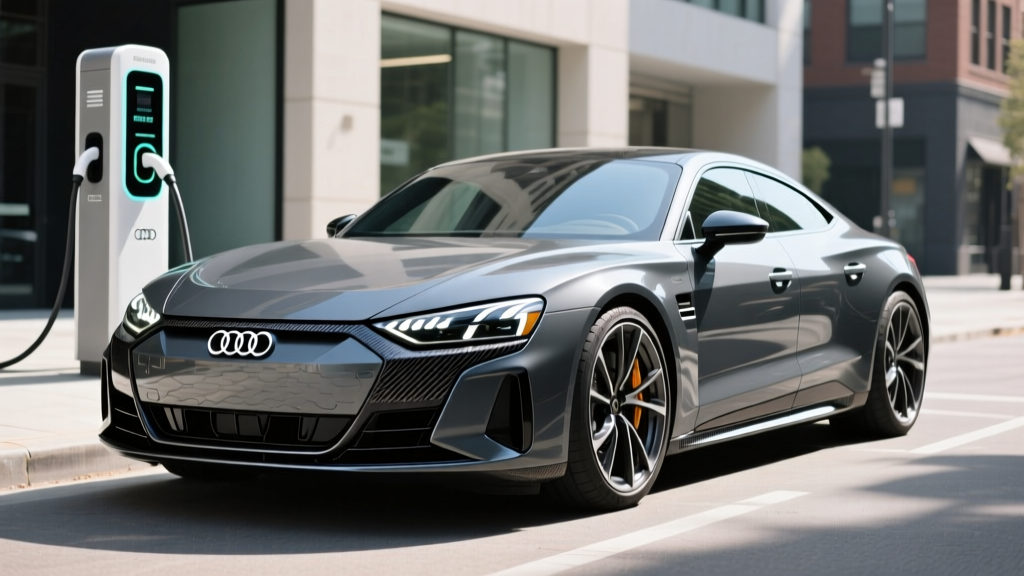
Quick Verdict: The 2025 Audi e-tron GT at a Glance
The 2025 Audi e-tron GT occupies a rare space in the EV market: a luxury grand tourer that pairs Porsche Taycan-derived engineering with Audi's design sensibility and daily-driver comfort. Built on the J1 Performance platform shared with the Taycan, the e-tron GT delivers blistering acceleration, an 800-volt architecture for class-leading DC fast charging, and a cabin that prioritizes material quality over touchscreen minimalism.
But with a starting price above $107,000 and an EPA range that peaks at 238 miles, the e-tron GT asks buyers to weigh emotional appeal against pragmatic efficiency. This review breaks down every number that matters — from real-world highway range to 10-80% charging times — so you can decide whether Audi's electric grand tourer earns a spot in your garage.
| Specification | e-tron GT quattro | RS e-tron GT | RS e-tron GT Performance |
|---|---|---|---|
| EPA Range | 238 mi | 232 mi | 232 mi (est.) |
| Battery (usable) | 83.7 kWh (NMC) | 83.7 kWh (NMC) | 93.4 kWh (NMC) |
| Horsepower | 522 hp (boost) | 637 hp (boost) | 912 hp (boost) |
| 0-60 mph | 3.9 sec | 3.1 sec | 2.5 sec |
| Drivetrain | Dual-motor AWD | Dual-motor AWD | Dual-motor AWD |
| Max DC Charge Rate | 270 kW | 270 kW | 320 kW |
| 10-80% DC Charge | ~22 min | ~22 min | ~18 min |
| Level 2 Rate | 11 kW (AC) | 11 kW (AC) | 11 kW (AC) |
| MPGe (combined) | 85 MPGe | 81 MPGe | TBD |
| Base MSRP | $107,995 | $149,995 | $164,995 |
Real-World Range: What to Expect Beyond the EPA Sticker
The EPA rates the base e-tron GT quattro at 238 miles of combined range, while the RS e-tron GT drops slightly to 232 miles due to stickier tires and more aggressive tuning. The 2025 RS e-tron GT Performance variant, which gains a larger 93.4 kWh battery pack (up from 83.7 kWh), is expected to push past 250 miles once EPA testing is finalized.
- City / suburban mixed driving (65-75°F): 230-250 miles — regenerative braking recovers energy in stop-and-go traffic
- Highway cruising (70-75 mph, 65-75°F): 195-215 miles — aerodynamic drag dominates at sustained speed
- Cold weather (20-35°F, highway): 160-185 miles — battery resistance increases and cabin heating draws 3-5 kW continuously
- Cold weather city (20-35°F): 185-205 miles — lower speeds and regen partially offset heating losses
Audi's thermal management system includes a heat pump (standard on 2025 models), which reduces cold-weather range loss compared to resistive heating. Preconditioning the battery while plugged in — using the myAudi app — recovers roughly 10-15 miles of range in freezing conditions by warming the pack before departure.
The e-tron GT's 800-volt architecture means the battery can accept higher charge rates with less heat buildup, but it also means the pack is optimized for performance discharge rather than maximum energy density. Competitors like the Lucid Air Pure (419 mi EPA) and Tesla Model S (402 mi EPA) offer substantially more range at similar or lower price points. If 300+ mile road trips without charging stops are a priority, the e-tron GT is not the optimal choice.
Charging Speed: 800-Volt Architecture Pays Off
The e-tron GT's 800-volt electrical system is its most practical differentiator. Where most 400-volt EVs peak at 150-175 kW and taper sharply, the e-tron GT sustains high charge rates deeper into the curve.
| Charging Level | Power / Rate | Miles Added | Notes |
|---|---|---|---|
| Level 1 (120V, 12A) | ~1.4 kW | ~3 mi/hr | Emergency/trickle only; ~80 hr for full charge |
| Level 2 (240V, 48A) | 11 kW (max onboard) | ~28 mi/hr | Full charge in ~8.5 hr; requires 60A circuit |
| DC Fast (e-tron GT quattro) | Peak 270 kW | ~180 mi in 10 min | 10-80% in ~22 min; tapers above 80% |
| DC Fast (RS Performance) | Peak 320 kW | ~200 mi in 10 min | 10-80% in ~18 min with larger pack |
Charging curve reality: The 270 kW peak on the standard e-tron GT holds from roughly 10-40% state of charge (SoC), then steps down to ~200 kW through 60%, and further to ~120 kW by 80%. The published 22-minute 10-80% time assumes optimal battery temperature (preconditioned via navigation to a DC charger). Without preconditioning in cold weather, expect 28-35 minutes for the same session.
At home on a Level 2 charger, the 11 kW onboard charger is competitive — most luxury EVs offer 11-19.2 kW. A full overnight charge from 20% to 100% takes roughly 7-8 hours, which is practical for daily use. Note that Audi includes a NACS (Tesla-style) charge port on 2025 models sold in North America, granting native access to the Tesla Supercharger network without an adapter — a meaningful advantage for road-trip charging reliability.
Performance and Driving Dynamics
Every 2025 e-tron GT uses a dual-motor all-wheel-drive layout with a two-speed transmission on the rear axle — a rarity among EVs. The second gear enables both explosive launches and efficient highway cruising, contributing to the car's relaxed high-speed character.
- e-tron GT quattro: 522 hp (with launch control boost), 0-60 in 3.9 seconds. Quick by any measure, with progressive throttle response that makes it easy to modulate in traffic.
- RS e-tron GT: 637 hp, 0-60 in 3.1 seconds. The RS tuning sharpens throttle mapping, tightens the adaptive air suspension, and adds rear-axle steering for tighter low-speed turns.
- RS e-tron GT Performance: 912 hp, 0-60 in 2.5 seconds. This is hypercar territory — a new rear motor and the larger 93.4 kWh pack deliver Taycan Turbo GT-rivaling acceleration.
The adaptive air suspension (standard across all trims) provides three ride heights and firmness settings. In Comfort mode, the GT absorbs highway expansion joints with a composure that belies its 5,100-pound curb weight. Switch to Dynamic and the body roll tightens noticeably, though the steering remains lighter and more isolated than a Taycan's — a deliberate Audi tuning choice that prioritizes grand-touring serenity over track-day feedback.
Regenerative braking offers three levels selectable via steering-wheel paddles, plus an Auto mode that uses radar and navigation data to modulate regen based on traffic and upcoming curves. One-pedal driving is possible but not as aggressive as in a Nissan Leaf or Chevrolet Bolt — Audi expects GT buyers to use the friction brakes regularly, and the blended pedal feel is among the best in the EV segment.
Interior, Cargo, and Technology
The e-tron GT's cabin is where Audi distances itself from the Taycan. Where Porsche leans into minimalist screens, Audi layers in physical controls, available open-pore wood trim, and diamond-stitched leather that feels hand-finished. The 10.1-inch upper touchscreen handles infotainment while an 8.6-inch lower screen manages climate and handwriting input — a dual-screen layout that some buyers prefer over Tesla's single-slab approach.
Passenger and cargo dimensions:
- Front legroom: 41.7 inches
- Rear legroom: 33.5 inches (tight for adults over 6 feet on long trips)
- Cargo (rear trunk): 9.2 cu ft
- Frunk (front trunk): 3.5 cu ft
- Total cargo: 12.7 cu ft — enough for two carry-on bags and a laptop bag, not a family road trip's worth of luggage
The rear seat is the e-tron GT's most significant practicality compromise. The roofline slopes aggressively, and the battery pack's "foot garage" cutouts help but don't fully solve knee clearance. Adults over 5'10" will find their heads brushing the headliner. For buyers who regularly carry rear passengers, the Audi Q8 e-tron SUV or the Porsche Taycan Sport Turismo (wagon) are more accommodating.
Driver assistance and tech:
- Audi pre sense basic and front (standard): forward collision warning, automatic emergency braking, lane departure warning
- Adaptive cruise assist with lane guidance (optional, part of the Driver Assistance package): SAE Level 2 system that handles steering, acceleration, and braking on highways — the driver must keep hands on the wheel
- Park assist with surround-view cameras (available)
- Head-up display with augmented-reality navigation overlays (standard on RS trims)
- Bang & Olufsen 3D sound system, 710 watts, 16 speakers (standard on RS, optional on base)
Pricing, Trims, and Federal Tax Credit Eligibility
The 2025 Audi e-tron GT lineup starts at $107,995 (including destination) for the base quattro trim and climbs steeply through the RS variants. Here is the current pricing structure:
| Trim | Base MSRP | As-Tested (typical options) | §30D Federal Credit |
|---|---|---|---|
| e-tron GT quattro Premium Plus | $107,995 | $115,000-$120,000 | Not eligible (MSRP exceeds $55,000 sedan cap) |
| RS e-tron GT | $149,995 | $158,000-$165,000 | Not eligible |
| RS e-tron GT Performance | $164,995 | $175,000+ | Not eligible |
- The IRS §30D credit caps eligible sedans at an MSRP of $55,000 (trucks, SUVs, and vans have an $80,000 cap). The e-tron GT is classified as a sedan and exceeds this limit at every trim level.
- Buyer income caps also apply: modified AGI must not exceed $150,000 (single), $225,000 (head of household), or $300,000 (joint filers).
- Battery critical-mineral and component sourcing requirements further restrict eligible vehicles — but the MSRP cap alone disqualifies the e-tron GT regardless of sourcing.
- Point-of-sale transfer (where the dealer applies the credit as a discount at purchase) is available for qualifying vehicles, but again, the e-tron GT does not qualify.
Source: IRS §30D Clean Vehicle Credit. Consult a tax professional for personal eligibility advice. Some states offer additional rebates that are not MSRP-capped — check your state's energy office for details.
Ownership Costs, Warranty, and Efficiency
The e-tron GT's 85 MPGe combined rating (quattro trim) translates to roughly 35 kWh per 100 miles. At the U.S. average residential electricity rate of ~$0.17/kWh (as of early 2026, per EIA data), that's approximately $5.95 per 100 miles of driving — compared to roughly $14-16 per 100 miles for a similarly quick gasoline sport sedan averaging 20 mpg at $3.20/gallon.
Warranty coverage:
- New vehicle limited warranty: 4 years / 50,000 miles
- High-voltage battery warranty: 8 years / 100,000 miles (covers capacity below 70% of original)
- Powertrain (motors, reduction gears): 8 years / 100,000 miles
- Corrosion perforation: 12 years, unlimited miles
- Roadside assistance: 4 years / unlimited miles
The 70% battery capacity retention threshold is standard for the luxury German segment (BMW, Mercedes, and Porsche use the same benchmark). Real-world degradation data from the J1 platform's first-generation Taycan and e-tron GT models (2019-2023) suggests roughly 5-8% capacity loss over the first 60,000 miles under normal use — well within warranty limits. The NMC chemistry used here offers higher energy density than LFP (lithium iron phosphate) but is more sensitive to sustained high-SoC storage; Audi recommends keeping the charge limit at 80% for daily use and charging to 100% only before long trips.
Pros, Cons, and Who Should Buy the 2025 Audi e-tron GT
- 270-320 kW DC fast charging is among the fastest in production — 10-80% in 18-22 minutes
- NACS charge port standard — native Tesla Supercharger access without adapter
- Cabin materials and build quality exceed the Taycan and rival the Mercedes-AMG GT
- Air suspension delivers genuine grand-touring comfort at highway speeds
- Two-speed rear transmission provides both launch performance and highway efficiency
- Heat pump standard (improves cold-weather range and charging speed)
- EPA range of 232-238 miles is below rivals (Lucid Air: 419 mi, Tesla Model S: 402 mi, BMW i5: 295 mi)
- Rear seat headroom and legroom are cramped for adults over 5'10"
- Cargo space (12.7 cu ft total) is limited for a car at this price
- No federal tax credit eligibility due to sedan MSRP cap
- Starting price of $107,995 is steep for the range offered
- Infotainment dual-screen layout feels dated compared to single-pane competitors
- You prioritize charging speed and build quality over maximum range
- Your daily commute is under 150 miles round-trip and you charge at home nightly
- You want native Tesla Supercharger access for road trips without adapters
- Rear-seat passengers are occasional and typically children or shorter adults
- You value understated luxury design over tech-forward minimalism
- You need 300+ miles of EPA range for frequent long-distance driving (consider Lucid Air, Tesla Model S, BMW i5)
- You regularly carry adult rear passengers (consider Audi Q8 e-tron, Porsche Taycan Sport Turismo, Mercedes EQS)
- Federal tax credit eligibility is a dealbreaker (consider the BMW i4, Hyundai Ioniq 6, or Tesla Model 3)
- Cargo capacity matters for your lifestyle (consider an EV SUV or wagon)
Frequently Asked Questions
What is the real-world range of the 2025 Audi e-tron GT?
The EPA rates the e-tron GT quattro at 238 miles combined. In real-world highway driving at 70-75 mph in moderate temperatures, expect 195-215 miles. In cold weather (below 35°F) on the highway, range drops to approximately 160-185 miles. City driving with regenerative braking can match or slightly exceed the EPA figure in warm conditions.
How fast does the 2025 e-tron GT charge?
On a DC fast charger, the e-tron GT quattro peaks at 270 kW and charges from 10-80% in approximately 22 minutes (with battery preconditioning). The RS e-tron GT Performance peaks at 320 kW and achieves 10-80% in roughly 18 minutes. At home on a Level 2 charger (240V, 48A), the 11 kW onboard charger adds about 28 miles of range per hour, fully replenishing the battery overnight in 7-8 hours.
Does the 2025 Audi e-tron GT qualify for the federal EV tax credit?
No. Under current IRS §30D rules, the e-tron GT does not qualify for the up-to-$7,500 federal tax credit because it is classified as a sedan and its MSRP exceeds the $55,000 sedan cap at every trim level. Buyer income limits and battery sourcing requirements also apply to the credit generally, but the MSRP cap alone disqualifies this vehicle. Some state-level incentives may still apply — check your state's energy office.
Is the 2025 Audi e-tron GT worth buying vs. the Porsche Taycan or Tesla Model S?
It depends on your priorities. The e-tron GT shares its platform with the Taycan and offers nearly identical driving dynamics, but with a more traditional luxury interior and (on 2025 models) a native NACS charge port. The Tesla Model S offers far more range (402 mi EPA) and access to the Supercharger network, but its interior materials and ride quality are a tier below. The Lucid Air is the range and efficiency leader but has a smaller service network. For buyers who value build quality, charging speed, and design over maximum range, the e-tron GT is a strong choice.
What are the biggest pros and cons of the 2025 e-tron GT?
The biggest strengths are its 270-320 kW DC fast charging, NACS Supercharger access, premium cabin materials, air-suspension ride quality, and dual-motor AWD performance. The biggest weaknesses are its 232-238 mile EPA range (below rivals), cramped rear seat, limited cargo space, and lack of federal tax credit eligibility. It excels as a daily-driven luxury commuter and weekend grand tourer but falls short for high-mileage road-trippers and families.
What battery chemistry does the e-tron GT use, and how long will it last?
The e-tron GT uses NMC (nickel manganese cobalt) lithium-ion cells, which prioritize energy density and high-rate charging over the cycle-life longevity of LFP chemistry. Audi warrants the battery for 8 years or 100,000 miles against capacity loss below 70%. Real-world data from earlier J1-platform vehicles suggests 5-8% degradation over 60,000 miles. For maximum longevity, set the daily charge limit to 80% and avoid frequent DC fast charging when Level 2 is available.
Can the e-tron GT use Tesla Superchargers?
Yes. The 2025 e-tron GT comes with a native NACS (North American Charging Standard) charge port, which is the connector used by Tesla Superchargers. No adapter is required. This gives the e-tron GT access to over 20,000 Supercharger stalls across North America — currently the most reliable DC fast-charging network in the U.S.