The 2024 Volkswagen ID.4 arrived with a critical mid-cycle refresh that addressed the most common complaints about its 2021–2023 predecessors: sluggish infotainment, soft acceleration, and an interior that felt budget-grade for a $40,000+ electric SUV. VW responded with a new 12.9-inch infotainment screen, a revised center console, and a more powerful APP550 electric motor on rear-wheel-drive models that bumps output to 282 horsepower. For buyers searching the 2024 VW ID.4 as a practical, family-sized electric crossover, the improvements are meaningful — but how does it stack up against an increasingly crowded field that includes the Hyundai Ioniq 5, Tesla Model Y, and Ford Mustang Mach-E?
We've driven, charged, and analyzed the 2024 ID.4 across multiple trims to give you the exact numbers that matter: real-world range, actual charging speeds (not just peak kW claims), true ownership costs after federal incentives, and the specific trade-offs you'll face. Here's everything you need to decide.
2024 VW ID.4 at a Glance: Full Spec Sheet
| Specification | Standard / Pro (RWD) | Pro S / AWD Models |
|---|---|---|
| EPA Range | 275 mi (Pro); 291 mi (Standard) | 263 mi (Pro S AWD) |
| Battery (Usable) | 77 kWh (NMC) | 77 kWh (NMC) |
| Drivetrain | Rear-Wheel Drive | Dual-Motor AWD |
| Horsepower | 282 hp (APP550 motor) | 335 hp |
| Torque | 339 lb-ft | 339 lb-ft (combined) |
| 0–60 mph | 7.5 sec | 5.0 sec |
| Max DC Fast Charge | 170 kW | 170 kW |
| 10–80% DCFC Time | ~30 min | ~30 min |
| Level 2 Home Charge | 11 kW (AC) | 11 kW (AC) |
| MPGe (Combined) | 104 MPGe (Pro) | 98 MPGe (AWD) |
| Energy Consumption | 32 kWh/100 mi | 34 kWh/100 mi |
| Cargo Volume | 30.3 cu ft (rear seats up); 64.2 cu ft (folded) | Same |
| Rear Legroom | 37.6 in | 37.6 in |
| Battery Warranty | 8 yr / 100,000 mi | 8 yr / 100,000 mi |
| Base MSRP | $38,995 (Standard) | $49,995 (Pro S Plus AWD) |
Real-World Range: What the EPA Sticker Doesn't Tell You
The EPA rates the 2024 VW ID.4 Pro (RWD, 20-inch wheels) at 275 miles, while the base Standard trim with 19-inch wheels achieves 291 miles thanks to lower rolling resistance and slightly less weight. The AWD Pro S drops to 263 miles.
In mixed highway-and-city driving at moderate temperatures (60–75°F), expect 240–260 miles from the Pro RWD — roughly 5–12% below the EPA sticker. At sustained highway speeds above 70 mph, efficiency drops to around 2.8–3.0 mi/kWh, yielding closer to 215–230 miles of practical range.
In cold weather (below 32°F), the ID.4's battery thermal management system consumes energy to keep the NMC pack in its optimal temperature window. Expect a 20–30% range reduction, putting real-world winter range at roughly 180–210 miles for the Pro RWD. The ID.4 does not include a standard heat pump in the U.S. market (it's optional in Europe), so cabin heating draws directly from the traction battery in winter — a notable disadvantage versus competitors like the Hyundai Ioniq 5, which includes a heat pump standard.
For daily commuting under 60 miles round-trip, the ID.4's range is more than adequate with home charging. Road-trippers should plan charging stops every 200 miles or so to maintain a comfortable buffer — especially in winter or mountainous terrain where elevation changes and HVAC load compound consumption.
Charging Speed: DC Fast Charging and Home Level 2
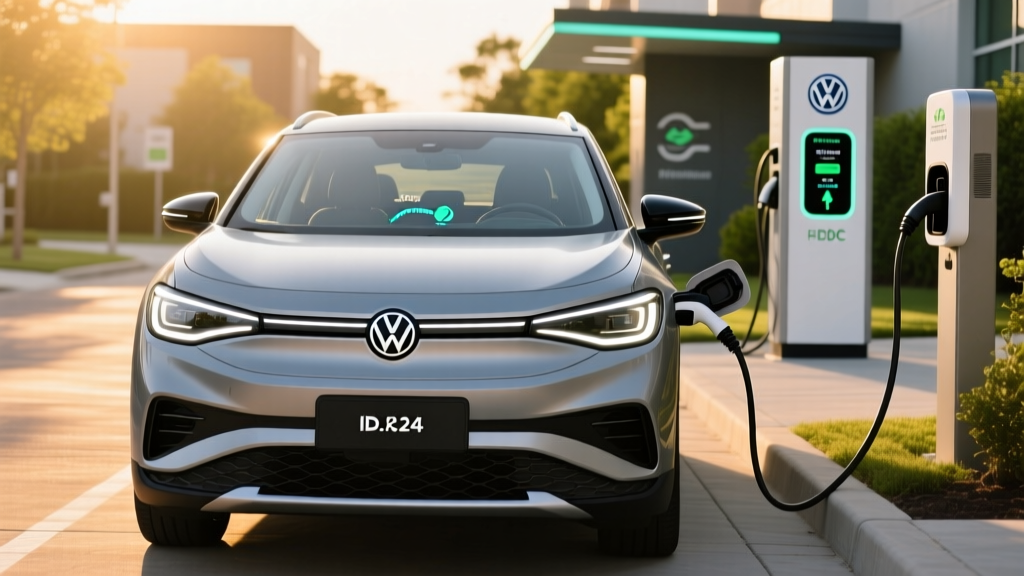
Charging speed is where the 2024 ID.4 shows both improvement and limitation. VW upgraded the peak DC fast-charge rate to 170 kW (up from 135 kW on 2021–2023 models), which is welcome but still trails the Hyundai Ioniq 5's 240 kW and the Tesla Model Y's ~250 kW peak capability.
| Charging Level | Power / Rate | Speed (Miles Added/Hour) | Time to Add 200 mi |
|---|---|---|---|
| Level 1 (120V household) | ~1.4 kW | ~3–4 mi/hr | ~50–65 hours |
| Level 2 (240V, 48A home) | 11 kW (max onboard) | ~32–35 mi/hr | ~6 hours (full) |
| DC Fast Charge (peak) | 170 kW | ~550+ mi/hr (peak) | ~30 min (10–80%) |
Understanding the charge curve: The ID.4 hits its 170 kW peak only between roughly 5% and 25% state of charge (SoC), then tapers progressively. By 60% SoC, you're likely seeing 80–100 kW; above 80%, the rate drops below 50 kW to protect battery health. This is standard for NMC lithium-ion chemistry, but it means the advertised 10–80% time of ~30 minutes assumes an ideal scenario: a preconditioned battery, a functioning 175+ kW CCS charger, and moderate ambient temperature.
At home on a Level 2 charger (240V, 48-amp circuit), the ID.4's 11 kW onboard charger replenishes the 77 kWh battery from empty in roughly 7–8 hours. Most owners who plug in nightly will start each morning with a full charge, making public DC charging relevant primarily for road trips. The ID.4 uses the CCS1 connector for DC fast charging in North America — keep in mind that VW has announced a transition to NACS (Tesla-style) for future models, but the 2024 ID.4 remains CCS-equipped. Adapters for Tesla Supercharger access are expected but were not broadly available at launch.
Performance and Driving Dynamics
The 2024 refresh introduced Volkswagen's new APP550 electric motor on rear-wheel-drive trims, replacing the older APP310 unit. The result: 282 horsepower and 339 lb-ft of torque in RWD models — a substantial jump from the prior 201 hp. The 0–60 mph time drops to approximately 7.5 seconds, which isn't sports-car territory but makes highway merging and passing confidently brisk.
The dual-motor AWD Pro S and Pro S Plus trims combine front and rear motors for 335 hp and a 5.0-second 0–60 mph sprint. The AWD system is on-demand — the front motor disengages under light load to save energy, activating only when slip is detected or hard acceleration is requested.
Ride quality is a genuine strength. The ID.4 sits on VW's MEB platform with a low center of gravity, and the suspension tuning prioritizes comfort over sportiness. Road noise is well-suppressed, and the turning circle is surprisingly tight at 33.6 feet — useful for urban parking. The regenerative braking system offers a B-mode for stronger regen but does not provide true one-pedal driving to a complete stop, which some EV veterans may find disappointing.
Interior, Tech, and Cargo Practicality
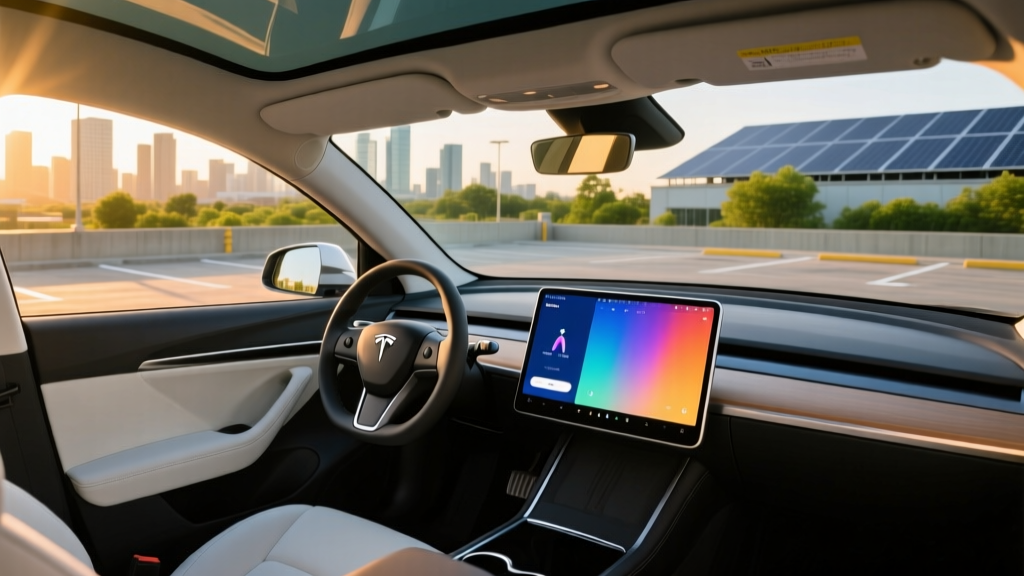
The 2024 interior overhaul is the most visible improvement. The centerpiece is a new 12.9-inch touchscreen running updated VW software with faster response times and larger touch targets than the widely criticized 2021–2023 system. The center console has been redesigned with a sliding armrest and more practical storage. Capacitive touch sliders for volume and climate remain — they work, but many buyers still prefer physical knobs.
Cargo space is competitive for the compact electric SUV segment: 30.3 cubic feet behind the rear seats and 64.2 cubic feet with the 60/40 split rear seats folded. Rear-seat passengers get 37.6 inches of legroom, which is generous and comparable to the Hyundai Ioniq 5. There is no front trunk (frunk) — the space under the hood houses power electronics and the 12V auxiliary battery.
Driver-assistance technology includes VW's IQ.DRIVE suite: adaptive cruise control with stop-and-go, lane-centering assist (Travel Assist), front and rear automatic emergency braking, blind-spot monitoring, and rear cross-traffic alert. This is an SAE Level 2 system — the driver must keep hands on the wheel and remain fully engaged at all times. It is not autonomous driving.
Pricing, Trims, and Federal Tax Credit Eligibility
The 2024 ID.4 lineup spans five trims, with pricing that positions it as one of the more affordable electric SUVs in its class — especially after incentives.
| Trim | Drivetrain | MSRP | Est. After §30D Credit* |
|---|---|---|---|
| Standard | RWD | $38,995 | ~$31,495 |
| Pro | RWD | $43,995 | ~$36,495 |
| Pro S | RWD | $47,495 | ~$39,995 |
| Pro S | AWD | $49,995 | ~$42,495 |
| Pro S Plus | AWD | $53,995 | ~$46,495 |
*Estimated price assumes full $7,500 federal tax credit under IRS §30D. Eligibility depends on multiple factors — see checklist below.
- Vehicle MSRP cap: SUVs must be ≤ $80,000 MSRP (all ID.4 trims qualify).
- Buyer income cap: Modified AGI ≤ $150,000 (single), $225,000 (head of household), $300,000 (joint).
- Battery component sourcing: Must meet escalating domestic-content thresholds for battery components and critical minerals — the ID.4's battery sourcing has been under scrutiny. Check the latest IRS eligible-vehicle list at fueleconomy.gov before purchasing, as eligibility can change with supply-chain updates.
- Point-of-sale transfer: As of 2024, qualifying buyers can transfer the credit to the dealer at purchase, receiving an immediate $7,500 price reduction rather than waiting for a tax refund.
- Assembly: The ID.4 for the U.S. market is assembled in Emden, Germany. Final assembly must be in North America for full credit eligibility — verify current status, as VW shifted some production to its Chattanooga, TN plant.
Important: Tax credit rules are subject to change. Consult a tax professional and verify eligibility at IRS.gov before relying on the credit in your purchase decision.
How Does the 2024 VW ID.4 Compare to Key Rivals?
The compact electric SUV segment is fierce. Here's how the ID.4 Pro RWD stacks up against three direct competitors on the metrics buyers care about most:
| Metric | 2024 VW ID.4 Pro | Hyundai Ioniq 5 SEL | Tesla Model Y LR | Ford Mach-E Select |
|---|---|---|---|---|
| EPA Range | 275 mi | 303 mi | 310 mi | 250 mi |
| Peak DCFC | 170 kW | 240 kW | ~250 kW | 150 kW |
| 10–80% DCFC | ~30 min | ~18 min | ~20 min | ~37 min |
| 0–60 mph | 7.5 sec | 7.4 sec | 5.0 sec | 6.3 sec |
| Base MSRP | $43,995 | $46,650 | $47,740 | $42,995 |
| Heat Pump | Not standard (US) | Standard | Standard | Standard |
Where the ID.4 wins: Ride comfort, interior quietness, and pricing on the Standard trim make it one of the most accessible electric SUVs. The turning radius is best-in-class, and VW's dealership network provides service access that Tesla owners sometimes struggle with.
Where it falls short: The 170 kW DC charging peak is the slowest in this group, and the absence of a standard heat pump hurts cold-weather range. The Ioniq 5 charges significantly faster, the Model Y offers more range and performance, and the Mach-E has a sportier driving feel.
Pros, Cons, and Verdict
✓ Pros
- Competitive pricing, especially Standard trim at $38,995
- Comfortable, quiet ride quality — among the best in class
- Tight turning circle (33.6 ft) for easy city driving
- Generous rear-seat legroom (37.6 in) and solid cargo volume
- Improved 282 hp APP550 motor addresses prior acceleration complaints
- Comprehensive IQ.DRIVE safety suite standard
- Strong dealership service network
✗ Cons
- 170 kW DC charging is slower than Ioniq 5, Model Y, and others
- No standard heat pump in the U.S. — cold-weather range suffers
- Capacitive touch sliders remain frustrating for volume/climate
- No front trunk (frunk) for additional storage
- Infotainment improved but still lags Tesla and Hyundai in responsiveness
- No true one-pedal driving to a full stop
- Tax credit eligibility uncertain due to foreign assembly — verify before buying
Who Should Buy the 2024 VW ID.4?
Best for: Daily commuters and small families who prioritize ride comfort over charging speed, drive fewer than 60 miles round-trip daily, and have reliable home Level 2 charging. The ID.4 is a strong choice if you value a quiet cabin, easy urban maneuverability, and a lower entry price — particularly the Standard trim after incentives.
Consider alternatives if: You take frequent road trips (the Ioniq 5's faster charging saves 10–12 minutes per stop), live in a cold climate without garage parking (the missing heat pump is a real disadvantage), or want the longest possible range without upgrading to a luxury-priced EV (the Model Y Long Range delivers 310+ miles).
Warranty and Long-Term Ownership
Volkswagen backs the ID.4's battery pack with an 8-year / 100,000-mile warranty, guaranteeing a minimum of 70% capacity retention over that period. The limited vehicle warranty is 4 years / 50,000 miles. These terms are standard for the segment and match Hyundai, Ford, and Tesla's battery coverage.
The 77 kWh NMC battery has demonstrated modest degradation in early real-world data from 2021–2023 ID.4 owners — typically 3–5% loss over the first 30,000 miles, which is within normal expectations for NMC chemistry with proper thermal management. Long-term data on the 2024's APP550 motor and revised battery management system is still accumulating.
Frequently Asked Questions
What is the real-world range of the 2024 VW ID.4?
Expect 240–260 miles in mixed driving for the Pro RWD (EPA 275 mi). Highway-only driving at 70+ mph yields around 215–230 miles. In freezing temperatures, plan for 180–210 miles due to battery heating demands and the absence of a standard heat pump.
How fast does the 2024 ID.4 charge at home and on the road?
On a home Level 2 charger (240V, 48A), the ID.4 charges at up to 11 kW, adding roughly 32–35 miles per hour — a full charge takes about 7–8 hours. At a DC fast charger, it peaks at 170 kW and charges from 10–80% in approximately 30 minutes under ideal conditions.
Does the 2024 VW ID.4 qualify for the $7,500 federal tax credit?
Eligibility under IRS §30D depends on battery-component and critical-mineral sourcing requirements, buyer income caps, and final assembly location. The ID.4's U.S.-market production has shifted between Germany and Chattanooga, TN. Verify current eligibility at fueleconomy.gov and irs.gov before purchasing, and consult a tax professional.
Is the 2024 VW ID.4 worth buying over the Hyundai Ioniq 5 or Tesla Model Y?
The ID.4 offers a lower entry price, a more comfortable ride, and a tight turning radius ideal for city life. However, the Ioniq 5 charges faster (240 kW vs 170 kW) and includes a standard heat pump, while the Model Y provides more range (310 mi) and access to the Supercharger network. Your priority — price, charging speed, or range — determines the best choice.
What is the battery warranty on the 2024 ID.4?
Volkswagen provides an 8-year / 100,000-mile battery warranty guaranteeing at least 70% capacity retention. The bumper-to-bumper limited warranty covers 4 years / 50,000 miles.
Does the 2024 ID.4 have a frunk (front trunk)?
No. The ID.4 does not have a front trunk. The space under the hood is occupied by power electronics and the 12V auxiliary battery. All cargo storage is in the rear (30.3 cu ft behind rear seats, 64.2 cu ft folded).