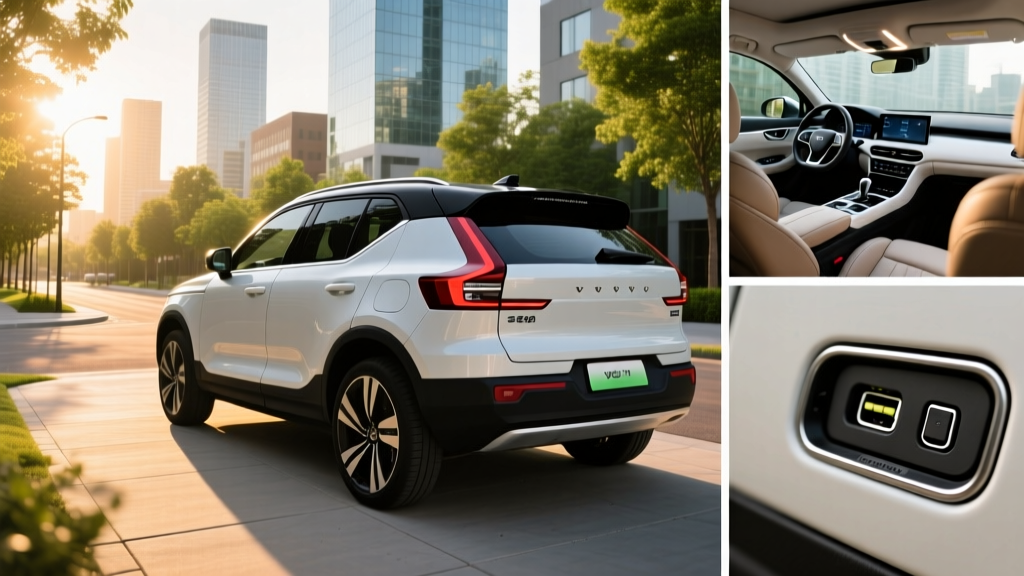
The 2024 Volvo XC40 Recharge arrived with a significant mid-cycle refresh: a larger 82 kWh battery, a new rear-wheel-drive single-motor option, and a redesigned front end that improved aerodynamics and range. For buyers shopping the compact luxury EV SUV segment, it slots between the Tesla Model Y and the Genesis GV60 in character — less tech-obsessed than Tesla, more conventionally premium than Genesis, and distinctly Scandinavian in execution.
This review covers the 2024 model year specifically, which remains widely available on dealer lots and as certified pre-owned inventory. We break down every number that matters — from real-world highway range to DC fast-charge taper — so you can decide whether this EV fits your daily driving and road-trip needs.
2024 Volvo XC40 Recharge: Key Specifications at a Glance
| Spec | Single Motor (RWD) | Twin Motor (AWD) |
|---|---|---|
| EPA Range | 293 miles | 254 miles |
| Battery (Usable) | 82 kWh (NMC) | 82 kWh (NMC) |
| Horsepower | 248 hp | 402 hp |
| 0–60 mph | 6.9 sec | 4.5 sec |
| Drivetrain | Rear-wheel drive | Dual-motor AWD |
| Max DC Fast Charge | 200 kW | 200 kW |
| 10–80% DC Time | ~28 min | ~28 min |
| Level 2 Home Charge | 11 kW (~37 mi/hr) | 11 kW (~37 mi/hr) |
| MPGe (Combined) | 100 MPGe | 92 MPGe |
| Efficiency | 34 kWh/100 mi | 37 kWh/100 mi |
| Cargo (behind rear) | 16.0 cu ft | 16.0 cu ft |
| Cargo (rear folded) | 47.6 cu ft | 47.6 cu ft |
| Base MSRP | $53,550 | $57,900 |
| Battery Warranty | 8 yr / 100,000 mi | 8 yr / 100,000 mi |
Source: EPA / fueleconomy.gov, Volvo Cars USA
Range and Efficiency: EPA vs. Real World
EPA Sticker: 293 miles (Single Motor) / 254 miles (Twin Motor)
Real-World Expectation: In mixed suburban/highway driving at 65–70 mph and moderate temperatures, expect 245–270 miles from the Single Motor and 215–240 miles from the Twin Motor. At sustained 80 mph highway speeds, subtract another 10–15%. In freezing conditions (below 32°F), range drops 20–30% without preconditioning — figure 185–210 miles for the Single Motor in winter highway use.
The 2024 refresh's shift from a 78 kWh to an 82 kWh (usable) nickel-manganese-cobalt (NMC) battery, combined with the new Single Motor RWD powertrain, gave the XC40 Recharge a meaningful range bump over the 2023 model (which was AWD-only at 223 miles EPA). The Single Motor's 293-mile rating is competitive with the BMW iX1 and slightly behind the Tesla Model Y Long Range (310+ miles), but the gap narrows in real-world highway driving where the Volvo's thermal management holds up well.
The Twin Motor AWD variant sacrifices roughly 40 miles of EPA range for the traction and 402-hp performance advantage. If you live in a snow-belt state and value all-wheel drive, that trade-off is rational — just plan your road trips around the 254-mile figure, not 293.
Efficiency-wise, the Single Motor achieves 100 MPGe combined (34 kWh per 100 miles), which is respectable for a 4,700-lb compact SUV. The Twin Motor drops to 92 MPGe. Both figures trail the Tesla Model Y (roughly 117 MPGe) because the XC40 Recharge is heavier and less aerodynamic — it rides on Volvo's CMA platform, originally designed to accommodate both ICE and electric powertrains.
Charging Speed: DC Fast Charging and Home Level 2
Charging speed is where the 2024 XC40 Recharge shows both progress and a persistent limitation. The upgraded 200 kW peak DC fast-charge rate is a welcome improvement over the 2023 model's 150 kW ceiling, but it still trails the Hyundai Ioniq 5 (240 kW) and Tesla Model Y (250 kW) at peak. More importantly, peak rate isn't sustained rate.
| Charging Level | Power / Rate | Speed | Notes |
|---|---|---|---|
| Level 1 (120V) | ~1.4 kW | ~4–5 mi/hr | Emergency/top-up only |
| Level 2 (240V, 48A) | 11 kW | ~37 mi/hr | Full charge in ~8.5 hours |
| DC Fast (peak) | 200 kW | ~170 mi in 10 min (peak) | Only sustained up to ~30% SoC |
| DC Fast 10–80% | Avg ~115 kW | ~28 minutes | Tapers significantly above 60% |
Charging curve reality: The XC40 Recharge hits its 200 kW peak only at low state-of-charge (roughly 5–25% SoC) and with a preconditioned battery. By 50% SoC, the rate drops to approximately 120–130 kW, and by 70%, it falls to roughly 80 kW. The 10–80% average of ~115 kW means a typical road-trip stop takes about 28 minutes at a 350 kW Electrify America or EVgo station. That's adequate but not class-leading — the Ioniq 5 does 10–80% in roughly 18 minutes under similar conditions.
Preconditioning matters. Use the Volvo Cars app or the in-car navigation to route to a DC fast charger, and the battery thermal management system will warm (or cool) the pack to optimize charge acceptance. Skipping preconditioning in cold weather can add 10–15 minutes to your 10–80% time and limit peak rate to well below 200 kW.
Home charging: The onboard charger supports 11 kW on Level 2 (240V, 48 amps). On a home wall connector like the ChargePoint Home Flex or Volvo's own Wall Charger, you'll add roughly 37 miles of range per hour, or fully recharge the 82 kWh pack from empty in about 8.5 hours. A standard 40-amp Level 2 circuit (common in older installations) delivers about 9.6 kW, adding ~32 miles per hour — still sufficient for overnight charging.
Performance and Driving Dynamics
The Twin Motor AWD variant is genuinely quick: 402 horsepower and 486 lb-ft of torque propel the XC40 Recharge to 60 mph in 4.5 seconds. That's sports-sedan territory in a compact SUV, and the instant electric torque makes it feel even quicker in real-world passing situations. The Single Motor RWD, at 248 hp and 361 lb-ft, hits 60 mph in 6.9 seconds — adequate for daily commuting but noticeably less thrilling.
Ride quality is a strong point. The XC40 Recharge's suspension is tuned for comfort over sportiness, absorbing rough pavement and expansion joints with composure. The steering is light and precise, and the one-pedal driving mode (with adjustable regenerative braking) makes city and stop-and-go traffic effortless. Volvo also offers a "soft" regen mode for drivers who prefer a more traditional coasting feel.
At highway speeds, cabin noise is well-controlled — there's minimal wind noise from the redesigned front fascia, and tire noise is muted on the standard 19-inch wheels. The 20-inch option looks better but introduces more road noise on coarse surfaces.
Interior, Tech, and Cargo Space
The cabin reflects Volvo's Scandinavian-minimalist design language. Materials are premium — standard leatherette or optional wool-blend upholstery, real aluminum inlays, and soft-touch surfaces throughout. The 12.3-inch digital instrument cluster and 9-inch portrait-oriented center touchscreen run Google built-in (Google Maps, Google Assistant, and the Play Store for apps like Spotify and YouTube when parked).
Infotainment pros: Google Maps navigation is excellent for EV route planning, automatically suggesting charging stops with estimated arrival SoC. Voice control via Google Assistant is best-in-class. Wireless Apple CarPlay is standard.
Infotainment cons: The 9-inch screen is smaller than competitors (Tesla's 15-inch, Hyundai's 12.3-inch). Climate controls are buried in the touchscreen rather than physical buttons — a frequent complaint. The interface can lag slightly when cold-booting.
Driver assistance: Volvo's Pilot Assist (SAE Level 2) provides adaptive cruise control with lane-centering. It works competently on highways but requires hands on the wheel and doesn't offer hands-free operation like GM's Super Cruise or Ford's BlueCruise. The standard suite includes automatic emergency braking, blind-spot monitoring with steering assist, rear cross-traffic alert, and run-off-road protection — all areas where Volvo excels.
Cargo and passenger space:
- Cargo behind rear seats: 16.0 cu ft (adequate for groceries and carry-ons, less than the Model Y's 30 cu ft)
- Cargo with rear seats folded: 47.6 cu ft
- Front trunk (frunk): 1.1 cu ft — essentially a small cubby for charging cables, not a real storage area
- Rear legroom: 36.1 inches (comfortable for adults on shorter trips, tight for tall passengers on long rides)
- Front headroom: 39.0 inches
The XC40 Recharge is a compact SUV, and it shows in rear-seat and cargo dimensions. If you regularly haul adults in the back or need maximum cargo volume, the Tesla Model Y or the larger Volvo EX90 are better fits.
Pricing, Trims, and Federal Tax Credit Eligibility
The 2024 XC40 Recharge was offered in three trims, all available in either Single Motor or Twin Motor configurations:
| Trim | Single Motor MSRP | Twin Motor MSRP | §30D Credit Eligible? |
|---|---|---|---|
| Core | $53,550 | $57,900 | Yes (subject to sourcing/income rules) |
| Plus | $56,050 | $60,400 | Yes (subject to sourcing/income rules) |
| Ultimate | $59,550 | $63,900 | Yes (subject to sourcing/income rules) |
Destination charge: $1,195 additional. Prices shown are base MSRP before options.
Federal tax credit (§30D): The 2024 XC40 Recharge qualifies for up to $7,500 in federal EV tax credits, but eligibility depends on several IRS rules that buyers must verify:
- MSRP cap: SUVs must have an MSRP at or below $80,000. All XC40 Recharge trims clear this threshold.
- Buyer income cap: Modified adjusted gross income must not exceed $150,000 (single), $225,000 (head of household), or $300,000 (joint filers).
- Battery sourcing: The battery's critical minerals and components must meet phased-in domestic-content thresholds set by the IRS. Volvo sources from suppliers that have met these requirements for 2024, but always verify the specific VIN on fueleconomy.gov.
- Point-of-sale transfer: Starting in 2024, buyers can transfer the credit to the dealer at purchase, reducing the out-of-pocket price by up to $7,500 rather than waiting to claim it on a tax return.
Effective price with credit: A Single Motor Core at $53,550 + $1,195 destination, minus $7,500, comes to approximately $47,245 before state incentives, dealer fees, or options. That's competitive with a similarly equipped Tesla Model Y Long Range and substantially less than the Genesis GV60.
For the latest eligibility details, consult IRS.gov §30D guidance and confirm with your tax professional before purchase.
Warranty and Long-Term Ownership
Volvo backs the XC40 Recharge's battery and drive units with an 8-year / 100,000-mile warranty, which guarantees the battery will retain at least 70% of its original capacity during that period. The limited vehicle warranty is 4 years / 50,000 miles, with complimentary scheduled maintenance for 3 years / 36,000 miles and roadside assistance for 4 years.
Battery chemistry and longevity: The 82 kWh (usable) pack uses NMC (nickel-manganese-cobalt) chemistry. NMC offers higher energy density than LFP (lithium iron phosphate), which is why Volvo chose it for the XC40's compact platform — but NMC is more sensitive to sustained high states of charge. Best practice for long-term health: charge daily to 80–90% and reserve 100% charges for road trips. Volvo's battery management system includes a top buffer to protect against overcharge degradation, and real-world data from earlier Volvo EVs (like the XC40 P8) suggests 5–8% degradation over 100,000 miles is typical.
Insurance: Expect premiums 15–25% higher than a comparable gas-powered XC40, consistent with EV industry averages. Shop quotes from GEICO, State Farm, and EV-specialty insurers before purchasing.
Resale: The XC40 Recharge holds value moderately well for a luxury EV, though all EVs have faced accelerated depreciation since 2023 due to price cuts from Tesla and new-model influx. Plan for 45–55% value retention at 5 years / 60,000 miles based on current auction data.
How It Compares: XC40 Recharge vs. Key Rivals
Choose the Volvo XC40 Recharge if:
- You want a premium, quiet, comfortable cabin with top-tier safety credentials
- You prefer Google built-in infotainment with excellent EV navigation
- You value Scandinavian design over tech-forward minimalism
- You want a proven luxury brand with strong dealer support
Choose the Tesla Model Y if:
- Maximum range (310+ mi) and Supercharger network access are priorities
- You need significantly more cargo space (30 cu ft rear)
- You prefer over-the-air updates and a tech-centric experience
Choose the Hyundai Ioniq 5 if:
- Faster DC charging (10–80% in ~18 min at 240 kW) matters for road trips
- You want a lower starting price (~$42,000) with similar range
- 800V architecture and V2L capability are important to you
Pros and Cons
Pros
- Refined, quiet ride with excellent build quality
- Strong safety suite (IIHS Top Safety Pick+)
- Google built-in navigation with smart EV routing
- Competitive real-world range (Single Motor)
- Eligible for full $7,500 federal tax credit
- Comfortable one-pedal driving with adjustable regen
- Premium interior materials (wool-blend option)
Cons
- Small cargo area (16 cu ft) and tiny frunk for the class
- DC charging slower than Ioniq 5 and Model Y rivals
- Rear seat is tight for tall adults on long trips
- Climate controls buried in touchscreen
- Twin Motor range (254 mi EPA) is modest for road trips
- 9-inch center screen is undersized vs. competitors
- Insurance premiums run 15–25% higher than gas XC40
Frequently Asked Questions
What is the real-world range of the 2024 Volvo XC40 Recharge?
The Single Motor RWD achieves an EPA-estimated 293 miles, but expect 245–270 miles in mixed real-world driving and 185–210 miles in cold-weather highway use. The Twin Motor AWD is rated at 254 miles EPA; plan for 215–240 miles in practice. Preconditioning and moderate speeds help close the gap between sticker and reality.
How fast does the XC40 Recharge charge?
On DC fast charging, it peaks at 200 kW and averages ~115 kW from 10–80%, completing that session in about 28 minutes at a capable station. At home on a Level 2 (240V, 48A) wall connector, the 11 kW onboard charger adds roughly 37 miles of range per hour, fully recharging in about 8.5 hours.
Does the 2024 XC40 Recharge qualify for the $7,500 federal EV tax credit?
Yes, the XC40 Recharge is eligible for up to $7,500 under IRS §30D, provided the buyer meets income caps ($150K single / $300K joint), the vehicle MSRP is under $80,000 (all trims qualify), and battery sourcing requirements are met. The credit can be transferred to the dealer at point of sale. Always verify your specific VIN on fueleconomy.gov and consult a tax professional.
Is the XC40 Recharge worth buying over a Tesla Model Y?
It depends on priorities. The Model Y offers more range, more cargo space, faster Supercharger access, and a lower starting price. The XC40 Recharge counters with a more refined interior, superior ride comfort, better physical controls (despite the touchscreen climate issue), and Volvo's safety reputation. If luxury feel and comfort matter more than maximizing efficiency and space, the Volvo is compelling — especially after the $7,500 credit.
How long will the XC40 Recharge battery last?
Volvo warranties the 82 kWh NMC battery for 8 years or 100,000 miles with a 70% capacity retention guarantee. Based on data from earlier Volvo EVs, 5–8% degradation over 100,000 miles is typical when following best practices (daily charges to 80–90%, avoiding frequent 100% charges and deep discharges). A replacement battery, if needed out of warranty, would likely cost $15,000–$20,000 based on current NMC pack pricing trends.
Can the XC40 Recharge tow?
Yes, but modestly. The Twin Motor AWD variant has a maximum towing capacity of 2,000 pounds when equipped with the factory tow package. The Single Motor RWD is not rated for towing in the US market. This is sufficient for a small utility trailer or a pair of dirt bikes but not for a camper or boat.
Specs and pricing verified against fueleconomy.gov and Volvo Cars USA press materials. Tax credit rules per IRS §30D guidance. Safety ratings via IIHS. Always confirm current eligibility and pricing before purchase.