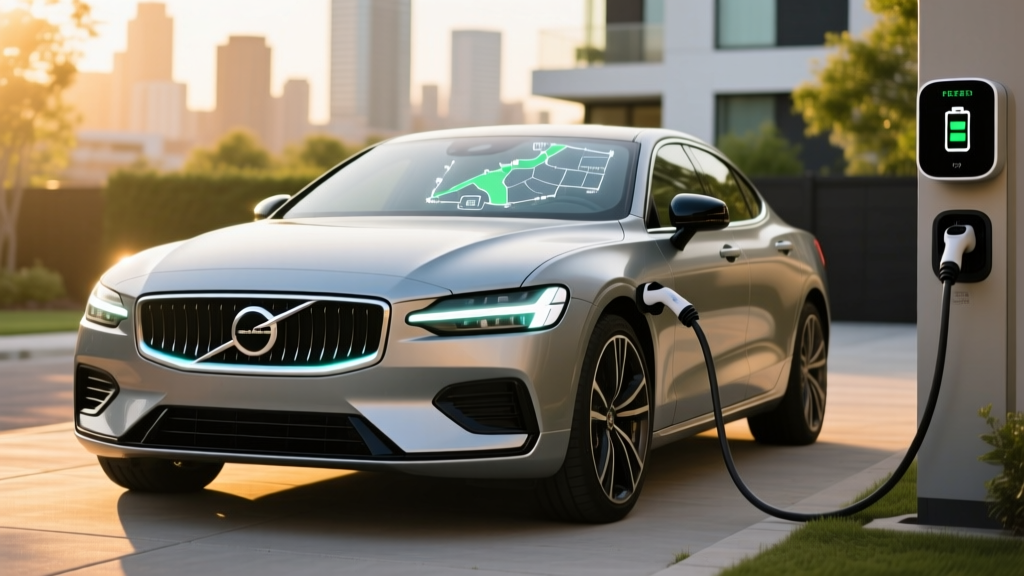
The 2024 Volvo V60 Polestar Recharge occupies a narrow but compelling slice of the electrified wagon market. It pairs a turbocharged and supercharged 2.0-liter four-cylinder with an 87-kW rear electric motor and an 18.8 kWh battery, producing 455 combined horsepower and 523 lb-ft of torque through all-wheel drive. For buyers who want a luxury sport wagon that handles daily commutes on electricity alone but still offers a 400-plus-mile total range for road trips, this plug-in hybrid (PHEV) delivers — with notable trade-offs in charging speed and electric-only efficiency.
This review covers the V60 Polestar Recharge specifically — the top-tier performance variant of Volvo's V60 plug-in hybrid lineup. The lesser Plus and Ultimate trims share the powertrain but tune output to 415 hp. Volvo's "Polestar Engineered" badge here denotes chassis, brake, and suspension upgrades developed by Polestar's performance division, not a standalone Polestar EV model.
Range, Efficiency, and Real-World Expectations
EPA Combined MPGe: 63 MPGe (electric + gas)
Gas-Only Combined MPG: 30 MPG
Total Range: ~470 miles (full tank + full battery)
Real-World Note: Expect 28–32 miles of electric range in mixed driving at 65–75 mph. Cold weather (below 35°F) reduces EV range by 20–30%, dropping to roughly 22–27 miles. Highway-only driving at 80 mph yields closer to 25 miles electric. The 14.7-gallon fuel tank provides the remaining range once the battery depletes.
The 18.8 kWh battery pack (14.9 kWh usable) is modest by modern PHEV standards, which is the primary reason the V60's electric range trails competitors like the BMW 330e xDrive Touring (not sold in the U.S.) or the Audi A6 PHEV. However, 35 miles covers most daily commutes. According to fueleconomy.gov, the V60 Polestar Recharge achieves 63 MPGe combined when operating in hybrid mode with a charged battery, and 30 MPG combined once the battery is depleted.
Energy consumption on electricity alone is rated at 54 kWh/100 miles — higher than a dedicated EV like the Polestar 2 (33 kWh/100 mi) because the V60 is a heavier wagon with a complex dual-powertrain setup. This matters for your electricity cost: at the U.S. average of $0.16/kWh, those 35 electric miles cost roughly $1.30 to "fill," compared to about $5.30 for the equivalent gasoline distance at $3.50/gallon.
Powertrain, Performance, and Drivetrain
| Spec | 2024 Volvo V60 Polestar Recharge |
|---|---|
| Powertrain | 2.0L turbo + supercharged I-4 + rear electric motor (PHEV AWD) |
| Combined Output | 455 hp / 523 lb-ft torque |
| 0–60 mph | 4.3 seconds |
| Drivetrain | eAWD (front: gas engine, rear: electric motor) |
| Battery | 18.8 kWh total / 14.9 kWh usable (NMC lithium-ion) |
| Electric Motor | 87 kW (117 hp) rear-mounted |
| Transmission | 8-speed automatic |
| Curb Weight | ~4,600 lbs |
The V60 Polestar's eAWD system splits power cleverly: the gas engine drives the front wheels, and the electric motor drives the rears. In Pure mode, the car runs rear-wheel-drive on electricity alone up to 85 mph. In Power mode, both systems combine for full all-wheel-drive grip and the 4.3-second 0–60 time. The Polestar Engineered variant adds manually adjustable Öhlins dampers, gold Brembo front calipers with 6-piston design, and stiffer springs — a genuine performance chassis, not just a cosmetic package.
One practical note: the battery sits in the center tunnel (where a traditional driveshaft would be in a RWD car), so interior space is preserved with no cabin compromise. The trade-off is that battery capacity is limited by that physical constraint.
Charging Speed: DC Fast Charge and Home Level 2
| Charging Level | Power (kW) | Time / Rate | Connector |
|---|---|---|---|
| Level 1 (120V household) | ~1.4 kW | ~10 hours for full charge; ~2 mi/hr | J1772 |
| Level 2 (240V home/public) | 3.7 kW max | ~5 hours 0–100%; ~12 mi of EV range per hour | J1772 |
| DC Fast Charge | Not supported | N/A | N/A |
This is the V60 Polestar Recharge's biggest practical limitation for a 2024 PHEV: it does not support DC fast charging. The onboard charger caps at 3.7 kW on Level 2, meaning a full charge from empty takes approximately 5 hours. For most owners who charge overnight at home, this is perfectly adequate — you'll wake up to 35 miles of electric range every morning.
However, on road trips, you cannot quickly top up the battery at a DC fast charger. Once the 35 EV miles are depleted, you're running on the gas engine at 30 MPG combined until you can plug in at a Level 2 destination (hotel, workplace). This is standard for many PHEVs in this class — the BMW 330e and Audi A7 TFSI e also lack DC fast charging — but it's worth understanding before purchase.
For home charging, a standard 240V / 20-amp circuit delivers the full 3.7 kW. Installation of a dedicated Level 2 circuit typically runs $500–$1,500 depending on panel proximity and local electrician rates. A licensed electrician should verify your panel has capacity before installation.
Pricing, Trim Levels, and Federal Tax Credit
| Trim | Base MSRP | Est. As-Tested | Federal Tax Credit (§30D) |
|---|---|---|---|
| V60 Recharge Plus | $72,350 | $74,000–$76,000 | Up to $7,500 (subject to rules) |
| V60 Recharge Ultimate | $76,850 | $78,500–$81,000 | Up to $7,500 (subject to rules) |
| V60 Polestar Recharge | $79,550 | $81,000–$83,000 | Up to $7,500 (subject to rules) |
All 2024 V60 Recharge trims qualify as SUVs under IRS guidelines (due to GVWR classification), which means the MSRP cap for the §30D federal tax credit is $80,000 — not the $55,000 sedan cap. The Polestar Recharge trim starts at $79,550, fitting under this threshold at base MSRP. However, adding packages or destination charges can push the final MSRP above $80,000, disqualifying that specific vehicle from the credit.
- MSRP Cap: ≤ $80,000 (SUV/wagon classification)
- Buyer Income Cap: AGI ≤ $300,000 (married filing jointly), $225,000 (head of household), $150,000 (single)
- Battery Sourcing: Critical minerals and battery components must meet phased-in percentages from U.S. or FTA-partner countries — Volvo has confirmed 2024 V60 Recharge models meet the full $7,500 threshold, but verify the specific VIN with your dealer
- Point-of-Sale Transfer: As of 2024, the credit can be transferred to the dealer at purchase for an immediate price reduction (requires dealer registration with IRS)
- Tax Liability: Credit is non-refundable — you must have sufficient federal tax liability to claim it (unless transferred at POS)
If eligible, the $7,500 credit effectively brings the Polestar Recharge from ~$81,000 to ~$73,500 — competitive with a well-equipped BMW M340i xDrive or Audi S4 Avant (neither of which offers electric-only commuting). Always confirm credit eligibility for the exact VIN you're purchasing via the IRS energy credit portal and consult a tax professional.
Cargo Space, Interior Dimensions, and Practicality
| Dimension | Measurement |
|---|---|
| Cargo Volume (behind rear seats) | 26.0 cu ft |
| Cargo Volume (rear seats folded) | 50.9 cu ft |
| Front Legroom | 42.3 in |
| Rear Legroom | 35.2 in |
| Front Headroom | 39.5 in |
| Rear Headroom | 38.2 in |
| Seating Capacity | 5 passengers |
The V60 wagon body provides genuinely useful cargo space — 26 cubic feet behind the rear row is more than a Tesla Model Y's frunk + trunk combined in some configurations, and the low, flat load floor makes it practical for strollers, groceries, or camping gear. The rear seats fold nearly flat for 50.9 cubic feet. Rear legroom at 35.2 inches is adequate for adults on shorter trips but tight for tall passengers on long drives — this is a compact-executive wagon, not a midsize family hauler.
Notably, the PHEV battery packaging does not eat into cargo or passenger space, thanks to the center-tunnel placement. There is no "frunk" (front trunk) since the gas engine occupies the engine bay.
Tech, Safety, and Driver Assistance
The 2024 V60 uses Volvo's Android Automotive OS (Google built-in), which includes Google Maps navigation, Google Assistant voice control, and Google Play Store for in-car apps. The 9-inch portrait touchscreen is showing its age in resolution and responsiveness compared to BMW's iDrive 8.5 or Mercedes MBUX, but the interface is logical and the Google Maps integration is excellent for route planning with charge stops.
Driver assistance comes via Volvo's Pilot Assist, which provides adaptive cruise control with stop-and-go, lane centering, and speed-limit recognition. This is an SAE Level 2 system — it assists with steering and acceleration but requires continuous driver supervision. It is not autonomous driving. Pilot Assist is competent on highways but less refined than GM's Super Cruise or Ford's BlueCruise on mapped roads.
Safety ratings are strong: the V60 earned an IIHS Top Safety Pick+ designation and NHTSA 5-star overall rating. Standard safety equipment includes automatic emergency braking with pedestrian/cyclist/large-animal detection, run-off-road protection (a Volvo signature), blind-spot monitoring with steering assist, and rear cross-traffic alert.
Warranty Coverage and Battery Longevity
| Coverage | Term |
|---|---|
| Limited Vehicle Warranty | 4 years / 50,000 miles |
| Powertrain Warranty | 4 years / 50,000 miles |
| Hybrid/EV Battery Components | 8 years / 100,000 miles (≥70% capacity retention) |
| Corrosion Warranty | 12 years / unlimited miles |
| Roadside Assistance | 4 years / unlimited miles |
| Complimentary Maintenance | 3 years / 36,000 miles |
Volvo's hybrid battery warranty meets the federal mandate for emissions-related components: 8 years or 100,000 miles with a capacity-retention threshold of 70%. In practice, Volvo's NMC battery packs in the Recharge lineup have shown minimal degradation — owners on Volvo forums report 90–95% state of health (SoH) after 3–4 years of daily Level 2 charging. The smaller 18.8 kWh pack is less stressed than a large BEV battery because it cycles at lower depth-of-discharge in typical PHEV use.
One ownership consideration: Volvo's 4-year/50,000-mile bumper-to-bumper warranty is shorter than Hyundai/Kia (5/60,000) or Genesis (5/60,000). Extended warranty options are available through Volvo dealers.
Pros, Cons, and Who Should Buy
- 455 hp / 523 lb-ft with genuine performance chassis (Öhlins, Brembo)
- 35 mi EV range covers most commutes; 470 mi total range eliminates range anxiety
- Wagon practicality with 26 cu ft cargo, flat load floor
- Qualifies for up to $7,500 federal tax credit (verify VIN)
- Top-tier IIHS/NHTSA safety ratings
- Google Automotive OS with native Google Maps
- No battery-packaging compromise to cabin/cargo space
- No DC fast charging — road-trip EV top-ups impossible
- 3.7 kW max Level 2 charge rate is slow vs. newer PHEVs (many offer 7.4 kW)
- 54 kWh/100 mi on electricity is inefficient for an EV-mode commute
- $79,550+ starting price is steep; options push past $80K credit cap
- Rear legroom tight at 35.2 in for a $80K wagon
- 9-inch infotainment screen feels dated vs. competitors
- 4-year/50,000-mi warranty is below segment average
- You want a performance wagon with electric commuting and no range anxiety
- Your daily commute is under 30 miles and you can charge at home nightly
- You value chassis dynamics (Öhlins dampers, Brembo brakes) over tech flash
- Safety ratings and wagon cargo practicality are top priorities
- You need more than 35 miles of electric range (consider the BMW X5 xDrive50e at 38 mi, or a full BEV)
- You frequently road-trip and want to charge the battery quickly (no DCFC here)
- Back-seat passenger space is critical (consider a midsize SUV PHEV like the Volvo XC90 Recharge)
- Budget is under $65K (the V60 Recharge Plus starts at $72,350 before credit)
Frequently Asked Questions
What is the real-world range of the 2024 Volvo V60 Polestar Recharge?
The EPA rates it at 35 miles electric-only. In real-world mixed driving at moderate speeds, expect 28–32 miles. Highway driving at 75+ mph drops this to roughly 25 miles, and cold weather (below 35°F) can reduce it to 22–27 miles. Once the battery depletes, the gas engine provides an additional ~435 miles at 30 MPG combined from the 14.7-gallon tank, for a total range of approximately 470 miles.
How fast does it charge at home and on the road?
The V60 Polestar Recharge charges at a maximum of 3.7 kW on Level 2 (240V), taking about 5 hours from empty to full. On a standard 120V outlet (Level 1), a full charge takes roughly 10 hours. There is no DC fast-charging capability. For most owners charging overnight, the 3.7 kW rate is sufficient to replenish the 14.9 kWh usable battery by morning.
Does the 2024 V60 Polestar Recharge qualify for the federal EV tax credit?
Yes, the 2024 V60 Recharge is eligible for up to $7,500 under IRS §30D, classified as an SUV with an $80,000 MSRP cap. However, eligibility depends on the buyer's AGI (≤$300K joint / ≤$150K single), the specific vehicle's MSRP staying at or below $80,000 (options can push it over), and battery-sourcing requirements. The credit can be transferred to the dealer at point of sale for an immediate price reduction. Always verify the specific VIN at irs.gov and consult a tax professional.
Is the V60 Polestar Recharge worth buying vs. competitors?
Against the BMW M340i xDrive wagon (not a PHEV, ~$62K), the V60 offers electric commuting and more power but at a $17K+ premium before the tax credit. Against the Audi A4 allroad (not a PHEV), the V60 is more powerful and efficient but pricier. There is no direct PHEV sport-wagon rival in the U.S. market — the V60 Polestar Recharge is essentially unique in combining 455 hp, AWD, a performance chassis, and 35 miles of EV range in a wagon body. If that exact combination matters to you, it has no substitute. If you can compromise on the wagon form factor, PHEV SUVs like the BMW X5 xDrive50e (38 mi EV, $67K) offer more space and similar capability.
What are the biggest ownership costs to expect?
Beyond the ~$81K purchase price, expect higher-than-average insurance premiums (performance AWD wagons with complex powertrains cost more to insure — roughly $2,200–$3,000/year depending on profile). Premium fuel is required for the 2.0L engine. Maintenance is complimentary for 3 years, then Volvo dealer service rates apply. Home Level 2 charger installation adds $500–$1,500 upfront. Depreciation for Volvo wagons is moderate — expect roughly 45–50% value retention at 5 years, aided by the PHEV tax credit at purchase.
What battery chemistry does the V60 Polestar Recharge use?
The 2024 V60 Recharge uses an NMC (nickel manganese cobalt) lithium-ion battery pack. NMC offers higher energy density than LFP (lithium iron phosphate), which is important in the constrained center-tunnel packaging. The trade-off is that NMC batteries benefit from avoiding sustained 100% state of charge — Volvo's battery management system includes a buffer, but for longevity, daily charging to 80–90% is ideal, with 100% reserved for days when you need full EV range.
Sources: EPA fueleconomy.gov, IRS §30D Clean Vehicle Credit, Volvo Cars USA specifications.