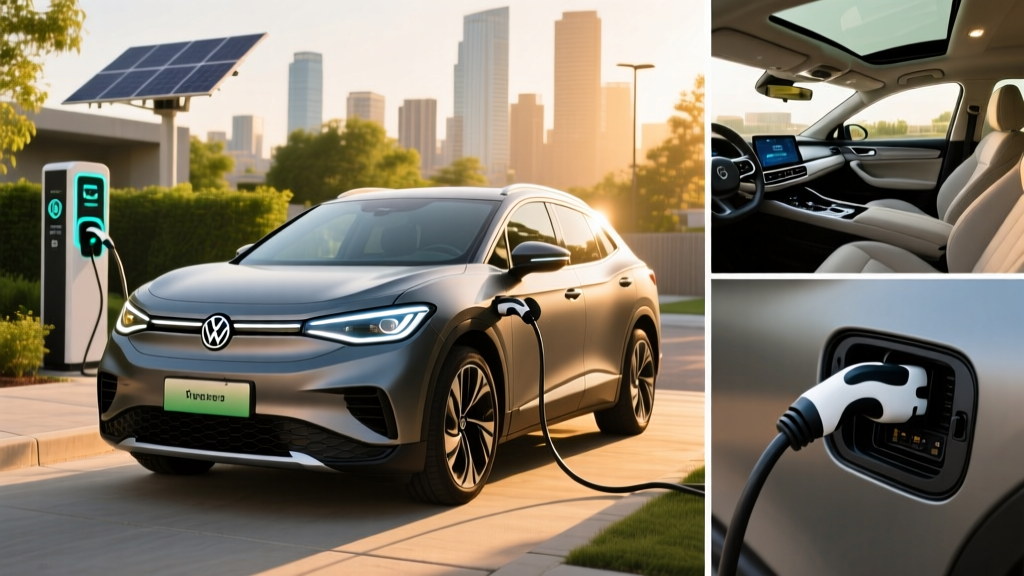
The 2024 Volkswagen ID.4 S occupies a specific niche in the compact electric SUV segment: a comfortable, practical family hauler that prioritizes ride quality and interior space over outright performance or segment-leading range. With a starting MSRP around $43,700 (before destination), it undercuts rivals like the Hyundai Ioniq 5 and Ford Mustang Mach-E on base price while offering competitive interior volume and a refined driving experience. But how does it actually perform in daily driving, on road trips, and at the charger? This profile breaks down every spec that matters.
Spec Sheet at a Glance
| Specification | 2024 VW ID.4 S (RWD) | 2024 VW ID.4 S (AWD) |
|---|---|---|
| EPA Range | 275 miles | 263 miles |
| Battery (usable) | 82 kWh (NMC) | 82 kWh (NMC) |
| Drivetrain | Rear-wheel drive | Dual-motor AWD |
| Horsepower | 201 hp | 295 hp |
| 0–60 mph | ~7.7 sec | ~5.4 sec |
| Max DC Fast Charge | 170 kW | 170 kW |
| 10–80% DC Charge | ~30 min | ~30 min |
| Level 2 Home Charge | 11 kW (~37 mi/hr) | 11 kW (~37 mi/hr) |
| MPGe (combined) | 107 MPGe | 101 MPGe |
| Efficiency | 31 kWh/100 mi | 33 kWh/100 mi |
| Cargo (rear seats up) | 30.3 cu ft | 30.3 cu ft |
| Cargo (rear seats folded) | 64.2 cu ft | 64.2 cu ft |
| Base MSRP | $43,745 | $47,545 |
| Battery Warranty | 8 yr / 100,000 mi | 8 yr / 100,000 mi |
Sources: EPA fueleconomy.gov, Volkswagen of America official specs.
Real-World Range: What the EPA Sticker Doesn't Tell You
The 2024 ID.4 S RWD carries an EPA-estimated 275 miles of range. In real-world mixed driving, expect roughly 240–260 miles in moderate temperatures. Sustained highway driving at 70–75 mph drops that to approximately 215–235 miles. In cold weather (below 32°F), plan for a 20–30% reduction, bringing usable range down to roughly 190–220 miles depending on cabin heating demand and whether you precondition the battery.
The 82 kWh usable battery uses NMC (nickel manganese cobalt) chemistry, which offers higher energy density than LFP but follows the typical NMC charging pattern: accept the 80% daily-charge recommendation to minimize long-term degradation. VW provides an 8-year/100,000-mile battery warranty with a 70% capacity retention threshold — meaning if your pack drops below roughly 57.4 kWh usable within that window, VW covers it.
At 31 kWh per 100 miles (RWD), the ID.4 S is less efficient than the Hyundai Ioniq 5 (28 kWh/100 mi) or the Tesla Model Y (28 kWh/100 mi). That translates to slightly higher electricity costs per mile and less range extracted from each kWh of battery. It's not a deal-breaker, but efficiency-conscious buyers should note the difference.
Charging Speed: DC Fast and Home Level 2
| Charging Level | Power | Speed | Notes |
|---|---|---|---|
| Level 1 (120V) | ~1.4 kW | ~4–5 mi/hr | Emergency/trickle only |
| Level 2 (240V, 48A) | 11 kW | ~37 mi/hr | Full charge overnight (~8.5 hrs) |
| DC Fast Charge | Peak 170 kW | 10–80% in ~30 min | Tapers significantly above 80% |
The ID.4 S peaks at 170 kW on a DC fast charger, but like most EVs, it doesn't sustain that rate across the entire session. The charge curve is strong from roughly 5–50% State of Charge, then begins tapering. Expect 10–80% in approximately 30 minutes under ideal conditions (warm battery, capable charger). Pushing from 80–100% adds another 20+ minutes — plan your road-trip stops around the 80% mark.
On a Level 2 home charger at 11 kW (48 amps on a 240V circuit), the ID.4 S adds about 37 miles of range per hour. A full 0–100% charge takes roughly 8.5 hours, making overnight replenishment straightforward. You'll need a NEMA 14-50 outlet or a hardwired Level 2 unit installed by a licensed electrician — budget $500–$1,500 for installation depending on your panel capacity and run length. If your home has a 100-amp panel with heavy existing loads, a panel upgrade ($1,500–$3,000) may be required.
The ID.4 S uses the CCS1 connector for DC fast charging. As VW transitions to NACS in future model years, 2024 models rely on the CCS network — Electrify America (which VW helped fund and offers complimentary charging on some trims), EVgo, and ChargePoint. If you frequently use Tesla Superchargers, you'll need a CCS-to-NACS adapter; VW has confirmed compatibility with approved adapters, but confirm with your specific unit.
Performance and Driving Dynamics
The RWD ID.4 S delivers 201 horsepower from its rear-mounted permanent-magnet synchronous motor. The 0–60 mph time of approximately 7.7 seconds is adequate for merging and passing but won't thrill anyone coming from a Tesla Model Y Long Range (5.0 seconds). The AWD variant bumps output to 295 hp and drops 0–60 to around 5.4 seconds — a meaningful improvement for highway confidence, though it costs you 12 miles of EPA range.
Where the ID.4 S genuinely excels is ride quality. VW tuned the suspension for comfort over sportiness, and it shows: potholes, expansion joints, and rough pavement are absorbed with a maturity that rivals more expensive electric SUVs. The steering is light and precise if somewhat numb, and the turning radius is impressively tight for a compact SUV — a real advantage in urban parking.
Regenerative braking is adjustable via steering-wheel paddles (D, D1, D2, D3, and B mode), but unlike some competitors, the ID.4 does not offer true one-pedal driving that comes to a complete stop. In B mode, regen is strong enough to slow significantly in traffic but you'll still need the brake pedal for final stops. This is a deliberate VW design choice that frustrates some EV converts but feels natural to drivers transitioning from ICE vehicles.
Interior, Tech, and Daily Livability
Interior space is a genuine strength. Rear-seat legroom measures 37.6 inches, comfortably fitting adults on longer trips. Cargo volume is 30.3 cubic feet behind the second row and 64.2 cubic feet with the rear seats folded — competitive with the segment and sufficient for strollers, groceries, and weekend luggage for a family of four.
The S trim includes VW's 12-inch infotainment touchscreen, wireless Apple CarPlay and Android Auto, heated front seats, a heated steering wheel, and adaptive cruise control with stop-and-go. The ID.4 comes standard with VW's IQ.DRIVE suite: lane-keeping assist, front assist with automatic emergency braking, blind-spot monitoring, and rear traffic alert.
VW's IQ.DRIVE and Travel Assist are SAE Level 2 driver-assistance systems. They provide steering, acceleration, and braking support, but the driver must remain fully engaged with hands on the wheel and eyes on the road at all times. This is not autonomous or "self-driving" capability.
The most-cited criticism of the ID.4's interior is the capacitive touch interface. Volume and climate controls use touch-sensitive sliders rather than physical buttons, which many owners find imprecise while driving. VW added an illuminated volume slider for 2024 to address visibility complaints, but the fundamental usability issue persists. The infotainment software itself improved with over-the-air updates through 2024, with faster response times and more intuitive menus than early 2021–2022 models.
Pricing, Trims, and Federal Tax Credit
| Trim / Config | MSRP (incl. destination) | Est. After §30D Credit |
|---|---|---|
| ID.4 S (RWD) | $44,740 | ~$37,240* |
| ID.4 S (AWD) | $48,540 | ~$41,040* |
| ID.4 S Plus (RWD) | $47,940 | ~$40,440* |
*Tax credit estimates assume full $7,500 §30D eligibility. Actual credit depends on buyer income, battery sourcing, and MSRP cap compliance. Verify with a tax professional.
The 2024 ID.4 S is assembled at VW's Chattanooga, Tennessee plant, which positions it favorably for the federal §30D EV tax credit. However, eligibility is not automatic. Under current IRS rules, you must meet several requirements:
- MSRP cap: The vehicle must have an MSRP at or below $80,000 for SUVs — the ID.4 clears this easily.
- Buyer income limits: Modified adjusted gross income must not exceed $150,000 (single), $225,000 (head of household), or $300,000 (joint).
- Battery component and critical mineral sourcing: A percentage of battery components must be manufactured or assembled in North America, and critical minerals must be sourced from the US or FTA partners. These thresholds increase annually. Confirm current-year compliance on fueleconomy.gov before purchasing.
- Point-of-sale transfer: As of 2024, you can transfer the credit to the dealer at purchase, reducing your out-of-pocket cost immediately rather than waiting for tax filing.
The ID.4 S's Chattanooga assembly and VW's supply-chain adjustments have generally kept it eligible for the full or partial credit, but battery-sourcing rules tighten each year. Always confirm eligibility at the point of sale for your specific model year and build date.
Pros and Cons
- Comfortable, composed ride quality
- Spacious interior with 37.6" rear legroom
- Competitive MSRP before incentives
- Strong Level 2 home charging (11 kW)
- Generous 8-yr/100,000-mi battery warranty
- Tight turning radius, easy urban driving
- Standard IQ.DRIVE safety suite
- Efficiency lags Ioniq 5 and Model Y
- Frustrating capacitive touch controls
- 170 kW peak DC charge rate trails 235–350 kW rivals
- No true one-pedal driving to a full stop
- Infotainment learning curve
- AWD range penalty (12 mi EPA loss)
- Real-world cold-weather range drops significantly
Who Should Buy the 2024 ID.4 S?
The ID.4 S is best suited for families and commuters who prioritize ride comfort, interior space, and value over cutting-edge efficiency or performance. If your daily routine involves a 30–60 mile round-trip commute with home Level 2 charging, the ID.4 S handles that effortlessly with range to spare. Its cargo space and rear-seat comfort make it a legitimate family vehicle for two adults and two children with gear.
It's less ideal for frequent long-distance road trippers who want the fastest possible DC charging, efficiency-focused buyers who count every kWh/100mi, or tech enthusiasts who want the most advanced infotainment and driver-assist features. For those use cases, the Hyundai Ioniq 5 (faster charging, better efficiency) or Tesla Model Y (Supercharger network, performance) may serve you better — at a higher starting price.
Choose the ID.4 S if: You want a comfortable, spacious electric SUV at a moderate price point, you charge primarily at home, and your road trips are under 250 miles between stops.
Look elsewhere if: You need 300+ miles of real-world range, the fastest DC charging available, or the most intuitive infotainment interface in the segment.
Frequently Asked Questions
What is the real-world range of the 2024 Volkswagen ID.4 S?
The EPA rates the RWD ID.4 S at 275 miles. In real-world mixed driving at moderate temperatures, expect 240–260 miles. Highway driving at 70+ mph reduces that to roughly 215–235 miles. Cold weather (below 32°F) can drop range to 190–220 miles depending on heating use and preconditioning.
How fast does the ID.4 S charge?
On a DC fast charger, the ID.4 S peaks at 170 kW and charges from 10–80% in approximately 30 minutes under ideal conditions. On a Level 2 home charger at 11 kW, it adds roughly 37 miles per hour, fully replenishing overnight in about 8.5 hours.
Does the 2024 ID.4 S qualify for the $7,500 federal EV tax credit?
The ID.4 S is assembled in Chattanooga, TN and generally qualifies, but eligibility depends on your income (under $150K single / $300K joint), the vehicle's battery sourcing compliance for the specific build date, and MSRP caps. Confirm eligibility on fueleconomy.gov and with your tax professional before purchasing. The credit can be transferred at point of sale to reduce your purchase price immediately.
Is the ID.4 S worth buying vs. the Ioniq 5 or Model Y?
The ID.4 S wins on ride comfort, base pricing, and interior quietness. The Ioniq 5 charges faster (up to 235 kW on 2024 models) and is more efficient. The Model Y offers the longest range, best Supercharger access, and strongest performance. Your priority — comfort vs. charging speed vs. range/network — determines the best fit.
What is the ID.4 S battery warranty?
Volkswagen covers the high-voltage battery for 8 years or 100,000 miles, whichever comes first, against defects and capacity loss below 70% of original capacity. The basic vehicle warranty is 4 years/50,000 miles.
Does the ID.4 have a front trunk (frunk)?
No. The 2024 ID.4 does not have a usable front trunk. The space under the hood houses electronics and is not accessible for cargo storage. All cargo capacity (30.3 cu ft rear, 64.2 cu ft total) is in the rear cargo area.