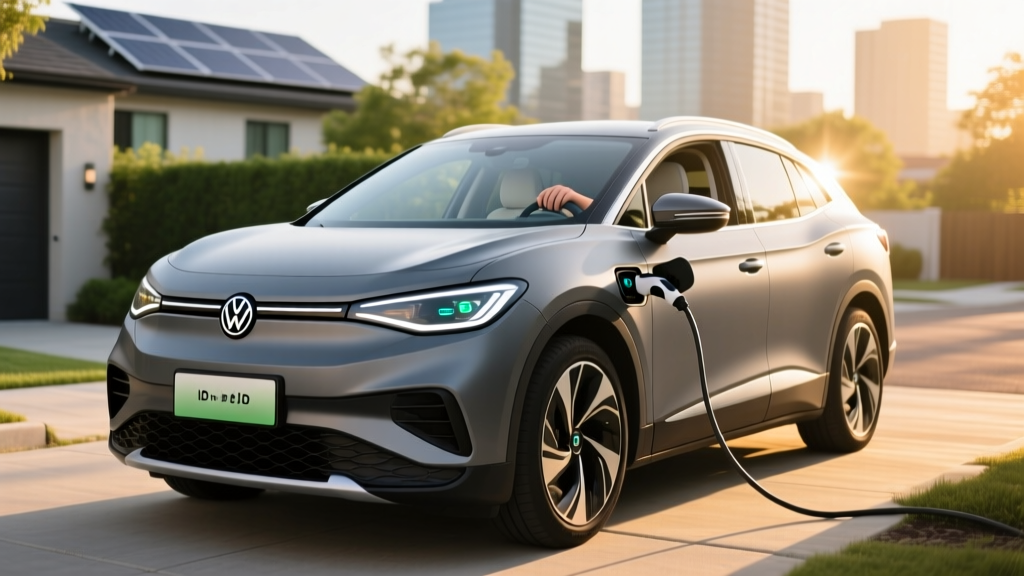
The 2024 Volkswagen ID.4 arrived with a clear mission: deliver a practical, roomy, all-electric compact SUV at a price that undercuts most rivals. With a starting MSRP near $39,000 and a refreshed interior over its 2021-2023 predecessors, the ID.4 positions itself as the sensible electric family hauler. But does its real-world range, charging speed, and ownership cost hold up outside the brochure? We break down every number that matters.
2024 Volkswagen ID.4 at a Glance: Key Specifications
| Specification | Pro (RWD) | AWD Pro S |
|---|---|---|
| EPA Range | 291 miles | 263 miles |
| Battery (usable / gross) | 77 kWh / 82 kWh | 77 kWh / 82 kWh |
| Battery Chemistry | NMC (Nickel Manganese Cobalt) | NMC |
| Horsepower | 201 hp | 295 hp |
| 0-60 mph | 7.7 seconds | 5.4 seconds |
| Drivetrain | Rear-Wheel Drive | Dual-Motor AWD |
| Max DC Fast Charge | 170 kW | 170 kW |
| 10-80% DC Charge Time | ~30 minutes | ~30 minutes |
| Level 2 Home Charge Rate | 11 kW (AC) | 11 kW (AC) |
| MPGe (combined) | 104 MPGe | 93 MPGe |
| Efficiency | 32 kWh/100 mi | 36 kWh/100 mi |
| Cargo (rear seats up / folded) | 30.3 / 64.2 cu ft | 30.3 / 64.2 cu ft |
| Rear Legroom | 37.6 inches | 37.6 inches |
| Base MSRP (incl. destination) | $39,735 | $48,735 |
| Battery Warranty | 8 yr / 100,000 mi | 8 yr / 100,000 mi |
Source: EPA Fuel Economy, Volkswagen USA
Real-World Range vs. EPA Sticker
EPA Estimate: 291 miles (RWD Pro) / 263 miles (AWD Pro S)
Real-World Expectation: ~230-260 miles on highway trips at 70+ mph; ~200-225 miles in cold weather (below 30°F); ~265-285 miles in mixed city/suburban driving with moderate climate use.
The ID.4's 291-mile EPA rating for the RWD Pro trim is competitive within the compact electric SUV segment. However, as with all EVs, that number assumes a mix of city and highway driving at moderate temperatures. In sustained highway driving at 70-75 mph, expect to see roughly 240-260 miles before the battery hits 10% State of Charge (SoC). The ID.4's relatively boxy SUV shape creates more aerodynamic drag than sleeker competitors like the Hyundai Ioniq 5, which penalizes efficiency at higher speeds.
Cold weather is the bigger range variable. The ID.4 uses a resistive PTC heater on base trims rather than a heat pump (the heat pump became available on select 2024 trims and packages). Without a heat pump, cabin heating in sub-freezing temperatures draws significant energy from the traction battery. Owners in northern climates should budget for 20-30% range reduction in winter, meaning a 291-mile EPA car may deliver closer to 200-220 miles on a cold January highway drive.
The 82 kWh gross (77 kWh usable) lithium-ion battery pack uses NMC (nickel manganese cobalt) chemistry supplied primarily by SK On. Volkswagen maintains a roughly 5 kWh buffer at the bottom of the pack to protect against deep-discharge degradation. NMC chemistry offers strong energy density but requires careful thermal management — the ID.4's liquid-cooled system handles this well in normal conditions.
Charging Speed: DC Fast Charging and Home Level 2
| Charge Level | Power (kW) | Miles Added per Hour | Notes |
|---|---|---|---|
| Level 1 (120V household) | ~1.4 kW | ~4-5 mi/hr | Emergency/top-up only; full charge in ~55+ hours |
| Level 2 (240V home/public) | Up to 11 kW | ~33-37 mi/hr | 0-100% in ~7.5 hours on a 48A circuit |
| DC Fast Charge (CCS) | Peak 170 kW | ~200+ mi in 30 min | 10-80% in ~30 min; tapers significantly above 80% |
The ID.4's 170 kW peak DC fast-charge rate is adequate but no longer class-leading. Competitors like the Hyundai Ioniq 5 and Kia EV6 (both on the E-GMP 800V architecture) accept up to 235-240 kW, completing a 10-80% charge in roughly 18 minutes versus the ID.4's ~30 minutes. For road-trippers who fast-charge frequently, that 12-minute gap per stop adds up on long drives.
A critical ownership note: the 2024 ID.4 uses the CCS1 connector standard. Volkswagen has confirmed that future models will adopt the NACS (Tesla) connector, but the 2024 ID.4 does not have native NACS. Owners can access Tesla Superchargers using a CCS-to-NACS adapter (Volkswagen offers one through its accessories catalog), but charging speeds on Superchargers may be limited by the adapter's throughput and the vehicle's 170 kW ceiling.
The charging curve matters more than peak numbers. The ID.4 sustains roughly 130-150 kW from 10% to about 40% SoC, then tapers progressively. Above 80%, charge speed drops below 50 kW — this is typical of NMC chemistry but worth understanding if you're tempted to charge past 80% on a road trip. For daily use, setting your charge limit to 80% preserves battery longevity.
At home on a Level 2 wallbox (such as a ChargePoint Home Flex or Emporia Level 2 charger) wired to a 60A circuit, the ID.4's 11 kW onboard charger replenishes roughly 33-37 miles of range per hour. A full 0-100% charge takes approximately 7.5 hours, making overnight charging straightforward for most commutes. Home installation of a Level 2 charger typically runs $800-$2,000 depending on your electrical panel's capacity and the distance from panel to garage — a licensed electrician should evaluate whether a panel upgrade (to 200A service) is needed.
Performance and Driving Impressions
The RWD ID.4 Pro delivers 201 horsepower from its rear-mounted permanent-magnet synchronous motor. That's enough for a 7.7-second 0-60 mph time — brisk for city merging but not thrilling. The single-motor layout keeps weight over the rear axle, giving the ID.4 surprisingly confident traction in light rain and snow.
The dual-motor AWD variant bumps output to 295 hp and drops the 0-60 time to 5.4 seconds, making it genuinely quick off the line. The AWD system is on-demand: the front induction motor disengages during steady cruising to maximize efficiency, engaging only when slip is detected or hard acceleration is requested.
Ride quality is where the ID.4 earns its "family SUV" reputation. The suspension tuning is soft and compliant — it soaks up potholes and expansion joints with a maturity that rivals more expensive vehicles. Steering is light and numb, which suits commuting but won't satisfy enthusiasts. Regenerative braking offers adjustable levels via steering-wheel paddles, including a B-mode for stronger regen, though true one-pedal driving (coming to a full stop via regen alone) is not as aggressive as in some competitors.
Interior, Tech, and Driver Assistance
The 2024 model year brought meaningful interior improvements over earlier ID.4s. The infotainment system now runs VW's ID.Software 4.0 on a 12.9-inch touchscreen (up from 12 inches), with faster response times, improved voice recognition, and a backlit touch-slider for volume and temperature. Earlier ID.4 models were notorious for laggy, unresponsive software — the 4.0 update substantially addresses those complaints.
Standard features across the lineup include:
- Wireless Apple CarPlay and Android Auto
- 12.9-inch touchscreen with navigation (Pro S and above)
- Wireless phone charging pad
- Heated front seats (standard on all trims)
- Panoramic fixed glass roof (Pro S and above)
- Power liftgate
On the driver-assistance front, the ID.4 comes equipped with Volkswagen's IQ.DRIVE suite, which includes:
- Adaptive cruise control with stop-and-go
- Lane-keeping assist with lane-centering
- Automatic emergency braking with pedestrian detection
- Blind-spot monitoring with rear cross-traffic alert
- Travel Assist (combines adaptive cruise and lane-centering for highway use)
Notable drawbacks include the ID.4's lack of a front trunk (frunk) — the space under the hood houses electronics and washer fluid. Rear drum brakes (instead of discs) are standard, a choice VW defends as reducing drag and regen conflict, though some buyers perceive them as cost-cutting. Cabin noise isolation is average for the class; wind noise becomes noticeable above 70 mph.
Pricing, Trims, and Federal Tax Credit Eligibility
| Trim | Drivetrain | MSRP (incl. destination) | Est. Price After §30D Credit* |
|---|---|---|---|
| Standard | RWD (62 kWh) | $39,735 | $32,235 |
| Pro | RWD (82 kWh) | $43,735 | $36,235 |
| Pro S | RWD (82 kWh) | $47,735 | $40,235 |
| AWD Pro | AWD (82 kWh) | $47,735 | $40,235 |
| AWD Pro S | AWD (82 kWh) | $48,735 | $41,235 |
| AWD Pro S Plus | AWD (82 kWh) | $53,735 | $46,235 |
*Tax-credit pricing assumes full $7,500 §30D credit eligibility. Actual credit amount varies — see eligibility checklist below.
The 2024 ID.4 qualifies for the federal EV tax credit under IRS §30D, but eligibility is not automatic. The vehicle must meet battery-component and critical-mineral sourcing requirements that phase in progressively. For the 2024 model year, the ID.4's battery is assembled in the U.S. (at VW's Chattanooga, Tennessee plant), which helps satisfy domestic-content rules. However, critical-mineral sourcing requirements tighten each year, and buyers should verify current eligibility on the fueleconomy.gov tax credit page at time of purchase.
- MSRP Cap: Vehicle MSRP must not exceed $80,000 for SUVs (ID.4 qualifies — all trims are under the cap)
- Buyer Income Cap: Modified AGI must not exceed $150,000 (single), $225,000 (head of household), or $300,000 (joint filers)
- Battery Sourcing: Battery components must meet domestic-content thresholds; critical minerals must be sourced from the U.S. or FTA partners — thresholds increase annually
- Point-of-Sale Transfer: As of 2024, the credit can be transferred to the dealer at purchase, reducing the purchase price directly (rather than waiting for a tax refund)
- Verify: Check IRS.gov clean vehicle credits for current rules before purchasing
Ownership Costs: Efficiency, Insurance, and Warranty
The RWD ID.4 Pro achieves a combined 104 MPGe (32 kWh per 100 miles), which translates to roughly $0.04-$0.06 per mile when charging at home on a national-average electricity rate of $0.16/kWh. Compare that to a comparable gas-powered compact SUV averaging 28 MPG at $3.40/gallon, which costs about $0.12 per mile. Over 15,000 miles annually, that's a fuel-cost difference of approximately $900-$1,200 per year in the ID.4's favor.
Volkswagen backs the ID.4's battery pack with an 8-year/100,000-mile warranty guaranteeing a minimum of 70% capacity retention. If the battery degrades below that threshold within the warranty period, VW will repair or replace it. The limited vehicle warranty covers 4 years/50,000 miles — in line with the industry but shorter than Hyundai/Kia's 5-year/60,000-mile bumper-to-bumper coverage.
Insurance costs for the ID.4 tend to run 10-20% higher than equivalent gas-powered compact SUVs, a pattern common across the EV market due to higher repair costs for battery-adjacent damage. Average annual premiums range from $1,600-$2,200 depending on state, driving record, and coverage level. Volkswagen includes three years of complimentary Electrify America DC fast charging (up to a set kWh allowance) with new ID.4 purchases, which partially offsets public-charging costs for road-trippers.
How the ID.4 Stacks Up Against Competitors
The compact electric SUV segment is crowded. Here's how the 2024 ID.4 compares on key decision factors:
- vs. Hyundai Ioniq 5: The Ioniq 5 charges faster (240 kW peak, 10-80% in ~18 min) and has more distinctive styling. The ID.4 offers more rear cargo space (30.3 vs. 27.2 cu ft) and a softer ride. Both are similarly priced after credits.
- vs. Tesla Model Y: The Model Y has superior range (320+ miles), access to the Supercharger network natively, and faster acceleration. The ID.4 counters with a quieter cabin, more traditional SUV ergonomics, and physical climate controls that some drivers prefer.
- vs. Ford Mustang Mach-E: The Mach-E offers sportier handling and an available extended-range battery with 312 miles EPA. The ID.4 provides a more compliant ride and a lower starting price.
- vs. Kia EV6: Like the Ioniq 5, the EV6 benefits from 800V ultra-fast charging. The ID.4 wins on rear-seat headroom and cargo volume.
Who Should Buy the 2024 Volkswagen ID.4?
- You want a roomy, comfortable electric SUV for family commuting and school runs
- You can charge at home and your daily driving is under 60 miles
- You prioritize ride comfort and cabin space over charging speed and sporty handling
- You want an EV from a mainstream brand with a widespread dealer network
- You value the included Electrify America charging for occasional road trips
- You take frequent long road trips and want the fastest possible DC charging
- You live in a very cold climate and need a heat pump for winter range preservation (verify trim/package availability)
- You want native Tesla Supercharger access without an adapter
- You need a frunk for charging-cable storage or groceries
Frequently Asked Questions
What is the real-world range of the 2024 VW ID.4?
The EPA rates the RWD Pro at 291 miles and the AWD Pro S at 263 miles. In real-world highway driving at 70+ mph, expect 240-260 miles (RWD) and 215-235 miles (AWD). In cold weather below 30°F, plan for 200-225 miles on the RWD and 180-200 on the AWD. Preconditioning the battery while plugged in helps preserve range in all conditions.
How fast does the ID.4 charge at home and on the road?
On a Level 2 home charger (240V, 48A), the ID.4 charges at up to 11 kW, adding roughly 33-37 miles of range per hour and reaching a full charge in about 7.5 hours. On a DC fast charger, it peaks at 170 kW, completing a 10-80% charge in approximately 30 minutes. Above 80% SoC, charging slows dramatically to protect battery health.
Does the 2024 ID.4 qualify for the $7,500 federal tax credit?
The ID.4 is eligible for the §30D federal tax credit, but the full $7,500 depends on battery-sourcing compliance (which changes annually), buyer income limits ($300,000 joint / $150,000 single), and the vehicle's MSRP staying under the $80,000 SUV cap (all ID.4 trims qualify). Since 2024, you can transfer the credit to the dealer at point of sale for an immediate price reduction. Always verify current eligibility on IRS.gov.
Is the ID.4 worth buying over the Tesla Model Y or Hyundai Ioniq 5?
The ID.4 is the best choice if you prioritize ride comfort, cargo space, and a traditional SUV feel at a competitive post-credit price. The Model Y wins on range, Supercharger access, and tech integration. The Ioniq 5 wins on charging speed and design. None is objectively "best" — the right choice depends on whether you value comfort (ID.4), efficiency and infrastructure (Model Y), or fast charging (Ioniq 5).
What are the biggest pros and cons of the ID.4?
Pros: Spacious cabin and cargo area, comfortable ride, competitive pricing after tax credit, VW dealer network, included Electrify America charging, improved infotainment on 2024 models.
Cons: 170 kW DC charging is slower than rivals, no frunk, rear drum brakes, wind noise at highway speeds, no native NACS connector, optional heat pump limits cold-climate range on base trims.
How long will the ID.4 battery last?
Volkswagen warranties the battery for 8 years or 100,000 miles with a guaranteed minimum of 70% capacity retention. Based on NMC chemistry degradation curves and data from earlier model-year ID.4s, owners can reasonably expect 85-90% capacity retention after 5 years / 75,000 miles of typical use. Avoiding frequent DC fast charging above 80% SoC and limiting routine charges to 80% (rather than 100%) will maximize long-term battery health.