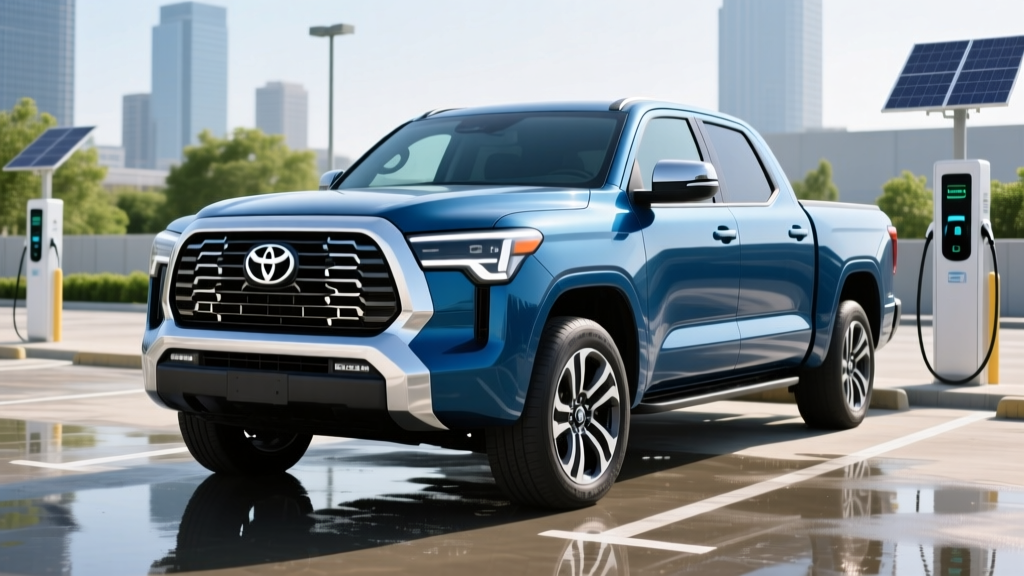
If you've landed here searching for the 2024 Tundra bolt pattern, you're likely shopping for aftermarket wheels, rotating tires, or evaluating whether the current Tundra platform will carry over into Toyota's anticipated electric pickup. The short answer on the bolt pattern: the 2024 Toyota Tundra uses a 6-lug, 139.7 mm (6×5.5-inch) bolt circle with a M14 × 1.5 thread pitch and a 110 mm center bore. That spec has remained consistent across the Tundra's third generation (2022–present), including all trims from SR through Capstone.
But for EV-minded truck buyers, the bolt pattern question opens a bigger conversation. Toyota has yet to release a fully electric Tundra, and as of 2026, the Tundra lineup remains exclusively powered by the i-FORCE and i-FORCE MAX hybrid powertrains. If you're cross-shopping electric pickups and wondering how the Tundra's chassis specs, towing capacity, and ownership profile compare to the EV truck segment, this guide breaks it all down with hard numbers.
2024 Tundra Bolt Pattern: The Exact Specs
| Specification | Value |
|---|---|
| Bolt Pattern | 6 × 139.7 mm (6 × 5.5 in) |
| Thread Pitch | M14 × 1.5 |
| Center Bore | 110 mm |
| Stock Wheel Sizes | 18" / 20" / 22" depending on trim |
| OEM Tire Sizes | 265/70R18, 275/60R20, 275/50R22 |
| Lug Nut Torque Spec | 97 lb-ft (131 Nm) |
The 6×139.7 mm pattern is shared with several other Toyota and Lexus trucks and SUVs — including the Toyota Sequoia, Land Cruiser (300 Series), and older Tacoma models — which opens up a wide aftermarket wheel selection. If you're fitting aftermarket wheels, ensure the center bore matches 110 mm or use hub-centric rings to avoid vibration. For EV truck buyers eyeing the F-150 Lightning, Rivian R1T, or Chevrolet Silverado EV, note that none of these share the Tundra's bolt pattern, so wheel cross-compatibility between the Tundra and current EV pickups is essentially nonexistent.
Where Toyota Stands on Electric Trucks in 2026
Toyota has confirmed development of a next-generation electric pickup for the North American market, but as of early 2026, the company has not released final specifications, pricing, or a firm on-sale date for an electric Tundra successor. Toyota's EV roadmap includes a mid-size and full-size electric truck built on a dedicated EV platform, likely at the company's Georgetown, Kentucky plant. What we know so far is preliminary:
- Platform: Dedicated BEV skateboard architecture (not a converted Tundra chassis)
- Target range: Toyota has hinted at 300+ miles EPA, though no official figure is published
- Towing target: Expected to rival the F-150 Lightning's 10,000-lb max capacity
- Bolt pattern: Unconfirmed — Toyota may retain the 6×139.7 mm pattern for parts commonality or shift to a new spec
Until Toyota officially unveils the production model, all specs remain estimated. If you need an electric truck today, the current market offers several proven alternatives worth cross-shopping.
How the 2024 Tundra Hybrid Compares to Today's EV Trucks
The closest thing Toyota currently offers to an electrified truck is the 2024 Tundra i-FORCE MAX hybrid. It's a traditional parallel hybrid — not a plug-in — so it has no electric-only range and no eligibility for the federal §30D EV tax credit. Here's how the top Tundra hybrid trim stacks up against the leading EV pickups on the metrics that matter:
| Spec | 2024 Tundra i-FORCE MAX | 2024 F-150 Lightning (Ext. Range) | 2024 Rivian R1T (Dual-Motor Max) | 2024 Silverado EV 4WT |
|---|---|---|---|---|
| Powertrain | 3.5L V6 Twin-Turbo Hybrid | Dual-Motor BEV | Dual-Motor BEV | Dual-Motor BEV |
| Horsepower | 437 hp | 580 hp | 665 hp | 664 hp |
| Torque | 583 lb-ft | 775 lb-ft | 829 lb-ft | 780 lb-ft |
| 0–60 mph | ~5.7 sec | ~3.8 sec | ~3.5 sec | ~4.5 sec |
| EPA Range / Fuel Economy | 20 mpg combined | 320 mi / 70 MPGe | 410 mi / 73 MPGe | 390 mi / 61 MPGe |
| Max Towing | 12,000 lb | 10,000 lb | 11,000 lb | 20,000 lb (fleet) |
| Bolt Pattern | 6×139.7 mm | 6×135 mm | 6×139.7 mm* | 6×139.7 mm* |
| Base MSRP | ~$57,000 (Limited) | ~$69,995 | ~$79,900 | ~$72,200 |
| Federal EV Tax Credit | Not eligible | Up to $7,500 (§30D) | Not eligible (MSRP cap) | Up to $7,500 (§30D commercial) |
*Rivian R1T and Silverado EV use 6-lug patterns but center bore and thread pitch may differ from the Tundra — always confirm with the wheel manufacturer before purchasing.
The Tundra hybrid's advantage is familiarity: no charging infrastructure required, proven towing, and a lower entry price. But on performance, fuel cost per mile, and acceleration, the EV trucks dominate. According to fueleconomy.gov, the F-150 Lightning Extended Range achieves 70 MPGe combined, translating to roughly $0.04–$0.06 per mile on home electricity versus the Tundra hybrid's ~$0.18–$0.22 per mile at $3.50/gallon.
EV Truck Charging: What Tundra Buyers Switching to Electric Should Expect
If you're considering leaving the Tundra for an EV pickup, charging logistics are the single biggest ownership shift. Here's what current EV truck owners experience with home and public charging:
| Charging Level | Power (kW) | Miles Added per Hour | Typical Use Case |
|---|---|---|---|
| Level 1 (120V household) | ~1.4 kW | 3–5 mi/hr | Overnight trickle; not practical for large EV truck batteries |
| Level 2 (240V home) | 7.7–19.2 kW | 20–50 mi/hr | Daily home charging; full overnight replenishment |
| DC Fast Charge (public) | 150–350 kW peak | N/A (10–80% in 20–45 min) | Road trips; charging curve tapers significantly above 80% |
The F-150 Lightning Extended Range (131 kWh usable battery, NMC chemistry) peaks at roughly 150 kW on DC fast charging, achieving a 10–80% charge in approximately 41 minutes. The Rivian R1T Max Pack (149 kWh, NMC) can accept up to 200+ kW on compatible chargers, hitting 10–80% in roughly 30–35 minutes. The Silverado EV, with its Ultium-based 200+ kWh pack, supports up to 350 kW peak on 800V-capable chargers, though real-world sustained rates are lower — expect 10–80% in about 25–30 minutes at a 350 kW station.
For home Level 2 charging, most EV truck owners install a 48-amp (11.5 kW) hardwired charger on a 60-amp circuit. Expect to pay $800–$2,000 for a quality Level 2 station (ChargePoint Home Flex, Emporia Level 2, or Ford Charge Station Pro) plus $500–$2,500 for electrician labor and permitting, depending on your panel capacity and run length. If your home has a 100-amp panel, a $1,500–$3,000 panel upgrade to 200 amps may be necessary to support EV charging alongside existing loads.
Federal EV Tax Credit: §30D Eligibility for Truck Buyers
The IRS §30D Clean Vehicle Credit can reduce your federal tax liability by up to $7,500 for a qualifying new EV truck, but eligibility hinges on several rules that change periodically. As of 2026, the key requirements include:
- MSRP Cap: Vans, SUVs, and pickup trucks must have an MSRP at or below $80,000 to qualify. This eliminates the Rivian R1T in most configurations and higher-trim Silverado EVs.
- Buyer Income Limits: Modified adjusted gross income must not exceed $150,000 (single), $225,000 (head of household), or $300,000 (joint filers).
- Battery Sourcing: The credit splits into two halves ($3,750 each) — one tied to critical minerals sourcing and the other to battery component manufacturing, both with escalating domestic-content thresholds each year. Vehicles with battery components from a "foreign entity of concern" (FEOC) may lose partial or full credit.
- Point-of-Sale Transfer: As of 2024, buyers can transfer the credit to the dealer at purchase, reducing the sale price directly rather than waiting to claim it on their tax return.
The F-150 Lightning (under the $80,000 MSRP cap in Lariat and select trims) has been a frequent qualifier, though battery sourcing compliance shifts model year to model year. Always verify current eligibility on IRS.gov's qualified vehicles list before purchasing, and consult a tax professional for your specific situation.
Should You Wait for an Electric Tundra or Buy an EV Truck Now?
- Buy an F-150 Lightning now if: You need a full-size electric truck today, want access to the BlueCruise hands-free highway system (SAE Level 2 — driver supervision required), and value Ford's extensive dealer network for service.
- Buy a Rivian R1T if: You prioritize off-road capability, want the most range (up to 410 mi EPA with Max Pack), and don't mind the higher MSRP and tighter service-center footprint.
- Buy a Silverado EV if: You need maximum towing (up to 20,000 lb in fleet trims), want GM's Ultium platform with 800V fast-charge capability, and can work with the limited retail availability.
- Wait for Toyota's electric truck if: You're loyal to the Tundra platform, want Toyota's reliability track record applied to an EV, and don't need to buy in the next 12–18 months. Understand that early-production models may carry first-year risk and limited initial inventory.
- Stick with the Tundra i-FORCE MAX hybrid if: You tow frequently in areas with sparse charging infrastructure, want zero range anxiety on remote job sites, and prefer the lowest upfront cost.
Pros and Cons: Tundra Hybrid vs. EV Trucks
2024 Tundra i-FORCE MAX — Pros
- 12,000-lb towing with no range anxiety
- Lower starting MSRP (~$57K vs. $70K+ for EV trucks)
- Proven hybrid reliability; no charging infrastructure needed
- Strong dealer and service network nationwide
- 6×139.7 mm bolt pattern with massive aftermarket wheel selection
2024 Tundra i-FORCE MAX — Cons
- Only 20 mpg combined — highest fuel cost per mile in this comparison
- No EV tax credit eligibility (not a plug-in vehicle)
- Slower 0–60 time (5.7 sec vs. sub-4 sec for EV trucks)
- No frunk, no V2L/V2H capability
- No electric-only driving mode for short trips or idle worksite power
EV Trucks (Lightning / R1T / Silverado EV) — Pros
- Dramatically lower per-mile energy cost (~$0.05/mi vs. ~$0.20/mi)
- Instant torque: 580–829 lb-ft with sub-4-second 0–60 capability
- V2L (vehicle-to-load) powers tools, tailgates, and job sites
- Frunk storage adds 10–14 cu ft of sealed, lockable cargo space
- Potential $7,500 federal tax credit reduces effective price
EV Trucks — Cons
- Higher base MSRP ($70K–$80K+) and insurance premiums
- Towing reduces range by 40–50% — a 320-mi truck may deliver ~170 mi while towing
- Home charging installation adds $1,500–$4,500 upfront
- Public charging reliability remains inconsistent in rural areas
- Cold-weather range loss of 20–30% on highway trips
Frequently Asked Questions
What is the 2024 Tundra bolt pattern?
The 2024 Toyota Tundra uses a 6-lug bolt pattern with a 139.7 mm (5.5-inch) bolt circle diameter. This is expressed as 6×139.7 mm or 6×5.5 inches. The thread pitch is M14 × 1.5, and the center bore is 110 mm.
Will the electric Toyota Tundra use the same bolt pattern?
Toyota has not confirmed the bolt pattern for its upcoming electric truck. The company may retain the 6×139.7 mm pattern for parts commonality or adopt a new specification on its dedicated EV platform. Until official specs are released, this remains unconfirmed.
Do any EV trucks share the Tundra's 6×139.7 mm bolt pattern?
The Rivian R1T and Chevrolet Silverado EV both use 6-lug patterns with 139.7 mm spacing, but center bore and thread pitch may differ. Always verify full wheel specifications — not just bolt pattern — before purchasing aftermarket wheels for cross-platform fitment.
How much does it cost to charge an EV truck at home versus fueling a Tundra hybrid?
At the U.S. average residential electricity rate of ~$0.16/kWh (per EIA data), fully charging a 131 kWh F-150 Lightning costs roughly $21, yielding about $0.05–$0.06 per mile. Fueling a 20 mpg Tundra hybrid at $3.50/gallon costs $0.175 per mile. Over 15,000 annual miles, that's roughly $825/year for the EV truck vs. $2,625/year for the Tundra hybrid — a savings of ~$1,800 annually with the EV.
Does the 2024 Tundra hybrid qualify for any federal tax credits?
No. The Tundra i-FORCE MAX is a conventional hybrid (HEV), not a plug-in electric vehicle. It does not qualify for the IRS §30D Clean Vehicle Credit, which applies only to battery-electric vehicles (BEVs) and plug-in hybrids (PHEVs) meeting battery capacity, sourcing, MSRP, and buyer income requirements.
Is the F-150 Lightning a better buy than the Tundra hybrid for towing?
It depends on your towing profile. The Tundra hybrid tows up to 12,000 lb with no range penalty beyond increased fuel consumption. The F-150 Lightning tows up to 10,000 lb but loses 40–50% of its range while towing — a 320-mile EPA truck may deliver only 160–190 miles under load. For long-distance towing in areas with sparse DC fast-charging infrastructure, the Tundra hybrid remains more practical today. For local towing with home charging, the Lightning's lower operating cost and instant torque are compelling.