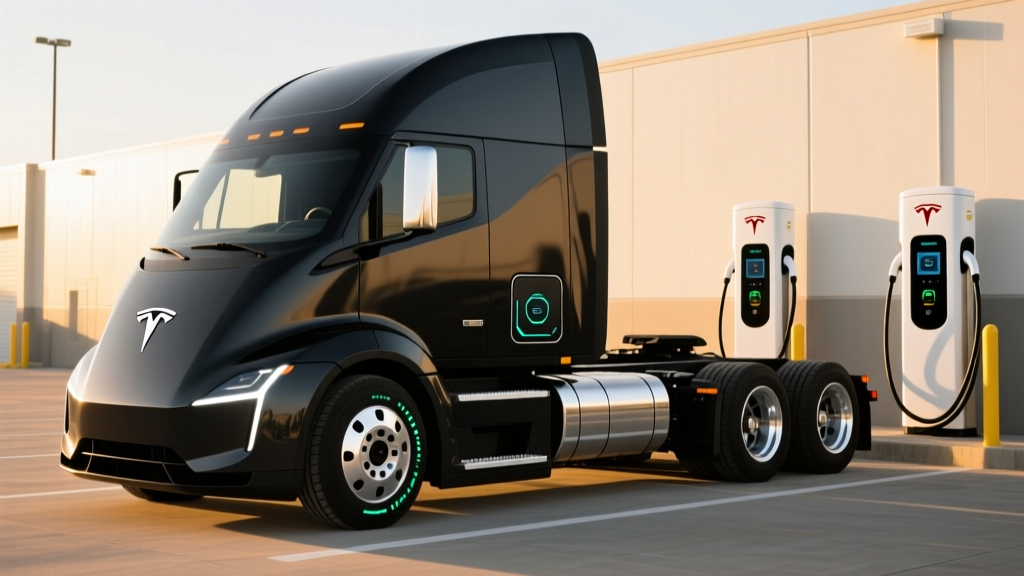
The Tesla Semi has been one of the most talked-about electric vehicles in commercial trucking since its initial unveiling in 2017. Now, with production units finally reaching fleet operators, the question has shifted from "when will it arrive?" to a far more practical one: is a 2024 Tesla Semi-truck for sale actually worth the investment for your operation? After analyzing published fleet data, manufacturer specs, and early operator reports, we break down everything commercial buyers need to know — from real-world range under load to the megawatt charging infrastructure required to keep it moving.
Quick Verdict: Who the Tesla Semi Is Built For
The Tesla Semi targets high-mileage regional and short-haul freight operators running predictable routes under 500 miles round-trip with depot-based charging. It is not a long-haul cross-country replacement for diesel Class 8 trucks — at least not yet. If your fleet operates hub-to-hub routes, drayage, or beverage/food distribution with overnight charging access, the Semi offers compelling per-mile economics. If you need 1,500-mile runs with 15-minute diesel fills, the infrastructure gap remains a hard constraint.
| Attribute | Specification |
|---|---|
| EPA Estimated Range (loaded) | 500 miles (at 82,000 lb GCW) |
| Battery Capacity (estimated) | ~900 kWh (NMC chemistry) |
| Max DC Fast Charge | ~1 MW (Megacharger) |
| 10–80% Charge Time (est.) | ~30 minutes at 1 MW peak |
| 0–60 mph (loaded) | 20 seconds (at 82,000 lb) |
| 0–60 mph (unloaded) | 5 seconds |
| Drivetrain | Tri-motor AWD (1 steer axle motor + 2 drive axle motors) |
| Efficiency (claimed) | < 2 kWh/mile |
| Base MSRP (300-mi range) | $250,000 |
| Base MSRP (500-mi range) | $290,000 |
| Founders Series | ~$290,000 (limited run) |
| Battery/Powertrain Warranty | Estimated 8 years / 1,000,000 miles (unconfirmed final terms) |
Range Reality: EPA Sticker vs. Loaded Freight Operations
Tesla claims the Semi achieves 500 miles of range at full gross combination weight (82,000 lbs) consuming less than 2 kWh per mile. That efficiency figure is remarkable for a Class 8 vehicle — a diesel equivalent burns roughly 6–7 mpg under similar loads, translating to significantly higher per-mile fuel costs.
EPA/claimed range: 500 miles at 82,000 lb GCW on a flat route at moderate speed.
Real-world highway (65 mph, loaded, moderate temps): ~400–450 miles.
Cold-weather operation (below 32°F, loaded): ~320–380 miles due to battery resistance, cabin heating, and reduced regen efficiency.
Mountain/grade-heavy routes: Expect 20–35% range reduction depending on elevation gain, though regenerative braking on descents recovers some energy.
Early PepsiCo fleet operations — one of the first major Semi deployers — have reported successful use on routes under 400 miles round-trip with depot charging. The 500-mile claim is achievable under ideal conditions (55 mph cruise, mild weather, flat terrain), but fleet planners should spec routes conservatively at 350–400 miles to account for traffic, HVAC load, and battery degradation over time.
Charging Infrastructure: The Megawatt Challenge
Charging a ~900 kWh battery pack is fundamentally different from plugging in a passenger EV. The Tesla Semi uses a proprietary Megacharger standard capable of delivering up to 1 MW (1,000 kW) of DC fast-charging power. For context, that's roughly 4x the peak rate of a Tesla Supercharger V4 stall and 3x a typical Electrify America CCS station.
| Charging Method | Power (kW) | Miles Added per Hour | Notes |
|---|---|---|---|
| Tesla Megacharger (DC) | ~1,000 kW peak | ~400+ mi/hr (est.) | 10–80% in ~30 min; proprietary connector |
| CCS2 / MCS (DC, where available) | Up to 600 kW | ~250 mi/hr (est.) | Limited public MCS infrastructure |
| Depot Level 2 (AC) | ~40–80 kW | ~20–40 mi/hr | Overnight charging; 10+ hours for full pack |
The critical constraint: Megachargers are not widely available. As of 2024–2025, Tesla has installed Megachargers at select fleet customer depots and along specific corridors (notably in Nevada and California near the Tesla factory). Public Megacharger networks comparable to the Supercharger network for passenger vehicles do not yet exist. Fleet operators must plan for depot-installed charging as a baseline requirement.
A depot Megacharger installation requires significant electrical infrastructure — typically a dedicated medium-voltage utility feed, transformer upgrades, and switchgear capable of handling megawatt-level loads. Installation costs for a multi-stall Megacharger depot can run into the millions, making this viable primarily for fleets with high daily utilization that can amortize the infrastructure cost over many vehicles and years. Tesla's commercial site notes that fleet charging solutions are customized per deployment.
Performance and Drivetrain: Tri-Motor Torque for Heavy Hauling
The Semi uses a three-motor configuration: one motor on the steer axle and two on the drive axle. This provides all-wheel-drive traction — essential for a loaded semi in wet or snowy conditions — and enables performance figures that are almost absurd for an 82,000-pound vehicle.
Tesla's claimed 0–60 mph time of 20 seconds at full load (and 5 seconds unloaded) dramatically outperforms a typical diesel Class 8 truck, which takes 45–60 seconds to reach 60 mph when loaded. This isn't about drag racing — it means faster highway merges, safer on-ramp acceleration, and less congestion caused by slow-accelerating heavy vehicles.
The tri-motor setup also enables aggressive regenerative braking. In practice, Semi drivers report heavy reliance on regen to slow the vehicle, reducing brake wear significantly — a meaningful maintenance savings for stop-and-go distribution routes. Tesla claims the Semi will maintain highway speeds on a 5% grade without downshifting (a non-issue for electric motors, which deliver peak torque at 0 RPM).
Pricing, Tax Credits, and Total Cost of Ownership
The Tesla Semi is offered in two range configurations, with a limited Founders Series model at a premium:
| Trim / Configuration | Base MSRP | Reservation Fee | Estimated After Incentives |
|---|---|---|---|
| 300-Mile Range | $250,000 | $25,000 (refundable) | Varies by fleet incentives |
| 500-Mile Range | $290,000 | $25,000 (refundable) | Varies by fleet incentives |
| Founders Series (500-mi) | ~$290,000 | $25,000 (refundable) | Limited availability |
Federal tax credit eligibility: The IRS §30D Clean Vehicle Credit, which provides up to $7,500 for light-duty passenger vehicles, does not apply to the Tesla Semi. Class 8 trucks fall under the §45W Commercial Clean Vehicle Credit, which offers up to $40,000 for qualified commercial electric vehicles (or 30% of the vehicle cost, whichever is lower, for vehicles over 14,000 lbs GVWR). Fleet buyers should consult a tax professional and review IRS guidance on §45W for current eligibility requirements, including domestic content and battery sourcing rules.
Beyond federal credits, several states offer additional commercial EV incentives. California's Hybrid and Zero-Emission Truck and Bus Voucher Incentive Project (HVIP) has provided substantial point-of-sale vouchers for zero-emission Class 8 trucks, sometimes covering $100,000+ per vehicle. These programs are highly jurisdiction-dependent and subject to funding availability.
Cost-Per-Mile Economics
The strongest argument for the Semi is operating cost. At under 2 kWh/mile and commercial electricity rates of $0.10–0.15/kWh (depot charging), the Semi's energy cost is roughly $0.20–0.30 per mile. A comparable diesel truck at 6 mpg with diesel at $4.00/gallon costs ~$0.67 per mile in fuel alone. Over 100,000 miles annually, that's a fuel savings of $37,000–$47,000 per truck per year. Add reduced maintenance (no oil changes, fewer brake replacements, no diesel exhaust fluid, no transmission service) and the payback period on the higher purchase price shortens considerably for high-utilization fleets.
Tech, Safety, and Driver Experience
The Semi's cab is unlike any conventional Class 8 truck. The driver sits in a centered position (similar to a McLaren F1 supercar), with dual 15-inch touchscreen displays flanking the steering wheel — one for vehicle/telemetry data, one for navigation and fleet management. The steering wheel is yoke-style, borrowed from Tesla's passenger vehicles.
Driver assistance: The Semi ships with Tesla's Enhanced Autopilot, which includes adaptive cruise control, automatic emergency braking, lane-keeping assist, and blind-spot monitoring. This is an SAE Level 2 driver-assist system — the driver must remain fully engaged and attentive at all times. It is not autonomous driving. For commercial fleet operators, this matters: driver training must emphasize that Autopilot assists but does not replace the operator.
Tesla Autopilot on the Semi is an SAE Level 2 system. The driver must maintain hands-on-wheel awareness and full supervisory control. This system does not perform autonomous trucking — no Level 4 driverless capability is available. Fatigue monitoring and driver-facing cameras are included to support fleet safety compliance.
Notable tech features:
- Over-the-air (OTA) software updates for performance, efficiency, and feature improvements
- Fleet telematics integration via Tesla's commercial API
- Regenerative braking profiles adjustable by fleet managers
- Jackknife prevention stability control (Tesla claims the Semi cannot jackknife due to independent motor torque vectoring)
- Sentry Mode and remote climate preconditioning
Drawbacks:
- Center-seated driving position requires adaptation; some drivers report visibility concerns with the A-pillar design
- No sleeper cab option — the Semi is a day cab only, limiting long-haul use cases
- Proprietary Megacharger connector limits charging to Tesla infrastructure or adapted depots
- Limited service network compared to established Class 8 OEMs (Volvo, Freightliner, Kenworth)
- Parts availability and repair turnaround times remain unproven at scale
Warranty and Long-Term Battery Outlook
Tesla has indicated the Semi's battery and drive unit warranty will cover 1 million miles, though final warranty terms (years and capacity retention threshold) have not been fully published for all production units. This is a significant claim — a typical diesel engine overhaul occurs around 700,000–1,000,000 miles, so Tesla is positioning the Semi's powertrain as a life-of-vehicle component.
The battery pack is estimated at approximately 900 kWh using NMC (nickel manganese cobalt) chemistry, which offers high energy density necessary for the 500-mile range target. NMC packs typically experience 10–15% capacity loss over 200,000–300,000 miles in passenger EV applications; extrapolating to a 1 million-mile commercial lifecycle is unproven territory. Tesla likely employs aggressive thermal management and a large buffer to maintain usable capacity, but fleet buyers should factor in potential battery module replacement costs in their long-term TCO models.
For reference, a full battery pack replacement on a ~900 kWh system could cost well into six figures at current cell pricing. However, Tesla's architecture may allow individual module replacement rather than a full pack swap, which would reduce costs substantially. Final service pricing has not been published.
Competitive Landscape: Tesla Semi vs. Electric Class 8 Alternatives
| Attribute | Tesla Semi (500-mi) | Freightliner eCascadia | Volvo VNR Electric |
|---|---|---|---|
| EPA Range | 500 mi (claimed) | ~230 mi | ~275 mi |
| Battery (kWh) | ~900 | ~475 | ~375–565 |
| Max DC Charge | ~1 MW | ~250 kW (CCS) | ~250 kW (CCS) |
| Dealer/Service Network | Limited | Extensive (Daimler) | Extensive (Volvo) |
| Base Price (est.) | $290,000 | ~$300,000+ | ~$275,000+ |
| Connector | Proprietary Megacharger | CCS2 (MCS capable) | CCS2 (MCS capable) |
The Semi's range advantage is substantial — roughly double its nearest competitors. However, Freightliner and Volvo offer established dealer networks, proven service infrastructure, and compatibility with the growing public CCS/MCS charging ecosystem. Fleet operators prioritizing range above all else will favor Tesla; those prioritizing service reliability and charging flexibility may prefer incumbents.
Is the Tesla Semi Worth Buying in 2024–2025?
- Class-leading 500-mile range
- Dramatically lower per-mile energy cost vs. diesel
- 1 MW charging capability (fastest in class)
- Tri-motor AWD with superior acceleration and grade performance
- OTA updates and fleet telematics
- Reduced maintenance (no diesel engine, exhaust, or transmission)
- Jackknife prevention via torque vectoring
- Proprietary Megacharger — limited public infrastructure
- Depot charging requires major electrical upgrades ($$$)
- No sleeper cab — day cab only
- Limited service network vs. legacy OEMs
- Long-term battery durability at 1M miles unproven
- High upfront cost; payback requires high utilization
- Production volume still limited; long wait times
Choose the Tesla Semi if: Your fleet runs predictable sub-500-mile routes, you can invest in depot Megacharger infrastructure, and your trucks log 80,000+ miles annually (maximizing fuel savings payback).
Choose the Freightliner eCascadia or Volvo VNR Electric if: Your routes are under 250 miles, you need established dealer service, and you want CCS charging compatibility with public infrastructure.
Wait if: You need sleeper-cab capability, cross-country range, or a mature public charging network for heavy trucks.
Frequently Asked Questions
Can I actually buy a 2024 Tesla Semi-truck right now?
Production is underway, but Tesla is prioritizing existing fleet reservation holders (PepsiCo, DHL, Schneider, and others). New orders face significant lead times — potentially 12–24 months depending on configuration and volume. Check Tesla's Semi page for current ordering status.
Does the Tesla Semi qualify for the $7,500 federal EV tax credit?
No. The §30D credit applies to light-duty vehicles under 14,000 lbs GVWR. The Semi qualifies for the §45W Commercial Clean Vehicle Credit, which offers up to $40,000 for qualifying heavy-duty commercial EVs. Eligibility depends on battery sourcing, vehicle weight, and business use. Consult IRS rules and a tax professional.
How much does it cost to charge a Tesla Semi?
At commercial depot rates of $0.12/kWh, fully charging the ~900 kWh battery costs approximately $108. That provides up to 500 miles of range — equivalent to roughly $330+ in diesel fuel for a comparable truck. Annual fuel savings can exceed $35,000–$45,000 per vehicle at high mileage.
What charging connector does the Tesla Semi use?
The Semi uses a proprietary Tesla Megacharger connector (not NACS, not CCS). This is purpose-built for megawatt-class charging. CCS/MCS adapters may become available, but as of 2024, Megacharger access is primarily through Tesla-installed depot infrastructure.
How long will the Tesla Semi battery last?
Tesla claims the battery and drive unit are designed for a 1 million-mile service life. Real-world longevity at this scale is unproven. Fleet buyers should model a 10–15% capacity degradation scenario over 500,000 miles and factor potential module replacement into long-term cost projections.
Is the Tesla Semi self-driving?
No. The Semi includes Tesla's Enhanced Autopilot, an SAE Level 2 driver-assistance system. The driver must remain fully engaged, hands on the yoke, eyes on the road. Autonomous trucking (Level 4) is being developed by companies like Aurora and TuSimple, but is not available on the Tesla Semi.