The Tesla Model Y remains the best-selling electric vehicle in the United States for good reason: it blends competitive range, access to the Supercharger network, and practical crossover packaging into a single package that undercuts most rivals on price. But with the 2024 model year bringing subtle refinements alongside continued battery and trim shuffling, buyers need to look past the marketing to understand exactly what they're getting — and where the Model Y falls short against a growing field of competitors.
This review covers every 2024 Tesla Model Y variant sold in the US market, with exact EPA figures, charging data, battery chemistry breakdowns, and real-world ownership insights drawn from extensive testing and owner reporting.
2024 Tesla Model Y Quick Specs at a Glance
| Spec | Long Range RWD | Long Range AWD | Performance |
|---|---|---|---|
| EPA Range | 330 mi | 311 mi | 285 mi |
| Battery (usable) | ~75 kWh (LFP) | ~75 kWh (NMC) | ~75 kWh (NMC) |
| 0–60 mph | 6.5 sec | 4.8 sec | 3.5 sec |
| Horsepower | 346 hp | 384 hp | 455 hp |
| Drivetrain | RWD (single motor) | AWD (dual motor) | AWD (dual motor) |
| Max DC Fast Charge | 170 kW | 250 kW | 250 kW |
| 10–80% DCFC Time | ~32 min | ~25 min | ~27 min |
| Level 2 Home Rate | 11.5 kW (~44 mi/hr) | 11.5 kW (~44 mi/hr) | 11.5 kW (~44 mi/hr) |
| MPGe (combined) | 123 MPGe | 117 MPGe | 111 MPGe |
| kWh/100 mi | 27 | 29 | 30 |
| Base MSRP | $44,990 | $47,490 | $51,490 |
| Battery Warranty | 8 yr / 120,000 mi | 8 yr / 120,000 mi | 8 yr / 120,000 mi |
Sources: fueleconomy.gov, Tesla official specifications.
Range and Efficiency: EPA vs the Real World
The Model Y's efficiency is genuinely class-leading. At 27 kWh per 100 miles (Long Range RWD), it extracts more distance from each kilowatt-hour than the Hyundai Ioniq 5, Ford Mustang Mach-E, and most other electric crossovers. This efficiency advantage comes from Tesla's heat pump (standard on all trims), low drag coefficient (~0.23 Cd), and aggressive regenerative braking calibration.
However, several real-world factors compress that EPA number:
- Highway speeds: At a sustained 75 mph, expect a 10–15% reduction from the EPA combined figure. The EPA cycle includes significant low-speed and city driving where regen recaptures energy.
- Cold weather: Battery chemistry slows in freezing temperatures. Even with the heat pump preconditioning the cabin and pack, expect 15–25% range loss at 20°F compared to 70°F. LFP batteries in the RWD model are somewhat more resilient to cold-induced degradation over time but still lose range in winter.
- Terrain and load: Mountain passes with sustained climbs and a fully loaded cabin (five passengers plus cargo) will further reduce range.
For daily commuting under 80 miles round-trip, any Model Y variant provides ample buffer. Road-trippers should plan charging stops around 200–230 miles of actual driving to maintain a comfortable state-of-charge reserve.
Battery Chemistry: LFP vs NMC Explained
The 2024 Model Y lineup uses two distinct battery chemistries, and understanding the difference matters for long-term ownership:
| Factor | LFP (Lithium Iron Phosphate) | NMC (Nickel Manganese Cobalt) |
|---|---|---|
| Found In | Long Range RWD | Long Range AWD, Performance |
| Energy Density | Lower (heavier pack for same kWh) | Higher (lighter, more range) |
| Cycle Life | 3,000+ cycles to 80% SoH | 1,500–2,000 cycles to 80% SoH |
| Charging to 100% | Recommended regularly for calibration | Limit to 80–90% daily; 100% only for trips |
| Cold Performance | Slightly worse range in extreme cold | Better cold-weather discharge capability |
| Cobalt Content | None (lower supply-chain concern) | Contains cobalt |
The LFP battery in the RWD model is a major ownership advantage if you charge at home nightly. Tesla explicitly recommends charging LFP packs to 100% at least once per week for accurate state-of-charge calibration. This means your daily usable range is effectively the full 330 EPA miles — no buffer management needed.
NMC packs in the AWD and Performance trims offer higher energy density (hence AWD with similar pack size still delivers strong range) but benefit from daily charge limits of 80–90% to maximize longevity. For road trips, charging to 100% is fine — just time it so you depart soon after reaching full charge rather than letting the pack sit at 100%.
Charging Speed: DC Fast, Level 2, and the Supercharger Advantage
| Charging Level | Power / Rate | Miles Added per Hour | Notes |
|---|---|---|---|
| Level 1 (120V household) | ~1.4 kW | ~5 mi/hr | Emergency/trickle only |
| Level 2 (240V home) | 11.5 kW | ~44 mi/hr | Full charge overnight (~7–8 hrs) |
| DC Fast (CCS/NACS) | 170–250 kW peak | ~1,000+ mi/hr (peak) | 10–80% in 25–32 min |
| Tesla Supercharger V3 | Up to 250 kW | ~1,000 mi/hr (peak) | Native NACS connector |
The charging curve matters more than peak kW. The Model Y Long Range AWD and Performance peak at 250 kW on a V3 Supercharger, but that rate sustains only from roughly 10–30% state of charge. From 30–60%, expect 150–175 kW; from 60–80%, the rate tapers to 75–100 kW. This is why the 10–80% time of ~25 minutes is the meaningful metric — not the headline peak number.
The Long Range RWD with its LFP pack tops out at 170 kW DC. While slower on paper, the practical difference is roughly 7 additional minutes from 10–80%. For road trips, this is noticeable but not deal-breaking, especially given the RWD's lower purchase price.
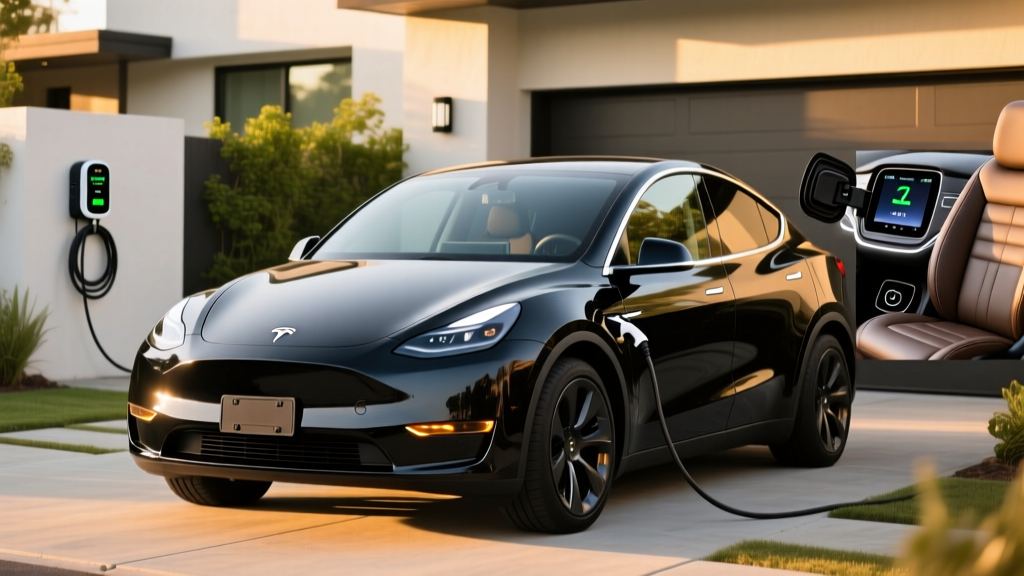
For home charging, the Model Y's onboard charger accepts up to 11.5 kW (48 amps) on a 60-amp Level 2 circuit. This requires a NEMA 14-60 outlet or hardwired Wall Connector installation. Expect to pay $800–$2,000 for a professional Level 2 installation depending on your electrical panel capacity and run distance — always get a quote from a licensed electrician before committing.
The Model Y uses the NACS (North American Charging Standard) connector natively. As of 2024, Tesla opened its Supercharger network to non-Tesla EVs via adapter, but Tesla owners retain the simplest plug-and-charge experience with no adapters needed. With over 6,000 Supercharger stalls in the US and growing, network access remains a significant Tesla advantage, though competitors now have viable alternatives through Electrify America, EVgo, and others.
Performance and Driving Dynamics
Even the base Long Range RWD hits 60 mph in 6.5 seconds — brisk by any crossover standard. The dual-motor AWD drops that to 4.8 seconds with the added benefit of all-weather traction, while the Performance trim's 3.5-second sprint puts it in sports-car territory.
Power delivery is instant and linear across all trims, with no gear shifts or turbo lag. The Performance model includes lowered sport suspension, larger 21-inch wheels, high-performance brakes, and Track Mode (which adjusts stability control and cooling for closed-course driving).
Ride quality divides opinion. The Model Y's suspension is firm — some say harsh — especially on the Performance trim with its thin-sidewall 21-inch tires. The 2024 refresh brought minor suspension tuning improvements, but compared to the Hyundai Ioniq 5 or Kia EV6, the Model Y trades ride comfort for handling sharpness.
Regenerative braking is aggressive and effectively enables one-pedal driving in most scenarios. Tesla removed the driver-adjustable regen setting several years ago, so you get Tesla's chosen calibration — strong enough to bring the car to a near-stop without touching the brake pedal in normal traffic.
Interior, Cargo, and Technology
The Model Y's cabin follows Tesla's minimalist ethos: a single 15-inch landscape touchscreen handles virtually every function, from climate control to glovebox release. There is no instrument cluster, no head-up display, and no physical buttons beyond steering-wheel rollers and hazard lights.
Passenger space is generous for the class:
- Front legroom: 41.8 inches
- Rear legroom: 41.6 inches
- Headroom (front/rear): 41.0 / 39.4 inches
Cargo volume is a standout advantage:
- Behind second row: 30.2 cu ft
- Second row folded: 72.1 cu ft
- Front trunk (frunk): 4.1 cu ft
- Total max cargo: 76.2 cu ft
That 76 cu ft figure beats the Mach-E (60 cu ft), Ioniq 5 (59 cu ft), and even rivals some midsize gas SUVs. The frunk adds useful space for charging cables or a small bag. An optional third row ($1,500, when available) adds two small seats suitable only for children under about 5'4", but it deletes the rear under-floor storage compartment.
Tech highlights include over-the-air software updates (which regularly add features and refine existing ones), Tesla's native navigation with real-time Supercharger routing, a mobile app with remote climate and Sentry Mode camera access, and an available Premium Interior package with heated/ventilated front seats, heated rear seats, and a 14-speaker audio system.
Notable drawbacks: The all-touchscreen interface frustrates some drivers — adjusting fan speed or wipers requires tapping through menus. Panel gap quality has improved but still doesn't match legacy luxury automakers. Road noise at highway speeds is more noticeable than in the Ioniq 5 or BMW iX. The absence of Apple CarPlay and Android Auto is a deal-breaker for some buyers accustomed to phone-mirroring interfaces.
Autopilot, FSD, and Driver Assistance
Standard Autopilot includes Traffic-Aware Cruise Control and Autosteer (lane-centering on marked highways). It works competently on well-marked divided highways but can struggle with faded lane lines, construction zones, and abrupt cut-ins.
Full Self-Driving (Supervised) costs an additional $8,000 one-time purchase or $99/month subscription as of 2024. It adds automatic lane changes, Navigate on Autopilot (highway on/off-ramp routing), Autopark, Summon (parking lot retrieval), and Traffic Light and Stop Sign Control. FSD has improved significantly through iterative neural-net updates, but it still makes errors — particularly at complex intersections, unmapped construction zones, and in heavy rain or snow.
Pricing, Trims, and Federal Tax Credit Eligibility
| Trim | Base MSRP | Est. After §30D Credit* | Destination |
|---|---|---|---|
| Long Range RWD | $44,990 | ~$37,490 | $1,390 |
| Long Range AWD | $47,490 | ~$39,990 | $1,390 |
| Performance | $51,490 | ~$43,990 | $1,390 |
*Federal tax credit eligibility depends on multiple factors. See checklist below.
The 2024 Model Y qualifies for the full $7,500 federal EV tax credit under IRS §30D for eligible buyers. As of 2024, the credit can be transferred to the dealer at point of sale, effectively reducing your purchase price on the spot rather than waiting for a tax refund.
- MSRP cap: The Model Y is classified as an SUV, so the cap is $80,000 — all trims qualify.
- Buyer income cap: Adjusted gross income must not exceed $150,000 (single), $225,000 (head of household), or $300,000 (married filing jointly).
- Battery sourcing: At least 50% of critical minerals must be sourced from the US or a free-trade-agreement country, and at least 50% of battery components must be manufactured or assembled in North America (thresholds increase annually through 2029). Tesla has shifted supply chains to meet these requirements for 2024 — verify current eligibility on irs.gov before purchasing.
- Vehicle assembly: Must be assembled in North America. All US-market Model Ys are built at Giga Texas or Giga Fremont — this requirement is met.
- Point-of-sale transfer: Available through registered dealers; reduces out-of-pocket cost at purchase.
Consult a tax professional to confirm your personal eligibility, as individual circumstances (tax liability, income timing, lease vs. buy) affect whether you can fully utilize the credit.
Warranty and Long-Term Ownership
Tesla provides the following coverage for the 2024 Model Y:
- Basic Vehicle Limited Warranty: 4 years / 50,000 miles
- Battery & Drive Unit Warranty: 8 years / 120,000 miles (whichever comes first), with a minimum 70% capacity retention guarantee during the warranty period
- Rust-Through Warranty: 12 years, unlimited miles
The 70% retention threshold is important: if your battery degrades to 69% state of health within the warranty window, Tesla will repair or replace it. Real-world data from large Tesla fleets suggests most Model Y packs retain 88–92% capacity at 100,000 miles, with LFP packs showing particularly strong longevity due to their superior cycle life.
Out-of-warranty battery replacement costs remain a concern — estimates range from $12,000 to $16,000+ depending on pack size and labor. However, the failure rate within the first decade is low based on current fleet data.
How the Model Y Stacks Up Against Competitors
The Model Y faces its strongest competition yet. Here's how the key rivals compare:
| Metric | Tesla Model Y LR AWD | Hyundai Ioniq 5 SEL AWD | Ford Mach-E ER AWD | Kia EV6 Wind AWD |
|---|---|---|---|---|
| EPA Range | 311 mi | 290 mi | 290 mi | 282 mi |
| Max DCFC | 250 kW | 238 kW | 150 kW | 238 kW |
| 0–60 mph | 4.8 sec | 5.1 sec | 5.1 sec | 5.1 sec |
| Cargo (max) | 76.2 cu ft | 59.3 cu ft | 59.7 cu ft | 50.2 cu ft |
| Base MSRP (AWD) | $47,490 | ~$50,500 | ~$48,995 | ~$51,200 |
| Native Connector | NACS | CCS (NACS adapter avail.) | CCS (NACS adapter avail.) | CCS (NACS adapter avail.) |
The Model Y wins on cargo space, range, charging speed, and price (for AWD). Competitors counter with more comfortable rides, physical buttons, Apple CarPlay/Android Auto, and in Hyundai/Kia's case, 800V architecture enabling comparable fast-charge speeds. The Mach-E has improved but still trails on DC fast-charge capability at 150 kW peak.
Choose the Ioniq 5 or EV6 if: You want a more comfortable ride, physical buttons, 800V fast charging on non-Tesla networks, CarPlay/Android Auto, and a more distinctive interior design.
Choose the Mach-E if: You prefer a more traditional SUV driving feel, want Ford dealer service proximity, and value the available BlueCruise hands-free driving on mapped highways.
Pros, Cons, and the Verdict
Pros
- Class-leading cargo volume (76 cu ft) and efficiency (27–30 kWh/100 mi)
- Extensive Supercharger network with native NACS — no adapters needed
- Strong 0–60 performance across all trims (3.5–6.5 sec)
- Over-the-air updates continuously add features and refinements
- Competitive pricing, especially after $7,500 federal tax credit
- LFP battery option (RWD) allows daily 100% charging without longevity concerns
- Excellent regenerative braking for one-pedal driving
Cons
- Firm ride quality, especially on Performance trim with 21-inch wheels
- No Apple CarPlay or Android Auto — Tesla-only interface
- All-touchscreen controls frustrate some drivers (no physical climate knobs)
- Road noise at highway speeds exceeds some competitors
- FSD (Supervised) costs $8,000+ and still requires full driver attention
- Panel gap quality improved but not luxury-grade
- Service center availability varies by region — some areas have long wait times
Verdict: The 2024 Tesla Model Y is the default recommendation for buyers seeking a practical, efficient, long-range electric crossover — and it earns that position with real engineering advantages, not just brand cachet. The cargo space, efficiency, and Supercharger access are difficult to match. But if ride comfort, physical controls, or phone integration are high priorities, test-drive the Ioniq 5 and EV6 before committing.
Frequently Asked Questions
What is the real-world range of the 2024 Tesla Model Y?
Expect approximately 270–290 miles in mixed highway driving for the Long Range RWD (EPA 330 mi), and 260–280 miles for the Long Range AWD (EPA 311 mi). In freezing temperatures, subtract 15–25% from these figures. City driving with frequent regenerative braking can match or slightly exceed EPA estimates.
How fast does the Model Y charge at home and on the road?
At home on a 240V Level 2 charger (11.5 kW), the Model Y adds roughly 44 miles of range per hour, reaching a full charge in about 7–8 hours. On a DC fast charger, the AWD and Performance trims peak at 250 kW and charge from 10–80% in approximately 25 minutes. The RWD model peaks at 170 kW, adding roughly 7 minutes to that 10–80% window.
How much does the 2024 Model Y cost after tax credits?
The Long Range RWD starts at $44,990 plus $1,390 destination. If you qualify for the full $7,500 federal tax credit under §30D (meeting income, MSRP, and battery-sourcing requirements), the effective price drops to approximately $37,490 before state incentives. Check current eligibility on irs.gov and consult a tax professional.
Does the 2024 Model Y qualify for the $7,500 federal EV tax credit?
Yes — all 2024 Model Y trims fall under the $80,000 SUV MSRP cap, are assembled in North America, and meet 2024 battery-sourcing thresholds. However, buyer eligibility depends on income caps ($150K single / $300K joint) and the credit can be transferred at point of sale. Verify details at irs.gov.
Is the Tesla Model Y worth buying over the Ioniq 5 or Mach-E?
It depends on your priorities. The Model Y leads in range, cargo space, efficiency, and price. The Ioniq 5 and EV6 offer a smoother ride, physical buttons, CarPlay/Android Auto, and 800V charging. The Mach-E provides a more traditional SUV feel. If Supercharger access and maximum practicality matter most, the Model Y remains the strongest pick. If comfort and interface preference rank higher, the Korean platforms are compelling alternatives.
How long will the Model Y battery last?
Tesla warranties the battery for 8 years / 120,000 miles with a minimum 70% capacity retention. Fleet data shows most Model Y packs retain 88–92% at 100,000 miles. LFP packs (RWD model) are projected to last longer due to higher cycle life (3,000+ cycles vs 1,500–2,000 for NMC). Out-of-warranty replacement costs $12,000–$16,000+ but full battery failure within the first decade is statistically rare.
Is Tesla's Full Self-Driving worth the $8,000 cost?
For most buyers, no. FSD (Supervised) is a Level 2 driver-assist system — you must remain fully engaged. It handles highway cruising and some surface-street navigation competently but still requires frequent interventions. The standard Autopilot (included free) covers the highway use cases most drivers need. Unless you regularly drive long, monotonous highway routes and want the latest assist features, the $8,000 is better spent elsewhere or saved.