Quick Verdict: Still the Benchmark Electric SUV
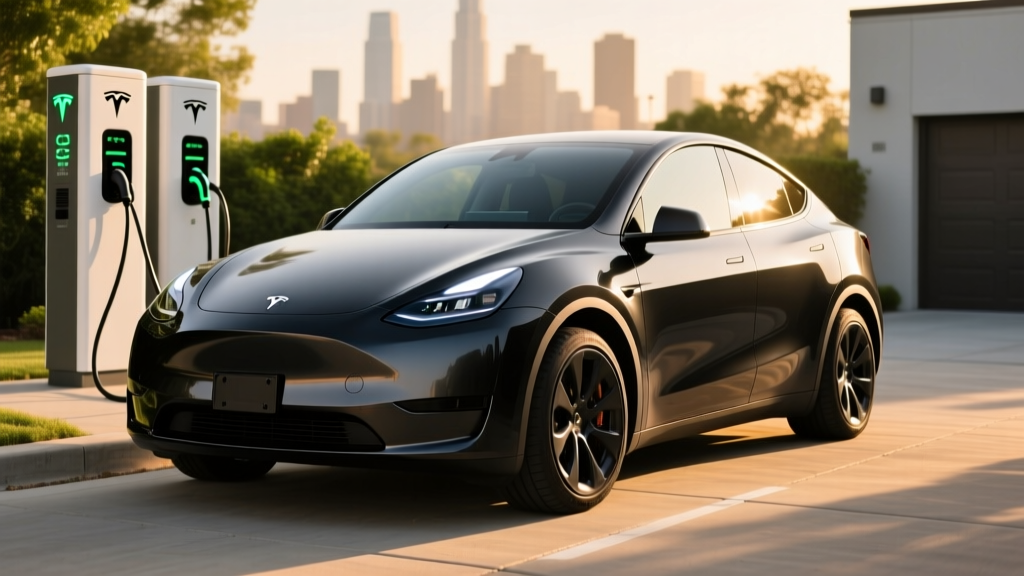
The 2024 Tesla Model Y Performance remains the dual-motor AWD crossover to beat in the $50K electric SUV segment. With 456 horsepower, a 3.5-second 0-60 time, and access to the most reliable DC fast-charging network in North America, it delivers sports-sedan acceleration in a practical five-seat package. However, the ride quality is firm, the minimalist interior won't appeal to everyone, and real-world highway range falls short of the EPA sticker. If you prioritize straight-line speed, charging infrastructure, and software polish over plush luxury, the Model Y Performance earns its spot at the top of the segment.
| Spec | 2024 Model Y Performance |
|---|---|
| EPA Range | 285 miles |
| Battery (usable) | ~75 kWh, NMC (2170 cells) |
| Drivetrain | Dual-motor AWD |
| Horsepower | 456 hp |
| 0-60 mph | 3.5 seconds |
| Top Speed | 155 mph |
| Max DC Fast Charge | 250 kW (peak) |
| 10-80% DC Charge Time | ~27 minutes |
| Level 2 Home Charge | 11.5 kW (~44 mi/hr) |
| MPGe (combined) | 111 MPGe |
| Efficiency | 30 kWh/100 mi |
| Cargo Volume | 30.2 cu ft (rear seats up) / 72.0 cu ft (folded) |
| Base MSRP | $52,490 (before incentives) |
| Battery Warranty | 8 years / 120,000 miles (70% retention) |
Range and Efficiency: EPA vs. Reality
The EPA rates the 2024 Model Y Performance at 285 miles of combined range. That's 37 miles fewer than the Long Range AWD trim (322 miles EPA), a trade-off for larger 21-inch Überturbine wheels, stickier summer tires, and the higher energy draw of the performance-tuned powertrain.
Real-World Range Expectations
- Mixed city/suburban (65°F): 260–280 miles achievable with moderate regen use.
- Highway cruising (70 mph, 75°F): Expect 230–250 miles. Aerodynamic drag at speed is the biggest range killer in any EV, and the Performance's wider tires add rolling resistance.
- Cold weather (30°F, highway): 190–220 miles. Lithium-ion batteries lose efficiency in the cold, and cabin heating (even with the Model Y's heat pump) draws significant energy. Preconditioning while plugged in recovers some of this loss.
On a 250-mile road trip in mild conditions, you'll arrive with roughly 10-15% state of charge remaining — comfortable, but you'll want to plan one Supercharger stop for trips beyond 200 miles in winter or at sustained highway speeds.
Efficiency is rated at 111 MPGe combined (30 kWh per 100 miles) according to fueleconomy.gov. That's slightly behind the Long Range AWD's 117 MPGe but still class-leading among dual-motor performance EVs in this price bracket. For comparison, the Ford Mustang Mach-E GT achieves 84 MPGe combined with its extended-range battery.
Charging Speed: Supercharger Access Is the Real Advantage
The Model Y Performance uses a ~75 kWh usable NMC (nickel-manganese-cobalt) battery pack built with Tesla's 2170 cylindrical cells. NMC chemistry provides higher energy density than LFP (lithium iron phosphate), which is why the Performance and Long Range trims use it, while the base RWD Model Y switched to LFP for 2024 to cut costs.
| Charging Level | Power / Rate | Speed | Typical Use |
|---|---|---|---|
| Level 1 (120V) | ~1.4 kW | ~4–5 mi/hr | Emergency / trickle |
| Level 2 (240V, 48A) | 11.5 kW | ~44 mi/hr | Home overnight (full charge in ~7 hrs) |
| DC Fast (V3 Supercharger) | 250 kW peak | 10–80% in ~27 min | Road trips |
| DC Fast (V4 Supercharger) | 250 kW (current Y cap) | 10–80% in ~27 min | Newer stations, same peak for this pack |
Understanding the charge curve: The 250 kW figure is a peak, not a sustained rate. The Model Y Performance hits peak draw around 15–25% state of charge, then progressively tapers as the battery fills. From 10–80%, the average rate is closer to 140–160 kW, which is why the full 10–80% session takes about 27 minutes rather than the ~18 minutes you'd calculate at a flat 250 kW. Charging past 80% slows dramatically to protect battery health — expect 80–100% to add another 25–30 minutes. On road trips, plan to charge to 80% and drive on.
One critical advantage: the Model Y natively uses the NACS (North American Charging Standard) connector, meaning seamless plug-and-charge access to over 20,000 Tesla Superchargers across North America. No adapter needed, no payment-app hassle — the car authenticates and bills your Tesla account automatically. For non-Tesla CCS chargers (Electrify America, EVgo), you'll need Tesla's CCS adapter (sold separately, ~$175) or use a station with a built-in NACS cable.
For home charging, a Tesla Wall Connector on a 60-amp circuit delivers the full 11.5 kW (48 amps), adding roughly 44 miles of range per hour. A typical overnight session (8 hours) replenishes about 350 miles — more than a full battery. Installation costs vary widely: expect $800–$2,000 if your electrical panel has capacity, or $2,500–$5,000+ if you need a 200-amp panel upgrade. Always get a quote from a licensed electrician before purchasing equipment.
Performance and Driving Dynamics
The dual-motor all-wheel-drive powertrain produces 456 horsepower and launches the Model Y Performance from 0–60 mph in 3.5 seconds. That's supercar territory from a five-seat crossover weighing over 4,400 pounds. Instant electric torque means there's no turbo lag or transmission shift — just seamless, relentless acceleration that never stops being startling the first few times you floor it.
The Performance trim adds several hardware upgrades over the Long Range:
- 21-inch Überturbine wheels with Pirelli P Zero summer performance tires (255/35R21 front, 275/35R21 rear)
- Performance brakes with larger front rotors for improved fade resistance
- Lowered suspension (roughly 0.5 inches lower than Long Range)
- Performance pedals (aluminum alloy)
- Carbon fiber spoiler
- Track Mode (adjustable torque split and stability control for closed-course driving)
The trade-off for this athleticism is ride quality. The lowered, stiffer suspension transmits more road imperfections into the cabin than competitors like the Hyundai Ioniq 5 or BMW iX. On smooth highways it's composed and planted; on broken pavement, the 21-inch wheels and low-profile tires can feel crashy. If your daily commute includes pothole-riddled city streets, the Long Range AWD on 19-inch wheels is noticeably more comfortable.
Regenerative braking is strong and adjustable. In "Hold" mode, the Model Y enables one-pedal driving — lift off the accelerator and the car decelerates briskly, often bringing you to a complete stop without touching the brake pedal. This reduces brake wear significantly; many Tesla owners report original brake pads lasting well past 80,000 miles.
Interior, Cargo, and Technology
The Model Y's interior is defined by minimalism. There's no instrument cluster — all information routes through the 15-inch center touchscreen. Build quality on 2024 models has improved noticeably over earlier years, with tighter panel gaps, acoustic glass on all windows, and a redesigned center console with ventilated front seats (standard on Performance).
Passenger space:
- Front headroom: 41.0 inches
- Front legroom: 41.8 inches
- Rear headroom: 39.4 inches
- Rear legroom: 36.5 inches
Rear-seat space is adequate for adults on shorter trips but tighter than the Ioniq 5 or Volkswagen ID.4 for tall passengers on long hauls. The panoramic glass roof creates an airy feel but offers no shade — in hot climates, aftermarket sun shades are a popular accessory.
Cargo capacity: 30.2 cubic feet behind the second row, expanding to 72.0 cubic feet with the 60/40 split rear seats folded. The rear load floor is flat and low, making it easy to slide in bulky items. There's also a small front trunk (frunk) for charging cables or a backpack. An optional third row adds two small seats (best for children under 5'4"), but it eliminates the rear under-floor storage and cuts cargo space significantly.
Infotainment and tech highlights:
- 15-inch touchscreen with navigation, streaming (Netflix, YouTube, Twitch while parked), and gaming
- Over-the-air software updates adding features post-purchase
- Tesla mobile app with remote climate control, location tracking, and Sentry Mode camera access
- Sentry Mode (360° camera recording when parked, triggered by proximity or impact)
- Dashcam (four-camera recording, USB storage)
- 14-speaker premium audio system with immersive sound
- Phone-as-key via Bluetooth (no fob needed)
Driver assistance — Autopilot and FSD: Every Model Y includes Tesla's Basic Autopilot (traffic-aware cruise control and autosteer within a single lane). Full Self-Driving (Supervised) is an optional $8,000 upgrade (or $99/month subscription as of late 2024) that adds automatic lane changes, traffic light/stop sign recognition, and autosteer on some city streets.
Important: SAE Level 2, Not Self-Driving
Despite the "Full Self-Driving" name, this system is classified as SAE Level 2 driver assistance. You must keep your hands on the wheel and eyes on the road at all times. The system can and does make errors — missed exits, phantom braking, misread construction zones. It reduces fatigue on long highway drives but does not replace an attentive driver. True Level 4 driverless operation (no human needed) is currently limited to geofenced robotaxi services like Waymo in select cities.
Pricing, Trims, and Federal Tax Credit
The 2024 Model Y Performance starts at $52,490 (including destination), before any incentives. That places it just under the IRS §30D MSRP cap of $80,000 for SUVs, making it potentially eligible for the full $7,500 federal tax credit — but eligibility is not automatic and depends on multiple buyer and vehicle criteria.
| Item | Cost |
|---|---|
| Model Y Performance Base MSRP | $52,490 |
| Red Multi-Coat Paint | +$2,500 |
| Full Self-Driving (Supervised) | +$8,000 |
| As-Tested Price (with FSD + paint) | $62,990 |
| Federal Tax Credit (§30D, if eligible) | −$7,500 |
| Effective Price After Credit | $55,490 |
IRS §30D Eligibility Requirements (2024 rules):
- MSRP cap: Vehicle base MSRP must be ≤ $80,000 (SUVs/trucks/vans). The Model Y Performance qualifies at $52,490.
- Buyer income cap: Modified AGI must not exceed $150,000 (single), $225,000 (head of household), or $300,000 (joint filers).
- Battery sourcing: The $7,500 credit splits into two halves — $3,750 for critical minerals sourcing and $3,750 for battery component manufacturing. Both must be met for the full amount. Sourcing requirements tighten annually. Verify current compliance on IRS.gov before purchasing.
- Point-of-sale transfer: As of 2024, you can transfer the credit to the dealer at purchase, reducing your out-of-pocket cost immediately rather than waiting to claim it on your tax return. The dealer must be IRS-registered.
- One credit per vehicle, one per taxpayer per year.
Tax rules change frequently. Consult a tax professional and verify current battery-sourcing compliance before finalizing your purchase.
Ownership Costs and Warranty
The Model Y Performance carries an 8-year / 120,000-mile battery and drive unit warranty with a minimum 70% capacity retention guarantee. If the battery degrades below 70% of its original capacity within that window, Tesla will repair or replace it. Real-world data from high-mileage Tesla owners suggests NMC packs in the Model Y typically retain 88–92% capacity at 100,000 miles when charged primarily on Level 2 and kept between 20–80% daily.
The basic vehicle limited warranty covers 4 years / 50,000 miles. That's shorter than Hyundai's 5/60,000 basic and 10/100,000 powertrain coverage — a point worth noting if long-term peace of mind matters to you.
Running costs vs. a gas competitor (BMW X3 M40i):
- Fuel/electricity: At $0.15/kWh (national average home rate), the Model Y costs roughly $4.50 per 100 miles. The X3 M40i at 24 mpg combined and $3.80/gallon costs about $15.83 per 100 miles — a $11.33 savings per 100 miles for the Tesla.
- Maintenance: No oil changes, no transmission fluid, minimal brake wear (regen does most of the work). Expect $300–$500/year for cabin air filters, wiper fluid, and tire rotation vs. $800–$1,200/year for the BMW.
- Insurance: The Model Y Performance typically costs 15–25% more to insure than the Long Range trim due to its higher repair costs and performance classification. Get quotes before purchasing — premiums vary significantly by state and driver profile.
- Tires: The 21-inch Pirelli P Zeros wear faster than all-season rubber. Expect 20,000–30,000 miles from a set at $350–$450 per tire. Many owners switch to all-season 20-inch wheels for daily driving to extend tire life and improve winter traction.
How It Stacks Up Against Competitors
The Model Y Performance doesn't exist in a vacuum. Here's how it compares to its closest rivals on paper and in practice:
| Spec | 2024 Tesla Model Y Perf. | 2024 Ford Mach-E GT | 2024 BMW iX M60 | 2024 Porsche Macan EV (Turbo) |
|---|---|---|---|---|
| EPA Range | 285 mi | 280 mi | 288 mi | 288 mi (est.) |
| 0-60 mph | 3.5 sec | 3.5 sec | 3.6 sec | 3.3 sec |
| Max DC Charge | 250 kW | 150 kW | 200 kW | 270 kW |
| Base MSRP | $52,490 | $59,995 | $111,500 | $105,300 |
| Charging Network | NACS (Supercharger) | CCS (+ NACS adapter) | CCS (+ NACS adapter) | CCS (+ NACS adapter) |
The Mach-E GT matches the Tesla's acceleration but charges slower and lacks Supercharger access without an adapter. The BMW iX M60 is a luxury step up with a far superior interior but costs double. The Porsche Macan EV Turbo is the only rival that beats the Model Y Performance on handling dynamics, but at twice the price. For pure performance-per-dollar, the Model Y Performance is unmatched.
Pros
- 3.5-second 0-60 in a practical 5-seat SUV
- Supercharger network — most reliable DC charging in North America
- Class-leading cargo space (72 cu ft)
- Low running costs (electricity + minimal maintenance)
- Over-the-air updates keep the car current
- Sentry Mode and Dashcam add security
- Eligible for up to $7,500 federal tax credit
Cons
- Firm ride on 21-inch wheels; harsh on rough roads
- No instrument cluster or physical buttons — all touchscreen
- 285-mi EPA range; ~220–240 mi real-world highway
- 21-inch summer tires wear quickly ($1,400–$1,800/set)
- FSD ($8,000) is Level 2, not autonomous — value debated
- Shorter basic warranty (4yr/50k) than some rivals
- No Apple CarPlay or Android Auto
Who Should Buy the Model Y Performance?
Choose the Model Y Performance if:
- You want supercar acceleration in a family-friendly crossover
- You road-trip frequently and want the best DC charging network
- You can charge at home (Level 2) and your commute is under 150 miles round-trip
- You value software features, OTA updates, and app integration
- You live in a mild-to-moderate climate (summer tires are standard; swap to all-seasons for snow)
Consider the Long Range AWD instead if:
- You prioritize ride comfort and 322 miles of EPA range over 0-60 times
- Your budget is closer to $48,000
- You drive on rough roads where the 19-inch wheels absorb impacts better
Look at competitors if:
- You want a traditional luxury interior (BMW iX, Mercedes EQE SUV)
- You need CCS-native charging without adapters (Mach-E, Ioniq 5)
- You prefer Apple CarPlay integration (nearly every non-Tesla EV)
Frequently Asked Questions
What is the real-world range of the 2024 Tesla Model Y Performance?
The EPA rates it at 285 miles, but expect 230–250 miles on highway trips at 70 mph in mild weather, and 190–220 miles in freezing temperatures with cabin heat running. City driving with regenerative braking can push closer to 270–280 miles.
How fast does the Model Y Performance charge?
On a V3 or V4 Tesla Supercharger, it peaks at 250 kW and charges from 10–80% in approximately 27 minutes. At home on a 48-amp Level 2 charger (11.5 kW), a full charge takes about 7 hours, adding ~44 miles of range per hour.
How much does the Model Y Performance cost after tax credits?
The base MSRP is $52,490. If you meet all IRS §30D requirements (income caps, battery sourcing, MSRP under $80K), the $7,500 credit brings the effective price to ~$44,990. As-tested with FSD and premium paint, expect ~$55,490 after the credit. Verify current sourcing eligibility on IRS.gov before purchase.
Is the Model Y Performance worth buying vs. competitors?
For performance-per-dollar and charging convenience, yes — nothing else at $52K offers 3.5-second 0-60 times with Supercharger access. If interior luxury, ride comfort, or CarPlay matter more, the Ford Mach-E GT, Hyundai Ioniq 5 N, or BMW iX are worth cross-shopping.
Does the 2024 Model Y Performance qualify for the federal EV tax credit?
It can qualify for up to $7,500 under IRS §30D, but only if the buyer's income falls within caps ($150K single / $300K joint), the battery meets current critical-mineral and component sourcing rules, and the MSRP is under $80,000 (it is, at $52,490). Rules tighten annually — confirm eligibility at IRS.gov and consult a tax professional.
What are the biggest drawbacks of the Model Y Performance?
The firm ride quality on 21-inch wheels, rapid tire wear on summer performance tires ($350–$450 per corner, 20K–30K mile lifespan), the absence of Apple CarPlay, and the all-touchscreen interface that controls everything from wipers to glovebox release. FSD at $8,000 remains a Level 2 system, not true self-driving.
How long will the battery last?
Tesla warranties the battery for 8 years or 120,000 miles with a 70% minimum capacity retention. Real-world data from high-mileage owners shows NMC packs typically retain 88–92% capacity at 100,000 miles when charged on Level 2 and kept in the 20–80% daily range. A full out-of-warranty battery replacement currently costs between $12,000 and $16,000 including labor.