The Tesla Model S has been the benchmark luxury electric sedan for over a decade, and the 2024 Model S continues to set the standard — though the competitive landscape has shifted dramatically. With up to 402 miles of EPA-estimated range, a 250 kW peak DC fast-charge rate, and the Supercharger network behind it, the 2024 Model S remains a compelling choice for buyers who prioritize range and road-trip capability. But at a starting price above $74,000, and with rivals like the Lucid Air and Mercedes EQS closing the gap in interior refinement, this is no longer a default purchase — it's a deliberate one.
This review covers every number that matters: real-world range expectations, charging speeds across all levels, performance data, interior dimensions, pricing by trim, and the complex question of whether the 2024 Model S qualifies for the federal EV tax credit under current IRS §30D rules.
Range and Efficiency: EPA vs. Real World
The 2024 Tesla Model S Long Range carries an EPA-estimated range of 402 miles on a full charge, one of the highest figures of any production EV sold in the U.S. The Plaid variant, with its tri-motor setup and stickier tires, drops to 396 miles EPA. Efficiency is rated at approximately 120 MPGe combined for the Long Range (roughly 28 kWh/100 mi), per fueleconomy.gov.
EPA sticker: 402 mi (Long Range) / 396 mi (Plaid)
Highway cruising (70-75 mph): Expect ~330-350 mi. The Model S's aerodynamic drag coefficient of 0.208 helps, but sustained highway speeds still consume more energy than the EPA mixed cycle suggests.
Cold weather (below 32°F): Plan for 25-35% range reduction, yielding roughly 260-300 mi on a full charge. The heat pump helps, but battery chemistry still suffers in deep cold.
Mixed suburban/city: Closest to EPA — typically 370-395 mi with regenerative braking recapturing energy at lower speeds.
The usable battery capacity is approximately 95 kWh (from a ~100 kWh gross pack), using NMC (nickel manganese cobalt) chemistry. Tesla does not publish official chemistry specs per trim, but teardown data and supplier reporting confirm NMC cells in the Model S lineup. This chemistry favors energy density over the cycle-life longevity of LFP — appropriate for a range-focused luxury sedan.
Charging Speeds: DC Fast, Level 2, and Level 1
Charging speed is where Tesla's vertical integration continues to pay dividends — if you're plugged into a Supercharger. The 2024 Model S supports up to 250 kW peak DC fast charging on V3 Superchargers and compatible third-party CCS stations (via the included NACS-to-CCS adapter or native NACS connector at Superchargers).
| Charging Level | Power (kW) | Speed (mi/hr added) | 10-80% Time |
|---|---|---|---|
| DC Fast Charge (V3 Supercharger) | Up to 250 kW peak | ~200 mi in 15 min | ~27-30 min |
| DC Fast Charge (V4 Supercharger) | Up to 250 kW | Similar to V3 | ~27-30 min |
| Level 2 (Tesla Wall Connector, 48A) | 11.5 kW | ~34 mi/hr | ~8-9 hr (0-100%) |
| Level 2 (Public, typical 7.2 kW) | 7.2 kW | ~21 mi/hr | ~13-14 hr (0-100%) |
| Level 1 (120V household) | ~1.4 kW | ~4 mi/hr | Not practical for full charge |
Charging curve reality: The 250 kW figure is a peak, not a sustained rate. In practice, the Model S charges at peak power roughly between 10-30% state of charge, then tapers progressively. From 50-80%, expect speeds closer to 80-120 kW. This is why a 10-80% session still takes roughly 27-30 minutes despite the impressive peak number. Battery preconditioning activates automatically when you navigate to a Supercharger, which is critical for achieving peak rates — never skip it in cold weather.
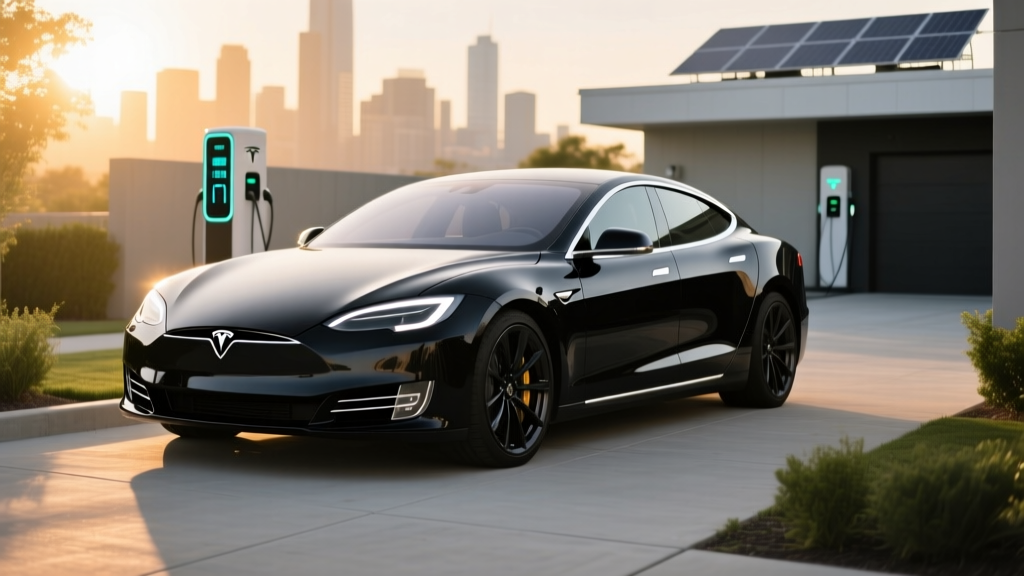
For home charging, the Tesla Wall Connector at 48 amps (11.5 kW) is the practical standard. On a 240V/60A circuit, you'll recover roughly 34 miles of range per hour — enough to fully replenish overnight for nearly any daily use case. Installation typically runs $800-$2,000 depending on panel proximity and whether a service upgrade is needed.
Performance: Long Range vs. Plaid
The 2024 Model S offers two powertrains, and the gap between them is enormous.
| Spec | Long Range | Plaid |
|---|---|---|
| Drivetrain | Dual-Motor AWD | Tri-Motor AWD |
| Horsepower | 670 hp | 1,020 hp |
| 0-60 mph | 3.1 seconds | 1.99 seconds |
| Top Speed | 155 mph | 200 mph (with track package) |
| Quarter Mile | ~11.3 sec | ~9.25 sec |
| EPA Range | 402 mi | 396 mi |
| Battery (usable) | ~95 kWh (NMC) | ~95 kWh (NMC) |
The Long Range is already brutally quick at 3.1 seconds to 60 — faster than most sports cars and entirely sufficient for any real-world driving scenario. The Plaid's 1.99-second claim (with rollout subtracted, per Tesla's methodology) makes it one of the quickest production cars ever built, but at a $35,000 premium, it's a track toy justification rather than a practical upgrade.
Both trims feature adaptive air suspension with automatic ride-height adjustment, and the regenerative braking system is strong enough for effective one-pedal driving in most conditions. The steering is precise but notably heavier than the pre-refresh Model S — a deliberate tuning choice that improves highway stability at the cost of low-speed effort.
Interior, Tech, and Cargo
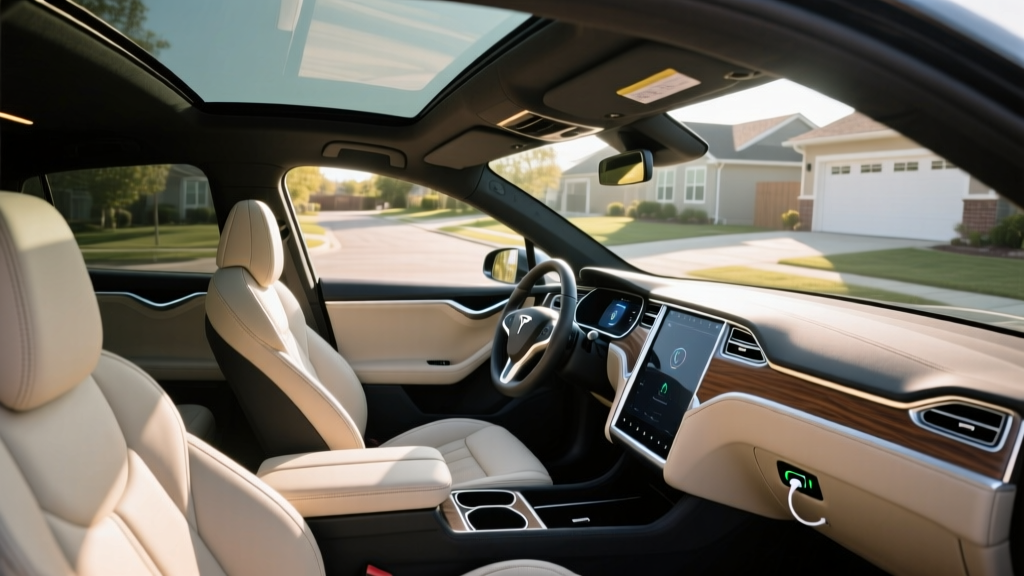
The 2024 Model S interior received meaningful improvements in the 2021 refresh (the "Palladium" platform), and the current model carries those forward: ventilated front seats, a 17-inch center touchscreen with 2200x1300 resolution, a rear-seat 8-inch display, a 22-speaker audio system, and tri-zone climate control. Build quality has improved noticeably over early Model S generations, though panel gaps and interior material quality still draw criticism compared to the Mercedes EQS or Lucid Air at this price point.
Dimensions and space:
- Front legroom: 42.7 inches
- Rear legroom: 35.4 inches
- Cargo (rear trunk): 26.3 cu ft
- Frunk (front trunk): ~5.3 cu ft
- Total cargo: ~31.6 cu ft (seats up), expandable with 60/40 split-folding rear seats
The rear seat is comfortable for two adults on longer trips but tighter for three across. The hatchback trunk design is one of the Model S's most practical features — the large opening swallows luggage, strollers, and gear far more easily than a traditional sedan trunk.
Standout tech:
- 17-inch infotainment: Netflix, YouTube, and gaming (including Cyberpunk 2021-level GPU performance for in-car gaming)
- Autopilot (standard): Traffic-aware cruise control and lane-keeping (SAE Level 2)
- Full Self-Driving (Supervised): Optional at ~$8,000 — adds automatic lane changes, intersection handling, and parking features, but remains SAE Level 2 requiring full driver attention
- Over-the-air updates: Continuous feature additions and performance improvements
- Sentry Mode and Dog Mode: Camera-based security and climate features
Autopilot and Full Self-Driving (Supervised) are SAE Level 2 driver-assistance systems. They do NOT make the Model S self-driving. The driver must remain fully engaged, keep hands on the wheel, and monitor the road at all times. Tesla's steering-wheel torque monitoring is less sensitive than GM's Super Cruise eye-tracking — complacency is a real risk on long highway stretches.
Pricing, Trims, and Federal Tax Credit
| Trim | Base MSRP | As-Tested (typical) | §30D Federal Credit |
|---|---|---|---|
| Long Range | $74,990 | $78,000-$82,000 | Not eligible (MSRP exceeds $55,000 sedan cap) |
| Plaid | $89,990 | $95,000-$105,000 | Not eligible (MSRP exceeds $55,000 sedan cap) |
The 2024 Model S does not qualify for the $7,500 federal EV tax credit under IRS §30D. The reason is straightforward: the §30D credit imposes an MSRP cap of $55,000 for sedans (the cap is $80,000 for SUVs, vans, and trucks). Since the Model S is classified as a sedan and starts at $74,990, it exceeds the limit regardless of battery sourcing or buyer income.
For buyers seeking to understand the full §30D eligibility framework — including income caps ($150,000 single / $300,000 joint), battery critical-mineral sourcing requirements, and the point-of-sale transfer option — the IRS clean vehicle credit page provides current-year rules. Always consult a tax professional before relying on credit eligibility for purchase decisions.
State-level incentives may still apply depending on your jurisdiction. California, Colorado, and several other states offer separate EV rebates or tax credits that have different MSRP thresholds — check your state's energy office for current programs.
Warranty and Long-Term Ownership
Tesla's warranty structure for the 2024 Model S:
- Basic vehicle limited warranty: 4 years / 50,000 miles
- Battery and drive unit warranty: 8 years / 150,000 miles, with a minimum 70% capacity retention guarantee
The 8-year/150,000-mile battery warranty is competitive with the industry standard (most premium EVs offer 8 years and 100,000-150,000 miles). The 70% retention threshold means Tesla will repair or replace the battery if it degrades below 70% of original capacity within the warranty period. Based on aggregated fleet data from sources like Recurrent Auto, most Model S packs retain 85-90% capacity at 100,000 miles under normal use — well above the warranty floor.
Long-term ownership considerations:
- Battery replacement cost (out of warranty): Estimated $15,000-$22,000 based on current service pricing — a significant liability for high-mileage used examples
- Tire costs: The Model S is heavy (~4,561 lbs Long Range) and torquier than most sedans — expect tire replacements every 20,000-30,000 miles at $1,200-$1,800 per set
- Insurance: Premiums run 20-40% higher than comparable ICE luxury sedans due to repair costs and parts pricing
- Depreciation: The Model S has historically depreciated steeply in years 3-5; the refresh helped stabilize this, but luxury sedans remain depreciation-prone
How It Compares: Model S vs. Key Rivals
| Spec | Tesla Model S LR | Lucid Air Pure | Mercedes EQS 450+ |
|---|---|---|---|
| Base MSRP | $74,990 | $69,900 | $104,400 |
| EPA Range | 402 mi | 419 mi | 390 mi |
| DC Fast Charge Peak | 250 kW | 200 kW | 200 kW |
| 0-60 mph | 3.1 sec | 5.0 sec | 5.9 sec |
| Charging Network | Supercharger (NACS) | CCS (EA, etc.) | CCS (EA, etc.) |
| §30D Tax Credit | No (MSRP cap) | No (MSRP cap) | No (MSRP cap) |
The Lucid Air Pure now beats the Model S on EPA range (419 mi) at a lower base price, though its DC fast-charge rate is slower and the CCS charging network remains less reliable than Tesla's Superchargers. The Mercedes EQS offers a dramatically more refined interior and ride quality but costs significantly more and delivers less range and performance.
Choose the Model S Long Range if: You prioritize the Supercharger network for frequent road trips, want a proven platform with years of OTA improvements, and value the combination of 400+ mile range with sub-3.5-second acceleration.
Choose the Lucid Air Pure if: Maximum range at the lowest price is your priority, you primarily charge at home, and you prefer a more traditional luxury sedan aesthetic.
Choose the Mercedes EQS if: Interior quality, ride comfort, and brand prestige matter more than outright performance or range, and budget is less constrained.
Look elsewhere if: You need the federal tax credit — no luxury sedan at this price point currently qualifies. Consider the Tesla Model 3 ($38,990 base, eligible for partial credit depending on sourcing) or Hyundai Ioniq 6 ($37,500, credit-eligible) if incentive maximization is critical.
Pros and Cons
- Class-leading EPA range (402 mi) backed by real-world usability
- Supercharger network remains the most reliable DC fast-charging ecosystem in North America
- Hatchback cargo design offers practicality that traditional luxury sedans can't match
- Continuous OTA updates add features and refine performance over time
- Tri-motor Plaid offers hypercar performance in a daily-drivable package
- Strong regenerative braking enables genuine one-pedal driving
- No federal tax credit eligibility due to $55,000 sedan MSRP cap
- Interior material quality and panel consistency still lag German competitors at this price
- Yoke steering wheel (now optional alongside round wheel) is polarizing and impractical for low-speed maneuvers
- 250 kW DC peak charge rate has been surpassed by Hyundai/Kia's 800V architecture (350 kW on Ioniq 5/EV6)
- Insurance premiums are notably higher than comparable ICE luxury sedans
- Rear seat comfort is adequate but not class-leading for a $75K+ vehicle
Frequently Asked Questions
What is the real-world range of the 2024 Tesla Model S?
The EPA rates the Long Range at 402 miles and the Plaid at 396 miles. In real-world highway driving at 70-75 mph, expect roughly 330-350 miles. In cold weather (below freezing), plan for 260-300 miles on a full charge. City and suburban driving with regenerative braking comes closest to the EPA figure, typically yielding 370-395 miles.
How fast does the 2024 Model S charge?
On a V3 Supercharger, the Model S peaks at 250 kW and can add approximately 200 miles of range in 15 minutes. A 10-80% DC fast-charge session takes about 27-30 minutes, accounting for the charge-curve taper above 50% SoC. At home on a Tesla Wall Connector (11.5 kW / 48A), you'll gain roughly 34 miles of range per hour, enabling a full overnight charge.
Does the 2024 Model S qualify for the federal EV tax credit?
No. Under IRS §30D rules, the federal clean vehicle credit has an MSRP cap of $55,000 for sedans. The Model S starts at $74,990, making it ineligible regardless of battery sourcing or buyer income. State-level incentives may still apply — check your state's energy department for details.
How much does the 2024 Model S cost with common options?
The Long Range starts at $74,990 (including destination). Adding Full Self-Driving (Supervised) at ~$8,000, premium paint ($1,500-$2,500), and 21-inch wheels ($4,500) can push the price to $88,000-$90,000. The Plaid starts at $89,990 and can exceed $105,000 with options. Neither trim qualifies for the federal tax credit.
Is the 2024 Model S worth buying over the Lucid Air or Mercedes EQS?
It depends on priorities. The Model S wins on Supercharger access, proven reliability of the platform, and the combination of range plus performance. The Lucid Air Pure offers more EPA range at a lower price but relies on the less-reliable CCS public charging network. The Mercedes EQS delivers superior interior luxury and ride quality at a much higher price. For road-trip-heavy buyers, the Supercharger advantage remains decisive.
What is the battery warranty on the 2024 Model S?
Tesla covers the battery and drive unit for 8 years or 150,000 miles, whichever comes first, with a guaranteed minimum of 70% capacity retention. Out-of-warranty battery replacement currently runs an estimated $15,000-$22,000 depending on the pack configuration and service location.
Is Autopilot or Full Self-Driving self-driving?
No. Both Autopilot (standard) and Full Self-Driving Supervised (optional) are SAE Level 2 driver-assistance systems. The driver must keep hands on the wheel and eyes on the road at all times. These systems assist with steering, acceleration, and braking but do not replace driver attention or responsibility. For context, only Waymo and Zoox robotaxi services currently operate at SAE Level 4 (driverless in geofenced areas).