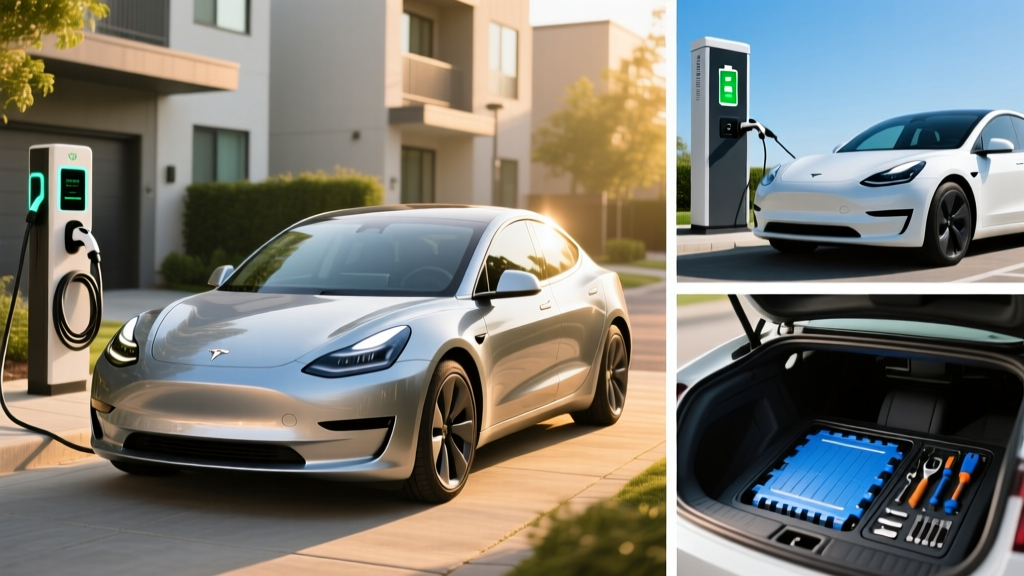
The Tesla Model 3 received its most significant refresh since launch for the 2024 model year, earning the internal "Highland" designation. The update brought a quieter cabin, refined suspension tuning, ventilated seats, ambient lighting, and a rear touchscreen for passengers. But beneath the cosmetic and comfort upgrades, the 2024 Model 3 remains one of the most efficient electric sedans on the market, with class-leading energy consumption and access to Tesla's Supercharger network — now increasingly open to competitors.
If you're researching the 2024 Model 3 in 2026, you're likely weighing it against newer entries like the Hyundai Ioniq 6, BMW i4, and the refreshed Polestar 2. This review breaks down every spec that matters — from real-world range and charging curves to tax credit eligibility — so you can make a data-driven decision.
2024 Model 3 Specs at a Glance
| Spec | RWD (Standard Range) | Long Range AWD | Performance (2025+) |
|---|---|---|---|
| EPA Range | 272 mi | 363 mi (18" wheels) / 315 mi (19" wheels) | 315 mi |
| Battery Capacity (usable) | ~57.5 kWh (LFP) | ~75 kWh (NMC) | ~75 kWh (NMC) |
| Drivetrain | Rear-Wheel Drive | Dual-Motor AWD | Dual-Motor AWD |
| Horsepower | 271 hp | 346 hp | ~510 hp |
| 0-60 mph | 5.8 sec | 4.2 sec | 2.9 sec |
| Top Speed | 125 mph | 125 mph | 163 mph |
| Max DC Fast Charge | 170 kW | 250 kW | 250 kW |
| 10-80% DCFC Time | ~25 min | ~27 min | ~27 min |
| Level 2 Home Charging | 11.5 kW (~44 mi/hr) | 11.5 kW (~44 mi/hr) | 11.5 kW (~44 mi/hr) |
| MPGe (combined) | 132 MPGe | 130 MPGe | 118 MPGe |
| Efficiency (kWh/100 mi) | 25 kWh | 25 kWh | 28 kWh |
| Cargo Volume | 23 cu ft (trunk + frunk) | ||
| Rear Legroom | 35.3 in | ||
| Base MSRP (at launch) | $38,990 | $47,740 | Not available in 2024 |
| Battery Warranty | 8 years / 120,000 mi (RWD) or 120,000 mi (AWD), 70% retention | ||
Real-World Range: What the EPA Number Doesn't Tell You
EPA Sticker: 272 mi (RWD) / 363 mi (Long Range 18")
Real-World Expectation: 230-250 mi highway (RWD); 300-330 mi highway (Long Range). Cold-weather range loss of 20-30% is typical in sub-freezing temperatures without preconditioning.
The 2024 Model 3 Long Range AWD with 18-inch wheels achieves an EPA-estimated 363 miles — among the highest of any production EV sedan. But EPA range is measured using a mix of city and highway driving cycles with climate control off, which doesn't reflect real-world road trips.
In independent highway testing at 70 mph with climate control on, the Long Range typically delivers 300-330 miles before needing a charge. That's roughly 85-90% of the EPA sticker — strong for any EV, but still something to plan around on long routes. The RWD model, with its smaller LFP battery, nets about 230-250 highway miles in similar conditions.
Cold-weather reality: In temperatures below 32°F, expect range loss of 20-30% if the battery isn't preconditioned. The Model 3's heat pump (standard on all trims) helps mitigate this compared to older resistance-heating EVs, but physics still wins. A Long Range that shows 363 miles on a warm spring morning may display closer to 260-280 miles on a 20°F January day. Preconditioning the battery while plugged in — using scheduled departure or the Tesla app — recovers a significant portion of that loss.
According to fueleconomy.gov, the Long Range AWD achieves 130 MPGe combined (25 kWh/100 mi), making it one of the most efficient all-wheel-drive EVs available. For context, that's roughly 4 miles per kWh — exceptional for a dual-motor sedan.
Charging Speed: DC Fast Charging and Home Setup
Charging speed is where the 2024 Model 3 trims diverge meaningfully.
| Charging Method | RWD (Standard Range) | Long Range / Performance |
|---|---|---|
| Level 1 (120V, standard outlet) | ~3-4 mi/hr | ~3-4 mi/hr |
| Level 2 (240V, home wall connector) | 11.5 kW / ~44 mi/hr | 11.5 kW / ~44 mi/hr |
| DC Fast Charge (peak) | 170 kW | 250 kW |
| 10-80% DCFC time | ~25 min | ~27 min |
| 15 min of DCFC adds (approx) | ~130 mi | ~175 mi |
| Connector | NACS (native Tesla); CCS adapter available | |
The Long Range and Performance trims peak at 250 kW on V3 Superchargers. However, peak rate is not sustained rate. The Model 3's charge curve tapers noticeably above 50% state of charge (SoC), and charging slows further above 80%. That 10-80% time of roughly 27 minutes assumes you arrive at a low state of charge (under 10%) with a preconditioned battery. If you arrive at 30% SoC without preconditioning, expect that session to stretch closer to 35 minutes.
The RWD model peaks at 170 kW — adequate for most needs but noticeably slower on road trips. A 10-80% session takes about 25 minutes, which is competitive with similarly priced EVs but falls short of 800V competitors like the Hyundai Ioniq 6 (which can sustain higher rates longer).
Home charging: Both trims accept up to 11.5 kW on Level 2, meaning a full charge from empty takes roughly 6-8 hours depending on battery size. The Tesla Wall Connector (~$400) paired with a NEMA 14-50 outlet or hardwired 60A circuit delivers the best home experience. Installation costs typically range from $500 to $2,000 depending on panel capacity and run length — budget for a potential panel upgrade if your home still has a 100A service.
Pricing, Trims, and Federal Tax Credit Eligibility
The 2024 Model 3 launched with two main trims. Tesla reintroduced a Performance variant for the 2025 model year, so if you're shopping in 2026, you may find all three on the used or new-remaining market.
| Trim | Base MSRP (at launch) | Est. Price After §30D Credit* | §30D Eligible? |
|---|---|---|---|
| RWD (Standard Range) | $38,990 | ~$31,490 | Yes (if sourced compliant) |
| Long Range AWD | $47,740 | ~$40,240 | Yes (if sourced compliant) |
| Performance | $52,990 (2025 MY) | ~$45,490 | Yes (subject to sourcing rules) |
*Federal tax credit caveat: The IRS §30D clean vehicle credit offers up to $7,500, split into two $3,750 halves — one for battery component sourcing and one for critical minerals sourcing. Eligibility depends on:
- MSRP cap: Sedans must be under $55,000 MSRP (all Model 3 trims qualify)
- Buyer income cap: AGI must not exceed $150,000 (single), $225,000 (head of household), or $300,000 (joint)
- Battery sourcing: Battery components and critical minerals must meet escalating domestic/free-trade sourcing thresholds that tighten annually through 2032
- FEOC exclusion: Vehicles with battery components from a "foreign entity of concern" (FEOC) are disqualified starting 2024; critical mineral FEOC rules took effect in 2025
- Point-of-sale transfer: As of 2024, the credit can be transferred to the dealer at purchase, reducing the sale price directly — no need to wait for tax filing
Tesla's US-built vehicles have historically qualified, but the critical minerals and FEOC rules are complex and shift annually. Always verify current eligibility on IRS.gov before purchasing, or ask the dealer to confirm point-of-sale credit availability at the time of delivery.
Performance and Driving Dynamics
The 2024 Highland refresh transformed the Model 3's driving experience. The previous generation was quick but harsh — road noise, firm ride, and minimal isolation were common complaints. Tesla addressed these with acoustic glass, improved damping, and revised suspension bushings.
RWD: 271 hp and a 5.8-second 0-60 time make the base model more than adequate for daily driving. It's the lightest trim, which benefits efficiency and handling balance. Rear-wheel drive means less traction in snow without winter tires — a consideration for cold-climate buyers.
Long Range AWD: 346 hp and a 4.2-second 0-60 deliver genuinely quick acceleration with the security of dual-motor all-wheel drive. This is the sweet-spot trim for most buyers — range, performance, and price balance well here.
Performance: Returning for 2025, the Performance trim pushes ~510 hp and a 2.9-second 0-60, with track-oriented suspension, larger brakes, and 20-inch wheels. It sacrifices some range (315 mi EPA) for speed and grip.
One-pedal driving via regenerative braking is strong in the Model 3, though Tesla removed the adjustable regen setting — it's always on at maximum. Most owners adapt quickly, but if you prefer a coasting feel, this takes adjustment.
Interior, Tech, and Cargo
The 2024 interior is minimalist in the extreme. A 15.4-inch center touchscreen handles all infotainment, climate, and vehicle controls — there are no physical buttons, no instrument cluster, and no heads-up display. The turn signals moved to the steering wheel (replacing stalks), which is the most polarizing change.
What works:
- Ventilated front seats (new for Highland) — a welcome addition for warm climates
- Ambient lighting strip across the dash and doors
- 8-inch rear touchscreen for passengers (climate, media, navigation)
- Excellent over-the-air (OTA) update cadence — the car improves over time
- Tesla's navigation with real-time Supercharger routing and preconditioning
What doesn't:
- Turn signals on the steering wheel are unintuitive during roundabouts or three-point turns
- No physical climate controls — everything requires screen taps
- No Apple CarPlay or Android Auto — Tesla's native system is capable but proprietary
- Rear visibility is limited; rely on cameras
Cargo: The Model 3 offers 23 cubic feet total (trunk + frunk). The trunk is a liftback design, making loading easier than a traditional sedan. Rear seats fold 60/40. Passenger space is adequate for four adults, but the rear middle seat is tight, and rear headroom is limited for taller riders due to the sloping roofline. Rear legroom measures 35.3 inches — competitive with the BMW i4 but less than the Hyundai Ioniq 6.
Driver Assistance: Autopilot and FSD (Supervised)
SAE Automation Level: Level 2 (driver assistance). Autopilot and Full Self-Driving (Supervised) require the driver to remain fully engaged, hands on the wheel, and eyes on the road at all times. These systems are not autonomous or self-driving.
Tesla's Autopilot comes standard and includes adaptive cruise control, lane centering, and automatic emergency braking. It's competent for highway driving but not class-leading — GM's Super Cruise and Ford's BlueCruise offer hands-free operation on mapped highways, which Tesla's steering-wheel torque detection does not.
Full Self-Driving (Supervised), available as an $8,000 add-on or $99/month subscription, adds automatic lane changes, traffic light/stop sign recognition, and city street navigation. As of 2026, FSD (Supervised) has improved significantly in urban environments but still requires active supervision. It handles most situations well but can hesitate at unprotected left turns or complex construction zones. According to NHTSA, Tesla vehicles using Autopilot have been involved in incidents that underscore the need for driver vigilance.
The Model 3 earned the IIHS Top Safety Pick+ designation for the 2024 model year, with top marks in crashworthiness. Active safety systems — automatic emergency braking, blind-spot monitoring, and lane departure warning — are strong and standard.
Pros, Cons, and Who Should Buy
Pros
- Best-in-class efficiency (25 kWh/100 mi Long Range)
- 363-mile EPA range on Long Range 18" — one of the longest of any sedan
- Access to the Tesla Supercharger network (most reliable public charging)
- Significantly improved cabin quietness and ride quality over pre-2024 models
- Strong over-the-air update support
- Competitive pricing, especially after §30D tax credit
- Excellent safety ratings (IIHS TSP+)
Cons
- Steering-wheel turn signals take significant adjustment
- No Apple CarPlay / Android Auto
- Rear seat headroom is tight for taller passengers
- FSD (Supervised) remains Level 2 and requires constant vigilance
- RWD model's 170 kW peak charge rate lags behind 800V competitors
- Minimal physical controls — everything routes through the touchscreen
Who Should Buy the 2024 Model 3?
Choose the RWD if: You commute under 50 miles daily, have reliable home charging, live in a mild climate, and want the lowest entry price with maximum efficiency.
Choose the Long Range AWD if: You take regular road trips, live in a cold or snowy climate, need all-wheel drive, and want the longest possible range buffer. This is the best all-around trim.
Choose the Performance if: Track capability and acceleration matter more than range, and you're willing to pay a premium for 2.9-second 0-60 times.
Look elsewhere if: You need maximum rear-seat space (consider the Model Y or Hyundai Ioniq 5), prefer physical buttons and CarPlay (BMW i4, Polestar 2), or want hands-free highway driving (GM Super Cruise vehicles).
Frequently Asked Questions
What is the real-world range of the 2024 Model 3?
The Long Range AWD with 18-inch wheels delivers approximately 300-330 miles on the highway in moderate temperatures, versus the 363-mile EPA estimate. The RWD model nets about 230-250 highway miles. In cold weather (below freezing), expect 20-30% range loss unless the battery is preconditioned while plugged in.
How fast does the 2024 Model 3 charge?
The Long Range and Performance trims peak at 250 kW on DC fast chargers, achieving 10-80% in approximately 27 minutes with a preconditioned battery. The RWD peaks at 170 kW with a similar 10-80% time of ~25 minutes. At home on a Level 2 Wall Connector (11.5 kW), both trims add roughly 44 miles of range per hour.
How much does the 2024 Model 3 cost after the federal tax credit?
The RWD launched at $38,990 MSRP and the Long Range at $47,740. If you qualify for the full $7,500 §30D credit (meeting income caps and battery sourcing requirements), effective pricing drops to approximately $31,490 and $40,240 respectively. The credit can be applied at point of sale. Always verify eligibility on IRS.gov at time of purchase, as sourcing rules change annually.
Does the 2024 Model 3 qualify for the federal EV tax credit?
Yes — all Model 3 trims fall under the $55,000 sedan MSRP cap, and Tesla's US manufacturing has historically met sourcing requirements. However, the §30D credit has buyer income limits ($150K single / $300K joint), and battery sourcing rules (critical minerals and FEOC exclusions) tighten each year. Confirm current eligibility before purchase.
Is the 2024 Model 3 worth buying vs. competitors?
Against the Hyundai Ioniq 6 (EPA 361 mi, 800V architecture, ~$42,000), the Model 3 offers a more mature charging network and slightly better efficiency but lacks CarPlay and has slower peak charging vs. the Ioniq 6's 350 kW capability. The BMW i4 offers a more traditional luxury interior and CarPlay but less range and higher pricing. The Model 3 remains the efficiency and value benchmark in the segment, particularly if Supercharger access matters to your travel patterns.
What's the biggest drawback of the 2024 Model 3 Highland refresh?
The steering-wheel-mounted turn signals are the most universally criticized change. Without stalks, signaling during roundabouts, parking maneuvers, or tight turns requires retraining muscle memory. Most owners adapt within 2-4 weeks, but it remains a friction point — and one that Tesla reversed for the refreshed Model Y. Test drive before committing.
How long will the 2024 Model 3 battery last?
Tesla warranties the battery for 8 years or 120,000 miles (whichever comes first) with a minimum 70% capacity retention. Real-world data from earlier Model 3 vehicles suggests NMC batteries (Long Range) degrade approximately 10-12% over the first 100,000 miles, then slow significantly. LFP batteries (RWD) tend to degrade even more slowly but should be charged to 100% regularly — unlike NMC, which benefits from daily limits of 80-90%.
Sources: EPA / fueleconomy.gov, Tesla Specifications, IRS Clean Vehicle Credits, IIHS