Quick Verdict: The Benchmark Sports Sedan Gets Sharper
The 2024 Tesla Model 3 Performance (internally called the "Highland" refresh) is not just a carryover with a badge swap. Tesla reworked the suspension, added adaptive dampers, redesigned the front and rear fascias for improved aerodynamics, and bumped battery capacity slightly. The result is a dual-motor AWD sedan that hits 60 mph in 3.1 seconds while delivering an EPA-estimated 315 miles of range — a combination that still has no direct rival under $60,000.
But the 2024 Model 3 Performance is also a study in trade-offs. The minimalist interior eliminates turn signal stalks and gear selectors, the rear seat remains snug for taller passengers, and Tesla's removal of ultrasonic sensors means you are fully dependent on Tesla Vision for parking assist. If you can adapt to those quirks, this is arguably the best all-around electric sports sedan on the market.
Range, Battery & Efficiency: The Numbers That Matter
EPA Estimated: 315 miles
Real-World Highway (70-75 mph, mild weather): ~270–290 miles
Real-World Highway (cold weather, below 32°F): ~220–250 miles
City / Mixed Commute: ~300–320 miles (regen-heavy driving can exceed EPA)
The 2024 Model 3 Performance uses an 82 kWh battery pack (approximately 79 kWh usable) with NMC (nickel manganese cobalt) chemistry. Unlike the standard-range Rear-Wheel-Drive Model 3, which uses LFP (lithium iron phosphate) cells, the Performance trim sticks with NMC for its superior energy density — necessary to hit 315 miles without adding prohibitive weight.
NMC chemistry means Tesla recommends daily charging to 80% for long-term battery health, reserving 100% charges for road trips. LFP owners can charge to 100% daily without degradation concerns, but LFP's lower energy density would have cost the Performance variant roughly 20–30 miles of range at the same pack weight.
Efficiency is rated at 116 MPGe combined (29 kWh/100 mi) per fueleconomy.gov. That is excellent for a 4,000+ lb dual-motor performance sedan, though it trails the Long Range AWD variant (132 MPGe combined) due to the Performance model's wider 235/40R19 tires, track-focused suspension tuning, and slightly higher curb weight.
| Spec | Value |
|---|---|
| EPA Range | 315 miles |
| Battery (Usable) | ~79 kWh (NMC chemistry) |
| Drivetrain | Dual-motor AWD |
| Horsepower | 510 hp |
| Torque | 546 lb-ft |
| 0–60 mph | 3.1 seconds |
| Top Speed | 163 mph |
| EPA Efficiency | 116 MPGe / 29 kWh/100 mi |
| Cargo Volume | 23 cu ft (trunk + frunk) |
| Rear Legroom | 35.2 inches |
| Curb Weight | 4,065 lbs |
| Base MSRP | $54,990 (incl. destination) |
Charging Speed: DC Fast Charge & Home Level 2
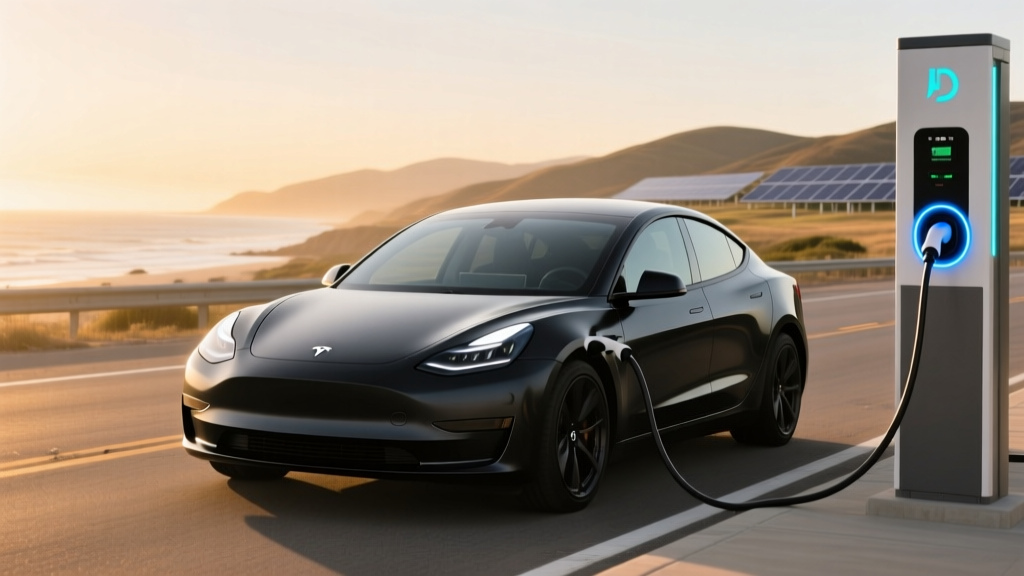
The 2024 Model 3 Performance supports a peak DC fast-charge rate of 250 kW on Tesla Superchargers (and via the NACS connector, which is now native to all Teslas). On a V3 or V4 Supercharger with battery preconditioning enabled, Tesla claims a 10–80% charge in approximately 25 minutes.
In real-world testing, the charging curve tells a more nuanced story. The pack pulls peak power (around 240–250 kW) only between roughly 10–30% state of charge. From 30–60%, the rate tapers to approximately 150–170 kW, and above 80%, it drops below 50 kW to protect cell longevity. If you arrive at a Supercharger with a cold battery and haven't preconditioned via the in-car navigation, expect peak rates closer to 150–180 kW and a 10–80% time of 30–35 minutes. Always route to your charger using the car's navigation to trigger automatic battery preconditioning.
| Charging Level | Max Power | Miles Added per Hour | Notes |
|---|---|---|---|
| Level 1 (120V / 12A) | ~1.4 kW | ~4–5 mi/hr | Emergency / trickle only |
| Level 2 (240V / 48A) | 11.5 kW | ~37–44 mi/hr | Home Wall Connector; full charge ~8 hrs |
| Level 2 (240V / 32A) | 7.7 kW | ~25–30 mi/hr | Mobile Connector on dryer outlet |
| DC Fast (Supercharger V3/V4) | 250 kW peak | ~1,000+ mi/hr (peak) | 10–80% in ~25 min (preconditioned) |
For home charging, the Tesla Wall Connector at 48 amps delivers 11.5 kW, adding roughly 37–44 miles of range per hour. An overnight charge from 20% to 80% takes about 5–6 hours — plenty for any daily commute. Installation of a 60-amp dedicated circuit typically costs $500–$1,500 depending on panel proximity, with a panel upgrade to 200A adding $1,500–$3,000 if your home's electrical service is older.
Performance & Driving Dynamics
The dual-motor powertrain produces 510 horsepower and 546 lb-ft of torque, launching the Model 3 Performance to 60 mph in 3.1 seconds. That puts it in the territory of a BMW M3 Competition or Porsche Cayman GTS, but with the instant torque delivery unique to electric motors — no turbo lag, no transmission shift delay.
The 2024 Highland refresh brought the most significant chassis overhaul since the Model 3 launched in 2017. Tesla added frequency-selective adaptive dampers, stiffer anti-roll bars, revised bushings, and a new front subframe. The result is noticeably improved ride compliance over broken pavement while maintaining the sharp turn-in that enthusiasts expect. Track Mode lets you adjust front/rear torque distribution, stability control intervention, and regenerative braking intensity — a legitimate performance feature, not a marketing gimmick.
One caveat: the 235/40R19 Pirelli P Zero tires provide excellent dry grip but wear quickly under aggressive driving and reduce range compared to the all-season tires on the Long Range variant. Budget $1,200–$1,600 for a set of four replacements every 20,000–25,000 miles if you drive hard.
Interior, Tech & Driver Assistance
The Highland refresh cleaned up the Model 3 interior substantially. Ventilated front seats, ambient lighting, a rear 8-inch touchscreen for passengers, improved sound deadening, and higher-quality materials close the gap with premium European rivals. The 15.4-inch center touchscreen remains the command center for everything — climate, mirrors, glovebox, wipers — which is either liberating or maddening depending on your tolerance for screen-based controls.
The most polarizing change: the turn signal stalks are gone
Autopilot comes standard and includes adaptive cruise control, lane centering, and automatic emergency braking. Full Self-Driving (Supervised) is a $8,000 add-on (or $99/month) that adds automatic lane changes, intersection navigation, and traffic light recognition. Both Autopilot and FSD (Supervised) are SAE Level 2 driver-assistance systems. The driver must remain fully engaged, keep hands on the wheel (or demonstrate attention via the cabin camera), and be prepared to take over at any moment. These are not "self-driving" systems. Level 4 driverless operation (no human needed) currently exists only in geofenced robotaxi services like Waymo in select cities. The 2024 Tesla Model 3 Performance starts at $54,990 (including the $1,390 destination fee). That is a single, fully loaded trim — there are no packages to add beyond paint color ($1,000–$2,500), wheels, and FSD. Federal tax credit eligibility requires meeting several criteria under IRS §30D rules: Warranty coverage: The battery and drive units are covered for 8 years or 120,000 miles (whichever comes first), with Tesla guaranteeing a minimum of 70% capacity retention over that period. The limited vehicle warranty is 4 years / 50,000 miles. This is competitive with Hyundai's 10-year/100,000-mile battery warranty but typical for the segment. Choose the Model 3 Performance if: You want sports-sedan acceleration with daily-driver range, you have access to home Level 2 charging, you value Supercharger network access for road trips, and you can adapt to a screen-centric interface. Look elsewhere if: You regularly carry rear-seat adults (consider the Model Y or Hyundai Ioniq 5), you want Apple CarPlay (BMW i4, Hyundai Ioniq 6), or you want LFP chemistry for carefree 100% daily charging (Model 3 RWD at $38,990). Against the BMW i4 M50 ($67,300), the Model 3 Performance is quicker to 60, has more EPA range, and costs over $12,000 less. The BMW wins on interior material quality, Apple CarPlay, and a more conventional control layout. The Hyundai Ioniq 6 N (expected ~$65,000) offers a more engaging driver experience with simulated gear shifts and an 800V architecture for faster DC charging, but its EPA range is lower (~280 miles estimated). The Polestar 2 Long Range Dual Motor ($53,300) is the closest in price, but it trails on range (276 miles EPA), acceleration (4.1 seconds), and charging speed (205 kW peak). The Model 3 Performance simply delivers more performance and range per dollar. The EPA rates it at 315 miles. In mixed real-world driving at moderate temperatures, expect 280–300 miles. Sustained highway driving at 75+ mph drops that to 250–275 miles, and cold weather (below freezing) can reduce range by 20–30%, yielding 220–250 miles. Preconditioning the cabin while plugged in and using seat heaters instead of cabin heat can recover some of that winter loss. On a Tesla Wall Connector (48A / 11.5 kW), you gain roughly 37–44 miles of range per hour, with a 20–80% charge taking about 5 hours. On a V3/V4 Supercharger, peak rate is 250 kW, and 10–80% takes approximately 25 minutes with preconditioning. Without preconditioning, add 5–10 minutes. It can, but eligibility depends on your income, the vehicle's MSRP (must be under $55,000 for sedans — the Model 3 Performance is $54,990, so it qualifies), and battery-sourcing requirements that tighten each year. Always verify current eligibility on fueleconomy.gov and consult a tax professional before relying on the credit. As of 2024, you can transfer the credit to the dealer at point of sale. If performance-per-dollar and Supercharger access are your top priorities, yes. The Model 3 Performance is faster, more efficient, and cheaper than the i4 M50. If you prefer traditional luxury controls, Apple CarPlay, or a more spacious rear seat, the BMW i4 or a crossover like the Ioniq 5 may suit you better. Tesla warranties the battery for 8 years / 120,000 miles with a minimum 70% capacity retention. Real-world data from older Model 3 owners suggests roughly 8–12% degradation over the first 100,000 miles with NMC packs charged primarily to 80%. A full battery replacement out of warranty currently costs approximately $12,000–$16,000 including labor, though prices continue to decline. For most buyers, no — not yet. FSD (Supervised) is an SAE Level 2 system that still requires full driver attention. It handles highway driving and some city scenarios impressively but makes unpredictable errors at construction zones, complex intersections, and unusual road configurations. The $99/month subscription is a lower-risk way to try it on a road trip before committing to the full purchase.Pricing, Tax Credits & Ownership Costs
Item Amount Base MSRP (incl. destination) $54,990 Ultra Red paint upgrade +$2,500 FSD (Supervised) — optional +$8,000 As-tested (with FSD + premium paint) $65,490 Federal Tax Credit (§30D) Up to $7,500 (see eligibility below) Effective price after max credit From ~$47,490
Pros, Cons & Who Should Buy
How It Compares to Key Rivals
Frequently Asked Questions
What is the real-world range of the 2024 Tesla Model 3 Performance?
How fast does it charge at home and on the road?
Does the 2024 Model 3 Performance qualify for the $7,500 federal tax credit?
Is it worth buying over a BMW i4 or Hyundai Ioniq 5?
How long will the battery last?
Is Tesla's FSD worth the $8,000 cost?