Quick Verdict: The Highland Refresh Fixed Almost Everything
The 2024 Tesla Model 3 — internally codenamed "Highland" — represents the first major overhaul of Tesla's volume sedan since its 2017 launch. The updates are substantial: a quieter cabin, a rear touchscreen, ventilated front seats, ambient lighting, a redesigned suspension, and the removal of nearly every physical stalk in favor of touchscreen and steering-wheel controls. For buyers who found the pre-refresh Model 3 too spartan or noisy, the Highland is a meaningful correction. For everyone else, it remains one of the most efficient, best-charging electric sedans on the market at a price that undercuts most rivals.
But the Highland isn't without trade-offs. The turn-signal buttons on the steering wheel are divisive, the lack of a driver display demands adjustment, and Tesla's build-quality reputation still lags legacy automakers in fit-and-finish consistency. This review covers every spec, charging figure, and ownership cost you need before signing a purchase agreement.
Range and Efficiency: EPA Numbers vs. the Real World
Real-World Expectation: 280–310 miles highway (Long Range); 220–250 miles highway (RWD). Cold weather (below 32°F) can reduce range by 20–30%, dropping the Long Range to roughly 230–270 miles in winter conditions.
The Long Range AWD variant uses a 75 kWh usable battery pack (approximately 82 kWh gross) with NMC (nickel manganese cobalt) chemistry, delivering an EPA-rated 341 miles — among the highest of any electric sedan in its price class. The base RWD model uses a smaller ~57.5 kWh usable LFP (lithium iron phosphate) pack, rated at 272 miles. That LFP chemistry is worth understanding: it tolerates daily charging to 100% without the degradation concerns of NMC, making it practical for commuters who need every mile every day. The trade-off is lower energy density (less range in a smaller pack) and reduced cold-weather performance compared to NMC.
Efficiency is where the Model 3 Highland shines. The Long Range achieves an EPA-rated 132 MPGe combined (approximately 25 kWh/100mi), while the RWD returns 132 MPGe combined as well — roughly 26 kWh/100mi. These figures beat the Hyundai Ioniq 6 (140 MPGe but with less total range), the BMW i4 (109 MPGe), and the Polestar 2 (107 MPGe). On a cost-per-mile basis, the Model 3 remains one of the cheapest vehicles to "fuel" in the EV market when charging at home on residential electricity rates.
| Spec | RWD (Base) | Long Range AWD | Performance (if avail.) |
|---|---|---|---|
| EPA Range | 272 mi | 341 mi | ~315 mi |
| Battery (usable) | ~57.5 kWh (LFP) | ~75 kWh (NMC) | ~75 kWh (NMC) |
| MPGe (combined) | 132 MPGe | 132 MPGe | ~119 MPGe |
| 0-60 mph | 5.8 sec | 4.2 sec | 2.9 sec |
| Horsepower | 283 hp | 346 hp | 510 hp |
| Drivetrain | RWD | Dual-Motor AWD | Dual-Motor AWD |
| Base MSRP | $38,990 | $47,740 | $52,990 (est.) |
Charging: DC Fast-Charge Speed and Home Level 2 Reality
| Charging Level | Power / Rate | Speed (Miles Added) | Notes |
|---|---|---|---|
| Level 1 (120V) | ~1.4 kW | ~3–4 mi/hr | Emergency/trickle only |
| Level 2 (240V, 48A) | 11.5 kW | ~35–44 mi/hr | Home Wall Connector or equivalent |
| DC Fast Charge | Peak 250 kW | 10–80% in ~25 min (Long Range) | Tapers above 80% SoC |
The Model 3 Long Range supports DC fast charging at a peak rate of 250 kW on Tesla Superchargers (V3 and V4 stalls). In practice, that peak rate holds roughly from 10% to 30% state of charge, then tapers progressively. Expect a 10–80% session to take approximately 25 minutes at a V3 Supercharger in optimal battery-preconditioned conditions. The RWD model, with its LFP pack, peaks closer to 170 kW, yielding a 10–80% time of roughly 30 minutes.
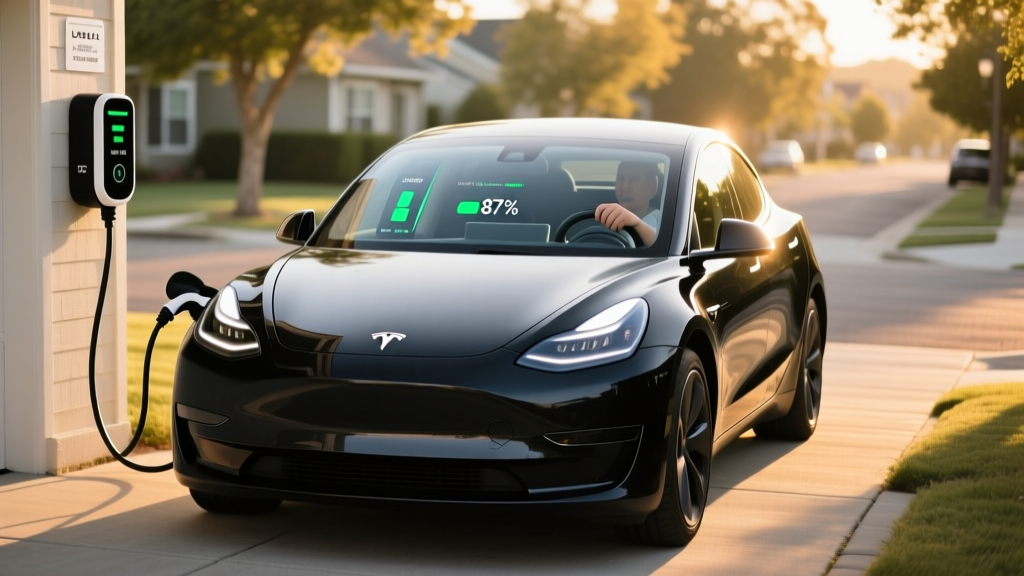
For home charging, the Model 3's onboard charger accepts up to 11.5 kW on a 240V / 48-amp circuit (the Tesla Wall Connector on a 60-amp breaker). That translates to roughly 35–44 miles of range per hour of charging — enough to fully replenish the Long Range pack overnight in approximately 7–8 hours. If your home electrical panel supports only a 40-amp circuit (32A continuous), you'll see about 7.7 kW and roughly 28 miles per hour, which is still adequate for most daily commutes.
Preconditioning matters. The Model 3 will automatically warm the battery when you navigate to a Supercharger in the infotainment system. Skipping this step — or arriving at a non-navigated charger — can slow peak charge rates significantly, particularly in cold weather. Always navigate to your charging stop for optimal speed.
The Highland retains the NACS (North American Charging Standard) connector natively. As of 2025–2026, most major automakers have adopted NACS, meaning the Model 3 can access the full Supercharger network without adapters, and competing EVs now use adapters to access Tesla's stalls. For CCS-based public chargers (Electrify America, EVgo), Tesla offers a CCS adapter, though the Supercharger network remains the most reliable DC fast-charging infrastructure in the U.S.
Performance and Driving Dynamics
The Long Range AWD delivers 346 horsepower and a 4.2-second 0–60 mph time — quick by any sedan standard, and effortless in daily merging and passing. The Performance variant drops that to 2.9 seconds with 510 hp, placing it in sports-car territory. The RWD, at 283 hp and 5.8 seconds, is adequate for commuting but won't thrill enthusiasts.
The Highland's suspension tuning is noticeably improved over the pre-2024 Model 3. Tesla softened the ride, added frequency-selective dampers, and improved sound insulation with acoustic glass all around. Road noise — a persistent complaint in earlier Model 3s — is substantially reduced. The steering remains quick and direct, though some drivers will find it overly assisted in Comfort mode. The Model 3 Highland is a more refined cruiser than its predecessor while retaining the responsive handling that made the platform popular.
Regenerative braking remains strong and consistent. Tesla offers a one-pedal driving experience in most conditions, though the "low" regen setting is now the only option (Tesla removed the adjustable regen setting in earlier software updates). Expect to use the friction brakes rarely in normal driving.
Interior, Tech, and Cargo
The Highland interior is a step-change improvement in materials and comfort. Ventilated front seats are now standard on all trims — a significant addition for warm climates. Ambient lighting strips run across the dashboard and doors. The new 8-inch rear touchscreen provides rear passengers with climate, media, and navigation controls (and doubles as a streaming display). The 15.4-inch center touchscreen runs Tesla's latest software with a responsive interface, though the removal of physical turn-signal stalks and the gear selector (now a capacitive strip on the console and a screen-based backup) requires an adjustment period.
Notable absence: There is no traditional instrument cluster or head-up display. Speed, range, and navigation information live on the center screen, positioned to the right. Most owners adapt within a week, but it's a dealbreaker for some buyers accustomed to a direct sightline for speedometer data.
Cargo space measures 23 cubic feet combined (trunk + frunk), with 21 cu ft in the rear trunk and approximately 2 cu ft in the front trunk. Rear legroom is 35.3 inches — adequate for average-height adults but tight for taller passengers on longer trips. The rear seat is best suited for two adults; the center position is narrow and raised.
Pricing, Trims, and Federal Tax Credit Eligibility
| Trim | Base MSRP | Est. Federal Credit (§30D) | Effective Price (before state/local) |
|---|---|---|---|
| RWD | $38,990 | Up to $7,500* | ~$31,490* |
| Long Range AWD | $47,740 | Up to $7,500* | ~$40,240* |
| Performance | $52,990 (est.) | Up to $7,500* | ~$45,490* |
*Federal tax credit eligibility under IRS §30D is subject to multiple requirements that change periodically:
- MSRP cap: Sedans must have an MSRP at or below $55,000. All current Model 3 trims fall under this cap.
- Buyer income cap: Modified adjusted gross income must not exceed $150,000 (single), $225,000 (head of household), or $300,000 (joint).
- Battery sourcing: The credit splits into two halves ($3,750 each) — one for critical-mineral sourcing and one for battery-component manufacturing. Qualifying amounts shift annually as sourcing requirements tighten. Check the latest fueleconomy.gov listings for the current eligible amount.
- Point-of-sale transfer: As of 2024, buyers can transfer the credit to the dealer at purchase, receiving the benefit as a down-payment reduction rather than waiting for tax filing. Tesla supports this at checkout.
The RWD Model 3, at an effective ~$31,490 after the full credit, is one of the least expensive new EVs available in the U.S. when factoring in its range, charging speed, and technology. Consult a tax professional to confirm your personal eligibility before relying on the credit in your purchase decision.
Warranty and Long-Term Ownership
Tesla provides a 4-year / 50,000-mile basic vehicle warranty and an 8-year / 120,000-mile battery and drive-unit warranty for the Long Range and Performance trims. The RWD (LFP) variant carries an 8-year / 100,000-mile battery warranty. Tesla guarantees the battery will retain at least 70% of its original capacity during the warranty period. In practice, Tesla fleet data and third-party analyses (including Tesla's own Impact Reports) suggest Model 3 batteries degrade approximately 10–12% over 150,000 miles, with LFP packs showing slightly less degradation in the first 50,000 miles but more variability in cold climates.
Insurance costs for the Model 3 tend to run 15–25% higher than comparable gas sedans, reflecting repair-cost data and parts pricing. Average annual premiums range from $1,800 to $2,800 depending on state, driver profile, and coverage level. Tesla Insurance is available in select states and can sometimes undercut traditional carriers, particularly for drivers with clean records and low annual mileage.
Who Should Buy the 2024 Tesla Model 3 Highland?
- You want maximum range per dollar in a premium sedan (341 mi at ~$40K after credit).
- You have access to home Level 2 charging and want the lowest cost-per-mile in the segment.
- You value the Tesla Supercharger network for road-trip reliability.
- You're comfortable with a minimal-control, screen-centric interface.
- You need generous rear-seat space for tall adults (consider the Hyundai Ioniq 6 or BMW i4).
- Physical buttons and a traditional instrument cluster are non-negotiable.
- You tow — the Model 3 is not rated for towing.
- You live in a region with limited Supercharger access and prefer CCS-native charging (though the adapter largely solves this).
Pros and Cons
Pros
- Class-leading efficiency (132 MPGe) and 341-mile EPA range (Long Range)
- 250 kW peak DC fast charging; 10–80% in ~25 minutes
- Supercharger network access — still the most reliable U.S. DC network
- Ventilated seats, rear screen, acoustic glass included at no extra cost
- LFP option (RWD) supports daily 100% charging without degradation worry
- Over-the-air updates continue to add features years after purchase
- Competitive pricing after §30D credit — as low as ~$31,490 effective
Cons
- No instrument cluster or HUD — all info on center screen
- Turn signals via steering-wheel buttons are unintuitive for many drivers
- Rear seat is tight for tall adults (35.3" legroom)
- No towing capacity
- Insurance premiums above segment average
- Build-quality consistency still lags German and Korean competitors
- FSD (Supervised) remains a Level 2 system requiring full driver engagement at $8,000–$12,000
Autopilot and FSD: What You're Actually Getting
Every Model 3 includes basic Autopilot (traffic-aware cruise control and lane centering) at no extra cost. The FSD (Supervised) package — priced at $8,000 as a one-time purchase or $99/month as of late 2024 — adds automatic lane changes, traffic-light and stop-sign recognition, and city-street navigation. While FSD has improved substantially with the v12 neural-network-based architecture, it still makes errors in construction zones, unusual intersections, and adverse weather. Treat it as an advanced cruise-control system, not a replacement for attentive driving.
FAQ
What is the real-world range of the 2024 Tesla Model 3 Highland?
The Long Range AWD delivers an EPA-estimated 341 miles, but expect 280–310 miles in real-world highway driving at 70+ mph. In cold weather (below freezing), range drops to approximately 230–270 miles due to battery resistance and cabin-heating demands. The RWD's 272-mile EPA rating translates to roughly 220–250 miles highway, and 180–210 miles in winter.
How fast does the Model 3 Highland charge at home and on the road?
At a Tesla V3 Supercharger, the Long Range peaks at 250 kW and charges from 10–80% in approximately 25 minutes. At home on a 240V / 48A Level 2 charger, expect 11.5 kW and roughly 35–44 miles of range per hour — a full overnight charge in 7–8 hours.
Does the 2024 Tesla Model 3 qualify for the $7,500 federal EV tax credit?
All Model 3 trims fall under the $55,000 sedan MSRP cap. However, full eligibility depends on your income (≤$150K single / ≤$300K joint), battery-sourcing compliance (which shifts annually), and whether you've already claimed a clean-vehicle credit in the prior three years. Check IRS.gov and fueleconomy.gov for the latest eligible credit amount before purchasing.
Is the Model 3 Highland worth buying over the Hyundai Ioniq 6 or BMW i4?
The Model 3 wins on range-per-dollar (341 mi at ~$40K effective), Supercharger network access, and efficiency. The Ioniq 6 offers more rear-seat room and an 800V architecture for faster peak charging (up to 350 kW), but less total range at a similar price. The BMW i4 provides a more traditional luxury interior and a driver display, but costs significantly more and delivers fewer miles per charge. If range and charging infrastructure are your top priorities, the Model 3 Highland is the strongest value.
What's the biggest drawback of the Highland refresh?
The removal of physical turn-signal stalks in favor of steering-wheel-mounted buttons is the most polarizing change. In roundabouts and when the wheel is turned, locating the correct button by feel is harder than flicking a traditional stalk. Most owners adapt, but test-drive with this specifically in mind.
Can I charge a Tesla Model 3 at non-Tesla public chargers?
Yes. Tesla sells a CCS adapter (~$175–$250) that allows the Model 3 to use Electrify America, EVgo, and other CCS-based networks. However, the native NACS connector and Supercharger network remain the most seamless experience. As of 2025–2026, most competing EVs have also adopted NACS, making Tesla's connector the de facto U.S. standard.