The 2024 Tesla Model 3 Highland: A Refined Benchmark Under Pressure
The 2024 Tesla Model 3 — internally dubbed "Highland" — was the first major refresh of Tesla's volume sedan since its 2017 debut. Quieter, better-riding, and more materially refined than its predecessor, the refreshed Model 3 entered a market far more crowded than the one it originally conquered. Now well into 2026, the Highland Model 3 remains one of the most efficient and best-charging electric sedans you can buy on the used and remaining-new market, though rivals like the Hyundai Ioniq 6 and BMW i4 have closed the gap in key areas. Here's exactly what you're getting, what it costs, and where it falls short.
The Long Range AWD carries an EPA-estimated 341 miles. In real-world highway driving at 70–75 mph, expect roughly 280–305 miles in mild weather. In sub-freezing winter conditions, that drops to approximately 240–265 miles due to cabin heating demand and increased battery resistance. The RWD model's 272-mile EPA sticker translates to about 225–245 miles on a cold-weather road trip.
Full Specifications at a Glance
| Spec | Model 3 RWD | Model 3 Long Range AWD | Model 3 Performance |
|---|---|---|---|
| EPA Range | 272 mi | 341 mi | 315 mi |
| Battery (usable) | ~57.5 kWh (LFP) | ~75 kWh (NMC) | ~75 kWh (NMC) |
| Drivetrain | RWD, single motor | AWD, dual motor | AWD, dual motor |
| Horsepower | 271 hp | 346 hp | 510 hp |
| 0–60 mph | 5.8 sec | 4.2 sec | 2.9 sec |
| MPGe (combined) | 132 MPGe | 121 MPGe | 113 MPGe |
| Efficiency | 25 kWh/100mi | 28 kWh/100mi | 30 kWh/100mi |
| Peak DC Charge | 170 kW | 250 kW | 250 kW |
| 10–80% DC Time | ~28 min | ~25 min | ~25 min |
| Base MSRP (2024) | $38,990 | $47,740 | $52,990 |
Source: EPA Fuel Economy, Tesla specifications. Prices reflect 2024 MSRP at launch; used/residual pricing in 2026 varies by mileage and condition.
Charging Speed: DC Fast, Level 2, and What You'll Actually See
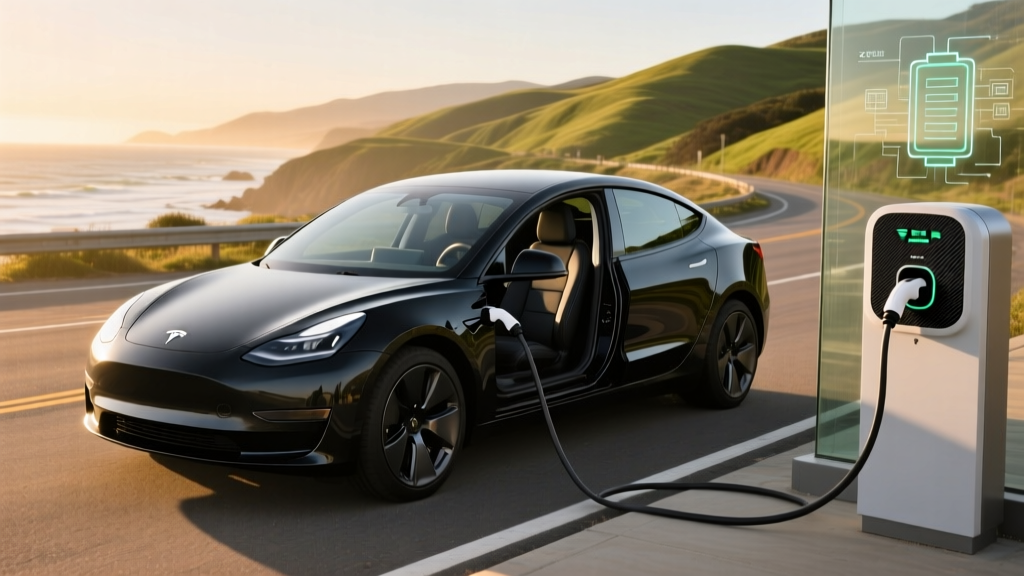
The 2024 Model 3 uses the NACS (North American Charging Standard) connector natively — the same plug now adopted by Ford, GM, Rivian, and most of the industry heading into 2026. This gives the Model 3 seamless access to the entire Tesla Supercharger network without an adapter, which remains the most reliable DC fast-charging ecosystem in North America.
| Charging Level | Power / Rate | Miles Added per Hour | Notes |
|---|---|---|---|
| Level 1 (120V household) | ~1.4 kW | ~3–5 mi/hr | Emergency/trickle only |
| Level 2 (240V / 48A Wall Connector) | 11.5 kW | ~44 mi/hr | Full charge in ~7–8 hrs |
| DC Fast (Supercharger V3/V4) | Up to 250 kW (LR/Perf) 170 kW (RWD) | Up to ~175 mi in 15 min (LR) | 10–80% in ~25 min (LR); tapers significantly above 80% |
Charging-curve reality check: The Long Range and Performance trims peak at 250 kW only briefly between roughly 10–30% state of charge. By 50% SoC, the rate drops to around 150 kW, and above 80% it falls below 50 kW. That 25-minute 10–80% time assumes battery preconditioning is active (the car automatically warms the pack when a Supercharger is entered in navigation). Without preconditioning — for example, at a non-Tesla DC charger with a cold battery — expect 10–80% to stretch to 35–40 minutes.
The RWD model's LFP (lithium iron phosphate) battery has a lower peak charge rate of 170 kW, but LFP chemistry has a key advantage: Tesla recommends regularly charging it to 100%, unlike the NMC packs in the Long Range and Performance trims where daily charging to 80% is recommended for longevity. This effectively narrows the usable range gap between the trims in daily driving.
Performance, Ride Quality, and Efficiency
The Highland refresh brought meaningful improvements to ride and handling. Tesla retuned the suspension, added frequency-selective dampers, and applied extensive acoustic glass and sound-deadening material. The result is a noticeably quieter cabin at highway speeds and fewer crash impacts over rough pavement compared to the pre-2024 Model 3 — areas where critics had long flagged it versus rivals like the BMW i4 and Hyundai Ioniq 6.
The Performance trim's 2.9-second 0–60 mph time is supercar territory, aided by dual-motor all-wheel drive with adaptive damping. The Long Range AWD's 4.2 seconds is brisk by any measure and more than adequate for highway merging and passing. Even the base RWD's 5.8-second run feels responsive thanks to the instant torque delivery characteristic of electric motors.
Efficiency remains a Tesla strong suit. The RWD model's 25 kWh/100 miles (132 MPGe combined) is among the best of any EV sold in the U.S., according to fueleconomy.gov. The Long Range's 28 kWh/100 miles is still excellent for a dual-motor AWD sedan. For context, the Hyundai Ioniq 6 SE Long Range achieves 140 MPGe combined (24 kWh/100mi) — slightly better — but with a smaller battery and less total range.
Interior, Cargo, Technology, and Driver Assists
The Highland interior overhaul replaced the minimalist-but-spartan feel of the earlier Model 3 with ambient lighting, ventilated front seats, a rear 8-inch touchscreen for passengers, and improved material quality (soft-touch surfaces, woven textile dash accents). The controversial removal of the turn-signal stalk (replaced by steering-wheel buttons) and gear selector stalk (replaced by touchscreen swipe) remains a polarizing choice and a genuine ergonomic step backward for some drivers.
Cargo and passenger space:
- Rear cargo (trunk + frunk): 23 cu ft total (19.8 cu ft trunk + 3.1 cu ft frunk)
- Rear legroom: 35.3 inches
- Front headroom: 40.3 inches
- Seating: 5 passengers
Compared to the Hyundai Ioniq 6 (12.3 cu ft trunk, no frunk), the Model 3 offers substantially more cargo versatility, though its trunk opening is narrower than a hatchback or liftback design would allow.
Tech and driver assists: The 15.4-inch center touchscreen runs Tesla's proprietary infotainment — no Apple CarPlay or Android Auto, which is a dealbreaker for some buyers. Navigation, over-the-air updates, Sentry Mode dashcam recording, and a robust mobile app are all included. Autopilot (lane centering + adaptive cruise) comes standard and is a competent SAE Level 2 system requiring constant driver supervision. Full Self-Driving (Supervised) — a $8,000 option at the time — adds automated lane changes, traffic-light recognition, and city-street navigation, but remains a Level 2 system, not a self-driving solution. Tesla's camera-only vision approach (no LiDAR or radar) continues to draw scrutiny in low-visibility conditions.
Autopilot and FSD (Supervised) are SAE Level 2 systems. The driver must keep hands on the wheel, eyes on the road, and remain fully responsible for vehicle operation at all times. These are not autonomous or self-driving systems. Only Level 4 services (e.g., Waymo) operate without a human driver.
Pricing, Tax Credit Eligibility, and Total Cost
At its 2024 launch, the Model 3 lineup was priced aggressively. In 2026, remaining new-old-stock and certified pre-owned examples trade at varied prices, but the original MSRP structure remains relevant for tax credit calculations and used-market benchmarks.
| Trim | 2024 Base MSRP | §30D Credit Potential | Effective Price (if eligible) |
|---|---|---|---|
| RWD | $38,990 | Up to $7,500 | ~$31,490 |
| Long Range AWD | $47,740 | Up to $7,500 | ~$40,240 |
| Performance | $52,990 | Up to $7,500 | ~$45,490 |
Federal tax credit rules (IRS §30D): The 2024 Model 3 Long Range and Performance qualified for the full $7,500 credit when new, as they met both critical-mineral and battery-component sourcing requirements and were below the $55,000 MSRP cap for sedans. The RWD model also qualified. However, eligibility depends on the buyer's modified adjusted gross income (≤$150,000 single / ≤$300,000 joint) and the vehicle's final assembly in North America. The credit can be transferred to the dealer at point of sale as an instant discount. For 2026 purchases of used 2024 Model 3 vehicles, a separate used-EV credit of up to $4,000 (30% of sale price, capped) may apply under §25E, subject to income caps and dealer reporting requirements. Always verify current eligibility at IRS.gov or with a qualified tax professional.
Warranty and Long-Term Ownership
- Basic vehicle warranty: 4 years / 50,000 miles
- Battery & drive unit warranty: 8 years / 100,000 miles (RWD) or 8 years / 120,000 miles (Long Range & Performance), with minimum 70% capacity retention guaranteed
- Maintenance: No scheduled engine/transmission maintenance; cabin air filter replacement recommended every 2–3 years; tire rotation every 6,250 miles
Tesla's battery warranty is competitive but not class-leading — Hyundai covers the Ioniq 6 battery for 10 years/100,000 miles. That said, real-world Tesla battery degradation data from fleet studies shows typical capacity loss of roughly 10–12% over 150,000 miles for NMC packs, with LFP packs in the RWD model showing even slower degradation curves. LFP chemistry's longer cycle life is a meaningful longevity advantage for high-mileage drivers.
Pros, Cons, and the Competition
- Best-in-class Supercharger network access (NACS native)
- Excellent efficiency (25–30 kWh/100mi across trims)
- Strong real-world DC charging speed (250 kW peak, 10–80% in ~25 min)
- LFP battery option (RWD) with 100% daily charge recommendation
- Over-the-air updates continuously add features
- Spacious cargo area with frunk (23 cu ft total)
- Highland ride/handling/NVH improvements are substantial
- No Apple CarPlay or Android Auto
- Stalkless turn signals and gear selector are divisive
- Camera-only Autopilot struggles in heavy rain/snow/glare
- Rear visibility is limited; no rear wiper
- Insurance premiums run 15–25% higher than segment average
- 4-year/50,000-mi basic warranty is shorter than Korean rivals
- Performance trim's stiff ride may not suit daily commuters
Key competitors in 2026: The Hyundai Ioniq 6 offers marginally better efficiency and a 10-year battery warranty but lacks a frunk and has slower DC charging (~350 kW peak on 800V architecture but limited station availability). The BMW i4 delivers superior interior quality and CarPlay but at a higher price point and with a smaller charging network. The Polestar 2 provides a more premium cabin and Google built-in but trails in range and charging speed.
Who Should Buy the 2024 Tesla Model 3?
- You road-trip frequently and want reliable, widespread DC fast-charging (Supercharger network)
- You prioritize efficiency and want to minimize your cost per mile
- You want a sporty sedan with genuine performance (especially Long Range and Performance trims)
- You're comfortable with Tesla's touchscreen-centric interface and camera-based driver assists
- You value over-the-air feature updates and a robust mobile app
- You need Apple CarPlay/Android Auto for daily navigation and music
- You frequently drive in heavy rain, snow, or fog and want radar/LiDAR-backed driver assists
- You want the longest warranty coverage (consider Hyundai/Kia)
- You prefer physical controls for turn signals, climate, and volume
Frequently Asked Questions
What is the real-world range of the 2024 Tesla Model 3?
The Long Range AWD's EPA rating is 341 miles, but real-world highway driving at 70–75 mph in moderate temperatures yields about 280–305 miles. In freezing weather, expect 240–265 miles. The RWD's 272-mile EPA rating translates to roughly 225–245 miles in cold highway conditions. Because the RWD uses an LFP battery that can be charged to 100% daily without degradation concern, its usable daily range is closer to the Long Range (which is typically charged to 80% for daily use, giving ~273 miles).
How fast does the 2024 Model 3 charge at home and on the road?
At home on a Level 2 Tesla Wall Connector (240V, 48A), the Model 3 charges at up to 11.5 kW, adding about 44 miles of range per hour — a full overnight charge from empty in 7–8 hours. On DC fast chargers, the Long Range and Performance peak at 250 kW (10–80% in about 25 minutes with preconditioning), while the RWD peaks at 170 kW (10–80% in about 28 minutes). Charging slows significantly above 80% SoC to protect battery health.
Does the 2024 Model 3 qualify for the federal EV tax credit?
When purchased new, all 2024 Model 3 trims qualified for the full $7,500 §30D federal tax credit, subject to buyer income limits ($150K single / $300K joint MAGI) and the $55,000 sedan MSRP cap. The credit could be applied as a point-of-sale discount. For used 2024 Model 3 purchases in 2026, the §25E used-EV credit may offer up to $4,000 (30% of the sale price, capped) if the buyer meets income requirements and the vehicle is purchased through a registered dealer. Always confirm current rules at IRS.gov.
Is the 2024 Model 3 worth buying over competitors in 2026?
For drivers who prioritize charging infrastructure reliability, efficiency, and performance-per-dollar, the 2024 Model 3 remains a top pick. The Supercharger network advantage is tangible on road trips. However, if interior quality, CarPlay support, or longer warranty coverage are higher priorities, the BMW i4, Hyundai Ioniq 6, or Polestar 2 are compelling alternatives. On the used market in 2026, the Model 3's strong depreciation curve (prices dropped significantly from MSRP) can make it an excellent value.
How long will the 2024 Model 3 battery last?
Tesla warranties the battery for 8 years / 100,000 miles (RWD) or 8 years / 120,000 miles (Long Range/Performance) with at least 70% capacity retention. Fleet data from sources like Recurrent Auto shows most Tesla Model 3 packs retain roughly 88–90% capacity at 100,000 miles. The RWD's LFP battery chemistry typically degrades even more slowly, making it an excellent choice for high-mileage drivers or those who plan to keep the vehicle well past the warranty period. Full battery replacement (out of warranty) currently costs approximately $12,000–$16,000 depending on trim.
What's the difference between LFP and NMC batteries in the Model 3?
The RWD trim uses an LFP (lithium iron phosphate) battery — it's slightly heavier, has lower energy density (hence the shorter EPA range), but offers a longer cycle life, slower degradation, and can be routinely charged to 100% without harm. The Long Range and Performance trims use NMC (nickel manganese cobalt) chemistry, which is lighter and more energy-dense (more range in the same space) but should be charged to 80% daily for longevity, reserving 100% for road trips. If you drive high daily miles and want maximum battery lifespan, the LFP RWD is the pragmatic choice.