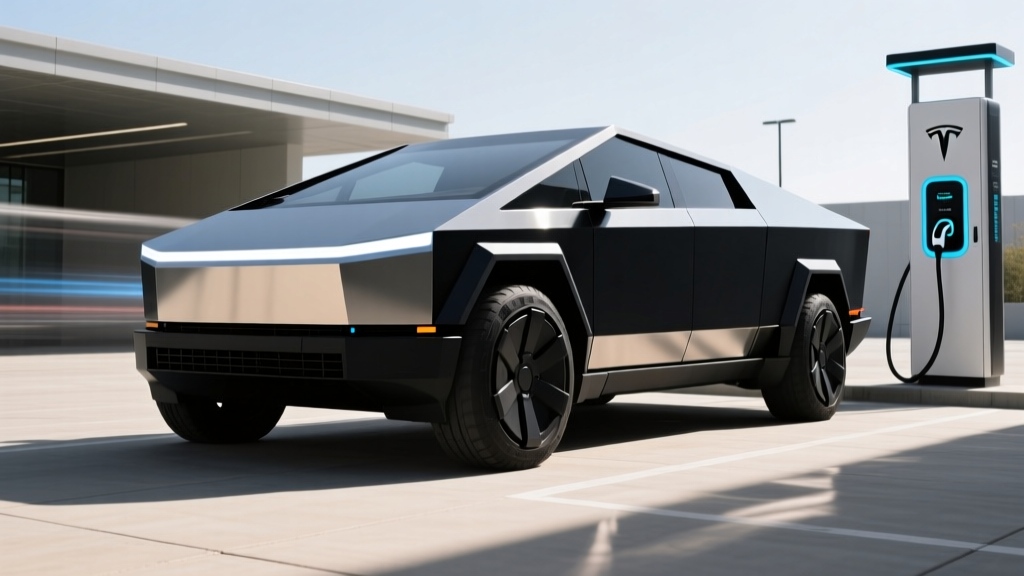
The 2024 Tesla Cybertruck Cyberbeast is the tri-motor flagship of Tesla's polarizing electric pickup lineup, combining supercar-level acceleration with a stainless-steel exoskeleton and a bed that's more vault than cargo bay. But beneath the angular armor and viral hype lies a practical question for serious truck buyers and EV enthusiasts: does the Cyberbeast deliver as a daily-driver pickup, or is it a $100,000 science project? After examining EPA data, real-world driving reports, and Tesla's own engineering specifications, we break down everything that matters — range, charging speed, tax credit eligibility, and whether this tri-motor beast justifies its premium over the Rivian R1T and Ford F-150 Lightning.
2024 Tesla Cybertruck Cyberbeast: Core Specifications at a Glance
| Specification | 2024 Cybertruck Cyberbeast |
|---|---|
| Base MSRP | $99,990 (before incentives) |
| EPA Range | 320 miles |
| Battery Capacity (usable) | ~123 kWh (NMC chemistry) |
| Drivetrain | Tri-Motor AWD (1 front, 2 rear) |
| Horsepower | 845 hp |
| 0–60 mph | 2.6 seconds |
| Top Speed | 130 mph |
| Max DC Fast Charge Rate | 250 kW (peak) |
| 10–80% DC Charge Time | ~28 minutes (est.) |
| Level 2 Home Charging | 11.5 kW / ~37 mi/hr |
| MPGe (combined) | 51 MPGe (2.0 kWh/mi) |
| Towing Capacity | 11,000 lbs |
| Payload Capacity | 2,500 lbs |
| Bed Length | 6 ft (72 in) with tailgate closed |
| Cargo Volume (bed + frunk) | ~67 cu ft bed + ~7 cu ft frunk |
| Battery/Drive Unit Warranty | 8 years / 120,000 miles |
| Basic Vehicle Warranty | 4 years / 50,000 miles |
Range: EPA Sticker vs. What You'll Actually Get
Real-World Expectation: Plan for 250–280 miles on sustained highway driving at 70–80 mph. In cold weather (below 32°F), expect a further 15–25% reduction, dropping effective range to roughly 200–240 miles. The Cyberbeast's heavy mass (~6,800 lbs), blunt aerodynamic profile, and large tire contact patch all work against highway efficiency compared to a sedan like the Model S.
The EPA rates the Cyberbeast at 320 miles on its combined cycle, which is a reasonable figure for mixed city/suburban driving where regenerative braking recovers significant energy. However, trucks live and die on the highway, and the Cyberbeast's efficiency drops notably at sustained speeds. Tesla originally promised over 500 miles of range with a range extender battery pack — that option has been delayed and may never materialize for the Cyberbeast trim specifically.
In real-world testing by multiple outlets, the Cyberbeast averages approximately 2.0 kWh per mile (50 MPGe equivalent) in mixed conditions, but highway-only loops at 75 mph push consumption closer to 2.3–2.5 kWh/mile. For road-trip planning, budgeting 250 miles between charging stops is the prudent approach, especially in winter or when towing.
Charging Speed: DC Fast Charging and Home Level 2
The Cyberbeast uses the North American Charging Standard (NACS) connector — the port Tesla pioneered and which has now been adopted by nearly every major automaker. Here's what charging looks like across the three levels:
| Charging Level | Power (kW) | Approximate Speed | Typical Use Case |
|---|---|---|---|
| Level 1 (120V) | ~1.4 kW | ~4–5 miles per hour | Emergency / trickle |
| Level 2 (240V, 48A) | 11.5 kW | ~37 miles per hour | Home overnight charging |
| DC Fast Charge | Up to 250 kW (peak) | 10–80% in ~28 min | Road trips, public stations |
Charging curve reality check: The Cyberbeast peaks near 250 kW only at low states of charge (roughly 10–25% SoC) with proper battery preconditioning. As the battery fills, charge rate tapers — by 60% SoC, you're likely seeing 120–150 kW, and above 80%, the rate drops sharply to protect the NMC cells. A full 10–80% session at a V3 Supercharger takes approximately 28 minutes under ideal conditions. At V4 Supercharger stalls or third-party 350 kW chargers, the Cyberbeast is still limited by its onboard charge acceptance to roughly 250 kW peak.
For home charging, a Tesla Wall Connector on a 60-amp circuit delivers the full 11.5 kW (48 amps continuous), adding roughly 37 miles of range per hour. A full overnight charge from 20% to 100% takes about 10–11 hours. Most Cyberbeast owners will charge from 50–80% nightly, which completes in roughly 3–4 hours.
Performance: 845 Horsepower in a Stainless Steel Wedge
The Cyberbeast's tri-motor powertrain produces 845 horsepower and launches the 6,800-pound truck to 60 mph in 2.6 seconds — making it one of the quickest production vehicles ever sold, regardless of powertrain. The dual rear motors and single front motor provide torque-vectoring AWD with independent rear-wheel torque control, which is genuinely useful off-road and in low-traction conditions.
Tesla's steer-by-wire system is the most polarizing engineering choice on the Cyberbeast. There is no mechanical connection between the yoke (or optional round wheel) and the front wheels — it's entirely electronic. The variable ratio means less than a full turn lock-to-lock, which eliminates hand-over-hand maneuvering but requires an adjustment period. At highway speeds, the system feels precise; at parking-lot speeds, some drivers report an artificial, video-game-like sensation.
Ride quality is managed by an adaptive air suspension with approximately 12 inches of travel and adjustable ride height. In "Extract" mode, the Cyberbeast raises to its maximum ground clearance of roughly 16 inches for off-road use. The suspension firms up noticeably in sport modes, which, combined with the truck's mass, produces body control that defies its size — but ride comfort over broken pavement is firm by luxury-truck standards.
Interior, Cargo, and Daily Usability
The Cyberbeast seats five across two rows. Rear legroom measures approximately 38 inches — adequate for adults on shorter trips, though the sloping roofline cuts into headroom for taller passengers. The front row offers generous space, with the minimalist dashboard dominated by an 18.5-inch touchscreen that handles nearly all vehicle functions, including glove-box release and mirror adjustments.
Cargo dimensions:
- Bed length: 72 inches (6 ft) with tailgate closed; extends to ~84 inches with the powered "vault" tailgate deployed as a ramp
- Bed width between wheel wells: ~43 inches (narrow — standard 4x8 sheets of plywood do NOT fit flat)
- Bed cargo volume: ~67 cubic feet
- Front trunk (frunk): ~7 cubic feet — lockable, drainable, useful for groceries or wet gear
- Max payload: 2,500 lbs
- Max towing: 11,000 lbs (though towing near max capacity will cut range by 40–50%)
The bed's powered retractable tonneau cover is a standout feature — it's rated to support 300 lbs of distributed weight (standing on it is fine), and it seals the bed from weather. However, the narrow width between wheel wells is a genuine limitation for anyone planning to haul building materials. This is a lifestyle truck, not a contractor's workhorse.
The rear "sail pillars" and angular rear window create significant blind spots. Tesla compensates with camera-based visibility — a rear-view camera feed displays on the touchscreen when backing up, and a camera-based "rearview mirror" option is available. It works, but it's another adaptation curve for traditional truck buyers.
Pricing, Trim Levels, and Federal Tax Credit Eligibility
| Trim | Base MSRP | Federal Tax Credit (§30D) | Effective Price (est.) |
|---|---|---|---|
| Cybertruck AWD (Dual Motor) | $79,990 | Up to $7,500 (if eligible) | ~$72,490 |
| Cybertruck Cyberbeast (Tri-Motor) | $99,990 | Up to $7,500 (if eligible) | ~$92,490 |
Federal EV tax credit (§30D) eligibility for the Cyberbeast is conditional. The Cyberbeast qualifies as a light truck under IRS rules, so the MSRP cap is $80,000 for trucks — wait, the Cyberbeast at $99,990 exceeds the $80,000 MSRP cap for trucks under §30D. This means the Cyberbeast trim does not qualify for the $7,500 federal tax credit. The dual-motor AWD trim at $79,990 sits at the cap boundary and may qualify depending on option packaging.
For the dual-motor AWD trim that does fall under the cap, buyers must also meet:
- Income limits: Modified AGI ≤ $300,000 (joint filers), $225,000 (head of household), $150,000 (single)
- Battery sourcing requirements: Critical minerals and battery components must meet phased-in thresholds per IRS §30D rules — Tesla's domestic battery production generally satisfies current-year requirements, but this should be verified at point of sale
- Point-of-sale transfer: Eligible buyers can transfer the credit to the dealer for an immediate price reduction rather than waiting to claim it on their tax return
Bottom line: If you're buying the Cyberbeast specifically, plan to pay full MSRP. The tax credit is a factor only for the lower dual-motor trim, and even then, income and sourcing rules apply. Consult a tax professional before relying on credit eligibility.
Technology, Driver Assistance, and Software
The Cyberbeast ships with Tesla's latest infotainment stack running on a Ryzen-powered processor. The 18.5-inch front touchscreen is supplemented by a 9.4-inch rear touchscreen for back-seat passengers. Wireless Apple CarPlay and Android Auto are not supported — Tesla uses its own interface exclusively, which includes native navigation, Spotify, Netflix/YouTube (while parked), and a robust trip planner with Supercharger routing.
Driver assistance — SAE Level 2, not self-driving:
Tesla's Autopilot and Full Self-Driving (Supervised) are Level 2 driver-assist systems, not autonomous driving. The driver must remain fully engaged, hands on the wheel (or applying torque to the yoke), and eyes on the road at all times. FSD (Supervised) can navigate on-ramps, city streets, and traffic lights, but it makes errors, requires constant supervision, and does not absolve the driver of legal responsibility. True driverless capability (Level 4) currently exists only in geofenced robotaxi services like Waymo.
The Cyberbeast includes standard Autopilot (adaptive cruise control + lane centering). Full Self-Driving (Supervised) is an $8,000 option (or $99/month subscription as of current pricing) that adds automatic lane changes, traffic-light recognition, and city-street navigation. The system has improved substantially but still struggles with construction zones, faded lane markings, and unprotected left turns. Treat it as a fatigue-reduction tool, not a chauffeur.
Unique Cyberbeast tech features include:
- Steer-by-wire with variable steering ratio (no mechanical linkage)
- 48-volt electrical architecture — a first for a mass-production vehicle, reducing wiring harness weight and enabling more powerful accessories
- Powered vault bed cover with 300-lb load rating
- Bioweapon Defense Mode (HEPA air filtration)
- Armor glass — laminated stainless-steel-framed glass, more impact-resistant than conventional auto glass
- V2H capability (vehicle-to-home) announced but not yet fully enabled via software
Ownership Costs, Warranty, and Long-Term Considerations
The Cyberbeast carries an 8-year/120,000-mile warranty on the battery pack and drive units — slightly more mileage coverage than Tesla's standard 8-year/100,000-mile warranty on its sedan platforms, reflecting the truck's heavier-duty positioning. The basic vehicle warranty covers 4 years or 50,000 miles.
The ~123 kWh NMC battery pack is liquid-cooled with an advanced thermal management system. Tesla does not publish an official degradation curve for the Cybertruck specifically, but based on Model S/X NMC data, owners can reasonably expect 10–15% capacity loss over 150,000 miles under normal use. The warranty guarantees a minimum of 70% capacity retention over the 8-year/120,000-mile period.
Estimated 5-year operating cost highlights:
- Electricity (home charging at $0.14/kWh): ~$4,800 for 60,000 miles (at 2.0 kWh/mi)
- Equivalent gasoline cost (15 MPG truck at $3.50/gal): ~$14,000 for 60,000 miles
- Estimated fuel savings vs. gas truck: ~$9,200 over 5 years
- Insurance: Expect premiums 25–40% higher than a comparable F-150 Lightning, driven by the Cyberbeast's $100K price, stainless-steel body repair complexity, and performance classification. Get quotes before ordering.
- Tires: The Cyberbeast uses a proprietary 35x8.5R20 tire — replacement costs are estimated at $400–$500 per tire, and availability may be limited compared to standard truck tires
Cyberbeast vs. Rivian R1T Tri-Motor and Ford F-150 Lightning Platinum
| Attribute | 2024 Cybertruck Cyberbeast | 2024 Rivian R1T Tri-Motor | 2024 F-150 Lightning Platinum |
|---|---|---|---|
| MSRP | $99,990 | ~$99,900 | ~$96,874 |
| EPA Range | 320 mi | ~380 mi (Max Pack) | 300 mi (Ext. Range) |
| Horsepower | 845 hp | 850 hp | 580 hp |
| 0–60 mph | 2.6 sec | ~3.0 sec | ~3.8 sec |
| Max DC Charge | 250 kW | ~220 kW | 150 kW |
| Bed Length | 72 in | 54 in (+ Gear Tunnel) | 67 in |
| Towing | 11,000 lbs | 11,000 lbs | 10,000 lbs |
| Tax Credit (§30D) | Not eligible (over MSRP cap) | Eligible (under $80K cap varies by pack) | Eligible (under $80K cap varies) |
Choose the Rivian R1T if: You want superior off-road capability (quad-motor tank turns), a more traditional steering feel, the Gear Tunnel for creative storage, and potential tax credit eligibility on lower trims.
Choose the F-150 Lightning if: You need a proven work-truck platform, dealer-service accessibility, Pro Power Onboard for job-site power, and a lower entry price with tax credit eligibility.
Pros, Cons, and Verdict
Pros
- 2.6-second 0–60 mph — absurdly quick for any vehicle, let alone a 6,800-lb truck
- Access to Tesla's Supercharger network (most reliable public DC charging in the US)
- Stainless-steel exoskeleton resists dents and corrosion
- Powered vault bed cover is genuinely useful and robust
- 48-volt architecture is an industry-first engineering achievement
- Over-the-air updates continue to add features post-purchase
- 11,000-lb towing capacity matches conventional heavy-duty trucks
Cons
- $99,990 MSRP exceeds the §30D tax credit cap — no federal incentive
- Real-world highway range drops to ~250 miles; cold weather compounds the loss
- Bed width between wheel wells (43 in) won't fit standard plywood sheets flat
- Steer-by-wire requires significant driver adaptation and feels artificial to some
- Proprietary tires are expensive and may have limited availability
- Rear visibility is poor; reliance on cameras frustrates some drivers
- Insurance premiums significantly higher than competing electric trucks
- Build quality on early-production 2024 units drew panel-gap and trim complaints
Verdict: The 2024 Tesla Cybertruck Cyberbeast is an engineering showcase — the quickest, most technologically dense electric pickup on the market. But it is not a universal truck replacement. It excels as a high-performance daily driver with genuine utility (11,000-lb towing, a sealed 6-foot bed, and a frunk), yet it compromises on bed width, rear-seat headroom, and real-world highway range. If you're a Tesla-ecosystem loyalist who values acceleration, software, and Supercharger access above all else, the Cyberbeast delivers. If you need a contractor-grade work truck, maximum range, or tax-credit savings, the Rivian R1T or F-150 Lightning are more pragmatic choices.
Frequently Asked Questions
What is the real-world range of the 2024 Cybertruck Cyberbeast?
The EPA rates the Cyberbeast at 320 miles combined. In real-world highway driving at 70–80 mph, expect approximately 250–280 miles. In freezing temperatures, effective range can drop to 200–240 miles. Plan road trips around 220–250 miles between Supercharger stops for a comfortable buffer.
How fast does the Cyberbeast charge on DC fast chargers and at home?
At a Tesla V3 Supercharger (250 kW capable), the Cyberbeast charges from 10–80% in approximately 28 minutes under ideal conditions with battery preconditioning. Peak charge rate of ~250 kW is sustained only at low SoC and tapers significantly above 60%. At home on a Level 2 Wall Connector (11.5 kW), you'll add roughly 37 miles per hour, fully replenishing the ~123 kWh pack in about 10–11 hours.
Does the Cyberbeast qualify for the $7,500 federal EV tax credit?
No. The Cyberbeast's $99,990 MSRP exceeds the IRS §30D MSRP cap of $80,000 for trucks, vans, and SUVs. The dual-motor AWD Cybertruck at $79,990 may qualify, subject to buyer income limits (≤$300K joint), battery-sourcing requirements, and point-of-sale transfer availability. Always verify current eligibility on IRS.gov and with a tax professional before purchasing.
Is the Cyberbeast worth buying over the Rivian R1T or F-150 Lightning?
It depends on your priorities. The Cyberbeast wins on acceleration (2.6 sec 0–60), Supercharger network access, and bed length (6 ft). The Rivian R1T offers better off-road capability, a more conventional steering feel, and superior range with its Max Pack (~380 mi). The F-150 Lightning wins on price, dealer service infrastructure, work-truck practicality, and tax credit eligibility. If performance and Tesla's ecosystem are paramount, the Cyberbeast justifies its price. For work or value, look elsewhere.
What are the biggest drawbacks of owning a Cyberbeast?
The most common owner complaints center on real-world range falling short of the EPA sticker (especially on highways and in cold weather), the steep learning curve of steer-by-wire, narrow bed width that won't accommodate standard plywood sheets, expensive proprietary tires, high insurance premiums, and the polarizing angular design that draws attention whether you want it or not. Early 2024 build-quality issues (panel gaps, trim rattles) have been documented but are improving with production maturity.
How long will the Cyberbeast battery last, and what does replacement cost?
Tesla warranties the battery for 8 years or 120,000 miles with a minimum 70% capacity retention guarantee. Based on NMC chemistry data from Tesla's sedan fleet, expect roughly 10–15% degradation over 150,000 miles with normal charging habits (avoiding frequent 100% charges and deep discharges). A full battery replacement outside of warranty would likely cost $20,000–$30,000 based on current Tesla pack pricing, though costs are expected to decline over the next decade.