Why the 2024 Tesla Cybertruck's Curb Weight Matters for Buyers
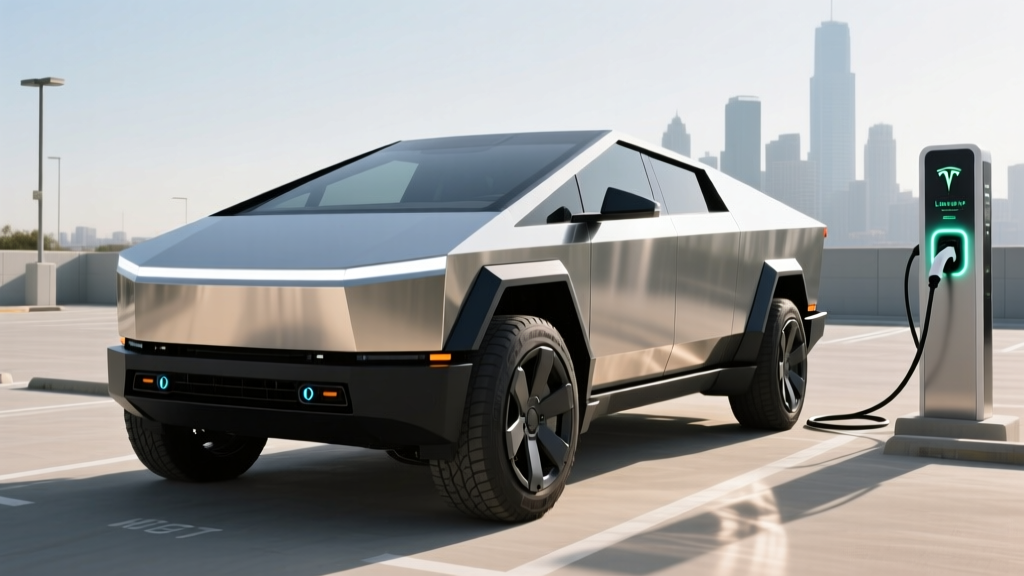
When Tesla finally delivered the first Cybertrucks in late 2023, one spec dominated forums and spec-sheet debates: mass. The 2024 Tesla Cybertruck curb weight ranges from approximately 6,603 lbs (Dual Motor AWD) to 6,843 lbs (Cyberbeast tri-motor), according to Tesla's published specifications. For context, that's roughly 1,000 lbs heavier than a Ford F-150 Lightning Extended Range and nearly 2,000 lbs more than a Rivian R1T with the Large Pack.
Why does curb weight matter beyond bragging rights or internet arguments? It directly impacts three things every EV truck buyer cares about: real-world range (heavier vehicles consume more kWh per mile), tire wear (the Cybertruck uses expensive, application-specific 35-inch tires), and payload/towing efficiency. Understanding the weight story is essential to understanding whether this truck fits your use case.
| Spec | Dual Motor AWD | Cyberbeast (Tri-Motor) |
|---|---|---|
| Curb Weight | ~6,603 lbs | ~6,843 lbs |
| EPA Range | 340 miles | 320 miles |
| Battery (usable, est.) | ~123 kWh (NMC) | ~123 kWh (NMC) |
| Horsepower | 600 hp | 845 hp |
| 0–60 mph | 4.1 seconds | 2.6 seconds |
| Max DC Fast Charge | 250 kW | 250 kW |
| 10–80% DC Charge Time | ~28 min | ~28 min |
| Level 2 Charge Rate | 11.5 kW (~37 mi/hr) | 11.5 kW (~37 mi/hr) |
| MPGe (combined) | 79 MPGe | 74 MPGe |
| Efficiency | 48 kWh/100 mi | 51 kWh/100 mi |
| Max Towing | 11,000 lbs | 11,000 lbs |
| Payload Capacity | 2,500 lbs | 2,500 lbs |
| Base MSRP (at launch) | $79,990 | $99,990 |
Sources: Tesla Cybertruck Design Page, EPA fueleconomy.gov.
Real-World Range: What the EPA Number Doesn't Tell You
Dual Motor AWD: EPA 340 miles. Expect ~270–295 miles at sustained 75 mph highway speeds; ~220–250 miles in sub-freezing temperatures with cabin heat.
Cyberbeast: EPA 320 miles. Expect ~255–280 miles highway; ~200–235 miles in cold weather.
The Cybertruck's curb weight, combined with its angular stainless-steel exoskeleton (which creates more aerodynamic drag than a rounded body), means highway efficiency suffers noticeably compared to lighter, sleeker EVs. At 48–51 kWh per 100 miles, the Cybertruck consumes roughly 60% more energy per mile than a Tesla Model Y Long Range.
During cold-weather testing in the 20s (°F), expect 25–35% range reduction. This is typical for EVs without a dedicated heat-pump-optimized thermal strategy under heavy cabin-heating loads. The Cybertruck does include a heat pump, but the sheer cabin volume and stainless steel's thermal conductivity work against it. If your commute is mostly city/suburban with regenerative braking opportunities, you'll land closer to the EPA sticker. Highway road-trippers should plan charging stops around 220–250 miles of usable range to maintain a comfort buffer.
The Foundation Series models delivered in 2024 included a range-extender option (a bed-mounted battery pack) that Tesla quoted at 470+ miles. However, this was a limited early-production package and is not broadly available. For the standard production configurations, 340 and 320 miles are the numbers to plan around.
Charging Speed: DC Fast Charging and Home Level 2
The Cybertruck uses the NACS (North American Charging Standard) connector natively — no adapter needed for Tesla Superchargers. It supports a peak DC fast-charge rate of 250 kW at V3 Supercharger stations, which Tesla estimates delivers up to 128 miles of range in 10 minutes under optimal conditions.
| Charging Level | Power | Speed | Notes |
|---|---|---|---|
| Level 1 (120V) | ~1.2 kW | ~3–4 mi/hr | Emergency/trickle only; full charge takes days |
| Level 2 (240V, 48A) | 11.5 kW | ~37 mi/hr | Full charge in ~10–11 hours; ideal for overnight |
| DC Fast (V3 Supercharger) | Peak 250 kW | 10–80% in ~28 min | Charge curve tapers significantly above 60% SoC |
| DC Fast (V4 Supercharger) | Up to 250 kW | Similar to V3 | Wider stalls, easier access for large vehicles |
A critical detail many spec sheets gloss over: the charging curve. The Cybertruck's ~123 kWh battery can accept peak power only at lower states of charge (roughly 10–40% SoC). As the battery fills, the charge rate tapers to protect cell longevity. A 10–80% session takes about 28 minutes, but pushing from 80–100% can add another 30–40 minutes. On road trips, plan to charge to 80% and move on — the time penalty for the last 20% is severe.
For home charging, a Wall Connector on a 60-amp circuit delivers the full 11.5 kW (48 amps continuous). That translates to roughly 37 miles of range per hour of charging, or a full 0–100% charge in about 10–11 hours. If your electrical panel only supports a 40-amp circuit (32A continuous), expect ~7.7 kW and roughly 25 mi/hr. Budget $500–$2,500 for professional installation depending on panel capacity and run length — consult a licensed electrician for your specific situation.
Performance: 0–60, Horsepower, and Drivetrain
Despite its mass, the Cybertruck delivers sports-car acceleration in the Cyberbeast trim. The tri-motor Cyberbeast produces 845 hp and hits 0–60 mph in 2.6 seconds — making it one of the quickest production trucks ever built. The Dual Motor AWD is no slouch either, with 600 hp and a 4.1-second 0–60.
Both configurations use a dual-motor or tri-motor all-wheel-drive layout with torque vectoring. The Cyberbeast adds a rear-axle dual-motor setup with independent torque control, which enhances both straight-line grip and off-road capability.
The air suspension provides up to 16 inches of ground clearance in Extract Mode (for off-road use) and automatically adjusts ride height based on speed and terrain. Approach, departure, and breakover angles are competitive with body-on-frame trucks, though the Cybertruck's unibody exoskeleton construction is fundamentally different from traditional truck architecture.
Steer-by-wire is standard — there is no mechanical connection between the steering yoke and the wheels. This enables a variable steering ratio (less than a full lock-to-lock turn at low speeds), but it takes acclimation. Some drivers love the precision; others find the yoke unintuitive, especially during three-point turns or parking maneuvers.
Pricing, Trims, and Federal Tax Credit Eligibility
| Trim | Base MSRP | Federal §30D Credit | Effective Price (if eligible) |
|---|---|---|---|
| RWD (announced, ~2025) | $60,990 | Up to $7,500 | ~$53,490 |
| Dual Motor AWD | $79,990 | Up to $7,500 | ~$72,490 |
| Cyberbeast | $99,990 | Up to $7,500 | ~$92,490 |
Important tax credit caveats: The IRS §30D federal tax credit has multiple eligibility gates that apply to the Cybertruck:
- MSRP Cap: Trucks/vans/SUVs must have an MSRP at or below $80,000. The Dual Motor AWD ($79,990) qualifies; the Cyberbeast ($99,990) does not.
- Buyer Income Cap: Modified adjusted gross income must not exceed $300,000 (joint), $225,000 (head of household), or $150,000 (single).
- Battery Sourcing: Critical minerals and battery component requirements phase in annually. Verify current-year compliance on IRS.gov qualified vehicle list.
- Point-of-Sale Transfer: As of 2024, eligible buyers can transfer the credit to the dealer at purchase, reducing the upfront cost rather than waiting for a tax refund.
The RWD trim was announced at $60,990 but was not available for delivery in 2024 — it was targeted for 2025 production. The Foundation Series models delivered to early reservation holders included premium packages that pushed prices above $100,000 even on the Dual Motor configuration. Always verify the exact as-tested or as-configured price with Tesla's current configurator.
Consult a tax professional to confirm your personal eligibility. Credit rules are subject to change, and battery-sourcing requirements have disqualified several vehicles mid-year in the past.
Cargo Space, Interior, and Practicality
The Cybertruck's 6-foot bed (with a motorized tonneau cover) offers ~67 cu ft of cargo volume in the bed. The vault includes a built-in ramp, 120V and 240V outlets (up to 9.6 kW of onboard power for tools or appliances), and integrated storage compartments in the bed walls.
Interior passenger space seats five. Front headroom and legroom are generous; rear-seat legroom is adequate for adults but not class-leading compared to a full-size crew cab. The rear seats fold flat to extend interior cargo capacity through the pass-through.
The front trunk (frunk) provides additional sealed storage — useful for groceries, charging cables, or gear you want to keep separate from the bed. Total frunk volume is approximately 7 cu ft.
The 18.5-inch center touchscreen handles nearly all vehicle functions, including climate, glove box, and mirror adjustments. There are minimal physical controls. A rear 9.4-inch touchscreen serves back-seat passengers. The UI is Tesla's familiar interface, though the Cybertruck runs an updated vehicle-specific build with off-road and tow/haul modes.
Battery Chemistry, Warranty, and Long-Term Ownership
The Cybertruck uses an NMC (nickel manganese cobalt) battery chemistry in a structural pack with approximately 123 kWh of usable capacity. NMC cells offer higher energy density than LFP (lithium iron phosphate), which is necessary given the truck's mass and range targets — but they are more sensitive to sustained high states of charge.
Tesla recommends daily charging to 80% for NMC batteries and reserving 100% for trips. This is a meaningful ownership habit: consistently charging to 100% and leaving the truck parked at full SoC can accelerate degradation.
Warranty coverage:
- Battery & Drive Unit: 8 years / 150,000 miles (whichever comes first), with a minimum 70% capacity retention threshold.
- Vehicle Limited Warranty: 4 years / 50,000 miles bumper-to-bumper.
Battery replacement costs for a pack of this size are estimated at $20,000–$30,000+ out of warranty, based on current Tesla service pricing for large-pack vehicles. However, Tesla's degradation data across its fleet suggests most packs retain 85–90% capacity at 150,000 miles under normal use patterns. The Cybertruck's thermal management system is robust, which should support long-term cell health.
Driver Assistance and Standout Tech
Tesla's Autopilot and Full Self-Driving (Supervised) are SAE Level 2 driver-assistance systems. The driver must remain fully engaged, hands on the yoke (or applying torque), and eyes on the road at all times. These systems do not make the Cybertruck self-driving. Only Level 4 services like Waymo operate without a human driver in geofenced areas.
The Cybertruck ships with Tesla's latest Autopilot hardware (HW4/AI4), including higher-resolution cameras and improved processing. FSD (Supervised) is available as a $8,000 add-on or $99/month subscription. It handles highway lane changes, on/off-ramp navigation, and city street turns — but requires constant supervision and intervention in construction zones, complex intersections, and adverse weather.
Other standout technology includes:
- Steer-by-wire with variable ratio — no mechanical steering column
- 48-volt electrical architecture — a first for a production vehicle at this scale, enabling thinner wiring harnesses and more efficient power distribution
- Powershare — bidirectional charging with up to 9.6 kW output for job-site tools, tailgating, or emergency home backup
- Armor glass — laminated stainless-steel-framed glass (more resistant to impact than conventional auto glass, though not impervious)
- Adaptive air suspension with automatic load-leveling when towing
- Stainless-steel body panels show fingerprints, smudges, and are difficult to repair — panel replacement is often required after dents
- Steer-by-wire yoke takes significant acclimation; some drivers find it unsafe for low-speed maneuvers
- No Apple CarPlay or Android Auto — Tesla's proprietary infotainment only
- High energy consumption (48–51 kWh/100 mi) means expensive road-trip charging
- Visibility is compromised by the angular design and thick A-pillars
- Tire costs are high — the custom 35-inch tires are expensive and may have limited availability
Who Should Buy the Cybertruck — And Who Shouldn't
Choose the Cybertruck if:
- You need a full-size electric truck for towing (11,000 lb rating) and job-site power (9.6 kW V2L)
- You want head-turning design and are willing to accept the practical trade-offs of stainless steel
- You're a Tesla ecosystem user who values Supercharger network access and over-the-air updates
- Acceleration and performance are priorities (2.6s Cyberbeast is supercar-quick)
Look elsewhere if:
- Maximum efficiency and lowest cost-per-mile matter most (a Model Y or F-150 Lightning is more efficient)
- You prefer traditional steering and physical controls
- You need proven long-term reliability data — the Cybertruck is a first-generation product with novel construction
- Your budget is under $70,000 and you need a truck now (consider the F-150 Lightning or wait for the RWD Cybertruck)
2024 Cybertruck vs. Key Competitors
| Spec | Cybertruck AWD | F-150 Lightning (Ext. Range) | Rivian R1T (Large Pack) |
|---|---|---|---|
| Curb Weight | ~6,603 lbs | ~6,358 lbs | ~7,148 lbs |
| EPA Range | 340 mi | 320 mi | 352 mi |
| Max Tow | 11,000 lbs | 10,000 lbs | 11,000 lbs |
| 0–60 mph | 4.1 sec | 3.8 sec | 3.0 sec |
| Peak DC Charge | 250 kW | 150 kW | 220 kW |
| Base MSRP | $79,990 | ~$69,995 | ~$79,900 |
| §30D Credit Eligible | Yes (Dual Motor) | Yes (select trims) | Yes (Dual-Motor) |
The Cybertruck's advantage is its combination of range, towing, and DC fast-charge speed. The F-150 Lightning wins on familiarity, dealer service network, and lower starting price. The Rivian R1T offers the best build quality and adventure-oriented design but at a weight and price penalty. None of these trucks are cheap to operate per-mile compared to a sedan or crossover EV — that's the physics of moving 6,500+ lbs.
Frequently Asked Questions
What is the 2024 Tesla Cybertruck curb weight?
The 2024 Tesla Cybertruck curb weight is approximately 6,603 lbs for the Dual Motor AWD and 6,843 lbs for the Cyberbeast tri-motor variant. These figures reflect the stainless-steel exoskeleton, structural battery pack, and heavy-duty suspension components.
What is the real-world range of the Cybertruck?
The EPA rates the Dual Motor at 340 miles and the Cyberbeast at 320 miles. In real-world highway driving at 75 mph, expect 270–295 miles (Dual Motor) and 255–280 miles (Cyberbeast). In sub-freezing temperatures, reduce those estimates by 25–35%.
How fast does the Cybertruck charge at home and on the road?
On a DC fast charger (Tesla Supercharger), the Cybertruck peaks at 250 kW, achieving a 10–80% charge in approximately 28 minutes. At home on a Level 2 Wall Connector (11.5 kW), it gains roughly 37 miles of range per hour, with a full charge taking about 10–11 hours.
Does the 2024 Cybertruck qualify for the $7,500 federal tax credit?
The Dual Motor AWD ($79,990 MSRP) falls under the $80,000 truck MSRP cap and may qualify for up to $7,500 under IRS §30D, provided the buyer meets income limits and the vehicle meets battery-sourcing requirements. The Cyberbeast ($99,990) exceeds the MSRP cap and does not qualify. Always verify current eligibility on IRS.gov and consult a tax professional.
Is the Cybertruck worth buying over the F-150 Lightning or Rivian R1T?
The Cybertruck offers the longest EPA range and fastest DC charging in the electric truck segment, plus unique tech like steer-by-wire and 48V architecture. However, the F-150 Lightning provides a more conventional truck experience with broader dealer support and a lower entry price. The Rivian R1T excels in build quality and off-road refinement. Your choice depends on whether you prioritize Tesla's ecosystem and performance, Ford's practicality, or Rivian's adventure focus.
How does the Cybertruck's weight affect tire wear and maintenance?
At 6,600+ lbs, the Cybertruck puts significant load on its tires. The custom 35-inch all-terrain tires are proprietary and carry a premium replacement cost. Expect tire rotations every 6,250 miles and plan for replacement sooner than a lighter vehicle. The regenerative braking system reduces brake pad wear substantially — many EV owners report brake life exceeding 100,000 miles.
Can the Cybertruck power my home or job-site tools?
Yes. Tesla's Powershare feature provides up to 9.6 kW of bidirectional power through 120V and 240V outlets in the bed and frunk. This is sufficient to run most job-site equipment simultaneously, power a tailgate setup, or provide emergency home backup during outages (with proper transfer switch installation by an electrician).