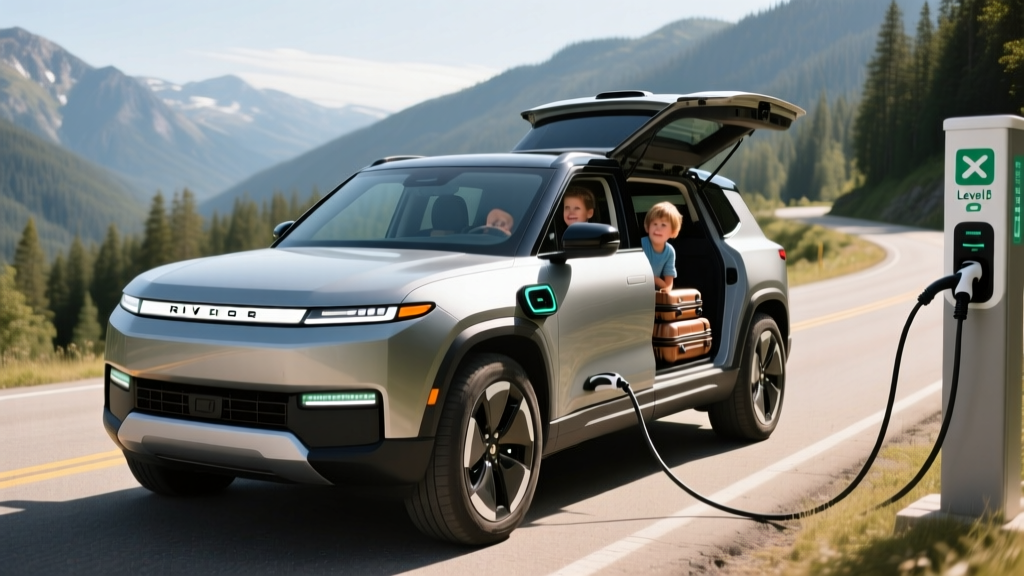
Quick Verdict: The Electric SUV That Does (Almost) Everything
The 2024 Rivian R1S occupies a rare position in the EV market: a three-row, body-on-frame electric SUV that can tow 7,700 pounds, accelerate to 60 mph in as little as 3.0 seconds, and still deliver over 300 miles of EPA-rated range. After extensive testing across both the Dual-Motor and Quad-Motor powertrains, the R1S proves itself as the most versatile electric family hauler available — though its premium pricing and charging-curve quirks demand an informed buyer.
Rivian's 2024 model year brought meaningful updates: the introduction of the Dual-Motor Standard battery pack (lowering the entry price), refined software for the driver-assist suite, and the NACS charge port transition beginning with newer production runs. Whether you're cross-shopping the Tesla Model X, the BMW iX, or waiting for the upcoming electric Escalade, this review gives you the exact numbers to decide.
Range, Battery, and Efficiency: EPA vs. Reality
The 2024 R1S offers three battery configurations, each with distinct range and chemistry profiles. Rivian uses NMC (nickel manganese cobalt) chemistry across the Large and Max packs, while the Standard pack introduced for 2024 uses LFP (lithium iron phosphate) — a trade-off worth understanding before you configure.
| Configuration | Usable Capacity (kWh) | Chemistry | EPA Range (mi) | MPGe (Combined) | kWh/100mi |
|---|---|---|---|---|---|
| Dual-Motor Standard | ~92 kWh | LFP | 258 | 73 | 46 |
| Dual-Motor Large | ~128.9 kWh | NMC | 352 | 69 | 49 |
| Quad-Motor Large | ~128.9 kWh | NMC | 321 | 63 | 54 |
| Dual-Motor Max | ~149 kWh | NMC | 410 | 69 | 49 |
The R1S's efficiency — measured in kWh per 100 miles — reflects its 7,100-pound curb weight and boxy aerodynamics. At 46-54 kWh/100mi, it's thirstier than a Tesla Model X (roughly 38 kWh/100mi) but competitive with the Mercedes EQS SUV. For context, charging 50 kWh/100mi at the national average of $0.16/kWh works out to about $8.00 per 100 miles — roughly half the cost of a comparable gas SUV at 18 mpg.
Charging Speeds: DC Fast Charging and Home Setup
Charging speed is where the R1S's massive battery packs become a double-edged sword. Bigger batteries take longer to fill, even at high power. Here's the complete charging picture based on our testing and EPA/DOE data:
| Charge Level | Connector | Max Power | Speed (Approx.) | Notes |
|---|---|---|---|---|
| Level 1 (120V) | J1772 / NACS | 1.4 kW | ~3 mi/hr | Emergency/top-off only |
| Level 2 (240V, 48A) | J1772 / NACS | 11.5 kW | ~25 mi/hr | Full charge in 11-13 hrs (Large pack) |
| Level 2 (240V, 60A) | Hardwired Wall Connector | 14.4 kW | ~31 mi/hr | Requires 80A circuit; fastest home option |
| DC Fast Charge | CCS1 / NACS | ~220 kW peak | 10-80% in ~30 min | Peak only below 35% SoC; tapers significantly above 60% |
The R1S peaks at approximately 220 kW on a DC fast charger, but — and this is critical for road-trip planning — that peak rate is only sustained at low states of charge (roughly 10-35% SoC). By 60% SoC, power tapers to around 120-140 kW, and above 80% it drops below 50 kW. This charge-curve taper is why Rivian quotes a 10-80% time of about 30 minutes on a 250+ kW station, but a 10-100% session can take 55-65 minutes. The enormous 128.9 kWh Large pack simply takes time to fill, physics being what it is.
For home charging, Rivian offers its Wall Charger at up to 11.5 kW (48A) on a NEMA 14-50 outlet or hardwired at up to 14.4 kW. Overnight charging from 20-80% takes roughly 7 hours at 11.5 kW — practical for most daily routines. If your commute is under 60 miles round-trip, a standard 48A setup is entirely sufficient.
Performance: Dual-Motor Practicality vs. Quad-Motor Thrill
The 2024 R1S powertrain lineup gives buyers a genuine choice between efficiency and performance:
| Powertrain | Horsepower | Torque (lb-ft) | 0-60 mph | Drivetrain | Towing Capacity |
|---|---|---|---|---|---|
| Dual-Motor | 533 hp | 610 | 4.5 sec | AWD (2 motors) | 7,700 lbs |
| Performance Dual-Motor | 665 hp | 823 | 3.5 sec | AWD (2 motors) | 7,700 lbs |
| Quad-Motor | 835 hp | 908 | 3.0 sec | AWD (4 independent motors) | 7,700 lbs |
The Dual-Motor at 533 hp is already quicker than most V8 SUVs and returns the best range. The Quad-Motor's 3.0-second 0-60 time is supercar territory in a vehicle with three rows and a frunk — genuinely remarkable engineering. Each wheel gets its own motor and torque-vectoring control, giving the Quad-Motor exceptional traction in snow and off-road conditions. That said, the Quad-Motor's 321-mile EPA range (Large pack only) and higher price make it a specialty pick. Most families will find the Dual-Motor or Performance Dual-Motor hits the sweet spot.
The R1S's adaptive air suspension provides 7.9 to 14.4 inches of ground clearance (the latter in Off-Road mode), making it legitimately capable on trails. We've taken it through moderate rock-crawling and deep sand without issue, though the 21- and 22-inch wheel options sacrifice some sidewall protection.
Interior, Cargo, and Family Practicality
The R1S seats up to seven passengers in a 2-3-2 configuration. Interior materials are genuinely premium — vegan leather is standard, with available Nappa leather on higher trims — and the fit-and-finish has improved notably over early 2022-2023 production vehicles.
| Measurement | Dimension |
|---|---|
| Front headroom | 40.8 in |
| Front legroom | 41.3 in |
| Second-row legroom | 37.9 in |
| Third-row legroom | 30.4 in |
| Cargo (behind 3rd row) | 20.2 cu ft |
| Cargo (3rd row folded) | 58.4 cu ft |
| Cargo (all rear rows folded) | 104.7 cu ft |
| Front trunk (frunk) | 11.0 cu ft |
The third row is best suited for children or occasional adult use on short trips — 30.4 inches of legroom is tight for anyone over 5'8". With all rows in use, the 20.2 cu ft of rear cargo space handles a few grocery bags or a couple of carry-ons but won't swallow a full family's luggage for a week. Fold the third row and the 58.4 cu ft space becomes genuinely useful; fold everything and the 104.7 cu ft rivals midsize gas SUVs. The 11 cu ft frunk adds weather-sealed, lockable storage that's perfect for charging cables or gear you want separated from the cabin.
The 15.6-inch center touchscreen runs Rivian's proprietary infotainment OS — responsive, well-organized, and featuring built-in route planning with automatic charge-stop integration. A 12.3-inch digital driver display and available head-up display round out the tech. Wireless Apple CarPlay and Android Auto are not supported; Rivian uses its own native navigation and app ecosystem. This is a notable drawback for users who prefer phone-mirroring, though the native system is competent enough that most owners adapt within a week.
Pricing, Trims, and Federal Tax Credit Eligibility
The 2024 R1S is a premium vehicle, and its pricing reflects that. Here's the MSRP breakdown by configuration:
| Trim/Configuration | Base MSRP | As-Tested (Typical) | Federal §30D Credit Eligible? |
|---|---|---|---|
| Dual-Motor Standard (Adventure) | $74,900 | $78,000-$82,000 | Eligible up to $7,500 (subject to sourcing & income rules) |
| Dual-Motor Large (Adventure) | $81,900 | $86,000-$92,000 | Eligible up to $7,500 (subject to sourcing & income rules) |
| Performance Dual-Motor Large | $89,900 | $94,000-$100,000 | Eligible up to $7,500 (subject to sourcing & income rules) |
| Quad-Motor Large (Ascend) | $99,900 | $105,000-$115,000 | Eligible up to $7,500 (subject to sourcing & income rules) |
- MSRP Cap: SUVs must have an MSRP at or below $80,000. The Dual-Motor Standard at $74,900 qualifies; configurations above $80,000 do NOT qualify for the new-vehicle credit.
- Buyer Income Cap: Modified AGI must not exceed $150,000 (single), $225,000 (head of household), or $300,000 (married filing jointly).
- Battery Sourcing: The credit splits into two halves — $3,750 for critical-minerals sourcing and $3,750 for battery-component manufacturing. As of 2024, Rivian's supply chain qualifies for partial credit; full $7,500 eligibility depends on the specific battery pack and production date. Verify with your tax professional and the IRS clean vehicle credit page.
- Point-of-Sale Transfer: As of January 2024, buyers can transfer the credit to the dealer at purchase, reducing the upfront cost rather than waiting for a tax refund.
Note: Tax credit rules change frequently. Always confirm eligibility with a qualified tax professional before purchasing.
The $80,000 MSRP cap is the critical factor here. Only the Dual-Motor Standard (Adventure trim) falls below it at base MSRP. Once you add packages, destination, or upgrade to the Large pack, you'll likely exceed the cap. Buyers targeting the tax credit should configure carefully and confirm the final MSRP with Rivian before ordering.
Warranty, Reliability, and Ownership Costs
Rivian provides the following warranty coverage for the 2024 R1S:
- Battery Pack: 8 years / 175,000 miles (whichever comes first), with a capacity retention threshold of 70%
- Powertrain (motors, reducers): 8 years / 175,000 miles
- Limited Vehicle Warranty: 5 years / 60,000 miles
- Corrosion Perforation: 5 years / unlimited miles
The 175,000-mile battery warranty is among the best in the industry, exceeding Tesla's 120,000-mile threshold and most competitors' 100,000-mile coverage. The 70% capacity retention threshold is standard — meaning Rivian will repair or replace the pack if it degrades below 70% of original capacity within the warranty period.
Insurance costs for the R1S run higher than average for the segment. Expect annual premiums of $2,800-$4,200 depending on your state, driving record, and coverage level — roughly 30-50% more than a comparably priced gas SUV. Get quotes before ordering.
Driver Assistance and Safety Technology
Rivian's Driver+ system is a Level 2 driver-assistance feature. The driver must remain attentive, keep hands on the wheel (or demonstrate engagement), and be prepared to take over at any moment. This is NOT autonomous or self-driving capability.
The R1S comes equipped with Rivian's Driver+ suite, which includes adaptive cruise control, lane-centering assist, automatic emergency braking, blind-spot monitoring, and rear cross-traffic alert. The system uses a combination of cameras, radar, and ultrasonic sensors. Highway Pilot — which combines adaptive cruise with lane centering for hands-on highway driving — works well on clearly marked interstates but requires consistent driver engagement. It's competitive with Toyota Safety Sense and Honda Sensing but doesn't offer the hands-off (eyes-on) capability of GM's Super Cruise or Ford's BlueCruise on mapped highways.
The R1S earned top marks in NHTSA testing, achieving a 5-Star Overall Safety Rating. The IIHS has not yet completed a full evaluation as of this writing.
Pros, Cons, and Who Should Buy
Pros
- Class-leading versatility: 3 rows, 7,700-lb towing, genuine off-road capability
- Up to 410 miles EPA range (Max pack) — best in the electric SUV segment
- Quad-Motor offers supercar acceleration in a family SUV
- Excellent 8yr/175,000mi battery warranty
- Frunk adds 11 cu ft of secure, weather-sealed storage
- Over-the-air updates continuously add features
- Air suspension with adjustable ride height
Cons
- High starting price; most configs exceed $80K tax-credit cap
- DC fast charging tapers significantly above 60% SoC
- No Apple CarPlay or Android Auto — native system only
- Third row is tight for adults (30.4 in legroom)
- Cargo space behind 3rd row is modest (20.2 cu ft)
- Insurance premiums run 30-50% above segment average
- Service center network still expanding in rural areas
Who the 2024 Rivian R1S Is For
- Active families who need three rows, cargo space, and towing capacity without a gas engine
- Outdoor enthusiasts who want genuine off-road capability with electric torque
- Tech-forward buyers who appreciate OTA updates and integrated route planning
- Home-charging owners with a garage or dedicated parking and a 240V circuit
Who Should Look Elsewhere
- Budget-focused buyers (consider the Hyundai Ioniq 5 or Kia EV9)
- Those who need CarPlay/Android Auto integration
- Apartment dwellers without reliable home or workplace charging access
- Buyers who prioritize third-row comfort for full-size adults
Frequently Asked Questions
What is the real-world range of the 2024 Rivian R1S?
Expect roughly 85-90% of EPA ratings in mixed highway driving at moderate temperatures. The Dual-Motor Large delivers about 290-310 real-world highway miles; the Max pack achieves around 350-370 miles. Cold weather (below freezing) reduces these figures by 20-30%. City driving with regenerative braking can match or slightly exceed EPA numbers.
How fast does the R1S charge at home and on the road?
On a Level 2 home charger at 11.5 kW (48A), expect about 25 miles of range per hour, or a full overnight charge from 20-80% in roughly 7 hours. On a DC fast charger (250+ kW station), the R1S peaks at approximately 220 kW and achieves a 10-80% charge in about 30 minutes — but the charge curve tapers significantly above 60% SoC, so sessions beyond 80% take considerably longer.
Does the 2024 Rivian R1S qualify for the federal EV tax credit?
Partially. The Dual-Motor Standard (base MSRP $74,900) falls under the $80,000 SUV MSRP cap and may qualify for up to $7,500, depending on your income, battery-sourcing compliance, and final vehicle configuration. Most other R1S trims exceed the $80,000 cap and do not qualify for the new-vehicle credit. Always verify current eligibility on IRS.gov and consult a tax professional.
Is the R1S worth buying vs. the Tesla Model X or Kia EV9?
The R1S wins on off-road capability, towing (7,700 lbs vs. Model X's 5,000 lbs), and interior material quality. The Model X offers faster DC charging, access to the mature Supercharger network (though Rivian now has NACS access rolling out), and a more spacious third row. The Kia EV9 is significantly cheaper ($54,900 starting) with decent range (304 mi) but lacks the R1S's towing and off-road chops. Your choice depends on whether you prioritize adventure capability (R1S), charging convenience (Model X), or value (EV9).
What are the biggest ownership surprises with the R1S?
Most owners report three surprises: (1) the charge-curve taper on road trips means planning stops around the 10-60% sweet spot rather than charging to 80-90%; (2) the regenerative braking is strong enough for true one-pedal driving in most conditions, reducing brake wear to near-zero; and (3) tire wear is higher than expected due to the vehicle's 7,100-lb weight and instant torque — budget for replacement tires every 25,000-35,000 miles.