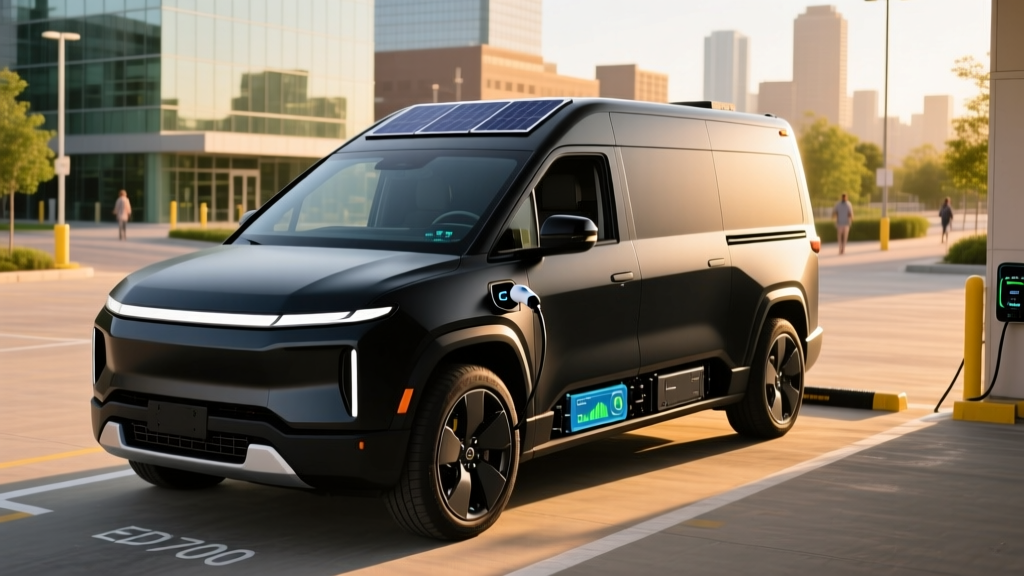
The Rivian EDV 700 — officially the Electric Delivery Van in its largest 700-cubic-foot cargo configuration — has become one of the most visible commercial EVs on American roads, thanks to Amazon's exclusive deployment of tens of thousands of units since late 2022. By the 2024 model year, Rivian had refined the EDV platform with software updates, improved thermal management, and broader availability beyond Amazon's fleet to select commercial operators. This review breaks down every spec that matters to fleet managers and commercial EV buyers evaluating the 2024 Rivian EDV 700 for last-mile delivery duty.
Powertrain, Battery, and Efficiency Specs
The EDV 700 is built on Rivian's commercial variant of its skateboard platform, sharing core architecture with the R1T and R1S but tuned for durability and cargo efficiency rather than performance. The 2024 model uses a single rear-mounted electric motor driving the rear wheels — a deliberate choice for simplicity, lower maintenance, and adequate traction in urban delivery environments.
| Spec | Value |
|---|---|
| EPA Range | 161 miles |
| Battery Capacity (Usable) | ~140 kWh (NMC chemistry) |
| Drivetrain | Rear-wheel drive, single motor |
| Horsepower | ~250 hp |
| Torque | ~350 lb-ft |
| 0–60 mph | ~8.5 seconds (unladen) |
| Top Speed | Electronically limited ~75 mph |
| Efficiency (EPA Combined) | ~1.9 kWh/mile (~53 MPGe equivalent) |
| Cargo Volume | 700 cu ft (cargo area) |
| Max Payload | ~2,500 lbs |
| GVWR | ~9,990 lbs (Class 2b/3 boundary) |
The NMC (nickel manganese cobalt) battery chemistry prioritizes energy density to keep the large 140 kWh pack within a manageable physical footprint under the cargo floor. NMC offers higher energy-per-kilogram than LFP, which matters in a van where every pound of battery weight reduces payload capacity. The trade-off: NMC cells typically degrade slightly faster than LFP over thousands of cycles, though Rivian's thermal management system and conservative charge limits in fleet software help mitigate long-term capacity loss.
Efficiency in real-world delivery use averages around 1.8 to 2.1 kWh per mile depending on route topography, payload, and climate-control demands. That translates to roughly 50–56 MPGe equivalent — unremarkable by passenger-car standards, but competitive for a 10,000-lb GVWR delivery vehicle. For context, a comparable diesel Sprinter returns roughly 15–18 mpg, meaning the EDV 700's energy cost per mile is approximately 40–60% lower depending on local electricity rates.
Charging Speed: DC Fast Charge and Depot Level 2
Fleet charging logistics are the single most critical operational variable for the EDV 700. Rivian designed the van to integrate with Amazon's depot charging infrastructure, but independent commercial operators need to understand the charge curve and realistic turnaround times.
| Charge Level | Power / Rate | Time / Recovery |
|---|---|---|
| Level 1 (120V) | ~1.4 kW | Impractical for 140 kWh pack; ~100+ hours 0–100% |
| Level 2 (240V AC) | Up to 11.5 kW | ~12–14 hours 0–100%; ~4–5 miles of range per hour |
| DC Fast Charge | Peak ~150 kW (CCS1) | 10–80% in ~50–55 minutes |
The EDV 700 uses a CCS1 connector for DC fast charging — the standard for most commercial and public networks in the U.S. (Note: Rivian's consumer vehicles have transitioned to NACS for Supercharger access, but the 2024 EDV fleet was built on CCS1.)
At a 150 kW DC fast charger, the EDV 700 peaks near 150 kW at low states of charge but tapers significantly above 60% SoC. The 10–80% charge takes approximately 50–55 minutes, which is adequate for mid-shift top-ups but not fast enough to serve as a quick pit stop. Most fleet operators rely on overnight Level 2 depot charging as the primary strategy, with DC fast charging reserved for extended routes or emergency replenishment.
Depot Level 2 charging at 11.5 kW adds roughly 4–5 miles of range per hour, meaning a full overnight session of 10–12 hours comfortably replenishes a full day's 120–150 miles of delivery driving. Fleet managers should budget for 240V/50-amp circuits per vehicle at the depot, with commercial-grade Level 2 chargers (ClipperCreek, ChargePoint, or Blink commercial units) running $1,500–$3,000 per port installed.
Cargo Capacity, Dimensions, and Practical Usability
The "700" in EDV 700 refers to the 700 cubic feet of cargo volume — the largest of the three EDV body configurations (the EDV 500 and EDV 900 round out the lineup at 500 and 900 cu ft respectively, though the 900 was limited in availability for 2024). The cargo area features a low, flat load floor enabled by the skateboard battery architecture, with interior height that allows most drivers to stand upright.
Key dimensional highlights:
- Cargo floor length: ~10 feet (interior)
- Interior cargo height: ~6.5 feet
- Side door opening: Wide passenger-side sliding door for curb-side loading
- Rear door: 60/40 split barn doors with 270-degree opening
- Driver cabin: Single driver seat with fold-down passenger seat, designed for frequent ingress/egress
Rivian integrated several delivery-specific features: a built-in shelving system designed with Amazon's delivery workflow in mind, an integrated tablet mount for route navigation, and a "delivery mode" that keeps the cargo area illuminated while minimizing cabin climate control to preserve range. The low step-in height (~18 inches) reduces driver fatigue over hundreds of daily entries and exits.
Pricing, Fleet Cost, and Federal Tax Credit Eligibility
The 2024 Rivian EDV 700 is not sold through traditional consumer dealerships — it is a commercial/fleet vehicle available through Rivian's commercial sales channel. Pricing is negotiated at fleet scale and varies by order volume, but industry reporting and fleet operator disclosures place the per-unit cost in the following range:
| Item | Estimated Cost |
|---|---|
| Base Unit Price (per van, fleet pricing) | $70,000–$85,000 |
| Amazon Exclusive Units (non-public pricing) | Undisclosed (volume-dependent) |
| Federal Commercial Clean Vehicle Credit (§45W) | Up to $7,500 (for vehicles under 14,000 lbs GVWR) |
| Depot Level 2 Charger (per port, installed) | $1,500–$3,000 |
| Estimated 5-Year Fuel Savings vs. Diesel | $8,000–$15,000 (route-dependent) |
Tax credit note: The EDV 700 does not qualify for the consumer §30D Clean Vehicle Credit because it is a commercial fleet vehicle. Instead, it may qualify for the §45W Commercial Clean Vehicle Credit, which provides up to $7,500 for qualifying commercial EVs under 14,000 lbs GVWR. Eligibility depends on the purchasing entity's tax status, the vehicle's battery component sourcing, and IRS guidance current at time of purchase. Consult IRS.gov's §45W page and a qualified tax professional before relying on credit projections.
Amazon's exclusive early access to the EDV limited availability for independent operators through 2023–2024. However, Rivian has signaled plans to broaden EDV sales to additional fleet customers, with the EDV platform potentially underpinning vehicles for other logistics companies, municipal fleets, and utility service operations.
Technology, Driver Assistance, and Fleet Software
The EDV 700's cabin technology is purpose-built for delivery work rather than consumer luxury. The centerpiece is a large central touchscreen running Rivian's commercial software stack, which integrates route optimization, package scanning, and delivery confirmation workflows. Amazon units run a proprietary integration with Amazon's logistics platform, while non-Amazon fleet units can interface with third-party fleet management systems.
Driver-assistance features include:
- Automatic emergency braking (AEB) with pedestrian detection
- Lane-keeping assist and lane-departure warning
- Blind-spot monitoring with trailer-length calibration
- 360-degree camera system for tight urban maneuvering
- Adaptive cruise control (available, not standard on all fleet configs)
Over-the-air (OTA) software updates are a core part of the EDV platform. Rivian has pushed updates improving regenerative braking calibration, thermal management efficiency, and route-prediction algorithms that pre-condition the battery based on learned delivery patterns. Fleet managers receive a dedicated dashboard for monitoring vehicle health, battery state of health (SoH), and driver behavior metrics across their fleet.
Warranty, Battery Longevity, and Maintenance
Rivian backs the 2024 EDV 700 with a commercial-oriented warranty package:
- Battery pack: 8 years / 100,000 miles (retaining ≥70% capacity)
- Powertrain (motor, inverter, reduction gear): 8 years / 100,000 miles
- Bumper-to-bumper: 5 years / 60,000 miles
- Roadside assistance: 5 years / 60,000 miles
For a delivery van averaging 20,000–30,000 miles per year, the 100,000-mile battery warranty covers roughly 3–5 years of heavy use. Fleet operators report that real-world battery degradation on early EDV units has been moderate — approximately 5–8% capacity loss after 60,000 miles of daily cycling, which is within expectations for NMC chemistry under daily 80% charge-limit fleet software settings.
Maintenance costs are significantly lower than diesel equivalents: no oil changes, no diesel exhaust fluid (DEF), no particulate filters, and reduced brake wear thanks to regenerative braking. Rivian offers mobile service vans for on-site fleet maintenance, reducing downtime versus traditional dealer service visits.
Pros, Cons, and Who the EDV 700 Suits Best
Pros
- 700 cu ft cargo volume with low, flat floor
- 40–60% lower energy cost per mile vs. diesel
- Purpose-built delivery ergonomics (low step-in, wide doors)
- OTA updates improve efficiency over time
- Reduced maintenance vs. ICE commercial vans
- Strong regenerative braking extends range in stop-and-go
Cons
- 161-mile EPA range limits route flexibility
- ~50-minute DC fast charge (10–80%) is slow for mid-shift
- Limited availability — Amazon priority allocation
- NMC battery degrades faster than LFP under heavy cycling
- RWD only — reduced traction in snow/ice vs. AWD
- No consumer purchase option; fleet-only sales channel
Who this EV suits best: The 2024 Rivian EDV 700 is ideal for last-mile delivery fleets operating predictable urban and suburban routes under 120 miles per day, with access to overnight depot Level 2 charging. It excels in high-stop-density delivery environments where regenerative braking recaptures energy and low operating costs compound over thousands of daily stops. It is not suited for long-haul routes, rural delivery without charging infrastructure, or operations requiring rapid mid-shift recharging turnaround.
How the EDV 700 Compares to Key Competitors
The commercial electric delivery van space has expanded rapidly. The EDV 700's primary competitors include:
- Ford E-Transit: 126-mile EPA range, 68 kWh battery, ~$45,000–$55,000 MSRP. Shorter range but lower entry price and broader dealer network.
- Mercedes-Benz eSprinter: ~200-mile EPA range (2024+ with 113 kWh battery), higher price point (~$75,000+), strong cargo volume.
- BrightDrop Zevo 600: ~250-mile range target, 120 kWh battery, GM-backed platform aimed at fleet scale.
The EDV 700 occupies a middle ground: more range than the E-Transit, slightly less than the updated eSprinter, with best-in-class delivery-specific ergonomics but limited availability outside Amazon's ecosystem. Fleet managers prioritizing range should evaluate the eSprinter; those prioritizing cost and dealer support should look at the E-Transit; those already in the Amazon logistics network will find the EDV 700 deeply integrated and hard to replace.
Frequently Asked Questions
What is the real-world range of the 2024 Rivian EDV 700?
The EPA estimates 161 miles. In real-world urban delivery use with regenerative braking, expect 140–160 miles. Highway-heavy routes, full payloads, and cold weather can drop this to 110–130 miles.
How fast does the EDV 700 charge?
On a 150 kW DC fast charger (CCS1), 10–80% takes approximately 50–55 minutes. On Level 2 depot charging at 11.5 kW, a full charge takes 12–14 hours, adding about 4–5 miles of range per hour.
Does the EDV 700 qualify for the federal EV tax credit?
Not the consumer §30D credit — it's a commercial vehicle. It may qualify for the §45W Commercial Clean Vehicle Credit (up to $7,500 for vehicles under 14,000 lbs GVWR). Eligibility depends on battery sourcing rules and buyer tax status. See IRS.gov §45W guidance.
Is the EDV 700 available to non-Amazon buyers?
Limited availability as of 2024. Amazon held priority allocation through the initial production ramp. Rivian has indicated plans to broaden sales to additional fleet customers, but supply remains constrained.
What is the battery warranty on the EDV 700?
Rivian provides an 8-year / 100,000-mile battery warranty guaranteeing at least 70% capacity retention. The powertrain carries the same coverage.
Can the EDV 700 tow?
The EDV 700 is not rated for trailer towing. It is designed exclusively for cargo delivery with up to ~2,500 lbs of internal payload.