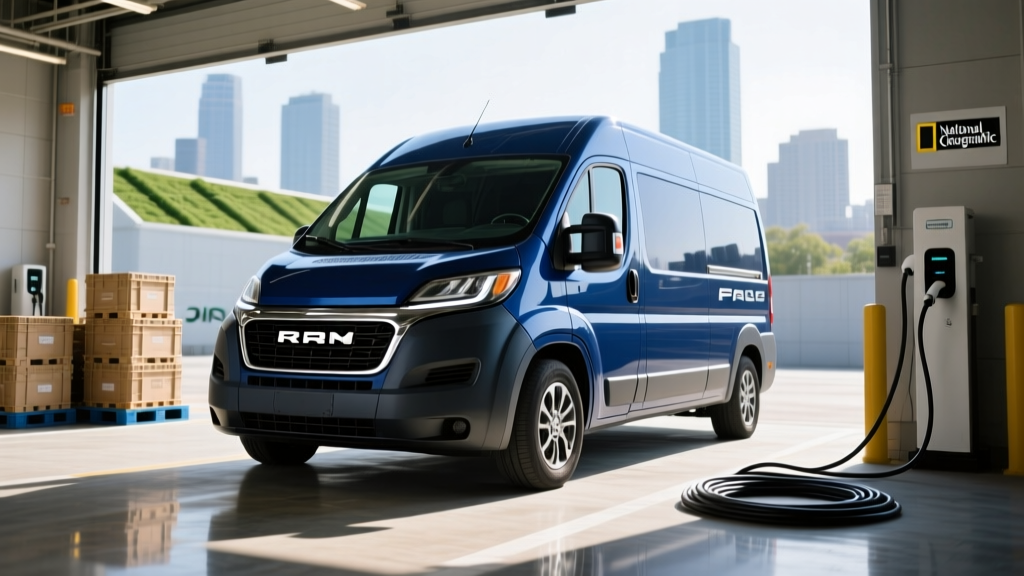
Quick Verdict: Is the 2024 Ram ProMaster EV Worth It?
The 2024 Ram ProMaster EV is a purpose-built electric cargo van aimed squarely at last-mile delivery fleets. With an EPA-estimated 162 miles of range, a 110 kWh battery pack, and up to 150 kW peak DC fast charging, it handles predictable urban routes well — but it is not a long-haul vehicle. Expect to pay around $65,000 before incentives, with the federal Commercial Clean Vehicle Credit (§45W) potentially covering up to $7,500 for qualifying fleet buyers. If your daily routes run under 120 miles with depot-based overnight charging, the ProMaster EV can cut fuel and maintenance costs significantly. If you need highway range or operate in extreme cold without garage parking, a gas ProMaster or a hybrid alternative may still make more sense.
Specs That Matter: Range, Battery, and Charging
| Specification | 2024 Ram ProMaster EV |
|---|---|
| EPA Range | 162 miles |
| Battery Capacity | 110 kWh (usable) |
| Battery Chemistry | NMC (Nickel Manganese Cobalt) |
| Peak DC Fast Charge Rate | 150 kW |
| 10–80% DC Charge Time | ~45 minutes |
| Level 2 AC Charge Rate | 11 kW (onboard charger) |
| Level 2 Full Charge Time (0–100%) | ~10–11 hours |
| Motor Output | 270 hp / 302 lb-ft torque |
| Payload Capacity | ~3,020 lbs |
| Cargo Volume | 463 cu ft (high-roof, extended) |
| Base MSRP (Delivery Tradesman) | ~$65,000 |
| Battery/Powertrain Warranty | 5 years / 60,000 miles |
Real-World Range vs. EPA Sticker
The EPA's 162-mile estimate assumes a mix of stop-and-go and moderate-speed driving. In practice, fleet operators running dense urban delivery routes at low speeds with frequent regenerative braking may see 140–160 miles of usable range. Highway driving at 65+ mph will drop that to roughly 110–130 miles. In cold weather (below 30°F), expect a 20–30% range reduction — putting realistic winter range around 110–130 miles for city use. This is why route planning is critical: the ProMaster EV works best when daily mileage stays well under its maximum.
Charging Infrastructure: Depot, Public, and Installation Costs
The ProMaster EV is designed for depot charging — meaning you plug in overnight at your fleet facility and start each morning with a full battery. Here's what that looks like in practice:
| Charging Level | Power | Miles Added per Hour | Typical Use Case |
|---|---|---|---|
| Level 1 (120V) | ~1.4 kW | ~2–3 miles/hr | Emergency trickle only — not viable for fleet |
| Level 2 (240V, 48A) | 11 kW | ~18–22 miles/hr | Overnight depot charging (full charge in ~10 hrs) |
| DC Fast Charge | Up to 150 kW | ~120+ miles in 30 min | Mid-shift top-ups, public stations |
Depot charging installation cost is a major line item for fleet buyers. Budget roughly:
| Component | Per-Charger Cost Range |
|---|---|
| Commercial Level 2 EVSE (hardwired, dual-port) | $2,500–$6,000 |
| Electrical panel upgrade (if needed, 200A+ service) | $3,000–$10,000+ |
| Conduit, wiring, trenching (varies by distance) | $1,500–$5,000 |
| Permits and inspection | $500–$2,000 |
| Total per charger (typical) | $7,500–$23,000 |
For a 5-van fleet, depot infrastructure could add $37,500–$115,000 upfront. However, the Alternative Fuel Vehicle Refueling Property Credit (§30C) may cover up to 30% of charging installation costs (capped at $100,000 per item for commercial property) through 2032, subject to census-tract and prevailing-wage requirements. Consult a tax professional for eligibility.
Cost of Ownership: ProMaster EV vs. Gas ProMaster
The core question for fleet managers is whether the higher upfront cost of the ProMaster EV pays off in operational savings. Here's a side-by-side comparison over 5 years and 75,000 miles of urban delivery driving:
| Cost Factor | ProMaster EV | Gas ProMaster 3500 (V6) |
|---|---|---|
| Purchase Price (base) | ~$65,000 | ~$48,000 |
| Federal Tax Credit | Up to $7,500 (§45W commercial) | $0 |
| Effective Purchase | ~$57,500 | ~$48,000 |
| Fuel/Energy (75k mi, $3.50/gal avg, $0.14/kWh) | ~$5,250 | ~$18,750 |
| Maintenance (5 years) | ~$2,000 | ~$6,500 |
| Depot Charging Install (1 charger, amortized) | ~$10,000 | $0 |
| Estimated Insurance (5 years) | ~$12,000 | ~$10,000 |
| 5-Year Total Cost | ~$86,750 | ~$83,250 |
At these assumptions, the EV is slightly more expensive over 5 years — but the gap narrows significantly with higher annual mileage, lower electricity rates (many commercial fleets pay $0.08–$0.10/kWh), and state-level incentives. At $0.09/kWh and 20,000 miles/year, the ProMaster EV breaks even around year 4 and pulls ahead thereafter. The EV also eliminates oil changes, spark plugs, transmission fluid, and exhaust system repairs — maintenance savings compound as the van ages beyond the warranty period.
Who Should Buy the ProMaster EV (and Who Shouldn't)
Actionable Decision Framework
Choose the ProMaster EV if:
- Your daily routes are under 120 miles and predictable
- You have (or can install) depot-based Level 2 charging
- You operate primarily in urban/suburban areas with low average speeds
- Your fleet qualifies for the §45W Commercial Clean Vehicle Credit
- You plan to keep vehicles 6+ years (maximizing fuel/maintenance savings)
- Your region has moderate winters or you have indoor parking
Stick with the gas ProMaster if:
- Routes regularly exceed 150 miles per day or are unpredictable
- You lack access to overnight depot charging and can't install it
- You operate in extreme cold (sub-10°F) without garage storage
- You need maximum payload (EV battery adds ~1,500 lbs of curb weight)
- Your fleet turns vehicles over every 3 years (savings won't offset premium)
Common Misconceptions About the ProMaster EV
| Myth | Fact |
|---|---|
| "162 miles of range isn't enough for any real delivery route." | The average last-mile delivery van drives 60–90 miles per day (EPA/DOE fleet data). 162 miles covers most urban routes with a comfortable buffer. |
| "Electric vans can't handle heavy cargo." | The ProMaster EV offers ~3,020 lbs of payload — adequate for most parcel and food delivery. It's not a heavy-freight hauler, but neither is the gas version in this class. |
| "Charging takes too long for commercial use." | Overnight Level 2 depot charging fully replenishes the 110 kWh battery in ~10 hours. DC fast charging adds ~120 miles in 30 minutes for mid-shift emergencies. |
| "The battery will need replacing in a few years." | Stellantis warranties the battery for 5 years/60,000 miles. Modern NMC packs in commercial service typically retain 85–90% capacity at 100,000 miles based on industry fleet data. |
| "The federal tax credit automatically applies." | The §45W Commercial Clean Vehicle Credit has specific requirements: the vehicle must be used for business, meet battery component and critical mineral sourcing rules, and the buyer must meet eligibility criteria. Always verify on IRS.gov before purchasing. |
What First-Time EV Fleet Buyers Need to Know
If you're transitioning a commercial fleet to electric for the first time, the ProMaster EV introduces several considerations that don't exist with gas vans:
1. Route auditing comes first. Before ordering, pull GPS or telematics data from your current vans. Map daily mileage, stop frequency, idle time, and peak loads. The ProMaster EV thrives on routes with high stop density (regenerative braking recovers energy) and low highway segments.
2. Electrical capacity is the hidden bottleneck. Many commercial buildings have 200A or 400A service. Adding multiple Level 2 chargers (each drawing ~48A) can exceed panel capacity. Budget for a panel upgrade or work with your utility on a dedicated feeder. Start the permitting process early — commercial electrical upgrades can take 2–4 months.
3. Winter preconditioning matters. The ProMaster EV supports battery preconditioning while plugged in. Setting departure times warms the battery to optimal temperature before you drive, preserving range and enabling faster charging. In cold climates, this feature alone can recover 10–15% of winter range loss.
4. Charging curves are not linear. The 150 kW peak rate applies only between roughly 10–40% state of charge. Above 60%, the charge rate tapers significantly — expect 50–70 kW. Above 80%, it drops to under 30 kW. Plan DC fast-charge stops to end at 80% rather than topping off to 100%, which wastes time.
5. Insurance costs more (for now). Commercial EV insurance premiums typically run 15–25% higher than equivalent gas vehicles, reflecting higher repair costs and parts pricing. Get quotes before purchasing and factor this into your TCO model.
Frequently Asked Questions
Does the 2024 Ram ProMaster EV qualify for the $7,500 federal tax credit?
It may qualify under the §45W Commercial Clean Vehicle Credit, which provides up to $7,500 for commercial vehicles with a GVWR under 14,000 lbs. However, eligibility depends on battery component sourcing, critical mineral requirements, and your business tax situation. Fleet buyers should consult a tax professional and verify current requirements on IRS.gov before relying on the credit in their purchase budget.
Can the ProMaster EV tow a trailer?
Stellantis has not published a towing rating for the ProMaster EV at launch. The gas ProMaster can tow up to 6,910 lbs when properly equipped. If towing is part of your operation, the gas version remains the safer choice until official EV towing specs are confirmed.
How does cold weather affect the ProMaster EV's range?
Like all EVs, the ProMaster EV's NMC battery loses efficiency in cold temperatures. Expect a 20–30% range reduction below 30°F, dropping real-world range from ~140–160 miles to roughly 100–130 miles in city driving. Using the cabin heater compounds this loss. Preconditioning while plugged in and using heated seats (if equipped) instead of cabin air heating can mitigate some of the impact.
What is the maintenance schedule for the ProMaster EV?
The EV eliminates most traditional maintenance: no oil changes, no spark plugs, no transmission fluid, no exhaust system. Expect periodic cabin air filter replacement, brake fluid checks, tire rotations, and windshield washer fluid. Regenerative braking significantly reduces brake pad wear — many EV fleets report brake pads lasting 100,000+ miles. Overall maintenance costs run roughly 60–70% lower than the gas ProMaster.
Is there a passenger version of the ProMaster EV?
For the 2024 model year, the ProMaster EV is available only as a cargo van (Delivery Tradesman trim). A passenger/wagon variant has not been announced. For electric passenger transport, fleets typically look at dedicated people-movers or the Chrysler Pacifica PHEV for smaller groups.
What's the total cost of ownership advantage over 8 years?
At 20,000 miles/year with commercial electricity rates ($0.09/kWh), the ProMaster EV saves approximately $3,500–$4,500 per year in fuel and maintenance compared to the gas ProMaster. Over 8 years (160,000 miles), that's $28,000–$36,000 in operational savings — enough to offset the higher purchase price and charging infrastructure, with significant net savings in the final years of ownership.