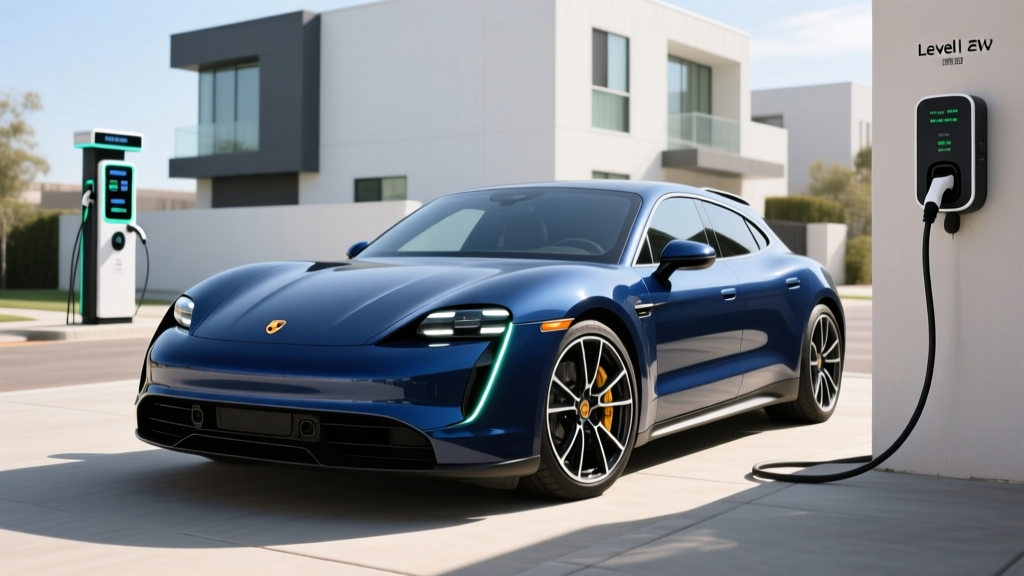
The 2024 Porsche Taycan Sport Turismo occupies a rare position in the EV market: a performance wagon that prioritizes driving dynamics without sacrificing practicality. As the long-roof variant of Porsche's all-electric sports sedan, the Sport Turismo adds cargo versatility and rear headroom while retaining the 800-volt architecture that made the Taycan a charging-speed benchmark. For 2024, Porsche refreshed the lineup with updated battery chemistry, improved range figures, and revised pricing — but the question remains whether a six-figure electric wagon justifies its premium against increasingly capable rivals.
We've analyzed EPA data, manufacturer specifications, and real-world driving patterns to give you the exact numbers you need before signing a purchase agreement.
Range and Efficiency: EPA vs. Real-World Expectations
The 2024 Taycan Sport Turismo lineup offers three main trims in the US market, each with distinct range profiles. Porsche upgraded the battery pack for 2024, moving from a 79.2 kWh gross / 71.0 kWh net usable pack to an improved 82.3 kWh usable capacity on the Performance Battery Plus variant.
| Trim | Drivetrain | Battery (Usable kWh) | EPA Range (mi) | MPGe (Combined) | kWh/100 mi |
|---|---|---|---|---|---|
| Taycan 4 Sport Turismo | AWD (Dual Motor) | 82.3 (NMC) | 277 | 83 | 40 |
| Taycan 4S Sport Turismo | AWD (Dual Motor) | 82.3 (NMC) | 273 | 82 | 41 |
| Taycan Turbo S Sport Turismo | AWD (Dual Motor) | 82.3 (NMC) | 265 | 78 | 43 |
All trims use NMC (nickel manganese cobalt) lithium-ion chemistry, which prioritizes energy density and performance over the cycle-life advantages of LFP. Porsche has not offered an LFP option in the Taycan lineup.
The EPA estimates 277 miles for the Taycan 4 Sport Turismo. In real-world highway driving at 70-75 mph, expect approximately 235–255 miles before needing to charge. In cold weather (below 32°F), range can drop an additional 15–25%, bringing effective range down to roughly 195–220 miles on the highway. City driving with regenerative braking recovers closer to EPA figures, and Porsche's thermal management system — including a standard heat pump — helps mitigate cold-weather losses compared to older EVs. Taycan owners historically report exceeding EPA estimates in mixed suburban driving, a pattern consistent with Porsche's conservative rating methodology.
The efficiency story here is nuanced. At 40–43 kWh/100 miles, the Taycan Sport Turismo is less efficient than a Tesla Model S Long Range (roughly 28 kWh/100 mi) or a Lucid Air Pure (24 kWh/100 mi). You're trading some efficiency for the 800V architecture's charging speed advantage and Porsche's performance tuning. Source: fueleconomy.gov.
Charging Performance: 800-Volt Architecture in Practice
The Taycan's 800-volt electrical architecture remains one of its most compelling technical features. While most competitors run 400V systems, the higher voltage allows the Taycan to accept higher charge power with lower current, reducing heat buildup and sustaining peak charge rates longer.
| Charging Level | Power (kW) | Time / Rate | Notes |
|---|---|---|---|
| Level 1 (120V household) | ~1.4 kW | ~3–4 mi/hr | Emergency/trickle only; 60+ hours for full charge |
| Level 2 (240V home, 48A) | 11.5 kW | ~30–33 mi/hr; ~9 hrs 10–80% | Requires NEMA 14-50 or hardwired EVSE; overnight charging |
| DC Fast Charge (Peak) | 270 kW (Turbo S) / 270 kW (4/4S w/ Perf. Battery Plus) | 10–80% in ~18 min (ideal conditions) | Requires 350 kW CCS station; taper begins ~55% SoC |
| DC Fast Charge (50 kW station) | 50 kW | 10–80% in ~65 min | Common at older public stations |
Charging curve reality check: The advertised 270 kW peak is not sustained across the entire session. The Taycan typically holds above 200 kW from roughly 10% to 45% state of charge, then tapers progressively. From 55% to 80%, expect rates between 80–130 kW. This means a 10–80% session averages closer to 160–180 kW in practice, still delivering the ~18-minute result Porsche claims under optimal battery preconditioning.
Preconditioning matters: Use the Porsche Charging Planner in the navigation system to route to your DC fast charger. The car will warm or cool the battery to the optimal temperature window before arrival, which can shave 3–5 minutes off your charge session and unlock higher peak kW. Without preconditioning — particularly in cold weather — peak charge rates may be limited to 150–180 kW initially.
Home Level 2 charging at 11.5 kW means a typical overnight session (8–10 hours) easily replenishes a full day's driving. For a 40-mile daily commute, you'd need roughly 3.5 hours on Level 2 to recover that energy.
Performance and Drivetrain Specifications
The Taycan Sport Turismo is engineered as a performance vehicle first, and the numbers reflect that priority across every trim.
| Spec | Taycan 4 | Taycan 4S | Turbo S |
|---|---|---|---|
| Horsepower (w/ Launch Control) | 402 hp | 562 hp | 750 hp |
| Torque (lb-ft) | 376 | 479 | 774 |
| 0–60 mph | 4.5 sec | 3.5 sec | 2.4 sec |
| Top Speed | 143 mph | 155 mph | 162 mph |
| Drivetrain | AWD, Dual Motor | AWD, Dual Motor | AWD, Dual Motor |
| Transmission | 2-speed rear / 1-speed front | 2-speed rear / 1-speed front | 2-speed rear / 1-speed front |
Porsche's unique two-speed transmission on the rear axle is a key differentiator. First gear provides explosive off-the-line acceleration, while second gear optimizes efficiency at highway speeds. Most competitors use a single-speed reduction gear. The result is strong passing power at 60–90 mph, not just 0–60 sprints.
The Turbo S's 2.4-second 0–60 time places it among the quickest production cars ever sold, EV or otherwise. But even the base Taycan 4 at 4.5 seconds outpaces most gas-powered sports sedans in its price class.
Pricing, Trims, and Federal Tax Credit Eligibility
The 2024 Taycan Sport Turismo is a premium product with pricing to match. Here's the MSRP breakdown before options:
| Trim | Base MSRP | Typical As-Tested | §30D Tax Credit Eligible? |
|---|---|---|---|
| Taycan 4 Sport Turismo | $111,100 | $120,000–$135,000 | No — exceeds MSRP cap |
| Taycan 4S Sport Turismo | $125,400 | $140,000–$160,000 | No — exceeds MSRP cap |
| Taycan Turbo S Sport Turismo | $190,500 | $200,000–$220,000+ | No — exceeds MSRP cap |
The 2024 Porsche Taycan Sport Turismo does not qualify for the $7,500 federal EV tax credit under IRS §30D rules. The reason is straightforward: the IRS imposes an MSRP cap of $55,000 for sedans/wagons (and $80,000 for SUVs/trucks/vans). Every Taycan Sport Turismo trim far exceeds this threshold. Additionally, the Taycan's battery components and critical minerals are sourced primarily from European and Asian supply chains that may not meet the domestic-content requirements even if the price were lower. Buyers should not factor any federal tax credit into their purchase calculation for this vehicle. Source: IRS §30D Clean Vehicle Credits.
Some states may offer their own EV incentives that have different price caps — check your state's energy or DMV website for current programs.
Cargo, Passenger Space, and Practicality
The Sport Turismo's wagon body style exists specifically to address the Taycan sedan's cargo limitations. Here's how the space breaks down:
- Rear cargo volume (behind second row): 15.7 cu ft (sedan: 14.3 cu ft)
- Rear cargo volume (seats folded): 42.8 cu ft
- Front trunk (frunk): 2.9 cu ft — enough for a charging cable bag and small soft duffel
- Rear headroom: 38.2 inches (vs. 36.5 in the sedan — a meaningful improvement for taller passengers)
- Rear legroom: 32.7 inches — adequate for adults on moderate trips, tight for six-footers on long hauls
- Roof rails: Standard, rated for roof-box/cargo-rack mounting
The 42.8 cu ft maximum cargo figure is competitive with compact luxury SUVs like the BMW X3 (31.5 cu ft) and significantly more usable than the Taycan sedan. The wide, flat load floor and hatch opening make the Sport Turismo genuinely practical for gear-heavy weekends — skis, bikes, or camping equipment fit without the roof box.
However, the frunk is disappointingly small at 2.9 cu ft. The Taycan's front-mounted power electronics consume space that rivals like the Ford Mustang Mach-E (4.7 cu ft frunk) or Rivian R1S (11.0 cu ft frunk) use more effectively. Plan to store your mobile connector in the rear cargo area.
Technology, Driver Assistance, and Interior
The 2024 Taycan's cabin centers on a curved 12.6-inch digital instrument cluster, a 10.9-inch central touchscreen running Porsche Communication Management (PCM), and an available 10.9-inch front-passenger display. An optional 8.4-inch touchpanel on the center console handles climate controls and handwriting input.
Infotainment strengths: Wireless Apple CarPlay and Android Auto, native navigation with EV route planning and charging-stop integration, over-the-air update capability, and a responsive interface that avoids the lag plaguing some competitor systems.
Driver assistance (SAE Level 2):
The Taycan's driver-assistance suite — branded as Porsche InnoDrive with Active Lane Keeping — is an SAE Level 2 system. This means it can simultaneously manage steering and speed on highways, but the driver must keep hands on the wheel (or demonstrate attentiveness via torque sensing) and eyes on the road at all times. This is not autonomous or "self-driving" capability. It does not handle stoplights, construction zones, or complex urban intersections without driver intervention.
- Adaptive cruise control with stop-and-go: Smooth and well-calibrated; maintains set distance without aggressive braking
- Active lane keeping: Centered and confident on well-marked highways; can struggle with faded lane lines
- Porsche InnoDrive (optional): Uses navigation data and radar to pre-adjust speed for curves, roundabouts, and speed limits up to 1.5 miles ahead — one of the more sophisticated predictive cruise systems available
- Night Vision Assist (optional): Thermal camera with pedestrian/animal detection displayed in the instrument cluster
- Park Assist with Surround View: 360-degree camera with automated parking; useful given the Taycan's wide footprint
Notable drawbacks: No hands-free driving mode (unlike GM's Super Cruise or Ford's BlueCruise on mapped highways). The steering-wheel touch sensors can be overly sensitive, and the absence of a physical volume knob continues to frustrate some owners. The optional Burmester audio system ($5,000+) is excellent but the standard 10-speaker system is merely adequate for the price point.
Battery Warranty and Long-Term Ownership
Porsche covers the Taycan's high-voltage battery with an 8-year / 100,000-mile warranty, guaranteeing a minimum of 70% state of health (capacity retention) over that period. If the battery drops below 70% capacity within the warranty window, Porsche will repair or replace modules to bring it above the threshold.
The powertrain (electric motors, power electronics, transmission) carries the same 8-year / 100,000-mile coverage. The basic vehicle warranty is 4 years / 50,000 miles.
For context on long-term degradation: NMC batteries in 800V systems like the Taycan's tend to degrade approximately 1–2% per year under normal use patterns (daily charging to 80%, occasional DC fast charging). Real-world Taycan owners from the 2020–2022 model years are reporting 3–6% total degradation at 30,000–50,000 miles, well within warranty parameters. Avoiding repeated 100% charges and frequent DC fast charging from very low SoC will maximize longevity.
Out-of-warranty battery replacement costs are significant. A full Taycan battery pack replacement has been estimated at $20,000–$30,000+ including labor, though module-level repairs (replacing individual degraded cell groups) can be substantially less. This is a long-tail risk worth factoring into ownership plans beyond year eight.
Competitive Positioning and Verdict
Pros
- Best-in-class DC fast charging via 800V architecture
- Exceptional driving dynamics; genuine sports-car feel in a wagon
- Practical hatchback cargo (42.8 cu ft) with roof rails
- 2-speed rear transmission for strong highway passing power
- Excellent build quality and materials
- Heat pump standard for cold-climate efficiency
Cons
- No federal tax credit eligibility (MSRP far exceeds cap)
- Below-average efficiency (40–43 kWh/100 mi) vs. rivals
- Small frunk (2.9 cu ft)
- Rear legroom tight for tall adults (32.7 in)
- No hands-free Level 2+ driving mode
- Options escalate price rapidly; $150K+ realistic for 4S
- Insurance premiums 20–35% above comparable gas Porsches
Decision Framework
Choose the Taycan 4 Sport Turismo if: You want the entry point into the lineup, prioritize range (277 mi EPA) over outright speed, and your daily driving is under 50 miles with home charging available.
Choose the Taycan 4S Sport Turismo if: You want the best balance of performance (3.5-sec 0–60) and daily usability, and you'll option it with the 21-inch wheels and InnoDrive for the complete package.
Choose the Turbo S Sport Turismo if: You want hypercar acceleration (2.4-sec 0–60) in a daily-drivable wagon and budget is not a primary constraint.
Look at the Audi RS e-tron GT instead if: You want a related 800V platform (shared J1 architecture) at a slightly lower price point, though with less cargo space (sedan only).
Look at the Tesla Model S Plaid if: You prioritize range (402 mi EPA), Supercharger access, and a lower starting price ($89,990), accepting a less premium interior.
Look at the Lucid Air Touring if: You want class-leading efficiency and range (425 mi EPA) in a sedan format, with a more spacious rear seat.
Frequently Asked Questions
What is the real-world range of the 2024 Porsche Taycan Sport Turismo?
In mixed driving, expect 250–270 miles from the Taycan 4 Sport Turismo. Sustained highway driving at 75 mph drops this to approximately 235–255 miles. In sub-freezing temperatures with cabin heating, plan for 195–220 miles of effective highway range. Porsche historically rates its EVs conservatively, and many owners report exceeding EPA estimates in suburban conditions with moderate regenerative braking use.
How fast does the Taycan Sport Turismo charge at home and on DC fast chargers?
On a Level 2 home charger at 11.5 kW (48 amps), the Taycan adds roughly 30–33 miles of range per hour, fully replenishing overnight in about 9 hours. On a 350 kW DC fast charger with battery preconditioning, the Taycan peaks at 270 kW and charges from 10–80% in approximately 18 minutes. On more common 150 kW chargers, expect 10–80% in roughly 28–32 minutes.
Does the 2024 Taycan Sport Turismo qualify for the $7,500 federal EV tax credit?
No. Under current IRS §30D rules, the federal tax credit for new EVs is capped at vehicles with an MSRP of $55,000 for sedans and wagons (or $80,000 for SUVs, vans, and trucks). The Taycan Sport Turismo starts at $111,100 and exceeds the cap on every trim. Additionally, buyer income caps ($150K single / $300K joint) and battery-component sourcing requirements apply to eligible vehicles. Consult a tax professional for your specific situation.
Is the Taycan Sport Turismo worth it versus key competitors?
If driving engagement, build quality, and charging speed are your top priorities, the Taycan Sport Turismo is arguably the best EV wagon available. The 800V architecture provides a tangible real-world advantage on road trips, and the chassis dynamics are unmatched in the segment. However, if maximum range, value, or rear-seat space matters more, the Tesla Model S, Lucid Air, or even the Audi e-tron GT (sedan) may serve you better at lower cost. The Taycan is a driver's car that happens to be electric — not an efficiency-maximizing appliance.
How does the Taycan Sport Turismo handle cold weather?
Porsche includes a standard heat pump, which significantly reduces the cabin-heating energy draw that plagues resistive-heater EVs. Expect 15–25% range reduction in sustained sub-freezing driving, which is in line with industry averages. The battery preconditioning system warms the pack for optimal regenerative braking and charging performance in cold conditions. Owners in northern climates report the Taycan handles winter competently, though the AWD system prioritizes performance over the deep-snow traction of a dedicated SUV platform.
What does insurance cost on a Taycan Sport Turismo?
Insurance premiums for the Taycan Sport Turismo typically run 20–35% higher than a comparably priced gas-powered Porsche Panamera Sport Turismo, driven by EV-specific repair costs, battery replacement risk, and the vehicle's performance profile. National average estimates for a Taycan 4S range from $3,200–$4,800 annually depending on driver profile, location, and coverage levels. Get quotes from multiple carriers before purchase — some insurers now offer EV-specific policies with battery-coverage riders.