Quick Verdict: The Driver's EV That Charges Like a Hypercar
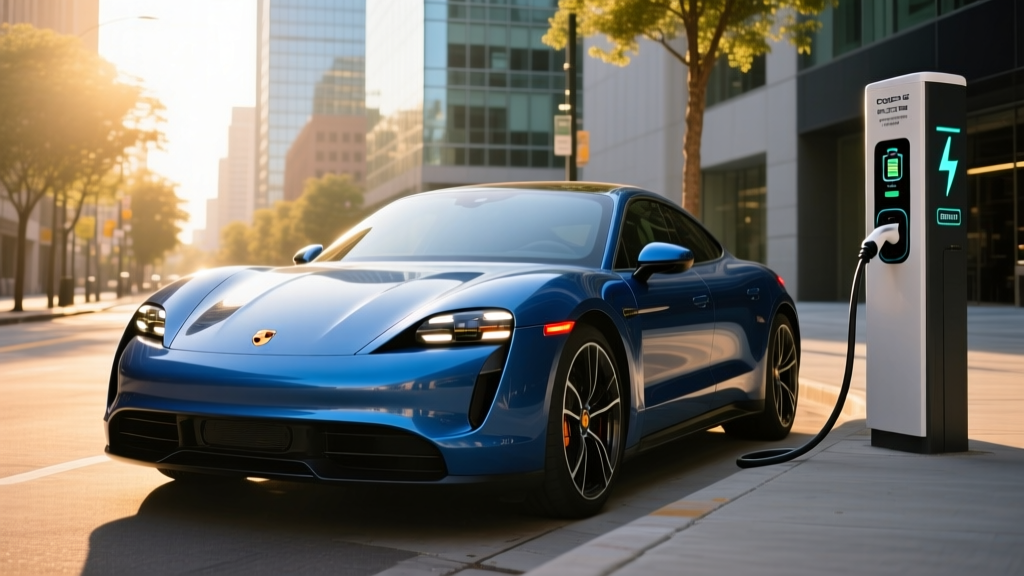
The 2024 Porsche Taycan (J1 platform, pre-refresh) remains the benchmark for EV driving dynamics, pairing Porsche's chassis wizardry with an 800-volt architecture that enables some of the fastest DC charging in production. But its EPA range figures — 200 to 227 miles depending on trim — tell only part of the story. This is a car engineered for how fast it uses electrons, not how many it stores.
If you prioritize steering feel, brake modulation, and 270 kW peak charging over 300+ mile range stickers, the 2024 Taycan is unmatched. If you need a family road-trip hauler, you'll want to cross-shop the Tesla Model S or Lucid Air.
Range and Efficiency: EPA Numbers vs. Real-World Reality
EPA Estimated Range: 200–227 miles (varies by trim and wheel size)
Real-World Expectation: 175–210 miles on highway loops at 70+ mph; 140–170 miles in sub-30°F cold weather with cabin heat active. City driving with regenerative braking recovers up to 290 kW, extending urban range closer to or above EPA estimates.
The 2024 Taycan's efficiency ranges from 82 to 92 MPGe combined (roughly 39–49 kWh/100 miles), per fueleconomy.gov. The base RWD model with the smaller 79.2 kWh battery (67.0 kWh usable) returns the best efficiency but the lowest range. The 4S, GTS, and Turbo variants use the larger 93.4 kWh pack (83.7 kWh usable), gaining range at the cost of weight.
Why the real-world gap? The Taycan's 800V architecture and two-speed rear axle optimize performance over efficiency. At sustained highway speeds above 75 mph, aerodynamic drag consumes more energy than in a teardrop-shaped Lucid Air. Cold weather compounds this: Porsche's thermal management system is competent, but the Taycan lacks a standard heat pump in all trims (it's optional on lower trims), meaning resistive cabin heating can slash range 25–35% in freezing temps.
Battery Chemistry, Capacity, and Longevity
Both battery packs in the 2024 Taycan use NMC (nickel-manganese-cobalt) chemistry — chosen for energy density and high-discharge performance rather than the cycle-life longevity of LFP. This matters for buyers planning to keep the car 8+ years.
| Spec | Performance Battery | Performance Battery Plus |
|---|---|---|
| Gross Capacity | 79.2 kWh | 93.4 kWh |
| Usable Capacity | 67.0 kWh | 83.7 kWh |
| Chemistry | NMC | NMC |
| Architecture | 800V nominal | 800V nominal |
| Buffer (top + bottom) | ~12.2 kWh | ~9.7 kWh |
| Available Trims | Base RWD | 4S, GTS, Turbo, Turbo S |
Porsche's large buffer is a deliberate degradation-management strategy — by hiding capacity at the top and bottom of the charge window, the battery management system (BMS) shields cells from the high-SoC and low-SoC stress that accelerates NMC wear. Expect 85–90% State of Health (SoH) retention at 100,000 miles based on fleet data from earlier J1-platform Taycans and the mechanically similar Audi e-tron GT.
Charging: 800-Volt Architecture Done Right
This is where the Taycan's engineering investment pays dividends. The 800V system isn't marketing — it enables sustained high-power charging that 400V competitors simply cannot match without excessive heat buildup.
| Charging Level | Power / Rate | Time / Miles Added |
|---|---|---|
| Level 1 (120V household) | ~1.2 kW | ~4 miles per hour |
| Level 2 (240V home, 48A) | 11.5 kW (onboard charger limited to 9.6 kW standard, 19.2 kW optional) | ~28–32 miles per hour (9.6 kW); ~56 miles/hr (19.2 kW optional) |
| DC Fast Charge (peak) | 270 kW (Battery Plus) / 225 kW (standard battery) | 10–80% in ~22.5 minutes (Battery Plus); ~27 minutes (standard) |
| DC Fast Charge (sustained avg) | ~175–200 kW average to 80% | ~120–140 miles added in 15 minutes |
Charging curve reality: The Taycan hits peak 270 kW only between roughly 5–35% SoC when the battery is preconditioned (via the Porsche Charging Planner navigation route or manual preconditioning). Above 50% SoC, the curve tapers to ~150 kW, and above 80% it drops sharply to ~50 kW. This is physics, not a flaw — but it means charging from 80–100% at a DC fast charger is wasteful and slow. For road trips, plan 10–80% stops.
On a 350 kW Electrify America or Ionity station, the Taycan Battery Plus consistently delivers 10–80% in 20–23 minutes in moderate temperatures (50–85°F). In cold weather (below 35°F) without preconditioning, expect that time to stretch to 35–45 minutes as the BMS limits charge rate to protect the cells.
Connector note: The 2024 Taycan uses CCS1 for DC fast charging in North America. Porsche has confirmed NACS adoption for future models, but 2024 Taycan owners will need a CCS-to-NACS adapter (provided by Porsche or purchased separately) to access Tesla Superchargers as the network opens to non-Tesla vehicles.
Performance: Where Porsche Earns the Premium
| Trim | Drivetrain | Horsepower (Launch Control) | 0–60 mph | Top Speed |
|---|---|---|---|---|
| Base RWD | Rear-wheel drive, single motor | 402 hp | 5.1 sec | 143 mph |
| 4S | AWD, dual motor | 562 hp | 3.8 sec | 155 mph |
| GTS | AWD, dual motor | 670 hp | 3.5 sec | 155 mph |
| Turbo | AWD, dual motor | 670 hp | 3.0 sec | 161 mph |
| Turbo S | AWD, dual motor | 750 hp | 2.6 sec | 161 mph |
The Taycan's two-speed rear transmission (unique among production EVs) gives it a genuine edge: first gear multiplies torque for savage launches, second gear keeps the motor in its efficiency sweet spot at highway speeds. The result is a 0–60 time that's repeatable — not a one-hit-wonder battery dump that overheats after two pulls.
Regenerative braking recuperates up to 290 kW — class-leading — meaning most daily deceleration happens without touching the friction brakes. Porsche blends regen and mechanical braking seamlessly; you'll rarely feel the transition.
Interior, Tech, and Cargo Practicality
The Taycan's cabin is undeniably premium — leather, Alcantara, and Porsche's curved digital instrument cluster create a cockpit that justifies six-figure pricing. But practicality is the trade-off.
Passenger space: Front legroom is generous at 41.3 inches, but rear legroom drops to 32.7 inches — tight for adults on long trips. The roofline (especially on Sport Turismo and Cross Turismo variants) eats into rear headroom. The sedan's rear seats suit children or occasional adult passengers; the Sport Turismo wagon body style adds ~0.5 inches of headroom and a more usable cargo area.
Cargo volume: The sedan offers 14.3 cubic feet behind the rear seats (trunk) plus 2.9 cu ft in the front trunk (frunk) — 17.2 cu ft total. The Cross Turismo wagon expands rear cargo to 15.7 cu ft (44.6 cu ft with rear seats folded). For context, the Tesla Model S offers 28 cu ft of rear cargo plus a frunk.
Infotainment: Porsche Communication Management (PCM) runs on a 10.9-inch center touchscreen with a secondary 8.4-inch haptic climate/control screen below. Wireless Apple CarPlay and Android Auto are standard. The optional passenger-side 10.9-inch display adds a wow factor but limited utility. The system is responsive but the multi-screen layout demands more attention than ideal while driving.
Driver assists (SAE Level 2): Porsche InnoDrive with Active Lane Keeping is standard on upper trims — it handles adaptive cruise, lane centering, and even reads speed-limit signs to adjust cruise speed. This is a Level 2 system: the driver must keep hands on the wheel and eyes on the road at all times. It's competent for highway cruising but doesn't approach the capability of GM's Super Cruise or Ford's BlueCruise on mapped roads. No hands-free driving is offered.
Pricing, Tax Credits, and Total Ownership Cost
| Trim | Base MSRP | As-Tested (typical options) | §30D Federal Tax Credit |
|---|---|---|---|
| Base RWD | $90,900 | $98,000–$105,000 | Not eligible (MSRP exceeds $55,000 sedan cap) |
| 4S | $106,100 | $115,000–$130,000 | Not eligible |
| GTS | $136,000 | $145,000–$155,000 | Not eligible |
| Turbo | $155,700 | $170,000–$185,000 | Not eligible |
| Turbo S | $190,500 | $200,000+ | Not eligible |
Why no federal tax credit? Under IRS §30D rules, the new clean vehicle credit has an MSRP cap of $55,000 for sedans (and $80,000 for SUVs/trucks/vans). Every 2024 Taycan trim exceeds this cap, making it ineligible for the up-to-$7,500 federal credit regardless of buyer income or battery sourcing. The Cross Turismo wagon body style is classified as an SUV for tax purposes (MSRP cap $80,000), but even the base 4S Cross Turismo starts at $111,100 — still well above the threshold.
Key §30D requirements (for reference on eligible vehicles):
- MSRP must not exceed $55,000 (sedans) or $80,000 (SUVs/trucks/vans)
- Buyer AGI must not exceed $150,000 (single) / $300,000 (joint filing)
- Battery critical minerals and component sourcing must meet annual phase-in thresholds
- Credit can be transferred to the dealer at point of sale as a purchase discount
5-Year Ownership Estimate (4S trim, 12,000 miles/year):
| Category | Estimated 5-Year Cost |
|---|---|
| Depreciation | $42,000–$50,000 |
| Electricity (home + DCFC mix) | $4,500–$5,500 |
| Insurance (national avg, high-performance EV) | $14,000–$18,000 |
| Maintenance (tires, cabin filter, fluid top-offs) | $2,500–$3,500 |
| Federal tax credit | $0 |
| Total estimated 5-year cost | $63,000–$77,000 |
Insurance premiums are notably higher than average — the Taycan's repair costs, performance classification, and parts pricing push annual premiums to $2,800–$3,600 for most drivers. Get quotes before purchasing.
Warranty Coverage
Porsche backs the 2024 Taycan with:
- New Vehicle Limited Warranty: 4 years / 50,000 miles
- Battery Warranty: 8 years / 100,000 miles, guaranteeing minimum 70% State of Health (capacity retention)
- Corrosion Perforation: 12 years, unlimited miles
- Roadside Assistance: 4 years / 50,000 miles
The 70% SoH threshold is industry-standard but worth noting: if your 83.7 kWh Battery Plus degrades to 58.6 kWh usable within 8 years/100,000 miles, Porsche will repair or replace the battery. In practice, NMC packs with large buffers and robust thermal management tend to retain 85%+ SoH at 100K miles under normal use.
Pros and Cons
Pros
- Class-leading driving dynamics — steering, braking, chassis balance
- 800V architecture enables 270 kW DC charging; 10–80% in ~22 minutes
- Repeatable performance — two-speed rear axle prevents thermal fade
- 290 kW regen capability reduces brake wear dramatically
- Premium interior build quality with genuine material luxury
- 8-year/100,000-mile battery warranty with 70% SoH guarantee
Cons
- EPA range of 200–227 miles lags Tesla Model S (405 mi) and Lucid Air (419 mi)
- No federal tax credit eligibility — all trims exceed §30D MSRP caps
- Rear seat legroom (32.7 in) is tight for adult passengers
- Cargo space (17.2 cu ft sedan total) is modest for the price
- Heat pump is optional on lower trims — cold-weather range suffers without it
- Insurance premiums run $2,800–$3,600/year — significantly above average
- CCS1 connector requires adapter for growing NACS/Tesla Supercharger network
Who Should Buy the 2024 Taycan?
Choose the Taycan if: You prioritize driving engagement over maximum range, have reliable home Level 2 charging, take road trips of 200 miles or fewer between stops, and value chassis dynamics above all else in an EV. The 4S with Performance Battery Plus is the sweet spot — 562 hp, 227 miles EPA, and the 270 kW charging capability.
Look elsewhere if: You need 300+ miles of range for frequent long-distance travel (consider the Lucid Air Grand Touring or Tesla Model S), require spacious rear seating for adults (BMW i5 or Mercedes EQS), or need the $7,500 federal tax credit to justify the purchase (every Taycan trim is ineligible).
Frequently Asked Questions
What is the real-world range of the 2024 Porsche Taycan?
In mixed driving at moderate temperatures (55–80°F), expect 185–215 miles from the Battery Plus trims (4S, GTS, Turbo). Highway driving at 75+ mph drops this to 170–195 miles. In sub-freezing weather without a heat pump, plan for 140–170 miles. The EPA rates the Taycan 4S at 227 miles, but real-world testing consistently falls 5–15% below that figure on highway-heavy routes.
How fast does the 2024 Taycan charge at home and on the road?
On a home Level 2 charger (240V, 48 amps), the standard 9.6 kW onboard charger adds roughly 30 miles per hour — a full overnight charge from 10–100% takes about 9 hours. The optional 19.2 kW onboard charger (requires a 100-amp dedicated circuit) cuts that to ~4.5 hours. At a 350 kW DC fast charger, the Battery Plus peaks at 270 kW and charges 10–80% in approximately 22.5 minutes when preconditioned.
Does the 2024 Taycan qualify for the federal EV tax credit?
No. Under IRS §30D rules, new sedans must have an MSRP at or below $55,000 to qualify. The cheapest 2024 Taycan starts at $90,900. The Cross Turismo wagon is classified as an SUV (cap: $80,000), but even the base Cross Turismo 4S starts at $111,100. No 2024 Taycan variant is eligible for the federal credit. Some state and utility incentives may still apply — check your state's programs.
Is the 2024 Taycan worth buying vs. the Tesla Model S or Lucid Air?
It depends on your priorities. The Model S offers 405 miles of EPA range, access to the Supercharger network, and a lower starting price — but its interior quality and driving dynamics can't match Porsche's. The Lucid Air delivers 419 miles and a more spacious cabin but lacks the Taycan's charging speed and chassis precision. If range and value are paramount, the Model S or Air wins. If driving feel, build quality, and 800V charging matter most, the Taycan stands alone.
What is the Taycan's battery replacement cost out of warranty?
Out-of-warranty replacement for the 93.4 kWh Battery Plus is estimated at $25,000–$35,000 including labor, based on Porsche dealer parts pricing and service bulletins. The smaller 79.2 kWh battery runs roughly $20,000–$28,000. However, with the 8-year/100,000-mile warranty and NMC degradation data showing 85%+ SoH retention at 100K miles, most owners will never face this cost. Individual module replacement (rather than the full pack) is possible and significantly cheaper.
Does the Taycan support one-pedal driving?
Not in the traditional sense. Porsche deliberately chose not to implement full one-pedal driving (where the car comes to a complete stop via regen alone). Instead, the Taycan's regen is aggressive but requires the friction brakes for the final stop. Porsche's engineering rationale is that blending regen and mechanical brakes provides more consistent pedal feel. You'll still use the brake pedal at stoplights, but highway and around-town deceleration is predominantly handled by the 290 kW regen system.