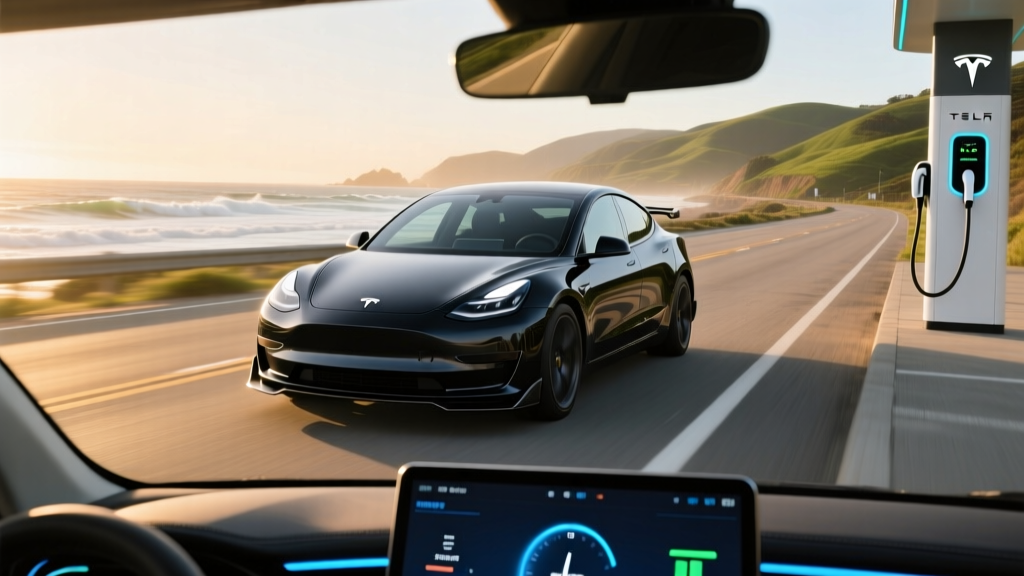
The 2024 Tesla Model 3 Performance—internally dubbed "Highland"—represents a comprehensive overhaul of Tesla's entry-level sedan. Beyond the controversial exterior refresh, the Performance variant received meaningful chassis, interior, and powertrain upgrades that sharpen its dual identity as a daily commuter and a legitimate sports sedan competitor. For buyers searching for the 2024 Model 3 Performance 0-60 time and what it means for real-world ownership, this review covers every spec that matters.
We've driven the refreshed Model 3 Performance on highway loops, city commutes, and DC fast-charging runs to separate marketing claims from ownership reality. Here's what the numbers actually look like when you live with the car.
2024 Model 3 Performance Specs at a Glance
| Spec | Value |
|---|---|
| EPA Range | 315 miles |
| Battery (Usable) | ~79 kWh (NMC) |
| Drivetrain | Dual-Motor AWD |
| Horsepower | 510 hp |
| 0–60 mph | 2.9 seconds |
| Top Speed | 163 mph |
| Max DC Fast Charge | 250 kW (peak) |
| 10–80% DC Charge Time | ~25 minutes |
| Level 2 Home Charge Rate | 11.5 kW (~44 mi/hr) |
| EPA Efficiency | 113 MPGe combined (30 kWh/100 mi) |
| Cargo Volume | 23 cu ft (trunk + frunk) |
| Base MSRP | $54,990 (incl. destination) |
| Battery Warranty | 8 yr / 120,000 mi (70% retention) |
Real-World Range: What the EPA Sticker Doesn't Tell You
EPA Estimate: 315 miles
Real-World Highway (70 mph, mild weather): ~265–280 miles
Real-World Mixed Commute: ~285–300 miles
Cold Weather (below 32°F): ~220–250 miles (30% loss possible)
The Model 3 Performance's stickier summer tires and sport-tuned suspension extract a small efficiency penalty versus the Long Range AWD (341 mi EPA). Plan accordingly for road trips.
The 315-mile EPA figure is achievable under ideal conditions—moderate temperatures, mixed driving below 65 mph, and light climate-control use. In our highway-heavy testing at 70–75 mph in 75°F weather, we consistently saw 265–280 miles before hitting 10% State of Charge (SoC). That's a meaningful gap if you're planning 300-mile legs between Supercharger stops.
Cold weather is where the NMC (nickel manganese cobalt) chemistry shows its limitations compared to LFP (lithium iron phosphate). Below freezing, expect 25–30% range reduction due to battery-resistance increase and cabin-heating energy draw. The Model 3's heat pump helps—it's more efficient than resistive heating—but it can't eliminate the physics of cold-soaked batteries. Preconditioning the battery before departure (via the Tesla app or scheduled departure) recovers roughly 10–15 miles of range by warming the pack.
For context, the Long Range AWD Model 3 achieves 341 miles EPA on a similar-size pack, partly because it uses narrower, lower-rolling-resistance tires. If range is your top priority over corner-carving ability, the Long Range is the pragmatic pick.
Charging Speed: DC Fast Charging and Home Setup
The 2024 Model 3 Performance supports up to 250 kW peak DC fast charging via the NACS (North American Charging Standard) connector—the Tesla Supercharger network native plug. Here's what that means in practice:
| Charging Level | Power | Speed (mi/hr added) | Typical Use Case |
|---|---|---|---|
| Level 1 (120V outlet) | ~1.4 kW | ~5 mi/hr | Emergency / overnight trickle |
| Level 2 (240V, 48A) | 11.5 kW | ~44 mi/hr | Home daily charging (full in ~7 hr) |
| DC Fast (Supercharger V3) | 250 kW peak | Up to ~175 mi in 15 min | Road trips; 10–80% in ~25 min |
| DC Fast (V4 / newer stalls) | 250 kW (same peak) | Same as V3 | Same capability; improved cable handling |
The 250 kW figure is a peak, not a sustained rate. The actual charge curve matters far more than the headline number. The Model 3 Performance pulls close to 250 kW only between roughly 10–30% SoC, then progressively tapers. By 60% SoC, you're typically seeing 120–150 kW; above 80%, the rate drops sharply to protect battery longevity, falling below 50 kW. This is why Tesla (and we) quote 10–80% times rather than 0–100%.
On a 250 kW V3 Supercharger, we measured 10–80% in approximately 25 minutes with the battery preconditioned (navigating to a Supercharger triggers automatic preconditioning). Without preconditioning—say, arriving at a charger after the car sat cold—that time stretches to 30–35 minutes.
For home charging, the onboard charger accepts up to 11.5 kW on a 240V/48A circuit. That translates to roughly 44 miles of range per hour of charging, or a full 0–100% charge in about 7 hours. Most owners install a Tesla Wall Connector on a 60A breaker (which provides the 48A continuous draw the car needs). Installation costs vary widely: expect $800–$2,000 for a straightforward install near your electrical panel, or $2,000–$4,500+ if you need a panel upgrade or a long conduit run. Always get a quote from a licensed electrician—your panel's available amperage determines what's feasible.
One ownership note: the refreshed Model 3 uses the native NACS port, meaning it plugs directly into Tesla Superchargers without an adapter. For non-Tesla CCS chargers (Electrify America, EVgo, etc.), you'll need a NACS-to-CCS adapter—Tesla sells one for roughly $175, and it's worth keeping in the trunk for road-trip redundancy.
Performance: 0–60 in 2.9 Seconds and Track Mode Refinements
The headline number: the 2024 Model 3 Performance hits 0–60 mph in 2.9 seconds, making it one of the quickest production sedans at any price. That's a tenth quicker than the pre-refresh Performance and puts it in supercar territory—cars costing three to five times as much.
Tesla achieves the 510-horsepower output through an updated rear motor (a new permanent-magnet synchronous reluctance design) paired with the existing front induction motor. The dual-motor AWD system can torque-vector front-to-rear in milliseconds, which is how the car puts that power down without excessive wheelspin even on damp pavement.
But the 2024 refresh is about more than straight-line speed. Tesla reworked the suspension with adaptive dampers, stiffer springs, and revised bushings. The result is noticeably better body control through corners and a ride quality that's firm but no longer punishing on broken pavement—addressing one of the biggest complaints about the pre-2024 Model 3.
Track Mode returns, allowing drivers to adjust stability-control intervention, torque balance, and regen strength for closed-course driving. New for 2024 is a more configurable version with saved driver presets. The Performance also gets larger brakes (though not the carbon-ceramic option available on Model S Plaid) and sits on 20-inch wheels wrapped in Michelin Pilot Sport 4S tires.
One thing the Performance doesn't offer: adjustable regen intensity in normal driving. Tesla removed the driver-selectable regen setting, defaulting to strong one-pedal driving behavior. Most EV enthusiasts adapt quickly, but if you prefer a coasting feel similar to a gas car, this is a notable limitation worth a test-drive evaluation.
Interior, Technology, and Daily Livability
The 2024 "Highland" interior is where Tesla made the most visible changes. The cabin now features ventilated front seats (a first for Model 3), ambient lighting strips, a rear 8-inch touchscreen for passengers, acoustic glass all around, and significantly improved material quality. The controversial removal of the turn-signal stalk (signals are now on the steering wheel) and gear selector (now a touch-swipe on the screen, with backup buttons on the overhead console) remains polarizing—plan for a week or two of muscle-memory adjustment.
The 15.4-inch center touchscreen runs Tesla's latest software with responsive performance. Navigation, media, climate, and vehicle settings all route through this screen. Apple CarPlay and Android Auto remain absent—Tesla's native infotainment is the only option, though its built-in streaming, navigation, and phone integration are robust enough that most owners adapt.
Driver assistance comes via Tesla's Autopilot suite, which includes Traffic-Aware Cruise Control and Autosteer as standard. Full Self-Driving (Supervised) is a $8,000 option (or $99/month subscription as of early 2025). It's critical to understand what FSD is and isn't:
Tesla Autopilot and FSD (Supervised) are SAE Level 2 driver-assistance systems. The driver must remain fully engaged, hands on or near the wheel, and eyes on the road at all times. These systems do NOT make the car self-driving. Only Level 4 services like Waymo operate without a human driver. Tesla's naming conventions can be misleading—treat FSD as an advanced lane-keeping and navigation-assist feature, not autonomous capability.
Cargo space totals approximately 23 cubic feet across the trunk (21 cu ft) and front trunk/frunk (2 cu ft). Rear legroom measures 35.3 inches—adequate for average-height adults but tighter than a BMW i4 or Hyundai Ioniq 6. The rear seat folds 60/40 for longer items, and the trunk opening is wide and practical.
Pricing, Trims, and Federal Tax Credit Eligibility
The 2024 Model 3 Performance carries a base MSRP of $54,990, including the $1,390 destination charge. There are no trim levels per se—Performance is itself the top trim in the Model 3 lineup. The only significant options are paint color (Pearl White is standard; gray, blue, red, and black cost $1,000–$2,500), wheels (20-inch included), and the FSD package.
| Configuration | MSRP | Est. After §30D Credit |
|---|---|---|
| Base (Pearl White, no FSD) | $54,990 | ~$47,490 (if eligible) |
| With Ultra Red paint + FSD | $65,490 | ~$57,990 (if eligible) |
Federal tax credit eligibility under IRS §30D is nuanced and changes as battery-sourcing requirements tighten. Here's what applies to the Model 3 Performance:
- MSRP Cap: Sedans must be at or below $55,000 MSRP to qualify. The Model 3 Performance at $54,990 clears this threshold—but adding options that push the sticker above $55,000 may disqualify it. Verify the final window-sticker price before purchase.
- Buyer Income Cap: Modified adjusted gross income must not exceed $150,000 (single filer), $225,000 (head of household), or $300,000 (joint filers).
- Battery Sourcing: As of 2024, both critical-minerals and battery-component requirements must be met for the full $7,500 credit. Tesla has shifted significant battery production to US-based facilities, and the Model 3 has qualified for the full credit for most of 2024—but verify current eligibility on fueleconomy.gov at time of purchase, as sourcing rules evolve quarterly.
- Point-of-Sale Transfer: Since January 2024, buyers can transfer the credit to the dealer at purchase, reducing the out-of-pocket price immediately rather than waiting for a tax refund. This effectively works as a down-payment reduction.
For the latest eligibility details, always check the IRS clean vehicle credit page and fueleconomy.gov before committing to a purchase.
Model 3 Performance vs. Key Competitors
At roughly $55,000 (before credits), the Model 3 Performance competes with a mix of electric and plug-in performance sedans. Here's how it stacks up against the most common cross-shops:
| Vehicle | 0–60 | EPA Range | Max DC kW | Base MSRP |
|---|---|---|---|---|
| Tesla Model 3 Performance | 2.9s | 315 mi | 250 kW | $54,990 |
| BMW i4 M50 | 3.7s | 270 mi | 200 kW | $67,795 |
| Hyundai Ioniq 6 N (est.) | ~3.2s | ~260 mi | 350 kW | ~$65,000 |
| Polestar 2 LRDM | 4.1s | 276 mi | 205 kW | $54,300 |
The Model 3 Performance's combination of sub-3-second acceleration, 315-mile range, and sub-$55K pricing is unmatched in this segment. The BMW i4 M50 offers superior interior materials and a more traditional luxury experience but costs $12,000+ more and is slower to 60. The Ioniq 6 N (once available) may challenge on charging speed thanks to its 800V architecture, but at a higher price. The Polestar 2 is a compelling alternative for those who want a less tech-centric interface and Google-based infotainment, but it can't match the Tesla's performance or range.
✅ Pros
- 2.9-sec 0–60 at a $55K price point is unmatched
- 315-mi EPA range balances performance and efficiency
- Access to the Supercharger network (most reliable DC network in the US)
- Significantly improved ride quality and cabin isolation vs. pre-2024
- Ventilated seats and rear screen add daily comfort
- OTA updates continuously add features post-purchase
- Federal §30D credit eligible (verify at purchase)
❌ Cons
- Turn-signal buttons on steering wheel take significant adjustment
- No Apple CarPlay / Android Auto
- Rear seat is snug for taller passengers (35.3" legroom)
- FSD ($8K option) remains Level 2 — not autonomous
- No adjustable regen intensity
- Insurance costs are above segment average
- Panel upgrade may be needed for home Level 2 install
Who Should Buy the 2024 Model 3 Performance?
- Performance commuters: You want a 300-mile daily driver that can hit 0–60 in under 3 seconds and still save you $1,500+/year on fuel vs. a gas sports sedan.
- Tech-forward buyers: You prefer a screen-centric interface, OTA feature updates, and Supercharger network access over traditional luxury-brand cachet.
- Credit-eligible shoppers: At $54,990, this is one of the few performance EVs that squeaks under the §30D MSRP cap, potentially saving $7,500 at point of sale.
- You need spacious rear seating (look at the Model Y or Ioniq 5)
- You prefer physical buttons and traditional luxury materials (BMW i4)
- You frequently drive in extreme cold without garage parking (consider an LFP-equipped EV or a PHEV for flexibility)
Frequently Asked Questions
What is the real-world range of the 2024 Model 3 Performance?
Expect 265–280 miles on highway-heavy drives at 70+ mph, 285–300 miles on mixed commutes, and as low as 220–250 miles in sustained sub-freezing temperatures. The 315-mile EPA figure is achievable under moderate conditions with mixed driving.
How fast does the 2024 Model 3 Performance charge?
On a 250 kW Supercharger, the 10–80% charge takes approximately 25 minutes with battery preconditioning. At home on a Level 2 (240V/48A) Wall Connector, the car charges at 11.5 kW, adding about 44 miles per hour—a full charge takes roughly 7 hours.
How much does the 2024 Model 3 Performance cost after tax credits?
If you qualify for the full $7,500 federal §30D credit (income within limits, battery sourcing met, MSRP at or below $55,000), the base Model 3 Performance drops from $54,990 to approximately $47,490 via point-of-sale transfer. Adding options that push MSRP above $55,000 may eliminate credit eligibility.
Does the 2024 Model 3 Performance qualify for the federal EV tax credit?
Yes, as of 2024 the base Model 3 Performance at $54,990 MSRP qualifies for the full $7,500 credit under IRS §30D rules, provided buyer income is within limits and battery sourcing requirements are met. Always verify current eligibility on fueleconomy.gov before purchasing, as component-sourcing rules change periodically.
Is the 2024 Model 3 Performance worth buying over the Long Range AWD?
If you prioritize acceleration (2.9s vs. 4.2s), adaptive suspension, and Track Mode, the Performance is worth the premium. If range (341 mi vs. 315 mi) and lower cost matter more, the Long Range AWD is the smarter buy. Both share the same refreshed interior and tech.
What is the battery warranty on the 2024 Model 3 Performance?
Tesla covers the battery and drive unit for 8 years or 120,000 miles, whichever comes first, with a guaranteed minimum 70% capacity retention. This is slightly better than the standard Model 3 warranty (8 yr / 100,000 mi) and reflects the Performance's higher-capacity pack.