Quick Verdict: A Stylish City EV With a Tiny Footprint
The 2024 Mini Cooper SE Hardtop 2 Door is an anomaly in the EV market: a premium subcompact that prioritizes driving fun and urban maneuverability over range and practicality. At just 152.8 inches in overall length, it's one of the shortest battery-electric vehicles sold in the United States, making it a parking-lot dream. But that compact footprint comes with trade-offs every prospective buyer needs to understand before signing a lease or purchase agreement.
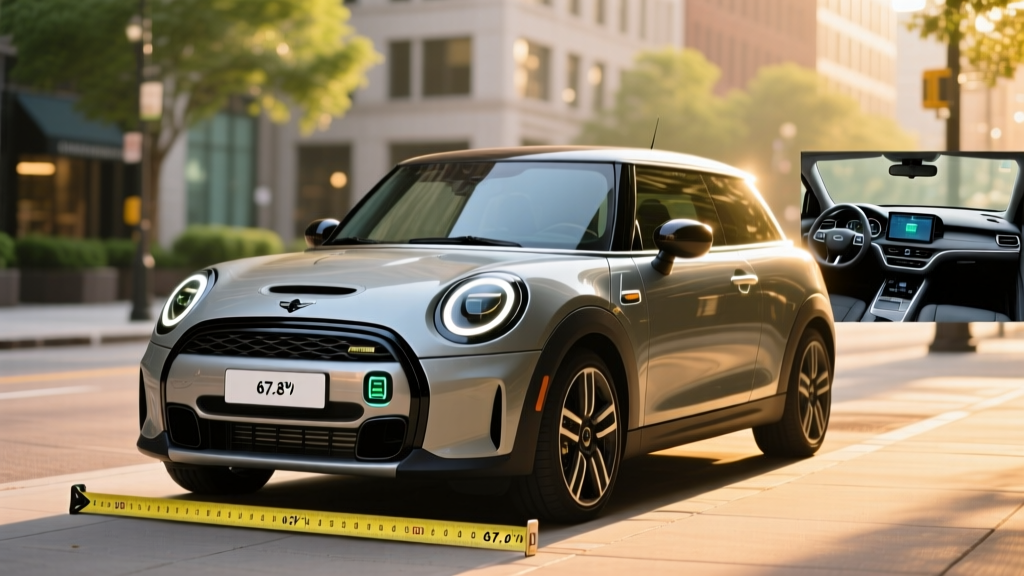
If you're searching for the 2024 Mini Cooper SE Hardtop 2 Door length in inches — it measures exactly 152.8 inches bumper to bumper. That's roughly 20 inches shorter than a Chevrolet Bolt EV and over 30 inches shorter than a Tesla Model 3. For context, it's closer in size to a Smart Fortwo than to most mainstream EVs. Whether that's an advantage or a limitation depends entirely on how you plan to use the car.
This review breaks down every spec that matters: real-world range, charging speed, performance, interior dimensions, pricing, and whether it qualifies for the federal EV tax credit in the current tax year.
Range, Battery, and Efficiency: The Numbers That Matter
Real-World Expectation: 90–105 miles at sustained highway speeds (70+ mph); 100–115 miles in mixed city driving. In cold weather (below 30°F), expect a 20–30% reduction, bringing range down to approximately 75–90 miles without preconditioning.
The 2024 Cooper SE carries a 32.6 kWh lithium-ion battery pack (approximately 28.9 kWh usable) using NMC (nickel manganese cobalt) cell chemistry. This is a modest pack by 2026 standards — for comparison, the Hyundai Kona Electric offers 64 kWh and the Tesla Model 3 starts at around 60 kWh. Mini made a deliberate engineering choice to keep the car light (curb weight around 3,146 lbs) and preserve the go-kart handling feel, rather than stuffing in a larger, heavier battery.
Efficiency on the combined cycle is rated at 110 MPGe (approximately 30 kWh per 100 miles) according to fueleconomy.gov. That's respectable but not class-leading — the Tesla Model 3 RWD achieves around 132 MPGe. The Cooper SE's relatively small frontal area helps, but its older EV platform isn't optimized for maximum efficiency the way dedicated EV architectures are.
| Specification | Value |
|---|---|
| EPA Range | 114 miles |
| Battery (Total / Usable) | 32.6 kWh / ~28.9 kWh |
| Battery Chemistry | NMC (Nickel Manganese Cobalt) |
| Efficiency (Combined) | 110 MPGe / 30 kWh/100mi |
| Overall Length | 152.8 inches |
| Wheelbase | 98.2 inches |
| Curb Weight | 3,146 lbs |
| 0–60 mph | 6.9 seconds |
| Horsepower | 181 hp (135 kW) |
| Torque | 199 lb-ft |
| Drivetrain | Front-Wheel Drive (FWD) |
| Cargo Volume (rear seats up) | 8.7 cu ft |
| Cargo Volume (rear seats folded) | 31.9 cu ft |
| Battery/Powertrain Warranty | 8 years / 100,000 miles |
Charging Speed: DC Fast Charge and Home Level 2
Charging is where the Cooper SE's age shows most clearly. The car uses a CCS1 connector for DC fast charging and a standard J1772 inlet for AC Level 1 and Level 2 charging. Mini did not equip the 2024 model with the newer NACS (Tesla) connector, though CCS-to-NACS adapters are available for accessing Tesla Superchargers at compatible stalls.
| Charging Level | Power / Voltage | Charge Time / Rate |
|---|---|---|
| Level 1 (120V household) | ~1.2 kW | ~24+ hours for a full charge (~4 mi/hr) |
| Level 2 (240V home/public) | 7.4 kW (max onboard) | ~4.5 hours 0–100% (~22 mi/hr of range added) |
| DC Fast Charge (CCS1) | 50 kW peak | 10–80% in approximately 36 minutes |
The 50 kW peak DC fast-charge rate is the Cooper SE's most significant limitation for anyone who road-trips. Most 2026-era EVs charge at 150–250 kW peak, meaning a 10–80% session takes 18–25 minutes. The Cooper SE takes nearly twice that long. Worse, the charge curve tapers noticeably above 80% State of Charge (SoC), so topping off at a fast charger becomes increasingly slow.
For daily home charging, the 7.4 kW Level 2 rate is perfectly adequate. Plug in overnight, and the car will be fully replenished by morning. A 240V / 32-amp Level 2 home charger (such as a ChargePoint Home Flex or Emporia Vue) paired with a NEMA 14-50 outlet installation typically costs $800–$1,500 for equipment and electrician labor, depending on your panel capacity and run length. Since the Cooper SE's battery is small, you don't need a 48-amp hardwired unit — a 32-amp plug-in charger matches the car's onboard charger limit exactly.
Performance and Driving Dynamics
Mini built its reputation on go-kart handling, and the electric Cooper SE preserves that character. The front-mounted electric motor produces 181 horsepower and 199 lb-ft of torque, sending the car from 0 to 60 mph in 6.9 seconds. That's quick enough for confident highway merging and genuinely entertaining in city driving, where instant electric torque makes the car feel punchier than the numbers suggest.
The single-speed transmission and front-wheel-drive layout mean no gear shifts and no drivetrain lag. Regenerative braking is adjustable — the Cooper SE offers multiple regen levels through the driving mode selector, and at the highest setting, it approaches one-pedal driving, though it doesn't always come to a complete stop without touching the brake pedal.
The low center of gravity (battery pack mounted under the floor) and sport-tuned suspension make the Cooper SE genuinely fun on a twisty road. Steering is quick and well-weighted. The trade-off is a firm ride — you'll feel expansion joints and potholes more than in a comfort-oriented EV like the Nissan Leaf or Hyundai Kona Electric.
Dimensions, Interior Space, and Practicality
Here's the dimensional breakdown buyers researching the 2024 Mini Cooper SE Hardtop 2 Door length in inches need to know:
- Overall Length: 152.8 inches
- Overall Width (without mirrors): 68.0 inches
- Overall Height: 56.4 inches
- Wheelbase: 98.2 inches
- Front Headroom: 38.8 inches
- Front Legroom: 41.4 inches
- Rear Headroom: 35.9 inches
- Rear Legroom: 28.6 inches
- Cargo (seats up): 8.7 cubic feet
- Cargo (seats folded): 31.9 cubic feet
The front seats are comfortable and supportive for long drives, with good adjustability. The rear seats, however, are best suited for children or occasional use — the 28.6 inches of rear legroom is tight for adult passengers on anything beyond a short trip. Cargo space at 8.7 cubic feet behind the rear seats is enough for a few grocery bags or a carry-on suitcase, but not much more. Folding the rear seats opens up 31.9 cubic feet, which is workable for a weekend trip for two.
There is no front trunk (frunk) — the Cooper SE was built on a platform originally designed for internal-combustion engines, and the electric motor occupies the space where a gasoline engine would sit.
Pricing, Trims, and Federal Tax Credit Eligibility
The 2024 Mini Cooper SE Hardtop 2 Door was offered in three trim levels. Here's the pricing breakdown:
| Trim | Base MSRP | Key Features |
|---|---|---|
| Signature | $30,900 | 8.8" touchscreen, heated seats, LED headlights |
| Iconic | $34,900 | Navigation, Harman Kardon audio, panoramic roof |
| Resolute Edition | $36,900 | Unique trim, Rebel Green exterior, special badging |
All prices include the $995 destination charge. A well-equipped Iconic trim — which most buyers gravitate toward — lands around $35,900 before options.
Does the 2024 Mini Cooper SE Qualify for the Federal EV Tax Credit?
This is where things get complicated, and it's essential to understand the current IRS §30D rules before counting on any incentive:
- MSRP Cap: The Cooper SE is a passenger car, so the MSRP cap is $55,000. All trims clear this easily. ✅
- Buyer Income Cap: Modified adjusted gross income must not exceed $150,000 (single), $225,000 (head of household), or $300,000 (joint). ✅ (if you qualify)
- Battery Component Sourcing: A percentage of battery components must be manufactured or assembled in North America. The Cooper SE's battery is sourced from CATL (China), which has disqualified it from the full $7,500 credit under current critical-mineral and battery-component rules. ❌
- Critical Minerals Requirement: A percentage of critical minerals must be sourced from the US or a free-trade-agreement country. The Cooper SE has struggled to meet this threshold. ❌
Bottom line: As of the current tax year, the 2024 Mini Cooper SE Hardtop 2 Door does not qualify for the full $7,500 federal tax credit due to battery-sourcing and critical-mineral requirements. It may qualify for a partial credit ($3,750) depending on the specific model year and manufacturing batch, but buyers should consult a tax professional and verify VIN-specific eligibility on the IRS clean vehicle credit page before assuming any credit amount. State and local incentives may still apply — check your state's energy office for details.
Tech, Safety, and Driver Assistance
The 2024 Cooper SE comes with Mini's 8.8-inch circular touchscreen infotainment system, which is visually distinctive (it sits in the center of the dash in a round housing, echoing the classic Mini speedometer). Wireless Apple CarPlay is standard; Android Auto requires a wired USB connection. A digital instrument cluster replaces the traditional gauge set, and the Iconic trim adds built-in navigation with real-time traffic.
Driver-assistance features are modest compared to rivals:
- Forward collision warning with automatic emergency braking (standard)
- Lane departure warning (standard)
- Park distance control (front and rear sensors)
- Adaptive cruise control (available on Iconic trim)
- Head-up display (available on Iconic trim)
Safety ratings from NHTSA and IIHS were not available for the 2024 Cooper SE at the time of publication. The related Mini Hardtop (gasoline) received a "Good" rating from IIHS in moderate overlap front testing, but the EV variant's heavier curb weight and different weight distribution may yield different results.
Who Should Buy the 2024 Mini Cooper SE?
- You live in a dense urban area where a 152.8-inch length makes parking dramatically easier
- Your daily commute is under 50 miles round-trip and you have reliable home Level 2 charging
- You prioritize driving engagement and style over range and cargo space
- This is a second vehicle in a multi-car household
- You need 200+ miles of range for highway road trips
- You regularly carry adult rear-seat passengers
- You need DC fast charging above 100 kW for frequent long-distance travel
- You want to maximize federal tax credit savings
Pros and Cons at a Glance
- Genuinely fun to drive — instant torque, go-kart handling
- Extremely compact (152.8" length) for easy city parking
- Premium interior materials and distinctive design
- Low operating cost — electricity vs. gasoline savings are significant for city driving
- 8-year/100,000-mile battery warranty provides peace of mind
- Lightweight for an EV (3,146 lbs) — less tire wear, easier to maneuver
- 114-mile EPA range is the lowest of any current-production EV
- 50 kW peak DC fast charging is painfully slow by 2026 standards
- Rear seats are cramped (28.6" legroom) — adults won't be comfortable
- 8.7 cu ft of cargo space limits practicality
- Likely does not qualify for the full $7,500 federal tax credit
- No NACS connector — requires adapter for Tesla Supercharger access
- CCS1 connector is being phased out in favor of NACS across the industry
Frequently Asked Questions
What is the exact length of the 2024 Mini Cooper SE Hardtop 2 Door in inches?
The 2024 Mini Cooper SE Hardtop 2 Door measures 152.8 inches in overall length, 68.0 inches in width, and 56.4 inches in height. Its wheelbase is 98.2 inches. This makes it one of the shortest EVs available in the US market.
What is the real-world range of the 2024 Mini Cooper SE?
The EPA rates the Cooper SE at 114 miles. In real-world city driving with moderate temperatures, owners typically see 100–115 miles. On the highway at 70+ mph, expect 90–105 miles. In freezing weather without preconditioning, range can drop to 75–90 miles. Preconditioning the battery while plugged in helps mitigate cold-weather losses.
How fast does the 2024 Mini Cooper SE charge?
On a DC fast charger, the Cooper SE peaks at 50 kW, taking approximately 36 minutes to go from 10% to 80% SoC. On a Level 2 home charger (240V), it accepts up to 7.4 kW, adding roughly 22 miles of range per hour and reaching a full charge in about 4.5 hours. Level 1 (120V) charging is impractical for daily use at roughly 4 miles of range per hour.
Does the 2024 Mini Cooper SE qualify for the $7,500 federal EV tax credit?
As of the current tax year, the Cooper SE likely does not qualify for the full $7,500 credit due to battery-component and critical-mineral sourcing requirements under IRS §30D. Its battery cells are sourced from CATL (China). Some partial credit ($3,750) may apply depending on manufacturing batch. Always verify VIN-specific eligibility on the IRS website and consult a tax professional before making a purchase decision based on credit assumptions.
Is the 2024 Mini Cooper SE worth buying versus competitors?
It depends on your use case. If you want the most range for the money, the Chevrolet Bolt EV (259 miles EPA, significantly lower price) or Hyundai Kona Electric (261 miles EPA) are more practical choices. If you want a premium badge and don't mind the range limitation, the Cooper SE delivers an unmatched driving experience in its size class. For buyers who need a fun, stylish urban commuter and can charge at home nightly, it remains a compelling — if niche — choice.
What is the battery warranty on the 2024 Mini Cooper SE?
Mini provides an 8-year / 100,000-mile warranty on the high-voltage battery pack and electric powertrain components, consistent with the industry standard for EV battery coverage. The warranty covers defects and excessive capacity degradation (typically below 70% of original capacity, though confirm specific terms with your dealer).