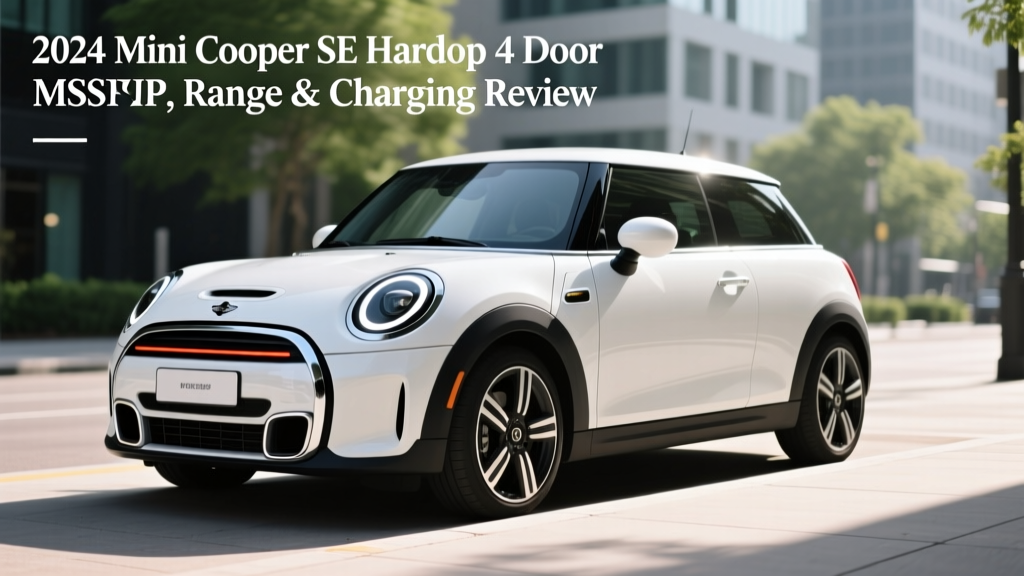
The Mini Cooper SE has always been a polarizing EV: beloved for its go-kart handling and iconic design, criticized for its short range. For the 2024 model year, Mini offered the Cooper SE exclusively as a 2-door Hardtop in the United States. The widely searched "4 Door" variant — known globally as the Mini Cooper SE — was not sold new in the US market for 2024, though it was available in Europe and other regions. This review covers the 2024 Mini Cooper SE Hardtop 2 Door (the US-spec model), addresses the 4 Door question directly, and provides the exact MSRP, range, charging, and tax-credit data buyers need.
If you're cross-shopping the used market or considering importing, we also note what the 4 Door variant offers. But for US buyers looking at 2024 dealer inventory, the 2-door Hardtop is what's on the lot.
2024 Mini Cooper SE Hardtop MSRP and Trim Pricing
Mini kept the 2024 Cooper SE lineup simple with two trims. Pricing below reflects the original MSRP at launch, including destination charge.
| Trim | Base MSRP | Destination | Total MSRP |
|---|---|---|---|
| Signature | $30,900 | $995 | $31,895 |
| Iconic | $34,900 | $995 | $35,895 |
The Iconic trim adds a panoramic moonroof, head-up display, Harman Kardon premium audio, navigation, and LED matrix headlights. Options like the Premium Package and specific paint colors could push an as-tested Iconic above $38,000.
For reference, the European-spec Mini Cooper SE 4 Door (not US-sold) started at approximately €39,500 (~$43,000 USD at 2024 exchange rates), which helps explain why the 2 Door remained the US offering — pricing and demand favored the shorter, lighter variant.
EPA Range, Battery, and Real-World Expectations
Real-World Expectation: 90–110 miles highway or cold weather; 115–125 miles city in mild conditions
Battery: 32.6 kWh gross / 28.9 kWh usable, NMC (nickel manganese cobalt) chemistry
The 114-mile EPA figure is the lowest among mainstream EVs sold in 2024. For context, the Chevrolet Bolt EV delivered 259 miles, the Hyundai Kona Electric 261 miles, and even the similarly sized Fiat 500e managed 149 miles.
According to fueleconomy.gov, the 2024 Cooper SE achieves 110 MPGe combined (116 city / 102 highway), consuming roughly 30 kWh per 100 miles. That efficiency is respectable for the car's weight, but the small battery simply can't store enough energy for longer trips.
In real-world driving, expect the following:
- City commuting (mild weather): 115–125 miles — regenerative braking recovers energy in stop-and-go traffic
- Highway driving (65–75 mph): 90–100 miles — aerodynamic drag and no regen opportunities drain the pack faster
- Cold weather (below 32°F): 75–90 miles — the Cooper SE uses a resistive heater (no heat pump), which can reduce range by 20–30%
The battery is NMC chemistry, which offers higher energy density than LFP but is more sensitive to frequent 100% charges and deep discharges. Mini recommends daily charging to 80–90% for longevity, using the 100% setting only for planned longer trips.
Charging Speed: DC Fast Charge and Home Level 2
Charging speed is where the Cooper SE's age shows. The 2024 model carries over the previous generation's electrical architecture with a 50 kW peak DC fast-charge rate and a 7.4 kW onboard charger for Level 2.
| Charging Level | Power (kW) | Charge Time | |
|---|---|---|---|
| Level 1 (120V household) | 1.4 kW | ~22 hours (0–100%) | ~4 mi/hr |
| Level 2 (240V, 32A) | 7.4 kW | ~4.25 hours (0–100%) | ~24 mi/hr |
| DC Fast Charge (CCS) | 50 kW peak | ~36 min (10–80%) | N/A |
The 50 kW peak rate is the car's biggest practical limitation. Most 2024 EVs charge at 150–250 kW on DC fast chargers. At 50 kW, the Cooper SE adds roughly 100 miles of range in 30 minutes — adequate for its small battery, but it means you won't blaze through road-trip charging stops.
On a typical Electrify America or EVgo 150+ kW station, the Cooper SE will only pull its 50 kW maximum. The charge curve is relatively flat between 10–70% SoC, then tapers sharply above 80%, which is standard for NMC packs. Expect the 10–80% session to take approximately 36 minutes in moderate temperatures.
For home charging, the 7.4 kW Level 2 rate is perfectly adequate. Since the usable battery is only 28.9 kWh, a full overnight charge on a Level 2 home station takes just over 4 hours. Most owners will plug in nightly and wake up to a full battery — the Cooper SE is fundamentally a home-charging commuter car.
The 2024 Cooper SE uses the CCS1 connector for DC fast charging and the J1772 connector for Level 2 AC. With the North American industry shift to NACS (Tesla's connector), adapters are available from Mini and third parties for Tesla Supercharger access, though the 50 kW peak rate means you won't benefit from Supercharger V3 speeds.
Performance, Handling, and Drivetrain
The Cooper SE's electric motor produces 181 horsepower and 199 lb-ft of torque, driving the front wheels. Mini claims a 0–60 mph time of 6.9 seconds — brisk for a subcompact and noticeably quicker off the line than the gas-powered Cooper S.
The instant torque and low center of gravity (battery mounted under the floor) make the Cooper SE genuinely fun to drive. The steering is sharp, body roll is minimal, and the one-pedal driving mode with aggressive regen makes city driving effortless. This is where the car earns its reputation: as a driver's EV, not a range champion.
Key performance specs:
- Drivetrain: Front-wheel drive (single motor)
- Horsepower: 181 hp
- Torque: 199 lb-ft
- 0–60 mph: 6.9 seconds
- Top speed: 93 mph (electronically limited)
- Curb weight: ~3,215 lbs
Interior, Cargo Space, and Technology
The 2024 Cooper SE carries over the previous generation's interior, which means a traditional Mini layout with a central circular display (8.8-inch touchscreen), physical toggle switches, and analog-inspired digital instrument cluster. It's charming but dated compared to the all-new electric Mini platform that debuted for the 2025 model year.
Cargo and passenger dimensions:
- Cargo volume (rear seats up): 7.9 cu ft
- Cargo volume (rear seats folded): 30.2 cu ft
- Front legroom: 41.4 inches
- Rear legroom: 29.9 inches
- Seating capacity: 4 passengers
The 2 Door's rear seat is best suited for children or occasional use. If you need genuine rear-seat practicality, the unavailable-in-US 4 Door variant added approximately 3 inches of rear legroom and a slightly more usable cargo area. For US buyers needing more space, the only alternative was shopping the used import market or choosing a competitor.
Standard tech features (Signature trim):
- 8.8-inch touchscreen with Apple CarPlay (wireless) and Android Auto (wired)
- 6-speaker audio system
- Dual-zone automatic climate control
- Heated front seats and heated steering wheel
- Keyless entry and push-button start
Iconic trim additions:
- Panoramic glass moonroof
- Head-up display
- Harman Kardon 12-speaker premium audio
- Navigation with real-time traffic
- LED matrix headlights with adaptive high beams
- Parking assistant with rear-view camera
Driver-assistance features: The 2024 Cooper SE includes forward collision warning, automatic emergency braking, lane departure warning, and active cruise control. These are SAE Level 1 assists — they support the driver but do not automate steering or lane-keeping. There is no Level 2 hands-free system like BlueCruise or Super Cruise available.
Federal Tax Credit Eligibility and Incentives
The 2024 Mini Cooper SE's eligibility for the IRS §30D federal EV tax credit depends on several factors that changed significantly during the 2024 calendar year.
- MSRP cap: Vehicle must be under $55,000 (sedans/hatchbacks) — the Cooper SE qualifies ✓
- Buyer income cap: AGI must not exceed $150,000 (single) / $300,000 (joint) — varies by buyer
- Battery sourcing: Critical minerals and battery components must meet phased-in percentages — the Cooper SE's BMW Group supply chain had partial compliance in early 2024
- Assembly: Final assembly must be in North America — the Cooper SE was assembled in Oxford, UK ✗
- Point-of-sale transfer: Eligible buyers could transfer the credit to the dealer for an upfront price reduction starting January 1, 2024
Critical detail: Because the 2024 Cooper SE was assembled in the United Kingdom (not North America), it did not qualify for the full $7,500 §30D credit for most of 2024. The North American final assembly requirement disqualified it outright. This was a significant disadvantage versus competitors like the Chevrolet Bolt EV (assembled in Michigan) or the Hyundai Kona Electric (assembled in Georgia for 2024).
Some buyers in early 2024 may have qualified for a partial credit ($3,750) if the battery sourcing requirement was met before the assembly rule was strictly enforced, but this was inconsistent. Always verify with a tax professional and check the vehicle's VIN on fueleconomy.gov before assuming eligibility.
State-level incentives varied: California's CVRP offered up to $2,000 for income-eligible buyers, Colorado offered a $5,000 state credit, and several utility companies provided $500–$1,000 rebates. Check your state and local programs for specifics.
| Scenario | Signature Trim | Iconic Trim |
|---|---|---|
| MSRP (with destination) | $31,895 | $35,895 |
| Federal §30D credit | $0 (UK assembly) | $0 (UK assembly) |
| Effective price (no federal credit) | $31,895 | $35,895 |
| With $2,000 state incentive (example) | $29,895 | $33,895 |
Warranty and Battery Coverage
Mini provides the following warranty coverage for the 2024 Cooper SE:
- Limited vehicle warranty: 4 years / 50,000 miles
- Powertrain warranty: 4 years / 50,000 miles
- High-voltage battery warranty: 8 years / 100,000 miles (retains at least 70% of original capacity)
- Corrosion warranty: 12 years / unlimited miles
- Roadside assistance: 4 years / unlimited miles
The 8-year/100,000-mile battery warranty is standard for the industry and matches competitors like the Bolt EV and Kona Electric. The 70% capacity retention threshold means Mini will replace or repair the battery if it degrades below 70% of its original 28.9 kWh usable capacity within the warranty period. Real-world data from European Cooper SE fleets suggests NMC degradation of approximately 8–12% over the first 100,000 miles under normal use patterns.
Who Should Buy the 2024 Mini Cooper SE?
- You have reliable home Level 2 charging and a commute under 50 miles round-trip
- You prioritize driving dynamics and style over range
- You want a premium-brand subcompact EV with strong build quality
- This is a second car in a two-car household
- You live in a mild climate (less cold-weather range loss)
- You need 200+ miles of range for road trips or long commutes
- You lack home charging access and depend on public DC fast chargers (50 kW is slow)
- You need rear-seat space for adults or car seats
- You want the $7,500 federal tax credit (UK assembly disqualifies it)
- You live in a cold climate and need reliable winter range
The Cooper SE is a superb city commuter and a genuine driver's car. It's not a road-trip EV, and at 114 miles EPA, it demands honest self-assessment about your driving patterns. If 90% of your driving is within a 40-mile radius and you charge at home nightly, the range is manageable. If you regularly drive 80+ miles or need flexibility for weekend trips, you'll feel constrained.
Competitor Comparison
| Spec | Mini Cooper SE | Chevy Bolt EV | Hyundai Kona Electric | Fiat 500e |
|---|---|---|---|---|
| EPA Range | 114 mi | 259 mi | 261 mi | 149 mi |
| Battery (usable kWh) | 28.9 | 65.0 | 64.8 | 37.3 |
| DC Fast Charge (peak kW) | 50 | 55 | 100+ | 85 |
| 0–60 mph | 6.9 sec | 6.5 sec | 7.2 sec | 8.5 sec |
| Base MSRP | $31,895 | $27,495 | $34,095 | $37,595 |
| Federal Tax Credit | $0 | $7,500 | $7,500 | $7,500 |
| Cargo (cu ft) | 7.9 | 23.6 | 25.8 | 9.0 |
The Bolt EV is the clear value winner: more range, more cargo, lower MSRP, and full tax-credit eligibility — making its effective price under $20,000 after credit. The Kona Electric offers similar range with faster charging. The Fiat 500e is the closest in spirit (small, stylish, urban) but still beats the Cooper SE on range and tax credit.
The Cooper SE wins on driving dynamics, brand cachet, and interior material quality. But on pure numbers, it's the weakest value proposition in this segment.
Pros and Cons
- Best-in-class handling and steering feel — genuinely fun to drive
- Premium interior materials and build quality
- Quick 0–60 time (6.9 sec) with instant electric torque
- Compact size ideal for urban parking
- Strong standard features (heated seats, CarPlay on base trim)
- 114-mile EPA range is lowest in class
- 50 kW DC fast charging is slow vs. 150+ kW competitors
- No federal tax credit eligibility (UK assembly)
- Tight rear seat and small cargo area (7.9 cu ft)
- No heat pump — significant cold-weather range loss
- Dated infotainment vs. the all-new 2025 Mini EV platform
Frequently Asked Questions
Was the 2024 Mini Cooper SE available as a 4 Door in the US?
No. The 2024 Mini Cooper SE was sold exclusively as a 2-door Hardtop in the United States. The 4 Door variant was available in Europe and other markets but was not part of the US lineup. US buyers wanting a 4 Door electric Mini would need to look at the redesigned 2025+ Mini Cooper Electric or consider the used import market.
What is the real-world range of the 2024 Mini Cooper SE?
The EPA rates the Cooper SE at 114 miles. In real-world city driving with mild temperatures, expect 115–125 miles. Highway driving at 70 mph drops that to roughly 90–100 miles. In freezing weather with the heater running, range can fall to 75–90 miles due to the resistive heater (no heat pump).
How fast does the Cooper SE charge?
On a DC fast charger, the Cooper SE peaks at 50 kW, taking approximately 36 minutes to charge from 10–80%. On a home Level 2 charger (7.4 kW), a full charge takes about 4.25 hours. Level 1 (standard 120V outlet) takes roughly 22 hours for a full charge — only practical as a trickle-charge supplement.
Does the 2024 Mini Cooper SE qualify for the federal EV tax credit?
No. The 2024 Cooper SE was assembled in Oxford, United Kingdom, which disqualifies it from the IRS §30D federal tax credit. The credit requires final assembly in North America. State and local incentives may still apply — check your jurisdiction's programs and consult a tax professional.
Is the Cooper SE worth buying in 2026?
As a used purchase, the Cooper SE can be a strong value if the price reflects its range limitations and lack of tax credit. Expect used Signature trims in the $18,000–$23,000 range. It's worth buying if you need a fun, premium commuter with home charging and a sub-50-mile daily drive. For longer commutes or road-trip flexibility, the Bolt EV, Kona Electric, or the newer 2025+ Mini Cooper Electric (with 200+ mile range) are better choices.
What's the battery replacement cost?
Out-of-warranty high-voltage battery replacement for the Cooper SE is estimated at $8,000–$12,000 based on BMW Group parts pricing. However, the 8-year/100,000-mile warranty (70% capacity retention) covers premature degradation, and real-world data suggests the NMC pack retains 88–92% capacity at 100,000 miles under normal use.