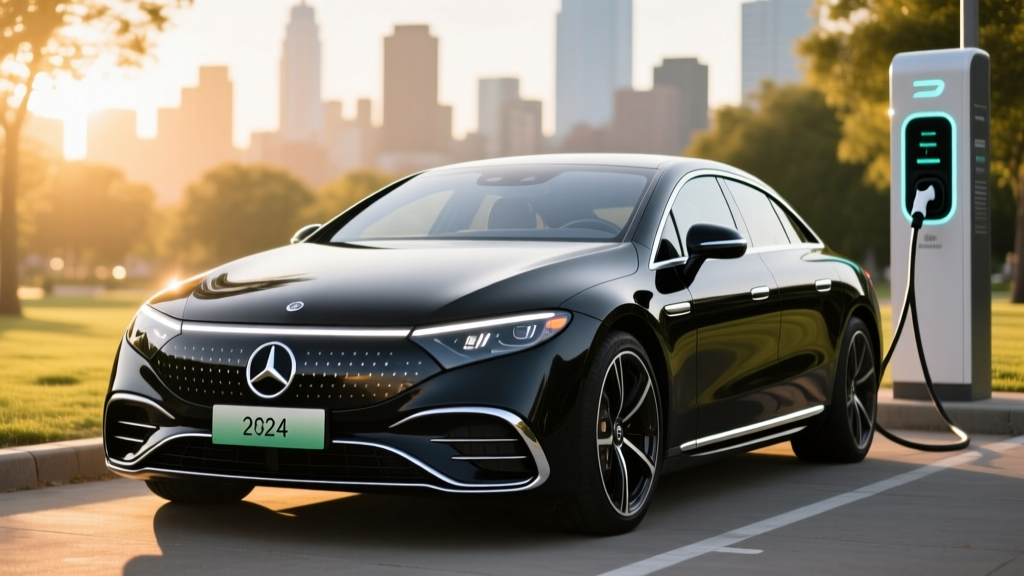
The 2024 Mercedes EQS remains the benchmark for luxury electric sedans, blending S-Class refinement with a dedicated EV platform that prioritizes range and cabin silence. But at a six-figure starting price, buyers need more than prestige—they need hard data on range, charging speed, and total ownership cost. This review breaks down the 2024 Mercedes EQS lineup with the exact numbers that matter.
2024 Mercedes EQS: Quick Verdict and Core Specs
| Spec | EQS 450+ Sedan | EQS 450 4MATIC | EQS 580 4MATIC | AMG EQS |
|---|---|---|---|---|
| EPA Range | 390 mi | 371 mi | 371 mi | 330 mi |
| Battery (usable) | 118 kWh NMC | 118 kWh NMC | 118 kWh NMC | 118 kWh NMC |
| Horsepower | 355 hp | 355 hp | 536 hp | 649 hp (750 w/ Race Start) |
| 0-60 mph | 5.9 sec | 5.3 sec | 4.1 sec | 3.4 sec |
| Drivetrain | RWD single-motor | AWD dual-motor | AWD dual-motor | AWD dual-motor (AMG) |
| Max DC Charge | 200 kW | 200 kW | 200 kW | 200 kW |
| 10-80% DC Time | ~31 min | ~31 min | ~31 min | ~31 min |
| Level 2 Rate | 9.6 kW (~28 mi/hr) | 9.6 kW (~28 mi/hr) | 9.6 kW (~28 mi/hr) | 9.6 kW (~28 mi/hr) |
| MPGe (combined) | 97 MPGe | 94 MPGe | 94 MPGe | 79 MPGe |
| Base MSRP | $104,400 | $107,400 | $125,950 | $149,900 |
The 2024 EQS uses a 120 kWh gross battery (118 kWh usable) with nickel-manganese-cobalt (NMC) chemistry across all trims. The single-motor EQS 450+ leads the lineup in efficiency and range, while the dual-motor variants trade some efficiency for all-weather traction and stronger acceleration.
Real-World Range: What the EPA Sticker Doesn't Tell You
Real-World Expectation: ~310–340 miles on highway trips at 70+ mph; ~250–280 miles in freezing temperatures (below 32°F). City and mixed driving with regen braking can match or slightly exceed the EPA figure.
Efficiency: 97 MPGe combined / 34 kWh per 100 miles (EQS 450+)
Source: EPA / fueleconomy.gov
The EQS 450+ sedan's 390-mile EPA rating is among the highest of any EV sold in the U.S. However, the sedan's aerodynamic advantage (a drag coefficient of 0.20) matters most at highway speeds. On a sustained 75 mph interstate run in moderate temperatures, expect roughly 320–340 miles before the battery buffer kicks in. In cold weather—particularly below 20°F—battery chemistry and cabin heating demands can reduce range by 25–35%, bringing real-world highway range down to approximately 250–280 miles.
The SUV variant (EQS SUV 450+ with 305 miles EPA) sacrifices roughly 85 miles of range due to its taller profile and heavier curb weight, but offers significantly more cargo volume. If your use case involves frequent road trips in northern climates, the sedan's range advantage is substantial.
The EQS includes a heat pump as standard equipment on 2024 models, which mitigates cold-weather losses compared to resistive heating systems. Preconditioning the battery via the Mercedes me app before departure—while plugged in—preserves range by warming the pack using grid power rather than battery energy.
Charging Speed: DC Fast, Level 2, and the Charge Curve Reality
| Charging Level | Power / Connector | Speed (mi/hr added) | Time / Notes |
|---|---|---|---|
| Level 1 (120V) | ~1.4 kW / J1772 | ~3–4 mi/hr | Emergency/trickle only; 0-100% in 80+ hours |
| Level 2 (240V) | 9.6 kW / J1772 (CCS1 adapter) | ~28 mi/hr | 0-100% in ~12.5 hours; ideal overnight |
| DC Fast Charge | 200 kW peak / CCS1 | ~170 mi in 15 min (peak) | 10-80% in ~31 min; tapers above 80% |
The 2024 EQS charges at up to 200 kW on DC fast chargers via its CCS1 port. On a 350 kW Electrify America or similar station, the EQS typically sustains 175–200 kW from approximately 10% to 45% state of charge, then progressively tapers. The full 10–80% session takes roughly 31 minutes under ideal conditions (preconditioned battery, warm ambient temperature). Above 80%, charge speed drops sharply to protect the NMC cells—expect the final 80–100% to take an additional 35–45 minutes. This charge-curve taper is standard behavior for NMC packs and is why road-trip planning should target 10–80% stops rather than full charges.
At home, the onboard 9.6 kW charger adds about 28 miles of range per hour on a 240V Level 2 circuit (40-amp breaker, 48-amp circuit recommended). A full overnight charge from 20% to 100% takes roughly 10–11 hours. Mercedes includes a portable dual-voltage charger with the vehicle, but most owners will install a dedicated wallbox. Budget $500–$1,200 for a quality Level 2 unit (ChargePoint Home Flex, Emporia Level 2, or Mercedes-branded wallbox) plus $800–$2,500 for professional installation depending on panel proximity and local permitting.
The EQS uses the CCS1 connector standard. Mercedes-Benz has announced future NACS (Tesla-style) adoption, but 2024 EQS models ship with CCS1 and can access Tesla Superchargers using a Mercedes-approved NACS adapter.
Performance, Ride Quality, and Drivetrain Options
The EQS 450+ single-motor RWD model delivers 355 horsepower and a 5.9-second 0-60 mph time—adequate for a luxury sedan focused on comfort rather than sportiness. The 450 4MATIC adds a front motor for all-wheel drive without increasing horsepower (still 355 hp), but drops 0-60 to 5.3 seconds thanks to improved traction.
The EQS 580 4MATIC is the performance sweet spot: 536 hp, 4.1 seconds to 60 mph, and standard AWD. The AMG EQS pushes 649 hp (750 hp with Race Start mode activated) and a 3.4-second 0-60, but sacrifices 60 miles of EPA range and adds a stiffer suspension calibration that compromises the ride comfort the EQS platform is designed around.
All trims feature standard AIRMATIC air suspension with adaptive damping. The ride is exceptionally compliant, absorbing road imperfections with the composure expected of a flagship Mercedes. Rear-axle steering (up to 10 degrees on higher trims, 4.5 degrees standard) makes this 207-inch sedan surprisingly maneuverable in parking situations, reducing the turning circle to as little as 35.8 feet—comparable to a compact hatchback.
Interior, Cargo Space, and Technology
The EQS cabin is dominated by the available MBUX Hyperscreen—a 56-inch curved glass panel spanning the full dashboard width, incorporating a 17.7-inch central OLED display, a 12.3-inch passenger screen, and a 12.3-inch driver cluster. The Hyperscreen is standard on the 580 and AMG trims, optional on the 450+ and 450 4MATIC (which otherwise use a 12.8-inch central portrait screen).
Passenger space is generous, consistent with the EQS's S-Class positioning:
- Front legroom: 41.7 inches
- Rear legroom: 42.2 inches (sedan)
- Cargo volume (sedan): 22.0 cu ft behind rear seats (hatchback liftback design)
- Cargo volume (SUV): 26.0 cu ft behind second row / 63.0 cu ft with seats folded
The sedan's liftback design provides a wider cargo opening than a traditional trunk, and the rear seats fold 40/20/40 for longer items. There is no front trunk (frunk) on the EQS—the space is occupied by the HEPA filtration system and power electronics.
Driver assistance includes standard Active Distance Assist DISTRONIC (adaptive cruise), Active Lane Keeping, Active Steering Assist, and automatic emergency braking. The available DRIVE PILOT system offers SAE Level 3 conditional automation in heavy traffic at speeds up to 40 mph on limited-access highways in approved states (currently Nevada and California). This is a significant distinction: DRIVE PILOT is a true Level 3 system where the driver can legally disengage under specific conditions, unlike Level 2 systems that require constant attention.
Pricing, Trims, and Federal Tax Credit Eligibility
| Trim | Base MSRP | Federal §30D Credit | Effective Price (if eligible) |
|---|---|---|---|
| EQS 450+ Sedan | $104,400 | $0 (exceeds MSRP cap) | $104,400 |
| EQS 450 4MATIC Sedan | $107,400 | $0 (exceeds MSRP cap) | $107,400 |
| EQS 580 4MATIC Sedan | $125,950 | $0 (exceeds MSRP cap) | $125,950 |
| AMG EQS Sedan | $149,900 | $0 (exceeds MSRP cap) | $149,900 |
| EQS 450+ SUV | $104,400 | Up to $7,500 (SUV cap: $80,000 — exceeds) | $104,400 |
The 2024 Mercedes EQS does not qualify for the federal §30D new EV tax credit. Under current IRS rules, the credit is limited to sedans with an MSRP at or below $55,000 and SUVs/pickups/vans at or below $80,000. Every EQS trim exceeds these caps by a wide margin. Additionally, buyer income caps apply ($150,000 single / $300,000 joint AGI), and battery critical-mineral and component sourcing requirements must be met.
Some buyers may qualify for state-level incentives (California's CVRP, Colorado's state credit, etc.) or utility rebates for home charger installation—check state-specific programs for current availability. Leasing the EQS may allow the dealer to capture the commercial clean vehicle credit (§45W) and pass savings through as a reduced lease payment, though this depends on the lessor's tax position and is not guaranteed.
Ownership Costs: Warranty, Efficiency, and Depreciation
Mercedes backs the 2024 EQS with the following warranty coverage:
- New vehicle limited warranty: 4 years / 50,000 miles
- High-voltage battery warranty: 10 years / 155,000 miles (capacity retention guaranteed above 70% of original)
- Powertrain (e-motors, power electronics): 10 years / 155,000 miles
- Corrosion perforation: 6 years / unlimited miles
The 10-year/155,000-mile battery warranty is competitive with rivals like the BMW i7 (8 years/100,000 miles) and Lucid Air (8 years/100,000 miles). The 70% capacity retention threshold is industry-standard for NMC packs.
Charging costs depend on your electricity rate. At the U.S. average of $0.16/kWh, fully charging the 118 kWh battery costs approximately $18.88 at home, yielding roughly $0.05–0.06 per mile. DC fast charging at $0.35–0.48/kWh raises that to $0.12–0.17 per mile—still well below the $0.15–0.20 per mile fuel cost of a comparable gas-powered S-Class (22 MPG combined at $3.50/gallon).
Depreciation remains a concern for luxury EVs. The EQS has experienced steeper initial depreciation than the S-Class sedan, with 2022–2023 models losing 35–45% of value within the first two years according to industry data. Buyers planning short ownership cycles should factor this into their total cost of ownership or consider leasing to transfer residual-value risk.
How the 2024 EQS Compares to Key Rivals
| Spec | 2024 Mercedes EQS 450+ | 2024 BMW i7 eDrive50 | 2024 Lucid Air Pure | 2024 Tesla Model S LR |
|---|---|---|---|---|
| EPA Range | 390 mi | 318 mi | 419 mi | 402 mi |
| Base MSRP | $104,400 | $105,700 | $69,900 | $74,990 |
| Max DC Charge | 200 kW | 195 kW | 220 kW | 250 kW |
| 0-60 mph | 5.9 sec | 5.5 sec | 5.2 sec | 3.1 sec |
| Battery | 118 kWh NMC | 101.7 kWh NMC | 88 kWh NMC | ~100 kWh |
| §30D Credit | No (MSRP cap) | No (MSRP cap) | No (MSRP cap) | No (MSRP cap) |
| Rear Legroom | 42.2 in | 42.8 in | 39.6 in | 35.4 in |
The EQS leads its direct luxury competitors (BMW i7) in range by a significant margin—72 miles more EPA range than the i7 eDrive50. The Lucid Air Pure offers more range at a far lower price but trades interior material quality and dealer-service infrastructure. The Tesla Model S remains the performance and Supercharger-network value leader, but its aging interior and panel-gap consistency place it in a different luxury tier.
- You prioritize cabin silence, ride comfort, and S-Class-level luxury materials
- You need 350+ miles of real-world range for highway commuting or road trips
- You value Mercedes' dealer service network and available Level 3 DRIVE PILOT
- Rear-seat passenger comfort is a top priority (42.2 inches of legroom)
- You want the lowest price-per-mile of range (Lucid Air Pure wins decisively)
- You need access to the Tesla Supercharger network without an adapter
- You prioritize sporty handling over ride comfort (BMW i7 or Porsche Taycan)
- Tax credit eligibility is a deal-breaker (no luxury sedan over $55K qualifies)
Pros and Cons: The Honest Assessment
Pros
- Class-leading 390-mile EPA range (450+ sedan)
- Exceptionally quiet and compliant air-suspension ride
- Available Level 3 DRIVE PILOT (limited conditions)
- Generous rear-seat space and liftback cargo versatility
- 10-year/155,000-mile battery warranty exceeds BMW/Lucid
- Heat pump standard for better cold-weather efficiency
- MBUX Hyperscreen is visually impressive and responsive
Cons
- No federal tax credit due to MSRP cap
- 200 kW peak DC charge is slower than Tesla (250 kW) and Lucid (220 kW)
- High depreciation in the first 2–3 years of ownership
- No front trunk (frunk) — cargo space is rear-only
- Hyperscreen is optional on lower trims (~$8,000+ add)
- Brake pedal feel is inconsistent due to regen blending
- High insurance premiums (luxury EV average: $3,200–$4,500/year)
Frequently Asked Questions
What is the real-world range of the 2024 Mercedes EQS?
The EQS 450+ sedan achieves an EPA-estimated 390 miles. In real-world highway driving at 70–75 mph in moderate temperatures, expect 320–340 miles. In freezing conditions (below 20°F), highway range drops to approximately 250–280 miles despite the standard heat pump. City driving with regenerative braking can match or exceed the EPA estimate.
How fast does the 2024 EQS charge?
On DC fast charging, the EQS peaks at 200 kW and charges from 10–80% in approximately 31 minutes under ideal conditions. The charge curve tapers significantly above 80%. At home on a 240V Level 2 charger (9.6 kW), it adds about 28 miles of range per hour, with a full charge taking 12–13 hours.
Does the 2024 Mercedes EQS qualify for the federal EV tax credit?
No. Under IRS §30D rules, the new clean vehicle credit is capped at sedans with an MSRP of $55,000 or less. The EQS starts at $104,400, disqualifying every trim. State incentives and utility rebates may still apply. Leasing may allow the lessor to claim a commercial credit and pass savings through reduced payments.
How much does it cost to charge the EQS at home?
At the U.S. average electricity rate of $0.16/kWh, a full charge of the 118 kWh usable battery costs approximately $18.88—roughly $0.05–0.06 per mile. This compares to $0.15–0.20 per mile for a gas-powered S-Class at 22 MPG and $3.50/gallon.
Is the EQS worth buying over the BMW i7 or Lucid Air?
The EQS wins on range (390 vs. 318 miles for the i7), battery warranty (10 years vs. 8), and available Level 3 automation. The BMW i7 offers a slightly more traditional luxury interior layout and marginally more rear legroom. The Lucid Air Pure undercuts both on price by $35,000+ while offering more range (419 miles) but with a less established dealer network and tighter rear seat.
What is the battery replacement cost for the EQS?
Out-of-warranty high-voltage battery replacement for the EQS is estimated at $22,000–$32,000 including labor, based on current Mercedes parts pricing. However, the 10-year/155,000-mile warranty (70% capacity retention threshold) should cover most owners through the typical ownership cycle.
Does the EQS have a frunk (front trunk)?
No. The space under the hood houses the HEPA air filtration system, power electronics, and HVAC components. All cargo capacity (22.0 cu ft in the sedan) is in the rear liftback area with 40/20/40 folding rear seats.
The 2024 Mercedes EQS is the range king of the luxury EV sedan segment and delivers the ride refinement its badge promises. Its limitations—no tax credit, moderate DC charge speed, and steep depreciation—are real but may be acceptable trade-offs for buyers who prioritize comfort, range, and brand cachet over value metrics. Test-drive it back-to-back with the i7 and Lucid Air to decide which interpretation of electric luxury fits your priorities.