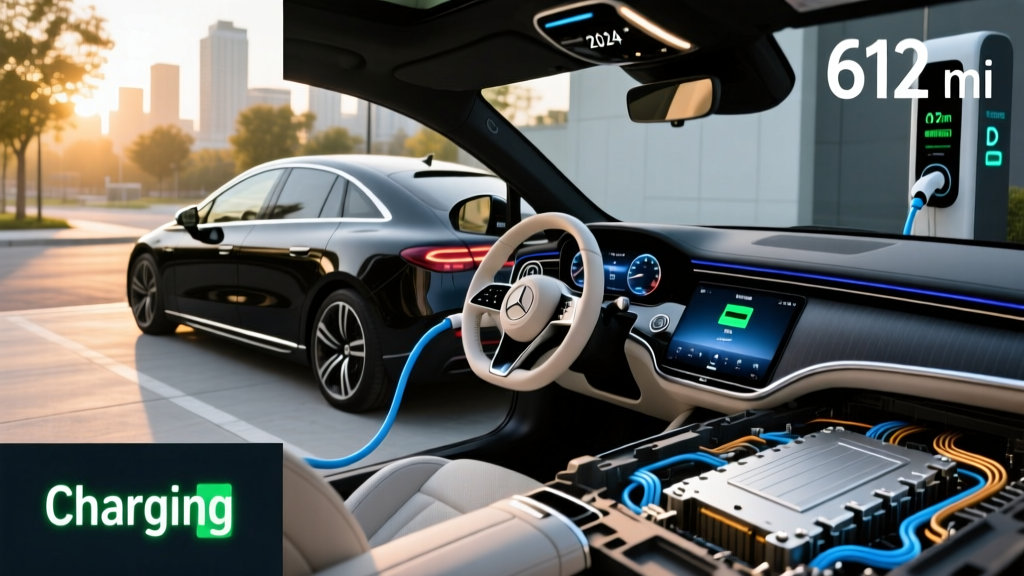
The 2024 Mercedes-Benz EQE sedan occupies a rare position in the luxury EV market: it's a midsize electric executive car that prioritizes ride comfort and cabin isolation over outright sportiness. Built on Mercedes' dedicated EVA2 platform, the EQE shares its architecture with the larger EQS but trims the footprint to something closer to a traditional E-Class. For buyers evaluating the 2024 Mercedes-Benz EQE as a daily driver or road-trip companion, the real questions come down to efficiency, charging practicality, and whether the federal tax credit applies to your situation.
This review covers the EQE 350+ (rear-wheel drive) and EQE 500 4MATIC (dual-motor AWD), including exact specs, real-world range observations, charging behavior, and total ownership costs. We'll also address the tax-credit situation head-on, because the EQE's eligibility under IRS §30D is more nuanced than a simple yes or no.
2024 Mercedes-Benz EQE at a Glance: Core Specs
| Spec | EQE 350+ (RWD) | EQE 500 4MATIC (AWD) |
|---|---|---|
| EPA Range | 305 miles | 277 miles |
| Battery (usable) | 90.6 kWh, NMC | 90.6 kWh, NMC |
| Horsepower | 288 hp | 402 hp |
| Torque | 391 lb-ft | 633 lb-ft |
| 0–60 mph | 6.2 sec | 4.5 sec |
| Drivetrain | Rear-wheel drive | Dual-motor AWD |
| DC Fast Charge (peak) | 170 kW | 170 kW |
| 10–80% DC Time | ~32 min | ~32 min |
| Level 2 Charge Rate | 9.6 kW (~30 mi/hr) | 9.6 kW (~30 mi/hr) |
| EPA Efficiency | 94 MPGe / 36 kWh/100mi | 86 MPGe / 39 kWh/100mi |
| Cargo Volume | 15.2 cu ft | 15.2 cu ft |
| Base MSRP | $74,900 | $85,900 |
| Battery Warranty | 10 yr / 155,000 mi | 10 yr / 155,000 mi |
These figures come from EPA data at fueleconomy.gov and Mercedes-Benz's official US specification sheets. The 90.6 kWh usable battery is an NMC (nickel-manganese-cobalt) chemistry — chosen for its higher energy density, which helps the EQE achieve over 300 miles of EPA range despite its ~5,300 lb curb weight.
Real-World Range: What the EPA Number Doesn't Tell You
EPA sticker: 305 miles
Real-world highway (70–75 mph, moderate temps): ~250–270 miles
Cold weather (below 32°F, highway): ~200–230 miles
City / suburban mixed driving: ~280–300 miles
The 305-mile EPA figure for the EQE 350+ is achievable in mixed suburban driving where regenerative braking recovers energy frequently. On a sustained highway run at 75 mph — the scenario that matters most for road trips — expect closer to 250–270 miles before you're searching for a charger. The EQE's aerodynamic efficiency (drag coefficient of 0.22) helps, but its heavy mass and luxury-grade sound insulation add weight that physics can't ignore.
In cold weather, the NMC battery's performance drops as internal resistance increases. Without preconditioning the battery, range loss of 20–30% is typical. The EQE does include a heat pump (standard on all trims), which reduces cabin-heating energy draw compared to resistive heaters, but it doesn't eliminate cold-weather range loss entirely. Plan for roughly 200–230 miles of usable range on a 30°F highway trip.
The EQE 500 4MATIC, with its second motor and higher consumption (39 kWh/100mi vs. 36 kWh/100mi), sees real-world highway range closer to 220–245 miles in fair weather, dropping to roughly 180–200 miles in cold conditions. If range is your primary concern, the RWD 350+ is the clear choice.
Charging Speed: DC Fast Charging and Home Level 2
Charging is where the EQE's EVA2 platform shows both its strengths and its limitations relative to newer competitors with 800-volt architectures.
| Charging Level | Power / Rate | Miles Added per Hour | Notes |
|---|---|---|---|
| Level 1 (120V household) | ~1.4 kW | ~4 mi/hr | Emergency/trickle only |
| Level 2 (240V, 40A) | 9.6 kW | ~30 mi/hr | Full charge in ~10 hrs |
| DC Fast Charge (peak) | 170 kW | ~170 mi in 15 min (10–55%) | Tapers significantly above 80% |
| DC Fast Charge (10–80%) | Avg ~110 kW | — | ~32 minutes total |
The EQE's peak DC fast-charging rate of 170 kW is adequate but not class-leading. Competitors like the Hyundai Ioniq 6 (peak 240 kW on its 800V architecture) or the Porsche Taycan (peak 270 kW) can add range significantly faster at compatible stations.
Here's the practical reality of the EQE's charge curve: it holds close to 170 kW from roughly 10% to 40% state of charge, then gradually tapers to ~120 kW by 60%, and drops below 50 kW past 80%. This means the advertised 10–80% time of about 32 minutes is realistic, but charging from 80–100% adds another 40+ minutes. On road trips, plan to charge in the 10–80% window and skip the top-off unless you have time to spare.
For home charging, the onboard 9.6 kW AC charger is competitive. A full 0–100% charge takes approximately 10 hours on a 240V/40A Level 2 circuit. Most owners will need a NEMA 14-50 outlet or a hardwired wall connector installed by a licensed electrician. Expect a 10–15 hour overnight charge to replenish the full 90.6 kWh battery — perfectly practical for daily use if you charge nightly.
The EQE uses the CCS1 connector standard for DC fast charging. As of 2024, Mercedes has not adopted the Tesla NACS connector for the EQE (that transition begins with future models). You'll use Electrify America, EVgo, ChargePoint, and other CCS-compatible networks.
Performance, Ride Quality, and Daily Driving
The EQE 350+ delivers 288 hp and 391 lb-ft of torque to the rear wheels — sufficient for confident highway merging and a 6.2-second 0–60 mph time. It's not a sports sedan, and it doesn't pretend to be. The EQE 500 4MATIC's 402 hp and 633 lb-ft cut the 0–60 time to 4.5 seconds, which is genuinely quick, though still behind the Tesla Model S or Lucid Air in straight-line performance.
Where the EQE excels is ride isolation. The available AIRMATIC air suspension (standard on 500, optional on 350+) delivers a genuinely plush ride that absorbs road imperfections with the composure of a flagship luxury sedan. Rear-axle steering (optional, up to 10 degrees) dramatically tightens the turning circle to 34.8 feet — useful in parking structures and city driving.
The cabin is exceptionally quiet at highway speeds, aided by acoustic laminated glass and extensive sound deadening. Mercedes' MBUX infotainment system spans the dashboard in the available Hyperscreen configuration (a 56-inch curved glass panel combining instrument cluster, central touchscreen, and passenger display). The standard setup uses a 12.8-inch central screen and 12.3-inch driver display, which is more than adequate for most buyers.
For driver assistance, the EQE includes standard Active Distance Assist DISTRONIC (adaptive cruise), Active Lane Keeping, and Active Brake Assist. The optional Driver Assistance Package adds Active Lane Change Assist and Route-Based Speed Adaptation. These are SAE Level 2 systems — the driver must remain attentive and keep hands on the wheel at all times.
Pricing, Trims, and Federal Tax Credit Eligibility
The 2024 EQE lineup is straightforward: two powertrains, each available in a base and Pinnacle trim level.
| Trim | Base MSRP | Federal §30D Credit | Effective Price |
|---|---|---|---|
| EQE 350+ (base) | $74,900 | Not eligible | $74,900 |
| EQE 350+ Pinnacle | $79,550 | Not eligible | $79,550 |
| EQE 500 4MATIC (base) | $85,900 | Not eligible | $85,900 |
| EQE 500 4MATIC Pinnacle | $90,550 | Not eligible | $90,550 |
The 2024 Mercedes-Benz EQE does not qualify for the $7,500 federal EV tax credit under IRS §30D rules. There are two reasons:
- MSRP cap: Sedans must have an MSRP at or below $55,000 to qualify. Every EQE trim exceeds this threshold significantly.
- Battery sourcing: The EQE's battery cells are manufactured outside the US and do not meet the critical-minerals and battery-component sourcing requirements that took effect in 2024.
Additionally, buyers must meet income caps ($150,000 single / $300,000 joint AGI) to claim the credit — though this is moot given the MSRP disqualification. If you're shopping the EQE expecting a tax-credit discount, you'll need to look elsewhere or explore your state's individual EV incentives, which vary by jurisdiction.
For comparison, the EQE's pricing places it against the BMW i5 ($67,100 base), Tesla Model S ($74,990 base), and Lucid Air Pure ($69,900 base). The EQE commands a premium that's justified primarily by interior quality and ride comfort rather than range or performance advantages.
Interior Space, Cargo, and Practicality
The EQE is a midsize sedan with generous interior dimensions, though its sloping roofline and sedan trunk (not a hatchback) limit cargo versatility.
- Front headroom: 39.5 inches
- Front legroom: 41.7 inches
- Rear headroom: 37.8 inches
- Rear legroom: 38.2 inches
- Trunk volume: 15.2 cu ft
- Frunk: None (no front trunk on the EQE)
Rear-seat comfort is strong, with ample legroom for adults on longer trips. The trunk's 15.2 cu ft is competitive with the BMW i5 (17.4 cu ft) but trails hatchback rivals like the Lucid Air (32 cu ft with seats folded). The EQE's trunk opening is relatively narrow, which makes loading bulky items more difficult than in a liftback design. If cargo flexibility is a priority, the EQE's sedan form factor is a genuine limitation.
There is no front trunk (frunk), which is a missed opportunity given the EVA2 platform's packaging. Mercedes uses that space for HVAC and electronics components.
Ownership Costs, Warranty, and Long-Term Considerations
Mercedes-Benz provides a competitive warranty package for the EQE's battery and powertrain:
- Battery warranty: 10 years / 155,000 miles (whichever comes first), covering capacity below 70% of original
- Powertrain warranty: 4 years / 50,000 miles
- Basic vehicle warranty: 4 years / 50,000 miles
- Complimentary maintenance: None (Mercedes discontinued this program)
The 155,000-mile battery warranty is among the longest in the luxury EV segment (most competitors offer 100,000 miles). The 70% capacity retention threshold is standard — if the battery degrades below 70% of its original 90.6 kWh within the warranty period, Mercedes will repair or replace it.
Charging costs for the EQE are moderate. At the national average residential electricity rate of ~$0.17/kWh, a full home charge costs approximately $15.40 for 305 miles of range — roughly $0.05 per mile. DC fast charging at public stations (typically $0.35–$0.50/kWh) raises that to $0.11–$0.16 per mile, still competitive with premium gasoline at current prices.
Insurance costs for the EQE tend to run 15–25% higher than a comparable gasoline E-Class, driven by expensive sensor suites and body-panel repair costs. Expect annual premiums of $2,800–$3,600 depending on your profile and location.
Depreciation is a concern. Luxury EVs have experienced steeper depreciation than their gasoline counterparts in recent years. The EQE's high MSRP and lack of federal tax credit mean buyers are paying full price for a vehicle that may lose 45–55% of its value over three years. If you plan to sell or trade within a few years, factor this into your total cost of ownership.
Pros, Cons, and the Verdict
Pros
- Exceptionally quiet, comfortable ride — best-in-class isolation
- Strong EPA range (305 mi) on the 350+ RWD variant
- Generous 155,000-mile battery warranty
- Available rear-axle steering for tight maneuverability
- MBUX Hyperscreen is visually impressive and functional
- Heat pump standard on all trims
Cons
- No federal tax credit eligibility (MSRP too high)
- 170 kW peak DC charging trails 800V competitors
- Sedan trunk (not hatchback) limits cargo flexibility
- No frunk
- Significant real-world highway range loss vs. EPA sticker
- High depreciation risk typical of luxury EVs
- Premium pricing vs. BMW i5 and Lucid Air Pure
Who Should Buy the 2024 Mercedes-Benz EQE?
Choose the EQE 350+ if: You want a comfortable, quiet electric commuter and road-trip sedan with 250+ miles of real-world range, you have reliable home Level 2 charging, and you value ride quality over sportiness. It suits professionals and couples who prioritize cabin refinement and don't need hatchback cargo space.
Choose the EQE 500 4MATIC if: You need all-wheel drive for snow or inclement weather, want the 4.5-second 0–60 performance, and can accept ~220 miles of real-world highway range as the trade-off.
Look elsewhere if: You need federal tax-credit eligibility (consider the BMW i5 eDrive40 or Tesla Model 3 Performance), you want faster DC charging (Hyundai Ioniq 6, Porsche Taycan, Kia EV6), or you need cargo versatility (Lucid Air, Tesla Model S hatchback).
Frequently Asked Questions
What is the real-world range of the 2024 Mercedes-Benz EQE?
The EQE 350+ achieves an EPA-estimated 305 miles, but real-world highway driving at 70–75 mph yields approximately 250–270 miles in moderate temperatures. Cold weather (below 32°F) can reduce this to 200–230 miles. The AWD EQE 500 delivers about 220–245 miles real-world in fair conditions.
How fast does the EQE charge at home and on DC fast chargers?
On a 240V Level 2 home charger at 9.6 kW, the EQE adds roughly 30 miles of range per hour, with a full charge taking about 10 hours. On DC fast chargers, the EQE peaks at 170 kW and charges from 10–80% in approximately 32 minutes, though the charge rate tapers significantly above 80%.
Does the 2024 Mercedes-Benz EQE qualify for the $7,500 federal EV tax credit?
No. The EQE exceeds the $55,000 MSRP cap for sedans under IRS §30D rules, and its battery sourcing does not meet the critical-minerals requirements. No trim level qualifies. State-level incentives may still apply depending on your jurisdiction — check your local DMV or energy office for details.
How does the EQE compare to the BMW i5 and Tesla Model S?
The BMW i5 eDrive40 starts lower at $67,100 and offers a hatchback-like trunk, though with less EPA range (295 mi). The Tesla Model S ($74,990) provides 402 miles of EPA range and access to the Supercharger network but a less refined interior. The EQE wins on ride comfort and cabin quietness; it trails on charging speed, cargo versatility, and value.
Is the EQE's battery warranty competitive?
Yes. Mercedes offers 10 years / 155,000 miles of battery coverage with a 70% capacity-retention threshold. This exceeds the more common 10-year/100,000-mile warranty offered by most competitors, including BMW and Audi.
Does the EQE have a frunk?
No. The 2024 EQE does not include a front trunk. All under-hood space is occupied by HVAC and power electronics components.
Sources: EPA fuel economy data via fueleconomy.gov, IRS §30D Clean Vehicle Credit guidelines, Mercedes-Benz USA official specifications.