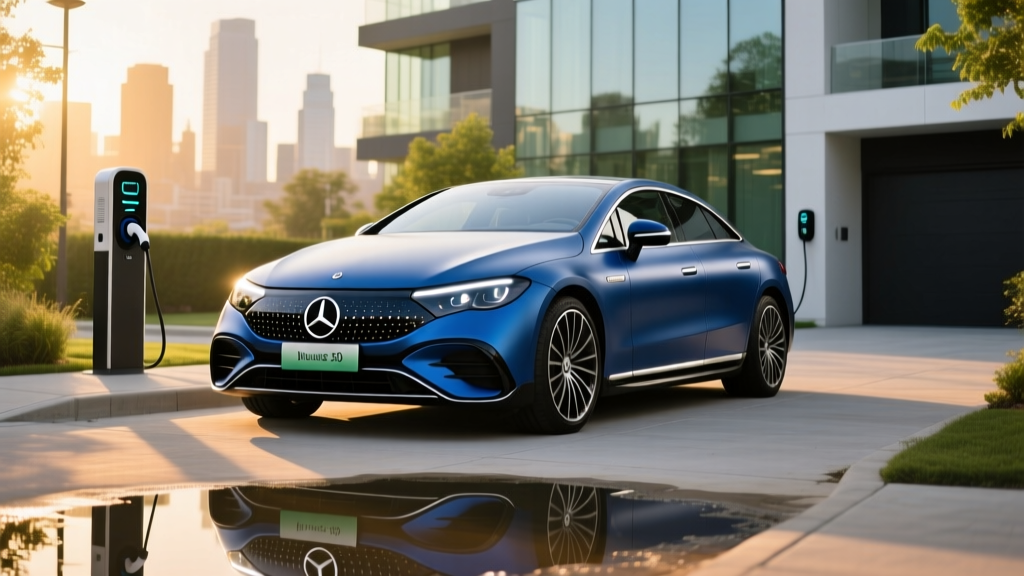
The 2024 Mercedes-Benz EQE 350 occupies a curious space in the luxury EV sedan market. Priced north of $75,000 and wrapped in Mercedes' signature cabin craftsmanship, it promises executive-level comfort with zero tailpipe emissions. But with an EPA range that trails key rivals and a tax-credit situation that requires careful navigation, buyers need hard numbers before signing the lease or purchase agreement. We break down the EQE 350's real-world efficiency, charging behavior, ownership economics, and where it fits against the Tesla Model S, BMW i5, and Lucid Air.
2024 Mercedes-Benz EQE 350 at a Glance: Full Spec Table
| Spec | EQE 350+ (RWD) | EQE 350 4MATIC (AWD) |
|---|---|---|
| Base MSRP | $76,050 | $79,050 |
| EPA Range | 260 mi (20" wheels) | 230–254 mi |
| Battery (usable) | 90.6 kWh, NMC | 90.6 kWh, NMC |
| Horsepower / Torque | 288 hp / 417 lb-ft | 288 hp / 564 lb-ft |
| 0–60 mph | 6.2 sec | 5.9 sec |
| Max DC Fast Charge | 170 kW | 170 kW |
| 10–80% DCFC Time | ~32 min | ~32 min |
| Level 2 (AC) Rate | 9.6 kW (~27 mi/hr) | 9.6 kW (~27 mi/hr) |
| EPA Efficiency | 89 MPGe (23 kWh/100 mi) | 82–86 MPGe |
| Drivetrain | RWD, single motor | AWD, dual motor |
| Cargo Volume | 15.2 cu ft trunk | 15.2 cu ft trunk |
| Battery Warranty | 8 yr / 100,000 mi | 8 yr / 100,000 mi |
Source: fueleconomy.gov, Mercedes-Benz USA
Real-World Range: What to Actually Expect
EPA Sticker: 260 miles (with 20" AMG wheels)
Real-World Highway (70 mph, mild weather): ~220–235 miles
Real-World City/Mixed: ~245–260 miles
Cold Weather (below 30°F, highway): ~185–210 miles
The EQE 350+ carries a 90.6 kWh usable lithium-ion battery using NMC (nickel manganese cobalt) chemistry. Mercedes quotes 260 miles on the EPA cycle for the RWD model equipped with 20-inch wheels — stepping to 21-inch wheels drops that figure by roughly 10–15 miles due to increased rolling resistance and aero drag.
In real-world mixed driving, the EQE 350+ can match its EPA sticker around town where regenerative braking recovers energy in stop-and-go traffic. Highway cruising at 70–75 mph is where the sedan loses ground: expect 220–235 miles in moderate temperatures. The EQE's aerodynamic shape (Cd of 0.22) helps, but its 5,300-pound curb weight works against it at sustained speed.
Cold weather hits all EVs, and the EQE is no exception. Below freezing, expect a 20–30% range reduction depending on cabin heating demand. The EQE uses a resistive PTC heater rather than a heat pump (a notable omission at this price point), which draws significant battery energy in winter. Preconditioning the battery while plugged in mitigates some of this loss, but the absence of a heat pump is a genuine efficiency gap versus competitors like the Hyundai Ioniq 6 or BMW i5.
Charging Speed: DC Fast and Level 2 Home Charging
The EQE 350 supports a peak DC fast-charge rate of 170 kW via its CCS1 connector. Mercedes quotes a 10–80% charge time of approximately 32 minutes under ideal conditions — meaning a properly preconditioned battery at a charger capable of delivering sustained power.
| Charging Level | Power / Voltage | Miles Added per Hour | Full Charge Time |
|---|---|---|---|
| Level 1 (120V household) | ~1.4 kW | ~3–4 mi/hr | ~65+ hours (0–100%) |
| Level 2 (240V home, 40A) | 9.6 kW | ~27 mi/hr | ~10 hours (0–100%) |
| DC Fast Charge (CCS1) | Up to 170 kW | ~180 mi in 15 min (peak) | ~32 min (10–80%) |
The charging curve matters more than the peak number. The EQE 350 holds close to 170 kW between roughly 10–30% state of charge, then tapers progressively. From 50–80%, expect sustained rates closer to 80–100 kW. This taper is standard for NMC batteries protecting longevity, but it means the back half of the charge takes noticeably longer than the front half. On a road trip, plan to charge from 10–60% and go (about 20 minutes) rather than waiting for 80%.
For home Level 2 charging, the onboard 9.6 kW charger adds roughly 27 miles of range per hour. A full overnight charge from 20% to 100% takes approximately 8–9 hours on a properly installed 240V/48A circuit. Mercedes includes a basic mobile charger; most buyers will want a dedicated wallbox (ChargePoint Home Flex, Emporia Level 2, or Mercedes' own Wallbox) installed by a licensed electrician. Expect $500–$2,000 for home charger installation depending on panel capacity and run length.
Performance and Driving Dynamics
The EQE 350+ (RWD) uses a single rear-mounted permanently excited synchronous motor producing 288 horsepower and 417 lb-ft of torque. The 0–60 mph sprint takes 6.2 seconds — adequate for merging and passing, but not thrilling in a segment where the Tesla Model S Plaid hits 60 in under 2 seconds and even the base Model S manages 3.1 seconds.
The EQE 350 4MATIC adds a front motor for all-wheel drive, bumping torque to 564 lb-ft and dropping the 0–60 to 5.9 seconds. Neither variant is a performance EV; Mercedes tuned the EQE for isolation and ride comfort, not lap times. The air suspension (standard on most trims) soaks up road imperfections effectively, and cabin noise levels are among the lowest in the segment.
Regenerative braking offers multiple modes selectable via steering-wheel paddles: coasting (D Auto), moderate regen (D+), and strong regen (D−). The EQE does not offer true one-pedal driving to a complete stop in all modes, which some EV veterans find frustrating. D Auto uses radar and camera data to adjust regen based on traffic ahead — clever in theory, but occasionally unpredictable in practice.
Interior, Cargo, and Technology
The cabin is where the EQE 350 justifies its premium pricing. The available Hyperscreen — a 56-inch curved glass panel spanning the entire dashboard — integrates a 12.3-inch driver cluster, 17.7-inch central OLED touchscreen, and 12.3-inch passenger display. The MBUX infotainment system is responsive and feature-rich, though the multi-layer menu structure can distract while driving.
Passenger space is generous in front but merely adequate in the rear for a car of this size. Rear legroom measures approximately 38.2 inches — enough for adults on moderate-length trips, though the sloping roofline limits headroom for taller passengers. The trunk holds 15.2 cubic feet, and unlike a hatchback or liftback (the Tesla Model S has a rear hatch), the EQE uses a conventional sedan trunk lid with a relatively narrow opening. There is no front trunk (frunk); the space under the hood houses drive components and ancillary systems.
Driver assistance falls under Mercedes' DRIVE PILOT branding. The standard suite includes adaptive cruise control, lane-keeping assist, blind-spot monitoring, and automated emergency braking. The available DRIVE PILOT system (where approved) offers conditional Level 3 automation at speeds up to 40 mph in heavy traffic on suitable highways — but availability is limited to specific mapped roads in Nevada and California, and the driver must be prepared to resume control within seconds when prompted.
The EQE's standard driver-assist features are SAE Level 2: the driver must remain engaged, hands on or near the wheel, eyes on the road. The optional DRIVE PILOT (Level 3, where available) permits conditional hands-off/eyes-off operation below 40 mph in approved zones, but the driver must be ready to take over within ~10 seconds. This is not a full self-driving system.
Pricing, Trims, and Federal Tax Credit Eligibility
The 2024 EQE 350+ starts at $76,050 (including $1,150 destination), while the 4MATIC AWD variant begins at $79,050. Higher trims — including the AMG EQE 43 and AMG EQE 54 — push well past $100,000. A well-equipped EQE 350+ with Hyperscreen, premium package, and driver-assist upgrades typically lands between $85,000–$92,000 as-tested.
Federal Tax Credit (§30D): Does the EQE 350 Qualify?
The 2024 EQE 350 faces significant hurdles for the $7,500 federal EV tax credit under current IRS §30D rules. Here is the eligibility checklist:
- MSRP Cap: Sedans must be at or below $55,000. The EQE 350+ at $76,050 exceeds the cap and does not qualify on price alone.
- Buyer Income Cap: AGI must not exceed $150,000 (single) / $300,000 (joint). Even qualifying buyers cannot overcome the MSRP barrier.
- Battery Sourcing: Critical minerals and battery components must meet phased-in percentages from US/FTA partners. The EQE's battery is manufactured in Germany, which complicates sourcing compliance.
- Assembly: Final assembly must occur in North America. The EQE is assembled in Bremen, Germany — disqualifying it from §30D.
Bottom line: The 2024 Mercedes-Benz EQE 350 does not qualify for the $7,500 federal purchase tax credit due to its MSRP exceeding the $55,000 sedan cap and its non-North-American assembly. Buyers should not factor the credit into their purchase math. Consult IRS.gov §30D guidelines and a tax professional for your specific situation. Some state-level incentives (such as California's CVRP or Colorado's state credit) may still apply — check your local program.
| Configuration | Base MSRP | Federal Tax Credit | Effective Price |
|---|---|---|---|
| EQE 350+ (RWD) | $76,050 | $0 (exceeds MSRP cap + foreign assembly) | $76,050 |
| EQE 350 4MATIC (AWD) | $79,050 | $0 | $79,050 |
| EQE 350+ w/ Hyperscreen & Pkg. | ~$88,000 | $0 | ~$88,000 |
Pros, Cons, and the Verdict
- Exceptional cabin quietness and ride refinement
- Hyperscreen is visually impressive and functional
- Strong build quality and materials throughout
- Adequate real-world range for commuting (245+ mi mixed)
- 8-year/100,000-mile battery warranty
- Available Level 3 DRIVE PILOT (limited markets)
- EPA range trails rivals (Ioniq 6: 361 mi, Model S: 402 mi)
- No heat pump — cold-weather efficiency suffers
- 170 kW peak DC charging is slower than 800V competitors
- No frunk; conventional trunk limits cargo versatility
- No federal tax credit eligibility
- Rear headroom tight for tall passengers
- Pricey once options are added
Who Should Buy the EQE 350?
The EQE 350 suits the luxury commuter who prioritizes cabin serenity, brand prestige, and daily comfort over maximum range or charging speed. If your typical day involves 40–80 miles of mixed driving with home charging, the EQE's real-world range is more than sufficient. It's also a strong pick for buyers who want Mercedes' dealer network and service infrastructure.
It is not the right choice for frequent road-trippers who need 300+ mile range and 20-minute charging stops, nor for budget-conscious buyers who want to maximize federal incentives. Families needing maximum cargo flexibility should look at SUV-shaped EVs or the Model S liftback.
2024 EQE 350 vs. Key Competitors
| Spec | Mercedes EQE 350+ | Tesla Model S LR | BMW i5 eDrive40 | Hyundai Ioniq 6 SEL |
|---|---|---|---|---|
| Base MSRP | $76,050 | $74,990 | $66,800 | $42,450 |
| EPA Range | 260 mi | 402 mi | 295 mi | 361 mi |
| Max DCFC | 170 kW | 250 kW | 205 kW | 240 kW (800V) |
| 0–60 mph | 6.2 sec | 3.1 sec | 5.7 sec | 6.2 sec |
| Federal Credit | No | Partial/Varies | No | Up to $7,500 |
| Heat Pump | No | Yes | Yes | Yes |
The Tesla Model S offers vastly more range and performance for similar money, but can't match the EQE's interior quality. The BMW i5 undercuts on price while offering competitive range and a more traditional sedan design. The Ioniq 6 is the efficiency and value leader but sits in a different luxury tier. The EQE wins on refinement and comfort, but loses on range, charging speed, and value.
Frequently Asked Questions
What is the real-world range of the 2024 Mercedes-Benz EQE 350?
Expect 220–235 miles on the highway in mild weather and 245–260 miles in mixed city/highway driving. Cold weather (below 30°F) can drop range to 185–210 miles due to battery chemistry and the lack of a heat pump.
How fast does the EQE 350 charge at home and on the road?
On a Level 2 home charger (9.6 kW), the EQE adds about 27 miles per hour, filling from empty in roughly 10 hours. On a DC fast charger, it peaks at 170 kW and charges 10–80% in about 32 minutes, though the charging curve tapers significantly above 50%.
Does the 2024 EQE 350 qualify for the $7,500 federal EV tax credit?
No. The EQE 350 exceeds the $55,000 MSRP cap for sedans and is assembled in Germany (not North America), disqualifying it from the IRS §30D federal credit. State incentives may still apply depending on your location.
Is the EQE 350 worth buying over a Tesla Model S or BMW i5?
If cabin luxury, ride comfort, and Mercedes brand ownership are your top priorities, yes. If range, charging speed, performance, or tax-credit eligibility matter more, the Model S, i5, or Ioniq 6 are stronger choices on paper.
What is the battery warranty on the EQE 350?
Mercedes covers the high-voltage battery for 8 years or 100,000 miles, whichever comes first. The warranty guarantees the battery will retain a specified percentage of its original capacity (typically 70%) during that period.
Does the EQE 350 have a frunk (front trunk)?
No. The EQE 350 does not have a front trunk. The under-hood space is occupied by drivetrain and power electronics. All cargo goes in the 15.2 cu ft rear trunk, which uses a conventional sedan lid rather than a liftback.