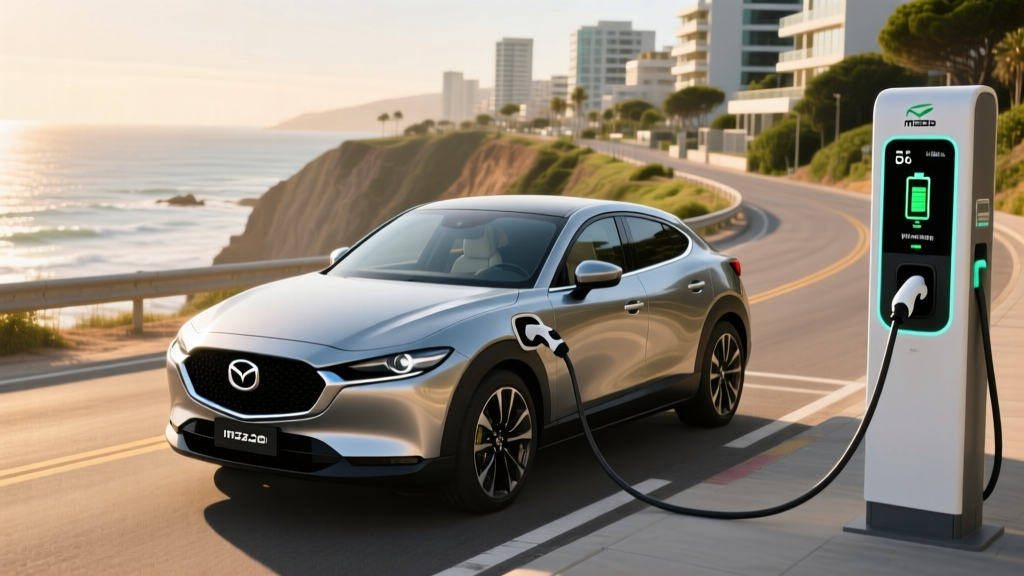
The 2024 Mazda MX-30 occupies a specific and increasingly narrow niche in the EV market: a subcompact crossover designed for short urban commutes, sold exclusively in California, and priced to undercut most competitors before incentives. With an EPA-estimated 100 miles of range from a 35.5 kWh battery, it is not a road-trip vehicle. But for the right buyer — a single commuter with reliable home charging and a sub-60-mile daily round trip — the MX-30 delivers Mazda's signature interior quality and engaging driving dynamics at an accessible entry point. This review covers every number that matters: real-world range, charging speeds, pricing after tax credits, and whether this EV still makes sense in a market that has largely moved past the 100-mile ceiling.
Range and Efficiency: The 100-Mile Reality
Real-World Expectation: 80–95 miles in mixed city/highway driving; as low as 65–75 miles in cold weather (below 40°F) or sustained highway speeds above 70 mph.
Efficiency: 92 MPGe combined / 36 kWh per 100 miles (EPA)
The MX-30's 100-mile EPA rating was already modest when the vehicle launched in the U.S. for the 2022 model year, and by 2024 standards it sits at the bottom of the new-EV range spectrum. For context, the Chevrolet Bolt EV (now discontinued but widely available used) delivered 259 miles, and the Nissan Leaf S offers 149 miles from a 40 kWh pack.
The MX-30 uses a relatively small 35.5 kWh lithium-ion battery (NMC chemistry — nickel manganese cobalt). Mazda intentionally chose a smaller pack to reduce weight, cost, and lifecycle environmental impact, a philosophy the brand has defended publicly. The result is a curb weight of approximately 3,655 pounds — lighter than most EVs in this segment — and decent efficiency at 36 kWh/100 mi in city-heavy driving.
Where range suffers is on the highway. The MX-30's aerodynamics are unremarkable, and at sustained 75 mph speeds, expect consumption to climb to roughly 40–43 kWh/100 mi, dropping effective range to around 80–85 miles. In cold weather, the resistive heating system (no heat pump is equipped) further reduces range by 20–35%, meaning winter commuters in colder California microclimates or mountain regions should plan for 65–75 usable miles between charges.
| Spec | Value |
|---|---|
| EPA Range (combined) | 100 miles |
| Battery Capacity (usable) | 35.5 kWh (NMC chemistry) |
| Efficiency | 92 MPGe / 36 kWh/100 mi |
| Motor Output | 143 hp / 200 lb-ft torque |
| Drivetrain | Front-wheel drive (single motor) |
| 0–60 mph | ~8.7 seconds |
| Cargo Volume (rear seats up) | 21.0 cu ft |
| Cargo Volume (rear seats folded) | ~45 cu ft |
| Rear Legroom | 33.1 inches |
| Base MSRP (MX-30 EV) | $34,110 |
| Battery/Powertrain Warranty | 8 years / 100,000 miles |
Charging Speed: DC Fast and Home Level 2
Charging is where the MX-30's small battery becomes both an advantage and a limitation. The advantage: even modest charge rates replenish the pack quickly in percentage terms. The limitation: the peak DC fast-charge rate is capped at approximately 50 kW, well below the 150–350 kW rates common among modern EVs.
| Charging Level | Power / Rate | Time or Miles Added |
|---|---|---|
| Level 1 (120V, 12A) | ~1.4 kW | ~4 miles per hour of charging |
| Level 2 (240V, 32A) | ~7.2 kW (onboard charger max) | Full charge in ~5 hours; ~20 mi/hr |
| DC Fast Charge (CCS) | Peak ~50 kW | 10–80% in ~36 minutes |
On a 50 kW DC fast charger, the MX-30 can add roughly 60–70 miles of range in 30 minutes. That is acceptable for occasional top-ups but makes long-distance travel impractical — a 300-mile trip would require three or four stops, each lasting 30+ minutes, with range anxiety between each one. The charge curve is relatively flat compared to larger-battery EVs: the MX-30 sustains near-peak rates through about 60% state of charge before tapering, but the absolute speed ceiling keeps it slow by 2024 standards.
For home charging, the 7.2 kW onboard charger means a full 0–100% replenishment in about five hours on a Level 2 home station. Most owners will plug in overnight and wake to a full battery every morning — which is the intended use case. A standard 120V outlet (Level 1) adds only about 4 miles of range per hour, meaning a full charge from empty would take over 24 hours. Level 1 is viable only as an emergency supplement.
Performance and Driving Impressions
The MX-30's single front-mounted motor produces 143 horsepower and 200 lb-ft of torque, delivering a 0–60 mph time of approximately 8.7 seconds. That is adequate for city merging and suburban driving but noticeably slower than competitors like the Hyundai Kona Electric (6.8 seconds) or the Kia Niro EV (7.3 seconds).
Where the MX-30 earns praise is ride quality and steering feel. Mazda tuned the suspension to prioritize comfort and composure over sportiness, and the result is a crossover that feels more refined than its price suggests. The steering is well-weighted, body roll is controlled, and the regenerative braking system offers adjustable levels via steering-wheel paddles — though it does not enable true one-pedal driving to a complete stop, a feature most EV buyers now expect.
Front-wheel drive is the only configuration. There is no AWD or dual-motor option, which limits the MX-30's appeal in snow-belt regions. Mazda does offer a mild-hybrid AWD version of the MX-30 in Japan and Europe, but that variant is not sold in the United States.
Interior, Tech, and Cargo Space
The MX-30's interior is its strongest selling point. Mazda uses sustainable materials — recycled bottle fabrics, cork trim accents (a nod to the company's origins as a cork manufacturer in the 1920s), and vegan leatherette — that give the cabin a distinctive, upscale feel absent in similarly priced competitors. The 8.8-inch infotainment display is controlled via a rotary dial on the center console rather than a touchscreen, which some drivers find frustrating for map navigation but others appreciate for reduced distraction.
Standard driver-assistance features include adaptive cruise control with stop-and-go, lane-keeping assist, blind-spot monitoring, rear cross-traffic alert, and automatic emergency braking with pedestrian detection. This is a comprehensive SAE Level 2 suite, though it requires full driver engagement at all times — it is not a hands-off system.
Cargo space is competitive for the subcompact segment: 21.0 cubic feet behind the rear seats and approximately 45 cubic feet with the 60/40 split rear seats folded. Rear legroom is tight at 33.1 inches — adequate for children or shorter adults but snug for tall passengers on longer trips. The rear doors are rear-hinged "freestyle" doors (similar to the BMW i3), which give the MX-30 a distinctive look but create a narrow opening that complicates loading car seats or bulky items.
Pricing, Trims, and Federal Tax Credit Eligibility
The 2024 MX-30 is offered in a single trim level, simply badged "MX-30 EV," with a base MSRP of $34,110 (including destination charge). A Premium Plus package is available for approximately $1,500 additional, adding a head-up display, heated steering wheel, and power-adjustable driver's seat.
| Item | Amount |
|---|---|
| Base MSRP (MX-30 EV) | $34,110 |
| Premium Plus Package (optional) | +$1,500 |
| As-Tested Price (with package) | ~$35,610 |
| Federal §30D Tax Credit (max) | Up to $7,500* |
| Estimated Price After Credit | ~$26,610 – $28,110* |
*Federal tax credit eligibility under IRS §30D depends on multiple factors current to the tax year: buyer income caps ($150,000 single / $300,000 joint MAGI), vehicle MSRP caps ($55,000 for SUVs, $55,000 for sedans — the MX-30 qualifies on MSRP), and battery component / critical-mineral sourcing requirements that phase in annually. As of 2024, many EVs have seen their credit reduced or eliminated due to sourcing rules. Consult a tax professional or the IRS Clean Vehicle provisions page to confirm your eligibility before purchasing. The credit may be applied as a point-of-sale reduction if the dealer is registered with the IRS Energy Credits Online system.
Mazda has also historically offered additional California state incentives and utility rebates that can stack with the federal credit, further reducing effective cost. Check the fueleconomy.gov tax incentive tool for current eligibility.
Who Should Buy the MX-30 — and Who Shouldn't
- Premium interior materials and build quality at a sub-$35K price
- Lightweight, comfortable ride with composed handling
- Quick overnight Level 2 home charging (~5 hours 0–100%)
- Comprehensive standard driver-assistance suite
- Low purchase price after potential tax credits
- 100-mile EPA range limits use to short commutes
- 50 kW DC fast-charge ceiling makes road trips impractical
- California-only availability (new)
- Tight rear legroom and freestyle doors complicate cargo/car-seat loading
- No heat pump — significant cold-weather range loss
- No AWD option
The MX-30 is best for: A California-based single driver or couple with reliable Level 2 home charging, a daily round-trip commute under 60 miles, and a second gas or long-range vehicle in the household for road trips. It works as an affordable, well-built commuter car that happens to be electric.
The MX-30 is not for: Families needing rear-seat space, anyone without home charging access, drivers in cold-winter climates, or anyone who wants a single EV to handle both commuting and road trips. The 100-mile range and slow DC charging make it a poor only-car choice for most households.
Competitor Comparison: MX-30 vs. Alternatives
At the MX-30's price point, the most direct comparison is the used-EV market or discontinued new models. The Chevrolet Bolt EV (259 miles EPA, ~$26,500 before discontinuation) offered vastly more range and practicality. The Nissan Leaf S (149 miles, ~$28,140) also exceeds the MX-30 on range, though its CHAdeMO connector limits DC charging access as the U.S. network standardizes on CCS and NACS.
Among current-production EVs, the Hyundai Kona Electric (261 miles EPA, ~$32,675) and Kia Niro EV (239 miles, ~$39,600) both offer more than double the range at comparable or modestly higher prices. The MX-30's advantage is interior quality and the potential for a very low net price after incentives — but only if 100 miles is sufficient for your daily needs.
Frequently Asked Questions
What is the real-world range of the 2024 Mazda MX-30?
The EPA rates the MX-30 at 100 miles combined. In real-world mixed driving, expect 80–95 miles. Sustained highway driving or cold weather (below 40°F) can reduce range to 65–75 miles due to the lack of a heat pump and the small battery buffer.
How fast does the MX-30 charge?
On a DC fast charger, the MX-30 peaks at approximately 50 kW, reaching 10–80% in about 36 minutes. At home on a Level 2 (240V) station, the 7.2 kW onboard charger delivers a full charge in roughly 5 hours.
How much does the MX-30 cost after tax credits?
The base MSRP is $34,110. If you qualify for the full $7,500 federal §30D credit (subject to income, MSRP, and battery-sourcing rules), the effective price drops to approximately $26,610. State and utility incentives in California may reduce cost further.
Does the 2024 MX-30 qualify for the federal EV tax credit?
It can, but eligibility depends on your income (MAGI caps apply), the vehicle's battery-sourcing compliance for the current tax year, and dealer registration for point-of-sale transfer. The MSRP is well below the cap. Verify current eligibility via IRS.gov and a qualified tax professional.
Is the MX-30 worth buying vs. competitors?
Only if your commute is short, you charge at home, and you value interior quality over range. If you need more than 100 miles or take road trips, the Hyundai Kona Electric, used Chevrolet Bolt EV, or Nissan Leaf offer substantially more utility at similar prices.
Is the MX-30 available outside California?
As of the 2024 model year, Mazda sells the MX-30 EV exclusively in California. It is not available for new purchase in other states.
What is the battery warranty?
Mazda covers the MX-30's high-voltage battery and electric powertrain for 8 years or 100,000 miles, whichever comes first — consistent with the industry standard for EV components.