Why Orange County Buyers Are Eyeing the 2024 Kona Electric Lease
Southern California remains one of the most EV-friendly regions in the country, and the 2024 Hyundai Kona Electric sits in a sweet spot for compact crossover shoppers who want real range without a premium price tag. With the redesigned second-generation Kona Electric offering an EPA-estimated 261 miles of range, a 65.4 kWh battery, and a starting MSRP around $32,675, it's a compelling lease candidate — especially when Orange County utility rebates and federal incentives stack up.
But leasing an EV involves different math than buying a gas car. Monthly payments are only part of the equation. Charging costs, insurance premiums, maintenance savings, and depreciation all shape what you'll actually spend over a typical 36- or 60-month term. This guide breaks down every dollar with 2026 data so you can decide whether a 2024 Hyundai Kona Electric lease in Orange County makes financial sense for your situation.
| EPA Range | 261 miles (SE trim); 240 mi (Limited) |
| Battery | 65.4 kWh usable, NMC chemistry |
| DC Fast Charge | Peak ~100 kW; 10-80% in ~43 min |
| Level 2 Charge | 10.9 kW onboard charger |
| Motor Output | 201 hp / 188 lb-ft torque (FWD) |
| 0-60 mph | ~7.4 seconds |
| MPGe (Combined) | 129 MPGe (SE); 120 MPGe (Limited) |
| Base MSRP | $32,675 (SE) – $41,075 (Limited) |
| Battery Warranty | 10 years / 100,000 miles |
Source: EPA / fueleconomy.gov
5-Year Total Cost of Ownership: The Full Picture
Before signing any lease, you need to see the full cost stack. Below is a realistic 5-year / 60,000-mile ownership projection for the 2024 Kona Electric in Orange County, compared against a comparably priced gas compact SUV (think Hyundai Tucson gas, ~29 MPG combined). These figures assume 12,000 miles driven annually, home Level 2 charging at Southern California Edison (SCE) residential rates, and current 2026 insurance averages.
| Category | Kona Electric (Est.) | Gas Compact SUV (Est.) |
|---|---|---|
| Purchase / Lease Payments (60 mo) | $22,800 | $21,000 |
| Fuel / Charging | $3,240 | $8,400 |
| Insurance | $11,400 | $9,600 |
| Maintenance | $1,500 | $4,200 |
| Depreciation (net equity loss) | $14,500 | $11,200 |
| Tax Credits / Rebates Applied | -$7,500 | $0 |
| 5-Year Net Total | ~$45,940 | ~$54,400 |
Estimates based on 2026 SoCal utility rates (~$0.27/kWh residential avg), $3.80/gal gas, 12k mi/yr. Individual results vary by driving pattern, electricity plan, and lease terms. Depreciation figures reflect current EV resale trends per Kelley Blue Book and Recurrent data.
The Kona Electric's fuel and maintenance savings are substantial, but higher insurance premiums and steeper initial depreciation partially offset those gains. The federal tax credit is the single biggest cost reducer — if you qualify. Let's unpack each line item.
Federal Tax Credit: Do You Qualify Under §30D?
The IRS §30D Clean Vehicle Credit can deliver up to $7,500 toward a qualifying new EV — and since 2024, it can be transferred to the dealer at point of sale, effectively reducing your lease's capitalized cost or your purchase price upfront. But eligibility is far from automatic. The rules have tightened considerably, and you need to check every box.
- Vehicle MSRP Cap: SUVs/crossovers must have an MSRP ≤ $80,000; sedans ≤ $55,000. The Kona Electric (starting ~$32,675) clears this easily.
- Buyer Income Limits: Modified AGI must not exceed $150,000 (single), $225,000 (head of household), or $300,000 (joint). Check your most recent tax return.
- Battery Sourcing — Critical Minerals (½ credit = $3,750): A required percentage of critical minerals must be sourced from the U.S. or a free-trade-agreement country. This threshold increases annually.
- Battery Sourcing — Components (½ credit = $3,750): A required percentage of battery components must be manufactured or assembled in North America. This threshold also increases annually.
- Foreign Entity of Concern (FEOC) Restriction: Vehicles with battery components from a FEOC (effective 2024) or critical minerals from a FEOC (effective 2025) are disqualified entirely.
- Point-of-Sale Transfer: You can elect to transfer the credit to the dealer, reducing your out-of-pocket at signing. The dealer must register the sale on the IRS Energy Credits Online portal.
- Lease Loophole (§25D / Commercial Credit): If you lease rather than buy, the credit technically goes to the lessor (the financing company). Many lessors pass it through as a capitalized cost reduction — but this is not guaranteed. Confirm with the dealer that the $7,500 is applied to your lease.
Source: IRS.gov — Clean Vehicle Credits
For the 2024 Kona Electric specifically: Hyundai manufactures the Kona Electric in South Korea (Ulsan plant), and battery cell sourcing involves LG Energy Solution and SK On. The critical-minerals and components requirements have become more restrictive through 2025 and 2026. Before signing, verify the specific VIN's eligibility on the IRS portal or with the dealer's F&I department. Hyundai's own Kona Electric page and fueleconomy.gov's tax credit lookup are reliable starting points, but the IRS portal is the final authority.
Charging vs. Gas: The Per-Mile Cost Reality in Orange County
Orange County drivers benefit from relatively robust public charging infrastructure and competitive residential electricity rates — but SoCal rates are still above the national average. Here's how the Kona Electric's charging cost compares to a gas equivalent.
| Metric | Kona Electric | Gas SUV (29 MPG) |
|---|---|---|
| Energy / Fuel Rate | $0.27/kWh (SCE residential avg) | $3.80/gallon |
| Efficiency | 3.3 mi/kWh (~30 kWh/100mi) | 29 MPG combined |
| Cost Per Mile | $0.054/mi | $0.131/mi |
| Annual Cost (12,000 mi) | $648 | $1,572 |
| 5-Year Fuel Savings | ~$4,620 | |
Assumes 80% home Level 2 charging at SCE residential TOU rates, 20% public DC fast charging (~$0.45/kWh avg). Public charging raises the blended EV cost to ~$0.062/mi. Gas price reflects SoCal 2026 average regular unleaded.
Key nuance: The Kona Electric's real-world efficiency matters here. The EPA rates it at roughly 30 kWh per 100 miles. In our experience with Hyundai's E-GMP platform, highway driving at 70+ mph pushes that closer to 33-35 kWh/100mi, while city driving with regenerative braking can drop it to 26-28 kWh/100mi. Cold weather isn't a major factor in Orange County, but if you frequently drive to Big Bear or Mammoth in winter, expect a 15-25% range and efficiency hit at elevation and low temperatures.
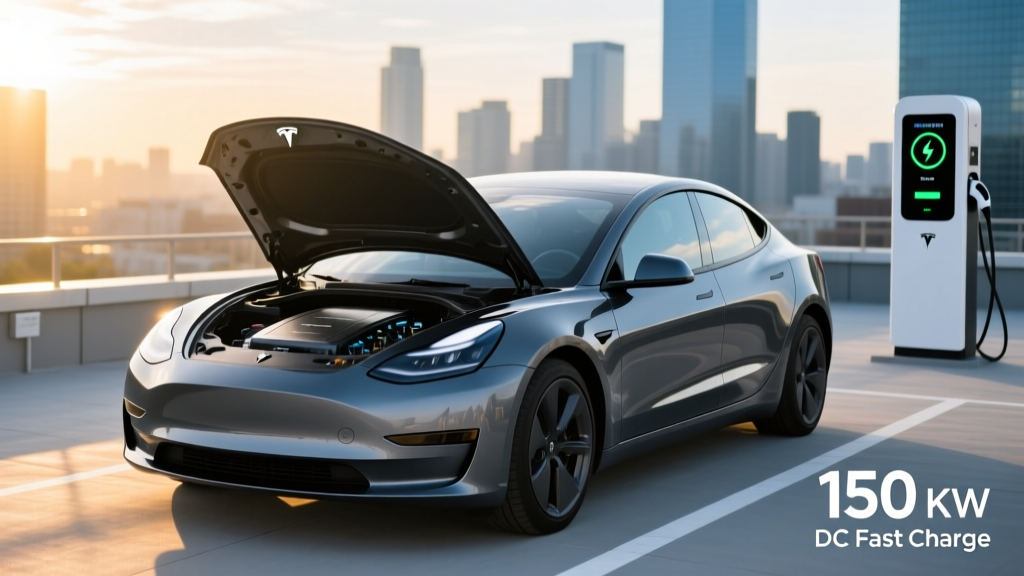
On DC fast charging, the Kona Electric peaks at roughly 100 kW. That's modest compared to Hyundai's own Ioniq 5 (which peaks around 240 kW on 800V architecture). Expect 10-80% in approximately 43 minutes at a 150+ kW station. The charge curve tapers significantly above 60% SoC, so plan accordingly on road trips along I-5 or the 405.
Maintenance Savings: Fewer Parts, Fewer Visits
EVs eliminate many routine service items that gas-car owners take for granted — and pay for. The Kona Electric has no engine oil, no spark plugs, no timing belt, no exhaust system, and no multi-speed transmission fluid to change. Regenerative braking dramatically reduces brake pad wear; many EV owners report original brake pads lasting 80,000-100,000+ miles.
| Service Item | Kona Electric | Gas Compact SUV |
|---|---|---|
| Oil Changes (5-7 over 60k mi) | $0 | $350–$560 |
| Brake Pads (1-2 replacements) | $0 (regen extends life) | $400–$700 |
| Transmission Fluid | $0 | $150–$250 |
| Engine Air Filter | $0 | $100–$150 |
| Spark Plugs | $0 | $200–$400 |
| Tire Rotation & Cabin Filter (both) | $600–$800 | $600–$800 |
| Coolant Check / Top-Off | $100–$150 | $100–$150 |
| Estimated 5-Year Total | ~$1,200–$1,500 | ~$3,500–$4,200 |
Over five years, the Kona Electric saves roughly $2,500–$3,000 in maintenance. Hyundai's 10-year/100,000-mile battery warranty also provides peace of mind against the largest potential repair cost — though for a lease, you'll likely return the vehicle well before that coverage matters.
Insurance: The Cost Item That Catches EV Lessees Off Guard
Here's where the EV math gets less rosy. Insurance premiums for electric vehicles are typically 15-25% higher than for comparable gas vehicles. The Kona Electric is no exception. Several factors drive this:
- Higher repair costs: EV-specific components (battery pack, power electronics, high-voltage wiring) are expensive to replace after a collision.
- Specialized labor: Fewer body shops have HV-certified technicians, increasing labor rates for EV repairs.
- Total-loss thresholds: Battery damage in a moderate collision can push repair costs above the vehicle's actual cash value, leading insurers to declare more total losses.
- Vehicle MSRP: The Kona Electric's starting price is higher than a base gas Tucson, which sets a higher insured-value baseline.
In Orange County, expect to pay roughly $1,800–$2,100/year for full-coverage insurance on a 2024 Kona Electric (varies by driving record, age, and coverage limits). A comparable gas SUV might run $1,500–$1,750/year. That's an extra $1,500–$2,000 over five years.
Mitigation tip: Shop quotes from GEICO, Progressive, State Farm, and EV-friendly carriers like Lemonade or Root before signing. Some insurers offer specific EV discounts or usage-based programs that can narrow the gap. Bundling home and auto also helps.
Depreciation and Resale: What the Kona Electric Holds
EV depreciation has been a volatile topic through 2024-2026. After aggressive price cuts by Tesla and intensifying competition drove used-EV values down significantly in 2023-2024, the market has stabilized somewhat — but EVs still generally depreciate faster than gas counterparts in the first three years.
For the 2024 Kona Electric, expect roughly 45-55% depreciation over five years / 60,000 miles, compared to approximately 35-45% for a gas compact SUV. Several factors influence this:
- Battery health confidence: Hyundai's 10-year battery warranty supports resale, but second owners often discount EVs over battery uncertainty regardless.
- Technology obsolescence: Newer EVs with faster charging (800V platforms, 200+ kW) make the Kona's ~100 kW peak look dated by 2029.
- Market normalization: As EV adoption grows and more used-EV buyers enter the market, depreciation curves are expected to flatten.
- Lease residual values: If you're leasing, the residual is set at signing. Hyundai Capital typically sets Kona Electric residuals around 45-50% at 36 months. If the actual market value is lower at lease-end, you walk away without owing the difference — a key lease advantage.
Orange County Incentives: State, Local, and Utility Rebates
Beyond the federal §30D credit, Orange County EV lessees can access several regional incentives — though availability and amounts change frequently. Always verify current programs before committing.
- California Clean Vehicle Rebate Project (CVRP): Historically offered up to $2,000 for income-eligible buyers. Funding has been intermittent — check the CVRP portal for current availability.
- Clean Cars 4 All (CC4A): Up to $9,500 for low-income residents who retire an older polluting vehicle and replace it with a new or used EV. Administered by the South Coast Air Quality Management District (SCAQMD), which covers Orange County.
- SCE Residential EV Rate Plan (TOU-EV): Southern California Edison offers time-of-use rates that make overnight Level 2 charging significantly cheaper — as low as $0.12-$0.15/kWh during off-peak super-off-peak hours. This can cut your annual charging cost to under $400.
- SCE Charge Ready Program: Rebates for home Level 2 charger installation. Amounts vary by income tier and whether you're in a disadvantaged community. Can offset $500–$1,500 of installation costs.
- HOV Lane Access: California's Clean Air Vehicle (CAV) decals grant solo carpool-lane access on the 405, 5, 55, and 73. Availability is limited and income-based for newer applicants — apply through the DMV after purchase/lease.
Incentive amounts, eligibility, and program availability change frequently. Confirm all details with official program websites and your tax professional before relying on specific dollar figures.
Frequently Asked Questions
How much does it really cost to own a 2024 Kona Electric over 5 years in Orange County?
Our analysis puts the 5-year net cost at approximately $45,000–$47,000 including lease/purchase payments, charging, insurance, maintenance, and depreciation, minus applicable tax credits. That's roughly $8,000–$10,000 less than a comparable gas SUV over the same period, primarily due to fuel and maintenance savings offset by higher insurance and depreciation.
Can I get the $7,500 federal tax credit on a Kona Electric lease?
Possibly, but it works differently than a purchase. On a lease, the §30D credit technically goes to the leasing company (lessor), not to you. Many lessors pass it through as a capitalized cost reduction, lowering your monthly payment. However, this is not legally required. Before signing, explicitly confirm with the dealer's finance department that the full $7,500 is applied to your lease's cap cost. Additionally, the vehicle must still meet all battery sourcing and FEOC requirements for the lessor to claim the commercial clean vehicle credit (§45W) that typically backs lease incentives.
How much will I save on fuel charging the Kona Electric at home in Orange County?
With SCE's residential TOU-EV rate and overnight charging, expect to pay roughly $0.12–$0.27/kWh depending on your time-of-use tier. At the Kona Electric's ~30 kWh/100mi efficiency, that translates to $0.036–$0.081 per mile — versus $0.13/mile for a 29-MPG gas SUV at $3.80/gallon. Over 12,000 miles annually, you'll save approximately $800–$1,100/year on fuel, or $4,000–$5,500 over five years, depending on your rate plan and public-charging frequency.
Is the Kona Electric more expensive to insure than a gas Hyundai Tucson?
Yes, typically 15-25% more. Expect $1,800–$2,100/year for full coverage in Orange County versus $1,500–$1,750 for a gas Tucson. Higher EV repair costs, specialized labor, and battery-replacement risk drive the premium. Shopping multiple carriers and bundling policies can narrow the gap.
What's the real-world range of the 2024 Kona Electric in Southern California?
The EPA rates the Kona Electric SE at 261 miles and the Limited at 240 miles (the Limited's larger wheels and added weight reduce efficiency). In real-world Orange County driving — mixed city/highway, moderate climate, minimal HVAC load — expect 230–250 miles from a full charge. Highway-only driving at 75+ mph on the 5 or 405 drops this to roughly 210–230 miles. The Kona Electric's heat pump (standard on most trims) helps preserve range in cooler weather, but SoCal's mild climate means you'll rarely see the 20-30% cold-weather losses that northern-state EV owners experience.
What home charging setup do I need for the Kona Electric?
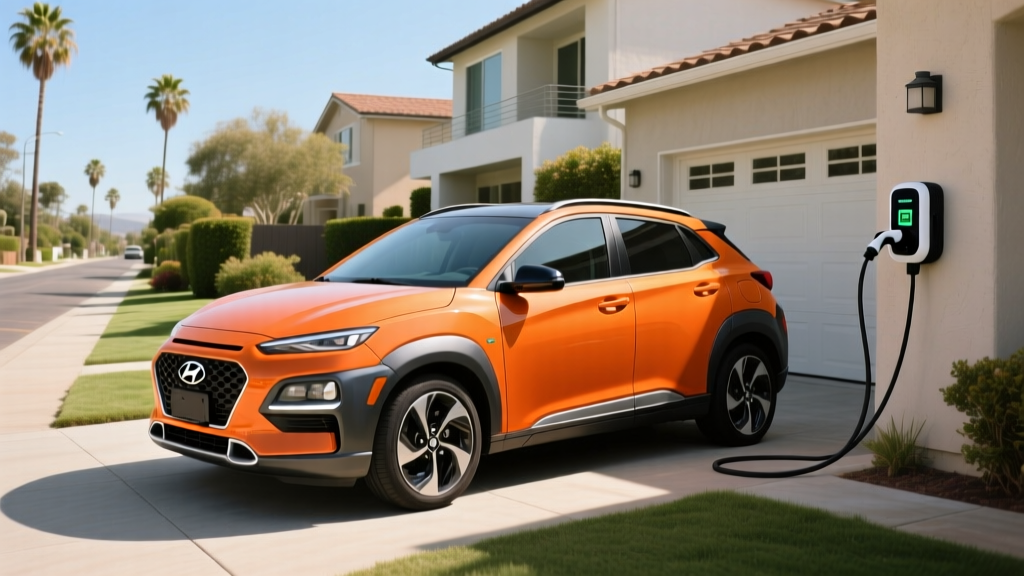
The Kona Electric has a 10.9 kW onboard charger and uses the J1772 connector (CCS1 for DC fast charging; note that Hyundai is transitioning to NACS on future models). For home Level 2 charging, you'll want a 240V / 48-amp circuit with a J1772 Level 2 station (or a NACS station with adapter). A full charge from empty takes roughly 6.5 hours at 10.9 kW. Installation costs in Orange County typically range from $800–$2,500 depending on panel capacity, conduit run length, and whether a 200A panel upgrade is needed. SCE's Charge Ready rebate can offset a portion of this.
How does the Kona Electric's charging speed compare on road trips?
With a peak DC fast-charge rate of ~100 kW, the Kona Electric adds roughly 100 miles of range in 30 minutes under ideal conditions (low SoC, preconditioned battery, 150+ kW station). A 10-80% charge takes approximately 43 minutes. This is adequate for road trips with planned stops but noticeably slower than Hyundai's Ioniq 5 (10-80% in ~18 min at 240 kW peak). If you frequently drive long distances — say, Orange County to San Diego or Las Vegas — consider whether the Kona's charge speed meets your patience threshold, or whether a vehicle on Hyundai's 800V E-GMP platform would serve you better.