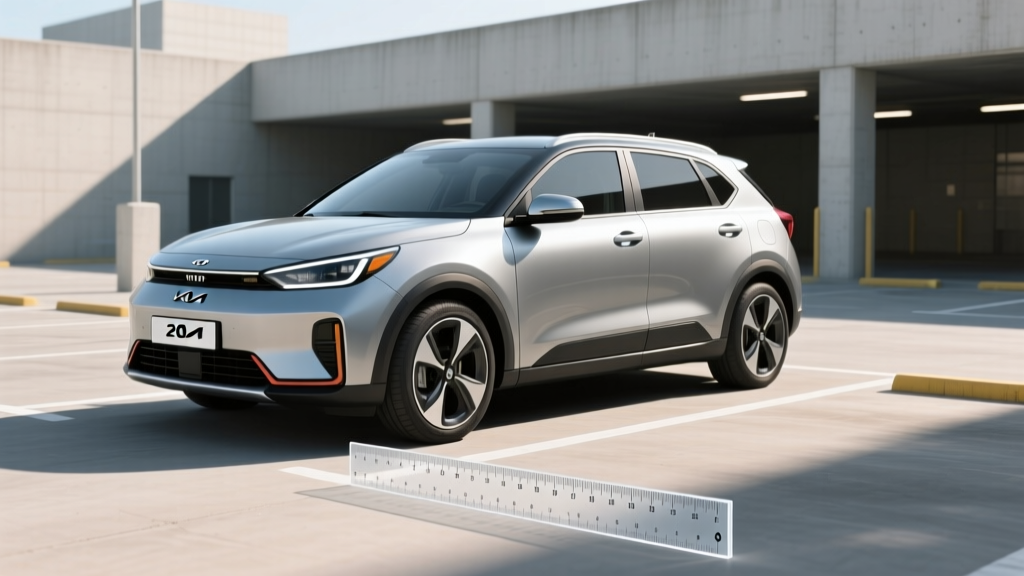
Quick Answer: 2024 Kia Niro EV Exterior Dimensions
Length: 174.0 inches (4,420 mm)
Width: 71.9 inches (1,825 mm) without mirrors
Height: 61.8 inches (1,570 mm) without roof rails
Wheelbase: 107.1 inches (2,720 mm)
Ground Clearance: 6.3 inches (160 mm)
Curb Weight: 3,750–3,814 lbs depending on trim
The 2024 Kia Niro EV is a compact crossover that slots between subcompact hatchbacks like the Chevrolet Bolt EV and larger SUVs like the Hyundai Ioniq 5. Its footprint is close to the gas Niro and Niro Hybrid, making it suitable for tight urban parking while still offering usable cargo space.
If you've been searching for 2024 Kia Niro EV dimensions length width height, the numbers above are the factory-confirmed exterior measurements from Kia's spec sheet. But dimensions alone don't tell the full ownership story. Below, we break down how these measurements translate to real-world usability, how the Niro EV compares to its hybrid sibling, what it costs to own, and whether its size works for your daily driving and charging needs.
Interior Space and Cargo Capacity
Exterior dimensions matter for your garage and parking spot, but interior volume determines whether the Niro EV actually fits your life. Here's how the cabin breaks down:
| Measurement | 2024 Niro EV | 2024 Niro Hybrid |
|---|---|---|
| Front Headroom | 40.5 in | 40.5 in |
| Rear Headroom | 38.4 in | 38.4 in |
| Front Legroom | 41.5 in | 41.5 in |
| Rear Legroom | 38.2 in | 38.2 in |
| Cargo (behind rear seats) | 23.9 cu ft | 22.8 cu ft |
| Cargo (rear seats folded) | 53.0 cu ft | 54.5 cu ft |
The Niro EV actually offers slightly more cargo space behind the rear seats than the hybrid variant because there's no exhaust system eating into the underbody. However, the hybrid edges ahead with seats folded due to differences in the load floor design. For most buyers hauling groceries, strollers, or luggage for a weekend trip, 23.9 cubic feet is competitive with vehicles like the Toyota RAV4 Hybrid (37.5 cu ft) only if you compare strictly to subcompact crossovers — the Niro EV trades cargo volume for a lower starting price and fully electric drivetrain.
Real-world note: The Niro EV has no front trunk (frunk). The space under the hood houses the electric motor, power electronics, and the 12V auxiliary battery. If frunk storage is a priority, look at the Hyundai Ioniq 5 or Ford Mustang Mach-E.
Powertrain, Range, and Charging Specs
Size only matters if the vehicle can actually cover your daily routes. Here's the complete electric powertrain picture for the 2024 Niro EV:
| Specification | 2024 Kia Niro EV |
|---|---|
| Battery Capacity | 64.8 kWh (usable) |
| Battery Chemistry | NMC (Nickel Manganese Cobalt) |
| EPA Range | 239 miles |
| Real-World Range (highway 70 mph) | ~200–215 miles |
| Real-World Range (cold weather, 20°F) | ~170–190 miles |
| Motor Output | 201 hp / 188 lb-ft torque |
| 0–60 mph | ~7.8 seconds |
| Combined MPGe | 113 MPGe |
| Efficiency | 30 kWh/100 mi |
| Max DC Fast Charge Rate | ~72 kW peak |
| 10–80% DC Fast Charge | ~45 minutes |
| Level 2 AC Charging | 11 kW onboard charger |
| Level 2 Full Charge Time | ~6.5 hours (0–100%) |
| Charge Port | CCS1 (J1772 + DC pins) |
Sources: EPA fueleconomy.gov, Kia America specifications.
Range reality check: The EPA rates the 2024 Niro EV at 239 miles, but expect roughly 200–215 miles during sustained highway driving at 70+ mph. In freezing temperatures (below 30°F), battery chemistry and cabin heating demands can reduce range by 20–30%, bringing real-world range down to approximately 170–190 miles. The Niro EV does not have a heat pump (available on the Wind trim only in some markets), so resistive heating draws additional energy in winter.
The 72 kW peak DC fast-charging rate is the Niro EV's most notable limitation. While competitors like the Hyundai Ioniq 5 (240 kW peak) or Chevrolet Equinox EV (150+ kW) can add 150+ miles in 15–20 minutes, the Niro EV requires closer to 45 minutes for a 10–80% session. If you regularly take road trips exceeding 200 miles, this charging speed will add meaningful time to your stops. For daily commuters who charge at home overnight, it's far less consequential.
Niro EV vs. Gas and Hybrid: Cost Comparison
The Niro lineup is unusual: Kia sells it as a conventional hybrid (HEV), a plug-in hybrid (PHEV), and a full battery-electric vehicle (BEV). Here's how the costs stack up over a 5-year ownership period, assuming 12,000 miles per year and a national average electricity rate of $0.16/kWh versus $3.50/gallon for regular unleaded:
| Cost Factor (5 Years) | Niro EV (Wind) | Niro Hybrid (EX) | Niro Gas (LX) |
|---|---|---|---|
| Starting MSRP | $39,600 | $30,790 | $28,290 |
| Federal Tax Credit (§30D) | Up to $7,500* | None | None |
| Effective Price After Credit | ~$32,100 | $30,790 | $28,290 |
| Fuel/Energy (60,000 mi) | $2,880 | $4,118 | $6,774 |
| Maintenance (5 yr) | ~$1,200 | ~$2,800 | ~$3,200 |
| Insurance (avg) | ~$8,500 | ~$7,200 | ~$7,000 |
| Estimated 5-Year Total Cost | ~$44,680 | ~$44,908 | ~$45,264 |
*Federal tax credit eligibility under IRS §30D depends on buyer income caps ($150K single / $300K joint), MSRP caps ($80K for SUVs), battery sourcing requirements, and point-of-sale transfer rules. The 2024 Niro EV has qualified for up to $7,500, but critical mineral and battery component sourcing rules change annually — verify current eligibility at the IRS site or with your tax professional before purchasing.
Key takeaway: After accounting for the federal tax credit, the Niro EV's effective purchase price nearly matches the hybrid. Over five years, the EV can break even or save slightly due to dramatically lower energy and maintenance costs. However, the EV buyer pays more in insurance premiums (typically 15–25% higher for EVs) and assumes battery degradation risk outside the warranty period.
Real-World Ownership Considerations
Dimensions and specs only get you so far. Here's what actually affects daily life with a 2024 Niro EV:
Home Charging Access
The Niro EV's 11 kW onboard AC charger means a full Level 2 charge (0–100%) takes about 6.5 hours. If you install a 48-amp Level 2 home charger (like a ChargePoint Home Flex or Emporia Level 2), you'll wake up to a full battery every morning. Installation costs typically range from $600 to $2,000 depending on whether your electrical panel needs upgrading from 100A to 200A service. Without home charging, relying on public Level 2 stations or the 72 kW DC fast charger becomes a friction point — plan accordingly.
Climate and Driving Patterns
If you live in the Sun Belt or Pacific Coast, the 239-mile EPA range is largely achievable year-round. In the Upper Midwest or Northeast, expect 20–30% range loss in winter. For a commuter driving 40–60 miles round trip, even degraded winter range leaves ample buffer. For those regularly driving 150+ miles one-way, the Niro EV's slower DC charging and moderate range become genuine constraints — consider the Hyundai Ioniq 5 or Tesla Model Y instead.
Ground Clearance and Parking
At 6.3 inches of ground clearance, the Niro EV handles speed bumps and light gravel without issue, but it is not designed for off-road use or deep snow. The 174-inch length fits easily into standard parallel parking spots (most are 192+ inches), and the 71.9-inch width clears compact garage bays. If you park in a tight single-car garage, measure your door opening — the Niro EV's width with mirrors extended approaches 81 inches.
Common Misconceptions About the Niro EV
| Myth | Fact |
|---|---|
| "The Niro EV is a large SUV." | It's a compact crossover — 174 inches long, closer in size to a Honda HR-V than a RAV4. |
| "It qualifies for the full $7,500 tax credit for every buyer." | Credit eligibility depends on your income, the vehicle's battery sourcing, and MSRP caps. Rules shift annually. Verify on IRS.gov. |
| "239 miles of range means I can drive 239 miles before charging." | Highway driving at 70+ mph reduces range to ~200–215 miles. Cold weather drops it further to ~170–190 miles. |
| "Fast charging takes 20 minutes." | At 72 kW peak, 10–80% takes ~45 minutes — significantly longer than 200+ kW competitors. |
| "EVs need no maintenance." | Tires, cabin filters, brake fluid, wipers, and the 12V battery still require service. But oil changes, transmission fluid, and exhaust repairs are eliminated. |
Who Should Buy the 2024 Kia Niro EV?
Choose the Niro EV if:
- You have home Level 2 charging access (or can install it)
- Your daily commute is under 80 miles round-trip
- You want a compact crossover footprint for urban/suburban driving
- You qualify for the federal tax credit (bringing the effective price near $32,000)
- You rarely take road trips exceeding 200 miles one-way
- You value Kia's 10-year/100,000-mile powertrain and battery warranty
Look elsewhere if:
- You rely solely on public DC fast charging (the 72 kW rate will frustrate you)
- You regularly drive 300+ miles between charges on road trips
- You need a frunk, all-wheel drive, or towing capacity (the Niro EV offers none of these)
- You live in an extreme cold-weather region and need 250+ miles of year-round range
- You need three rows or more than 53 cu ft of maximum cargo volume
Battery Warranty and Long-Term Ownership
Kia covers the Niro EV's 64.8 kWh NMC battery pack with a 10-year/100,000-mile warranty (whichever comes first). The warranty guarantees the battery will retain at least 70% of its original capacity — meaning if your usable capacity drops below approximately 45.4 kWh within that period, Kia will repair or replace the battery at no cost. This is one of the strongest battery warranties in the segment and a significant ownership advantage over used EVs with unknown battery history.
Based on NMC chemistry degradation data from similar Hyundai/Kia platforms, expect roughly 8–12% capacity loss over the first 100,000 miles under normal use patterns. Avoiding routine charging to 100% (staying in the 20–80% daily window) and minimizing DC fast charging in extreme heat will help preserve long-term state of health.
Frequently Asked Questions
What are the exact dimensions of the 2024 Kia Niro EV?
The 2024 Kia Niro EV measures 174.0 inches long, 71.9 inches wide (without mirrors), and 61.8 inches tall (without roof rails). The wheelbase is 107.1 inches and ground clearance is 6.3 inches.
Will the 2024 Niro EV fit in a standard garage?
Yes. A standard single-car garage door opening is typically 8–9 feet wide (96–108 inches) and at least 7 feet tall (84 inches). The Niro EV's 174-inch length and 71.9-inch width fit comfortably, even with wall shelving. Measure your specific space if you have a narrow or older garage.
Does the 2024 Niro EV have a front trunk (frunk)?
No. The Niro EV does not have a frunk. The under-hood area is occupied by the electric motor, power electronics, and 12V auxiliary battery.
How does Niro EV cargo space compare to the hybrid?
The Niro EV provides 23.9 cu ft behind the rear seats (vs. 22.8 cu ft for the hybrid) and 53.0 cu ft with seats folded (vs. 54.5 cu ft for the hybrid). The EV has a slight advantage in upright cargo volume due to the flat underbody with no exhaust routing.
What is the real-world range of the 2024 Niro EV?
The EPA rates it at 239 miles. Expect approximately 200–215 miles on the highway at 70 mph and approximately 170–190 miles in cold weather below 30°F. City driving with regenerative braking can approach or slightly exceed the EPA figure.
How long does it take to charge the Niro EV at home?
On a 48-amp Level 2 home charger (11 kW), a full 0–100% charge takes approximately 6.5 hours. On a standard 120V Level 1 outlet (~1.4 kW), a full charge takes approximately 46 hours — useful only for overnight top-ups or emergencies.
Does the 2024 Niro EV qualify for the $7,500 federal tax credit?
The Niro EV has qualified for up to $7,500 under IRS §30D, but eligibility depends on your adjusted gross income (≤$150K single / ≤$300K joint), the vehicle's battery sourcing compliance, and MSRP limits. Credit can be applied at the point of sale. Always verify current-year rules with the IRS or a tax professional before purchasing.
What size tires does the 2024 Niro EV use?
The 2024 Niro EV Wind trim rides on 215/55R17 all-season tires, while the Wave trim (if available) uses the same size. These are common, affordable sizes available from most tire manufacturers.