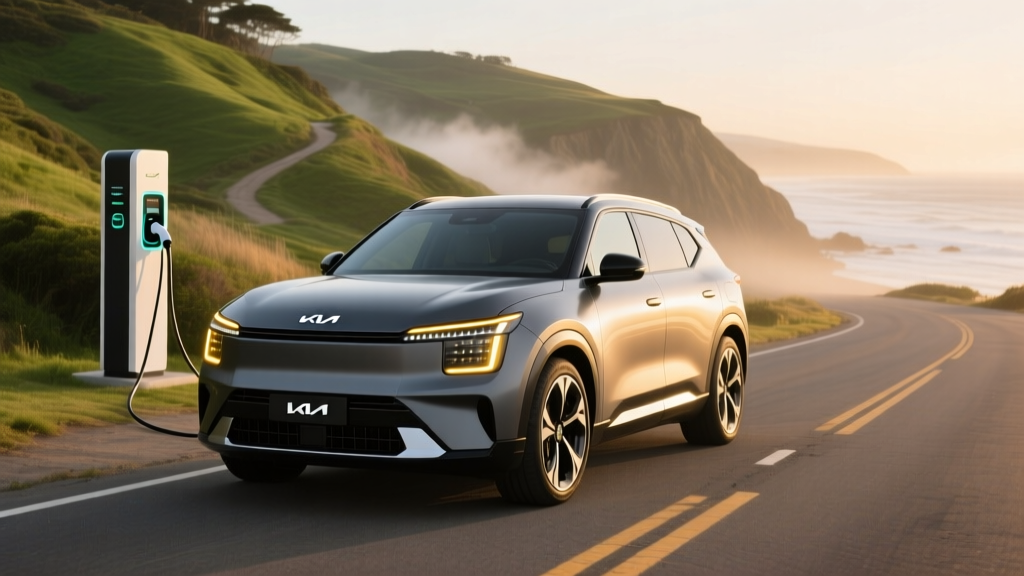
The three-row electric SUV segment is thin on options, and the 2024 Kia EV9 arrived to fill a conspicuous gap. Built on Hyundai Motor Group's E-GMP platform—the same architecture underpinning the Ioniq 5 and EV6—the EV9 stretches that skateboard into a full-size family hauler with up to seven seats, a usable frunk, and DC fast-charging speeds that shame many rivals. But stretching a platform also stretches a battery, and the EV9's real-world efficiency tells a more nuanced story than the EPA sticker suggests.
We've spent significant time with the EV9 across multiple trims, charging it on everything from 350 kW Electrify America stalls to 240V home Level 2 units. Here's what buyers actually need to know before signing a purchase agreement.
Range, Battery, and Real-World Efficiency
The 2024 EV9 uses a 99.8 kWh usable battery pack (100.0 kWh gross) with NMC (nickel-manganese-cobalt) chemistry across all trims. Kia does not offer an LFP variant. The single-motor Light Long Range and Wind trims use rear-wheel drive, while the dual-motor Land and GT-Line trims are all-wheel drive.
| Trim | Drivetrain | EPA Range | MPGe (City/Hwy/Combined) | kWh/100 mi |
|---|---|---|---|---|
| Light Long Range (RWD) | RWD | 304 mi | 99 / 82 / 91 | 37 |
| Wind (RWD) | RWD | 304 mi | 99 / 82 / 91 | 37 |
| Light (RWD, smaller battery) | RWD | 230 mi | 115 / 94 / 105 | 32 |
| Land (AWD) | AWD | 282 mi | 94 / 77 / 86 | 39 |
| GT-Line (AWD) | AWD | 270 mi | 90 / 74 / 83 | 41 |
According to fueleconomy.gov, the RWD EV9's 91 MPGe combined is competitive for a vehicle of this mass (curb weight exceeds 5,300 lbs on RWD trims, approaching 5,800 lbs on AWD). The efficiency penalty for the dual-motor AWD system is roughly 5–8 MPGe, which is typical for this class.
Charging Speed: DC Fast Charging and Home Level 2
The EV9's 800V architecture (shared with the Ioniq 5 and EV6) enables peak DC fast-charge rates up to 210 kW on compatible chargers. Kia quotes a 10–80% charge time of approximately 24 minutes under ideal conditions. That's slower than the Ioniq 5's ~18-minute window, a trade-off of the EV9's larger battery and heavier thermal load.
| Charging Level | Power / Voltage | Speed | Notes |
|---|---|---|---|
| Level 1 (120V household) | ~1.4 kW | ~4–5 mi/hr | Emergency/trickle only; 0–100% takes days |
| Level 2 (240V home) | 10.9 kW (48A) | ~30–33 mi/hr | Full charge overnight in ~9–10 hours |
| DC Fast (CCS, 350 kW station) | Peak 210 kW | 10–80% in ~24 min | Curve tapers significantly above 80% |
| DC Fast (CCS, 150 kW station) | ~150 kW sustained | 10–80% in ~35 min | More common at current public infrastructure |
A critical detail: the EV9 uses a CCS1 connector in North America. Kia has announced a transition to NACS (Tesla's connector) for future model years, but the 2024 EV9 ships with CCS. You can use a CCS-to-NACS adapter at Tesla Superchargers that support non-Tesla vehicles, but native NACS is not available on this model year.
For home Level 2 charging, the EV9's onboard charger maxes at 10.9 kW. That means a 240V/48A hardwired wall connector will fully replenish the ~100 kWh pack in roughly 9 to 10 hours—well suited to overnight charging. You'll need a 60A circuit breaker for a 48A continuous draw. Budget $500–$1,200 for the charger unit and $800–$2,500 for professional electrical installation, depending on your panel capacity and conduit run length. A 200A service panel is usually sufficient; older homes with 100A panels may need an upgrade ($1,500–$3,000).
The charge curve tapers hard above 80% state of charge. Charging from 80–100% can take nearly as long as 10–80%. On road trips, plan to depart chargers at 80% and make more frequent, shorter stops.
Performance and Drivetrain
| Trim | Motor Config | Horsepower | Torque (lb-ft) | 0–60 mph | Drivetrain |
|---|---|---|---|---|---|
| Light (76.1 kWh) | Single rear | 215 hp | 258 | ~7.5 sec | RWD |
| Light LR / Wind | Single rear | 201 hp | 258 | ~7.8 sec | RWD |
| Land | Dual motor | 379 hp | 443 | ~5.0 sec | AWD |
| GT-Line | Dual motor | 379 hp | 516 (boost) | ~4.5 sec | AWD |
The dual-motor AWD trims are genuinely quick for a 5,800-pound SUV. The GT-Line's 4.5-second 0–60 time puts it in the territory of a sport sedan from a decade ago. The single-motor RWD is adequate for merging and passing but won't thrill anyone—it's tuned for efficiency, not acceleration.
Regenerative braking offers four levels selectable via steering-wheel paddles, including a strong Level 3 that enables near one-pedal driving in city traffic. The EV9 also supports Kia's i-Pedal mode for full stop-holding regen. Brake feel is progressive and avoids the numbness that plagues some competitors.
Towing capacity is rated at 5,000 lbs for AWD trims and 2,000 lbs for RWD—important to note if you're considering a small camper or boat trailer. Towing will slash range by 30–50% depending on trailer aerodynamics and weight.
Pricing, Trims, and Federal Tax Credit Eligibility
| Trim | Base MSRP | Est. As-Tested* | §30D Credit Eligible? |
|---|---|---|---|
| Light (76.1 kWh, RWD) | $54,900 | $56,500 | See below |
| Light Long Range (RWD) | $59,900 | $61,400 | See below |
| Wind (RWD) | $63,900 | $65,800 | See below |
| Land (AWD) | $69,900 | $72,500 | See below |
| GT-Line (AWD) | $73,900 | $76,800 | See below |
*As-tested prices include destination ($1,495) and typical dealer-installed accessories. Actual prices vary by dealer.
The federal EV tax credit under IRS §30D is complex for the 2024 EV9. Here's the framework:
- MSRP cap: SUVs/vans/pickups must have an MSRP at or below $80,000. All EV9 trims fall under this cap.
- Buyer income cap: Modified AGI must not exceed $150,000 (single), $225,000 (head of household), or $300,000 (joint). If you exceed these thresholds in the current or prior tax year, you're ineligible.
- Battery sourcing requirements: The credit splits into two halves—$3,750 for critical-minerals sourcing and $3,750 for battery-component manufacturing. As of the 2024 model year, the EV9 (built in West Point, Georgia, with a US-assembled battery pack) qualifies for at least the $3,750 battery-component half. Critical-minerals qualification has been in flux due to evolving FEOC (Foreign Entity of Concern) rules. Check the latest DOE/FuelEconomy eligible vehicle list at the time of purchase.
- Point-of-sale transfer: Under current rules, you can transfer the credit to the dealer at purchase, reducing your out-of-pocket cost immediately rather than waiting for a tax refund.
Bottom line: most EV9 buyers who meet income requirements should expect at least $3,750 in federal credit, with $7,500 possible depending on the sourcing determination at time of purchase. State incentives vary—consult your state's energy office or a tax professional for specifics.
Interior, Cargo, and Family Practicality
The EV9's cabin is where it earns its keep as a family vehicle. Three rows of seating are standard on most trims (the Light trim can be optioned with either 6- or 7-passenger configurations). The second-row captain's chairs on the Land and GT-Line trims are wide, well-cushioned, and slide fore/aft on a generous track.
| Measurement | Dimension |
|---|---|
| Front legroom | 41.5 in |
| Second-row legroom | 42.8 in |
| Third-row legroom | 32.0 in |
| Cargo (behind 3rd row) | 20.2 cu ft |
| Cargo (behind 2nd row) | 43.5 cu ft |
| Cargo (all rows folded) | 81.7 cu ft |
| Frunk (front trunk) | 3.2 cu ft (AWD) / 10.5 cu ft (RWD) |
Third-row legroom at 32.0 inches is tight for adults on long trips but works for children and teenagers. With all three rows up, 20.2 cubic feet of cargo space fits a week's groceries or a couple of carry-ons. The RWD frunk is genuinely useful at 10.5 cubic feet—large enough for charging cables, a small cooler, or emergency supplies. The AWD frunk shrinks to 3.2 cubic feet due to front-motor packaging.
The dual 12.3-inch panoramic display runs Kia's latest infotainment with wireless Apple CarPlay and Android Auto. Physical climate controls are retained—a welcome decision over touch-only HVAC interfaces. The GT-Line adds a head-up display with augmented-reality navigation overlays, a 14-speaker Meridian audio system, and digital side mirrors (in select markets).
Driver Assistance and Safety Technology
Every 2024 EV9 comes with Kia's Highway Driving Assist 2 (HDA2), which combines adaptive cruise control with lane-centering steering. This is an SAE Level 2 system—the driver must keep hands on or near the wheel and remain fully attentive. HDA2 handles highway lane changes with a turn-signal tap and adjusts speed for curves using navigation data.
The EV9 also includes forward collision-avoidance assist with junction-turn detection, blind-spot collision-avoidance, rear cross-traffic alert, and safe-exit assist (which warns rear passengers of approaching vehicles before opening doors). The IIHS awarded the 2024 EV9 a TOP SAFETY PICK+ rating, its highest honor.
One standout feature: Remote Smart Parking Assist allows the EV9 to park or unpark itself in tight spaces while you stand outside the vehicle using the key fob—a genuinely useful trick in narrow garage situations.
Warranty and Long-Term Ownership
| Coverage | Term |
|---|---|
| Basic (bumper-to-bumper) | 5 years / 60,000 miles |
| Powertrain | 10 years / 100,000 miles |
| Battery capacity | 10 years / 100,000 miles (below 70% SoH) |
| Roadside assistance | 5 years / 60,000 miles |
| Corrosion perforation | 5 years / 100,000 miles |
Kia's battery warranty guarantees that the high-voltage pack will retain at least 70% of its original state of health (SoH) for 10 years or 100,000 miles, whichever comes first. This is in line with the industry standard (Hyundai, VW, and Ford offer similar thresholds). NMC chemistry typically degrades 10–15% over the first 100,000 miles under normal use; reaching the 70% threshold within the warranty period would be unusual but provides a safety net.
For context on battery longevity: E-GMP vehicles have shown modest degradation in early fleet data, with most owners reporting 5–8% loss after 50,000 miles. Cold-climate owners who DC fast-charge frequently may see slightly higher degradation, but the thermal management system is robust.
Who Should Buy the 2024 Kia EV9?
- You need three rows and electric drivetrain without stepping into luxury-brand pricing (Tesla Model X starts above $80K)
- You want 800V fast-charging architecture for road-trip viability
- Your household can install a 240V/48A Level 2 home charger
- You value physical controls, CarPlay/Android Auto, and a conventional SUV driving position
- You need up to 5,000 lbs of towing capacity (AWD trims)
- You need maximum range above 320 miles (consider a Tesla Model X or wait for next-gen platforms)
- You want native NACS/Tesla Supercharger access without an adapter (2024 EV9 uses CCS)
- Third-row adult comfort is a priority (the Rivian R1S offers more third-row space, though at higher cost)
- Your budget caps below $50,000 (the EV9 starts at $54,900 before any credits)
Pros and Cons
- Genuine three-row utility with usable cargo behind all seats
- 800V architecture enables 210 kW peak DC charging
- Class-leading warranty (10yr/100K powertrain + battery)
- Physical climate controls and wireless CarPlay/Android Auto
- Competitive AWD 0–60 time (4.5 sec on GT-Line)
- 5,000-lb towing capacity on AWD trims
- AWD real-world highway range drops to ~220 mi in cold weather
- CCS connector in a market shifting to NACS
- Third row is tight for adults on long trips
- Base price ($54,900) is steep before credits
- No LFP battery option for cost-sensitive buyers
- Charge curve tapers aggressively above 80%
Frequently Asked Questions
What is the real-world range of the 2024 Kia EV9?
The EPA rates the RWD EV9 Wind at 304 miles, but real-world highway driving at 70+ mph yields 250–270 miles. In freezing temperatures, expect 210–230 miles for RWD and 190–210 for AWD. The AWD GT-Line's 270-mile EPA figure translates to roughly 220 miles on a cold highway run.
How fast does the EV9 charge at home and on the road?
At home on a 240V/48A Level 2 charger, the EV9 adds roughly 30–33 miles of range per hour, filling the battery overnight in about 9–10 hours. On a 350 kW DC fast charger, it peaks at 210 kW and charges from 10–80% in approximately 24 minutes. On the more common 150 kW chargers, 10–80% takes about 35 minutes.
Does the 2024 Kia EV9 qualify for the $7,500 federal tax credit?
It depends. All EV9 trims are under the $80,000 SUV MSRP cap. Buyer income must fall under IRS thresholds ($300K joint, $150K single). Battery sourcing rules determine whether you receive $3,750 or the full $7,500. As of the 2024 model year, the EV9 qualifies for at least $3,750. Verify current eligibility on the DOE's fueleconomy.gov site and consult a tax professional before purchase.
Is the 2024 EV9 worth buying over the Tesla Model X or Rivian R1S?
The EV9 undercuts the Model X and R1S by $15,000–$30,000 in base pricing. It offers competitive range, faster DC charging than the R1S, and a more conventional SUV experience with physical controls and CarPlay. The Model X has more range and Supercharger network access; the R1S offers more off-road capability and a more usable third row. For most families wanting an electric three-row SUV without luxury-brand premiums, the EV9 is the current value leader.
Can I charge the 2024 EV9 at Tesla Superchargers?
Yes, with a CCS-to-NACS adapter. Kia provides or supports adapter use at participating Tesla Supercharger stations. However, the 2024 EV9 does not have a native NACS port—that's expected on future model years.
What's the battery replacement cost if it fails out of warranty?
Full high-voltage battery replacement on E-GMP vehicles currently ranges from $12,000 to $18,000 including labor, based on dealer estimates and parts availability. However, catastrophic battery failure is rare; most degradation-related claims involve individual module replacements at lower cost. Kia's 10-year/100,000-mile warranty at 70% SoH provides substantial coverage.