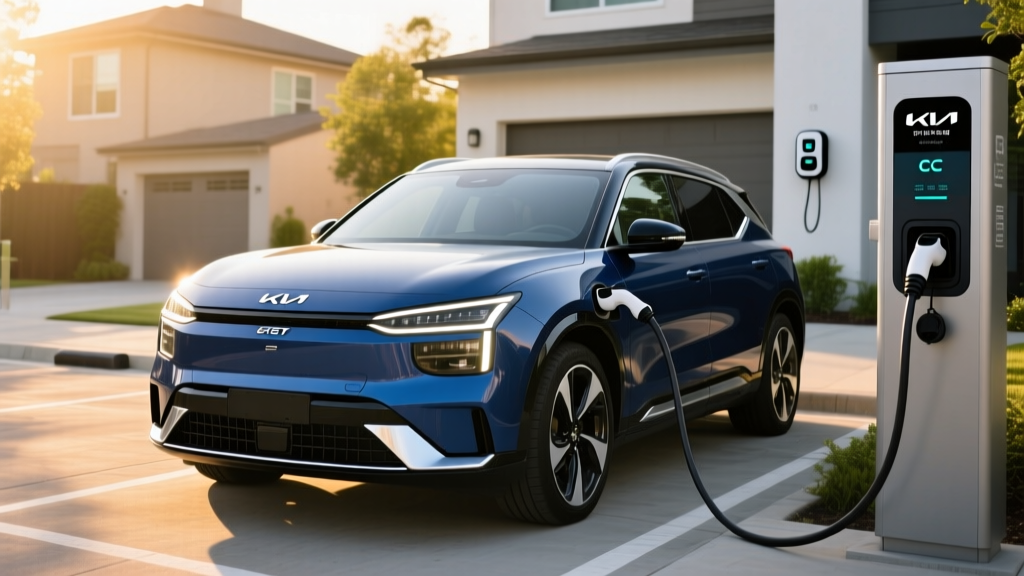
The three-row electric SUV segment was thin when Kia launched the EV9, and the 2024 Kia EV9 GT-Line remains one of the few battery-electric vehicles that can genuinely seat six or seven adults while offering credible road-trip charging speeds. As a flagship trim, the GT-Line pairs a 379-horsepower dual-motor AWD powertrain with Kia's largest battery pack and a feature list that rivals luxury alternatives at a fraction of the price. But flagship pricing also means navigating federal tax credit phase-outs and weighing real-world range against the EPA sticker. Here's the data-driven breakdown.
2024 Kia EV9 GT-Line: Core Specifications at a Glance
| Spec | 2024 Kia EV9 GT-Line AWD |
|---|---|
| EPA Range | 270 miles |
| Battery (usable) | 99.8 kWh (NMC lithium-ion) |
| Powertrain | Dual-motor AWD |
| Horsepower / Torque | 379 hp / 516 lb-ft |
| 0-60 mph | 5.0 seconds |
| Max DC Fast Charge | 210 kW (peak) |
| 10-80% DC Charge Time | ~24 minutes (optimal conditions) |
| Level 2 Home Charging | 10.9 kW onboard charger (~36 mi/hr) |
| Efficiency | 85 MPGe combined (40 kWh/100 mi) |
| Towing Capacity | 4,000 lbs (with tow hitch accessory) |
| Cargo (behind 3rd / 2nd / 1st row) | 20.2 / 43.5 / 81.7 cu ft |
| Base MSRP (GT-Line) | $73,900 |
| Battery/Powertrain Warranty | 10 years / 100,000 miles |
Real-World Range: What to Expect Beyond the EPA Sticker
Real-World Highway (70-75 mph, mild weather): ~230-245 miles
Real-World City/Mixed: ~255-270 miles
Cold Weather (below 30°F, highway): ~190-215 miles
The 2024 Kia EV9 GT-Line AWD carries the same 99.8 kWh (usable) NMC battery as the rest of the AWD EV9 lineup, but its 270-mile EPA rating reflects the larger 21-inch wheels, sport-tuned suspension, and slightly less aero-friendly body cladding that come with the GT-Line package. For comparison, the EV9 Light RWD with smaller wheels achieves an EPA-estimated 304 miles on a smaller 76.1 kWh pack, while the EV9 Land AWD with 20-inch wheels nets 282 miles.
In real-world highway driving at sustained 70-75 mph speeds, large three-row SUVs like the EV9 face significant aerodynamic drag. Expect to see roughly 230-245 miles before reaching 10% State of Charge (SoC) in fair weather. City driving, where regenerative braking recaptures energy, pushes efficiency closer to the EPA number. The EV9's standard heat pump helps mitigate cold-weather losses — a critical feature for buyers in northern climates — but any EV will lose 15-25% of range in sub-freezing highway driving. Plan for roughly 190-215 miles of real range on a cold winter road trip.
According to fueleconomy.gov, the EV9 AWD achieves 85 MPGe combined, translating to about 40 kWh per 100 miles. That's competitive with the Rivian R1S but slightly thirstier than the Tesla Model X due to the EV9's boxier proportions.
Charging Speed: DC Fast Charging and Home Setup
The EV9's 800-volt electrical architecture is one of its strongest assets for road-trip usability. Kia rates the GT-Line AWD at a peak DC fast-charge rate of 210 kW, which on a compatible 350 kW charger (like Electrify America or Ionity stations) can deliver a 10-80% charge in approximately 24 minutes under ideal thermal conditions.
| Charging Level | Power (kW) | Rate (approx.) | Notes |
|---|---|---|---|
| Level 1 (120V household) | 1.4 kW | ~5 miles per hour | Emergency/trickle only; full charge in ~70+ hours |
| Level 2 (240V, 48A) | 10.9 kW | ~36 miles per hour | Full charge in ~9 hours; ideal overnight home charging |
| DC Fast (peak) | 210 kW | ~160 miles in 15 min | Requires 350 kW-capable station; rate tapers above 80% SoC |
Charging curve reality check: The 210 kW figure is a peak, not a sustained rate. Like all EVs, the EV9's charge curve tapers significantly above 80% SoC to protect battery longevity. If you're road-tripping, plan your stops around 10-80% windows — the last 20% can take as long as the first 70%. The 800V architecture does give the EV9 a tangible advantage over 400V competitors (like the VW ID.4 or older Model X) in sustaining higher charge rates through the mid-SoC range.
For home charging, the 10.9 kW onboard charger means a properly installed 48-amp Level 2 wallbox (on a 60-amp circuit) will replenish the 99.8 kWh pack from empty in roughly 9 hours. Most owners charging from 20-80% daily will see a full overnight top-up in 5-6 hours. Installation costs for a Level 2 home charger typically range from $500-$2,000 depending on panel capacity and conduit run — budget for a potential panel upgrade to 200A if your home currently has a 100A service.
The EV9 uses the CCS1 connector for DC fast charging and J1772 for Level 2 AC. Kia has confirmed that future EV9 models will adopt the NACS (Tesla) connector, but the 2024 model year ships with CCS. Adapters are available for Tesla Supercharger access where Tesla has opened its network to CCS-equipped vehicles.
Performance and Drivetrain
The GT-Line's dual-motor AWD setup produces 379 horsepower and 516 lb-ft of torque, launching this 5,300-pound SUV to 60 mph in 5.0 seconds flat. That's genuinely quick for a three-row family hauler — quicker than a base Porsche Cayenne and comparable to the BMW X5 xDrive40i. Kia's GT-Line also adds a boost function that temporarily increases output, and the sport-tuned suspension provides noticeably firmer body control than the softer Land trim.
Drive modes include Eco, Normal, Sport, and Snow, with adjustable regenerative braking levels selectable via steering-wheel paddles. At max regen, the EV9 approaches one-pedal driving capability in city traffic, though it doesn't come to a complete hold without touching the brake — a deliberate choice by Kia for smoother stop transitions.
Towing capacity is rated at 4,000 pounds with the dealer-installed tow hitch accessory, which is adequate for a small boat or light camper but falls short of the Rivian R1S (7,700 lbs) and the Tesla Model X (5,000 lbs). Towing will also slash range by an estimated 30-50%, so plan charging stops accordingly.
Interior Space, Cargo, and Technology
The EV9's upright, boxy design pays dividends in interior volume. Second-row legroom measures 42.8 inches, and the third row offers a usable 32.0 inches — enough for adults on shorter trips, though taller passengers will prefer the second row. The GT-Line comes standard with six-passenger seating (captain's chairs in the second row); a seven-passenger bench configuration is available on lower trims.
Cargo space behind the third row is 20.2 cubic feet — sufficient for a week's groceries or a couple of carry-ons. Fold the third row for 43.5 cu ft, and fold both rear rows for a flat 81.7 cu ft of cargo volume. A small front trunk (frunk) adds 1.8 cu ft for charging cables or a laptop bag.
Tech highlights in the GT-Line include:
- Dual 12.3-inch displays (instrument cluster + infotainment) in a single curved panel
- Wireless Apple CarPlay and Android Auto
- Head-up display with augmented reality navigation
- Digital Key 2 (use your smartphone as the key fob via NFC/UWB)
- Highway Driving Assist 2 (HDA2) — SAE Level 2 driver assist with lane-centering, adaptive cruise, and lane-change assist
- Remote Smart Parking Assist (the EV9 can pull itself in/out of tight spots while you stand outside)
- Vehicle-to-Load (V2L) capability — power laptops, camping gear, or appliances from the EV9's battery via an interior or exterior outlet
Notable drawbacks include the EV9's touch-capacitive climate and media controls, which lack physical buttons and can be frustrating to adjust while driving. The infotainment system is responsive but Kia's menu hierarchy requires more taps than ideal for common functions. Road noise at highway speeds is also more noticeable than in the quieter Rivian R1S or Tesla Model X.
Pricing, Tax Credit Eligibility, and Value
The 2024 Kia EV9 GT-Line AWD starts at an MSRP of $73,900, including destination. With options like the GT-Line Prestige package (adds premium audio, ventilated second-row seats, and a head-up display upgrade), as-tested prices can reach $77,000-$78,500.
This pricing creates a significant tax credit challenge. Under IRS §30D rules, the federal EV tax credit has several constraints that affect the EV9 GT-Line:
- MSRP Cap: SUVs must have an MSRP at or below $80,000 to qualify. The EV9 GT-Line at $73,900 clears this threshold, but a fully loaded GT-Line Prestige may approach the cap — verify your exact build.
- Buyer Income Cap: Modified adjusted gross income must not exceed $150,000 (single), $225,000 (head of household), or $300,000 (joint filers).
- Battery Sourcing Requirements: The full $7,500 credit requires meeting both critical-mineral and battery-component sourcing thresholds, which tighten annually. Kia's supply chain has been evolving — verify current-year sourcing compliance on the IRS qualified vehicles list before purchase.
- Point-of-Sale Transfer: As of 2024, eligible buyers can transfer the credit to the dealer at purchase, reducing the purchase price upfront rather than waiting for a tax refund.
| Scenario | MSRP | Est. Federal Credit | Effective Price |
|---|---|---|---|
| GT-Line AWD (full credit eligible) | $73,900 | Up to $7,500 | ~$66,400 |
| GT-Line AWD (partial credit) | $73,900 | $3,750 | ~$70,150 |
| GT-Line AWD (no credit — income/sourcing) | $73,900 | $0 | $73,900 |
| GT-Line Prestige (full credit eligible) | $77,500 | Up to $7,500 | ~$70,000 |
State and local incentives may stack on top of the federal credit — check your state's energy office or AFDC incentive database for details. Always confirm eligibility with a tax professional before relying on the credit in your purchase decision.
How It Compares: EV9 GT-Line vs. Key Rivals
The three-row electric SUV field is small but competitive. Here's how the EV9 GT-Line stacks up:
- Tesla Model X Long Range: More range (348 mi EPA), faster Supercharger network, and falcon-wing doors, but starts above $77,000 with fewer standard features and a controversial yoke steering option. The EV9 offers better third-row comfort and a more traditional SUV interior.
- Rivian R1S Dual-Motor: Superior off-road capability, 7,700-lb towing, and a more adventurous brand image, but starts higher (~$79,900) with longer delivery wait times. The EV9 is more practical for daily commuting and has dealer-service infrastructure Rivian is still building.
- Volkswagen ID.4 AWD (3-row option limited): Significantly cheaper (~$55,000) but smaller, with less third-row space and slower DC charging (175 kW peak). Not a direct competitor for GT-Line buyers seeking premium features.
- You need a genuine six-passenger electric SUV with adult-usable third-row seating
- Fast DC charging (800V architecture) is a priority for road trips
- You want luxury-level features below $75,000 MSRP
- 10-year/100,000-mile battery warranty matters for long-term peace of mind
- Maximum range is your top priority (consider Model X or EV9 Light RWD)
- You need heavy towing above 4,000 lbs (Rivian R1S)
- You want Tesla Supercharger native access without adapters
Warranty and Long-Term Ownership
Kia backs the EV9's battery pack and electric powertrain with a 10-year/100,000-mile warranty — one of the longest in the industry and a significant advantage over Tesla's 8-year/120,000-mile coverage and most luxury competitors. The battery warranty guarantees that capacity will not drop below 70% of original capacity during the warranty period.
The NMC chemistry in the EV9's large pack is proven in Hyundai/Kia's E-GMP platform (shared with the Ioniq 5 and EV6), which has shown strong degradation resistance in real-world fleet data. Expect roughly 5-8% capacity loss over the first 100,000 miles under normal use — meaning a 270-mile EV9 might deliver 250-255 miles when new and settle around 248-256 miles after several years. The 100+ kWh pack size provides a generous buffer that helps mask degradation over time.
Maintenance costs are minimal compared to gas SUVs — no oil changes, no spark plugs, no transmission fluid. Budget for cabin air filter replacement (~$50-80 every 15,000-20,000 miles), brake fluid checks (regen braking extends pad life dramatically), and tire rotation. Insurance premiums for the EV9 GT-Line tend to run 15-25% higher than comparable gas SUVs due to repair costs and vehicle value — get quotes before committing.
Pros and Cons
- Genuine three-row space with adult-usable third row
- 800V architecture enables 210 kW DC fast charging
- 10-year/100,000-mile battery warranty
- 379 hp dual-motor AWD with 5.0-second 0-60
- V2L capability for camping and emergency power
- Premium GT-Line styling and feature content below luxury-brand pricing
- 270-mile EPA range is modest for a 100 kWh pack
- Touch-capacitive controls are distracting while driving
- CCS connector only (NACS adapter required for Tesla Superchargers)
- 4,000-lb towing limit trails Rivian R1S significantly
- Road noise at highway speeds is noticeable
- Tax credit eligibility depends on sourcing rules and income caps
Frequently Asked Questions
What is the real-world range of the 2024 Kia EV9 GT-Line?
The EPA rates the EV9 GT-Line AWD at 270 miles. In real-world highway driving at 70-75 mph in mild weather, expect roughly 230-245 miles. City driving and regenerative braking can push that closer to the EPA estimate. In cold weather (below 30°F), highway range drops to approximately 190-215 miles. The heat pump helps, but physics is physics — cold batteries and cabin heating consume significant energy.
How fast does the EV9 GT-Line charge at home and on the road?
On a 350 kW-capable DC fast charger, the EV9 peaks at 210 kW and can charge from 10-80% in about 24 minutes under optimal conditions. At home on a 48-amp Level 2 wallbox (10.9 kW), you'll add roughly 36 miles of range per hour, fully recharging the 99.8 kWh pack in about 9 hours. On a standard 120V outlet (Level 1), expect about 5 miles per hour — suitable only for emergency trickle charging.
Does the 2024 Kia EV9 GT-Line qualify for the federal EV tax credit?
It can, but eligibility is not automatic. The EV9 GT-Line's $73,900 MSRP falls under the $80,000 SUV cap for §30D. However, you must also meet income limits ($150K single / $300K joint), and the vehicle must satisfy battery-component and critical-mineral sourcing requirements that change annually. Check the IRS qualified clean vehicles list for the specific model year and build date. A tax professional can confirm your personal eligibility. The credit can be transferred to the dealer at point of sale, reducing your purchase price directly.
Is the Kia EV9 GT-Line worth buying over the Tesla Model X or Rivian R1S?
It depends on your priorities. The EV9 GT-Line offers the best value proposition if you want a well-equipped, fast-charging three-row EV under $75,000 with a strong warranty and conventional dealership service. The Model X wins on range and charging network convenience but costs more and has polarizing interior design. The R1S is the pick for off-road capability and towing but carries a higher starting price and limited service centers. For most families prioritizing daily usability, road-trip charging speed, and warranty coverage, the EV9 GT-Line is the strongest all-around choice in this segment.
What is the biggest drawback of the EV9 GT-Line?
The most common owner complaint is the touch-capacitive climate and media controls, which replace physical buttons with flat touch panels that are harder to use while driving. The 270-mile EPA range, while adequate for most use cases, is also on the lower end for a 100 kWh battery pack — the boxy GT-Line styling and 21-inch wheels exact an efficiency penalty. Finally, the CCS connector means you'll need an adapter for Tesla Supercharger access, though Kia and third-party adapters are widely available.
How long will the EV9 battery last?
Kia warranties the battery for 10 years or 100,000 miles against capacity loss below 70%. Based on real-world data from Kia/Hyundai's E-GMP platform, NMC packs in this family typically show 5-8% degradation over 100,000 miles. With proper care — avoiding frequent 100% charges, minimizing DC fast charging in extreme heat, and using the built-in battery preconditioning feature before fast charging — the EV9's battery should provide reliable service well beyond 150,000 miles before capacity loss becomes noticeable in daily driving.