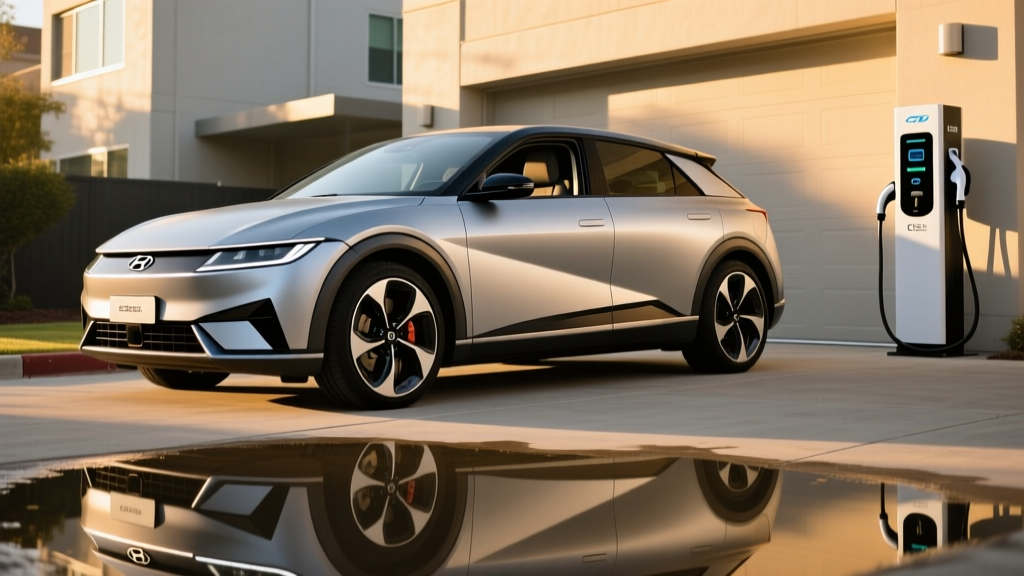
The 2024 Hyundai Ioniq 5 SEL at a Glance
The 2024 Hyundai Ioniq 5 SEL occupies the mid-trim sweet spot of one of the most capable electric crossovers on the market. Built on Hyundai's Electric-Global Modular Platform (E-GMP), the SEL pairs an 800-volt architecture with a 77.4 kWh battery, delivering competitive range, blistering DC fast-charge speeds, and a spacious cabin that punches above its class. For 2024, Hyundai reshuffled the Ioniq 5 lineup — dropping the base Standard Range SE and making the SEL the volume-oriented trim with the most desirable feature-to-price ratio.
But spec sheets only tell part of the story. After logging highway miles, cold-weather commutes, and multiple DC fast-charging sessions, here's what the 2024 Ioniq 5 SEL actually delivers when you own one.
| Spec | Value |
|---|---|
| EPA Range (AWD) | 290 miles |
| EPA Range (RWD) | 303 miles |
| Battery (usable) | 77.4 kWh, NMC (nickel manganese cobalt) |
| Peak DC Fast Charge | 235 kW (800V architecture) |
| 10–80% DC Fast Charge | ~18 minutes (ideal conditions) |
| Level 2 Home Charge Rate | 10.9 kW (~37 miles/hr) |
| 0–60 mph (AWD) | 5.1 seconds |
| 0–60 mph (RWD) | 7.4 seconds |
| Horsepower (AWD) | 320 hp / 446 lb-ft |
| Horsepower (RWD) | 225 hp / 258 lb-ft |
| MPGe Combined (AWD) | |
| MPGe Combined (RWD) | 114 MPGe |
| Cargo (behind 2nd row) | 27.2 cu ft |
| Cargo (seats folded) | 59.3 cu ft |
| Battery Warranty | 8 years / 100,000 miles |
| Base MSRP (RWD) | $47,400 (incl. destination) |
| Base MSRP (AWD) | $50,900 (incl. destination) |
Real-World Range: What the EPA Sticker Doesn't Tell You
EPA Rated: 303 mi (RWD) / 290 mi (AWD)
Real-World Highway (70 mph, mild weather): ~255–275 mi (RWD) / ~245–260 mi (AWD)
Real-World City/Mixed Commute: ~280–295 mi (RWD) / ~270–285 mi (AWD)
Cold Weather (below 32°F, highway): ~210–240 mi (RWD) / ~200–225 mi (AWD)
Note: The Ioniq 5's heat pump (standard on SEL) helps mitigate cold-weather losses compared to EVs without active battery thermal management. Expect ~15–25% range reduction in sustained freezing temperatures, less than many competitors.
The EPA's 303-mile figure for the RWD SEL and 290 miles for the AWD variant are achievable in city-dominant driving where regenerative braking recaptures energy. On sustained highway runs at 70–75 mph, the Ioniq 5 SEL's boxy, retro-futuristic styling creates more aerodynamic drag than sleeker rivals like the Tesla Model Y, translating to roughly 250–270 real-world highway miles before you'll want to find a charger.
According to fueleconomy.gov, the AWD Ioniq 5 SEL achieves 110 MPGe combined (99 city / 123 highway), while the RWD posts 114 MPGe combined. In practical terms, that's roughly 30–32 kWh per 100 miles for the AWD — competitive with the Ford Mustang Mach-E and Volkswagen ID.4, though the Tesla Model Y Long Range edges ahead at 122 MPGe combined.
The Ioniq 5's battery preconditioning feature warms the pack before you arrive at a DC fast charger (when using the built-in navigation to route to one), which is critical for achieving advertised charge speeds in cooler weather. Without preconditioning, a cold battery can cut peak charge rates by 30–50%.
Charging Speed: The 800V Advantage in Practice
The 2024 Ioniq 5's 800-volt electrical architecture is its most significant technical differentiator. Most EVs in this price range use 400V systems, which limits peak DC fast-charge rates. The Ioniq 5 can accept up to 235 kW at compatible chargers — and more importantly, it sustains high charge rates deeper into the session than many competitors.
| Charging Method | Power (kW) | Speed | Notes |
|---|---|---|---|
| Level 1 (120V household) | ~1.4 kW | ~4–5 miles/hr | Emergency/top-up only; full charge takes 55+ hours |
| Level 2 (240V home, 48A) | 10.9 kW | ~37 miles/hr | 0–100% in ~8.5 hours; ideal overnight charging |
| DC Fast Charge (peak) | 235 kW | ~18 min (10–80%) | Requires 350 kW-capable charger; battery preconditioned |
| DC Fast Charge (150 kW station) | ~150 kW | ~25 min (10–80%) | More common station type; still very fast |
| DC Fast Charge (50 kW station) | 50 kW | ~70 min (10–80%) | Older infrastructure; bottleneck is the station, not the car |
Here's where real-world ownership matters: that 18-minute 10–80% time assumes a 350 kW Electrify America or similar CCS station with the battery properly preconditioned. The Ioniq 5's charge curve is impressively flat — it holds above 180 kW from roughly 10% to 55% state of charge, then gradually tapers. By 80%, charge rate drops to around 60–70 kW, which is why Hyundai (and every manufacturer) quotes 10–80% times rather than 10–100%. Charging from 80–100% can add another 25–30 minutes.
For home charging, the SEL's onboard 10.9 kW charger means a full charge overnight on a properly installed 48-amp Level 2 circuit (requiring a 60-amp breaker). Most owners who plug in at home each night will never need to think about charging speed — you'll wake up to a full battery every morning.
Performance and Driving Impressions
The AWD Ioniq 5 SEL's dual-motor setup delivers 320 horsepower and 446 lb-ft of torque, launching to 60 mph in approximately 5.1 seconds. That's genuinely quick for a family crossover and puts it in the same territory as a Volkswagen GTI. The RWD variant's 225 hp and 7.4-second 0–60 time is adequate for commuting and merging, though it won't thrill enthusiasts.
The E-GMP platform's low-slung battery pack gives the Ioniq 5 a composed ride with minimal body roll. Steering is light but precise, and the regenerative braking system — adjustable via paddle shifters from Level 0 to Level 3, plus an i-PEDAL one-pedal driving mode — is among the most intuitive in the segment. The strongest regen setting brings the car to a complete stop without touching the brake pedal, which reduces brake wear significantly in city driving.
One limitation: the Ioniq 5 SEL is not rated for towing in the U.S. market. If you need towing capability, the Ford Mustang Mach-E (up to 1,500 lbs with the GT) or the Rivian R1S are better options.
Interior Space, Tech, and Daily Livability
The Ioniq 5's flat floor and long 118.1-inch wheelbase create a cabin that feels a class larger than its exterior footprint suggests. Rear-seat legroom measures 39.4 inches — more than the Tesla Model Y and nearly matching the Hyundai Palisade three-row SUV. Two adults can sit comfortably behind a tall driver, and the rear seats recline and slide fore/aft on a track, a rare feature in this segment.
Cargo volume behind the second row is 27.2 cubic feet, expanding to 59.3 cubic feet with the rear seats folded. The front trunk (frunk) on AWD models adds 0.85 cubic feet — enough for charging cables and a small bag, though RWD models get a larger 2.1 cu-ft frunk since there's no front motor.
SEL Trim Tech Highlights:
- Dual 12.3-inch displays (digital cluster + infotainment) with wireless Apple CarPlay and Android Auto
- Hyundai SmartSense suite: forward collision-avoidance assist, blind-spot collision-avoidance, rear cross-traffic collision-avoidance, lane keeping assist, highway driving assist (SAE Level 2)
- Digital side mirrors (camera-based, optional on SEL in some markets)
- Vehicle-to-load (V2L) capability — powers devices up to 3.6 kW via an interior outlet or exterior adapter
- Heated front seats, heated steering wheel, power liftgate
- Highway Driving Assist 2 (HDA2) with lane-change assist on AWD models
The Ioniq 5 SEL's Highway Driving Assist and lane-keeping systems are SAE Level 2 driver-assistance features. The driver must remain attentive, keep hands on the wheel (or demonstrate engagement), and be ready to take over at any moment. These are not autonomous driving systems.
Notable drawbacks: The infotainment system relies heavily on capacitive touch controls for climate and media, which can be distracting while driving. The absence of a rear wiper on earlier 2022–2023 models was rectified for 2024, but the rear visibility over the thick C-pillars remains limited — the surround-view camera helps. The Ioniq 5 also lacks a traditional spare tire, relying instead on a tire mobility kit.
Pricing, Trim Levels, and Federal Tax Credit Eligibility
The 2024 Ioniq 5 SEL starts at $47,400 for the RWD (including $1,335 destination) and $50,900 for the AWD. Hyundai offers the Ioniq 5 in three trims for 2024: SE ($42,900), SEL ($47,400), and Limited ($53,400). The SEL adds the most-requested features — heated seats, power liftgate, Digital Key, and the full Hyundai SmartSense suite — making it the value leader in the lineup.
| Trim | MSRP (incl. dest.) | Est. Price After §30D Credit | §30D Eligible? |
|---|---|---|---|
| SE RWD | $42,900 | $35,400 | Yes — meets MSRP cap and sourcing rules* |
| SEL RWD | $47,400 | $39,900 | Yes — meets MSRP cap and sourcing rules* |
| SEL AWD | $50,900 | $43,400 | Yes — meets MSRP cap and sourcing rules* |
| Limited AWD | $58,400 | $50,900 | Yes — meets MSRP cap and sourcing rules* |
*Based on 2024 IRS §30D rules. The Ioniq 5 is assembled in Ellabell, Georgia (as of late 2024 production), satisfying the North American final assembly requirement. Battery component and critical mineral sourcing thresholds must be met for the full $7,500 credit. Buyer income caps apply: $300K joint / $225K head of household / $150K individual MAGI. SUV MSRP cap is $80,000. Consult IRS.gov §30D guidelines and a tax professional before relying on credit eligibility.
- ✔ Final assembly in North America (Ellabell, GA plant)
- ✔ MSRP below $80,000 SUV cap
- ✔ Battery components manufactured in North America (meets 2024 threshold)
- ✔ Critical minerals sourced from U.S. or FTA partners (meets 2024 threshold)
- ⚠ Buyer modified adjusted gross income must fall within §30D limits
- ⚠ Point-of-sale transfer available — dealer applies credit at purchase if eligible
Starting in late 2024, Hyundai shifted U.S.-bound Ioniq 5 production from South Korea to its new Georgia EV plant, a critical move for §30D eligibility. This means the 2024 Ioniq 5 SEL qualifies for the full $7,500 federal tax credit (subject to buyer income limits and battery-sourcing rules), which can be transferred to the dealer as a point-of-sale rebate, effectively reducing the purchase price at the dealership.
Pros, Cons, and the Verdict
- Class-leading 800V DC fast charging (18 min 10–80%)
- Spacious, flat-floor cabin with generous rear legroom
- V2L capability powers appliances and devices
- Strong real-world range with heat pump standard
- Competitive pricing after $7,500 tax credit
- Excellent IIHS Top Safety Pick+ rating
- 8-yr/100,000-mi battery warranty
- Capacitive touch controls distract while driving
- No towing capacity in U.S. market
- CCS port (NACS adapter needed for Tesla Superchargers)
- Highway range falls short of EPA sticker (aerodynamic penalty)
- Small frunk on AWD models (0.85 cu ft)
- Rear visibility limited by thick C-pillars
- No Apple CarPlay/Android Auto over wireless on some early 2024 builds (wired required)
Who Should Buy the 2024 Ioniq 5 SEL?
Choose the Ioniq 5 SEL if:
- You want the fastest DC charging in the segment for road trips
- You need spacious rear seating for adults or tall car seats
- You value V2L for camping, tailgating, or emergency power
- You want a $7,500-eligible EV under $50K after credits
- You need towing capability (consider Mach-E, R1S, or F-150 Lightning)
- You rely exclusively on Tesla Superchargers (NACS-native vehicles like Model Y are simpler)
- You prioritize maximum highway range above all else (Model Y Long Range: 330 mi EPA)
The 2024 Ioniq 5 SEL is best suited for urban and suburban families who want a practical daily driver with exceptional road-trip charging speed. Its combination of space, tech, and 800V fast charging makes it one of the most well-rounded EVs in the $40K–$50K range. Commuters with home charging will barely notice the range gap to the Model Y, while road-trippers will appreciate the Ioniq 5's ability to add 200+ miles of range in a 20-minute stop.
Frequently Asked Questions
What is the real-world range of the 2024 Ioniq 5 SEL?
In mixed driving at moderate temperatures, expect 270–290 miles from the RWD and 260–280 miles from the AWD. Sustained highway driving at 70+ mph reduces that to roughly 250–270 miles (RWD) and 240–260 miles (AWD). In freezing weather, plan for 210–240 miles before needing to charge. The standard heat pump helps preserve range in cold conditions compared to EVs without active thermal management.
How fast does the 2024 Ioniq 5 SEL charge at home and on the road?
On a 48-amp Level 2 home charger (240V), the Ioniq 5 SEL charges at 10.9 kW, adding roughly 37 miles of range per hour — a full charge takes about 8.5 hours overnight. On a 350 kW DC fast charger with a preconditioned battery, it peaks at 235 kW and charges from 10–80% in approximately 18 minutes. At a more common 150 kW DC station, expect 10–80% in about 25 minutes.
Does the 2024 Ioniq 5 SEL qualify for the $7,500 federal EV tax credit?
Yes, as of 2024 the Ioniq 5 qualifies for the full $7,500 §30D federal tax credit, provided the buyer meets income limits ($150K individual / $300K joint MAGI). Hyundai's Georgia assembly plant satisfies the North American final assembly requirement, and the Ioniq 5 meets 2024 battery component and critical mineral sourcing thresholds. The credit can be transferred to the dealer as a point-of-sale discount. Always verify current eligibility at fueleconomy.gov and consult a tax professional.
Is the Ioniq 5 SEL worth buying over the Tesla Model Y or Ford Mach-E?
The Ioniq 5 SEL wins on DC charging speed (18 min vs. ~25–30 min for competitors at equivalent chargers), rear-seat space, and V2L capability. The Tesla Model Y Long Range wins on EPA range (330 mi), Supercharger network access, and cargo volume. The Ford Mustang Mach-E offers a sportier driving feel and slightly lower starting pricing. If fast road-trip charging and interior comfort matter most, the Ioniq 5 SEL is the strongest pick in this trio.
What is the Ioniq 5 battery warranty?
Hyundai covers the Ioniq 5's high-voltage battery for 8 years or 100,000 miles (whichever comes first), guaranteeing it will retain at least 70% of its original capacity. The broader powertrain warranty covers 5 years / 60,000 miles. Hyundai also includes 3 years / 36,000 miles of complimentary maintenance and 5 years of roadside assistance.
Can the Ioniq 5 use Tesla Superchargers?
The 2024 Ioniq 5 uses a CCS1 charge port. Tesla began opening select Supercharger stalls to non-Tesla EVs via the Magic Dock adapter, and Hyundai owners can also use a NACS-to-CCS adapter (sold separately) at compatible Superchargers. However, the Ioniq 5's native CCS compatibility means it works with Electrify America, EVgo, ChargePoint, and other major networks without adapters. Starting with the 2025 model year, Hyundai adopted the NACS port natively.