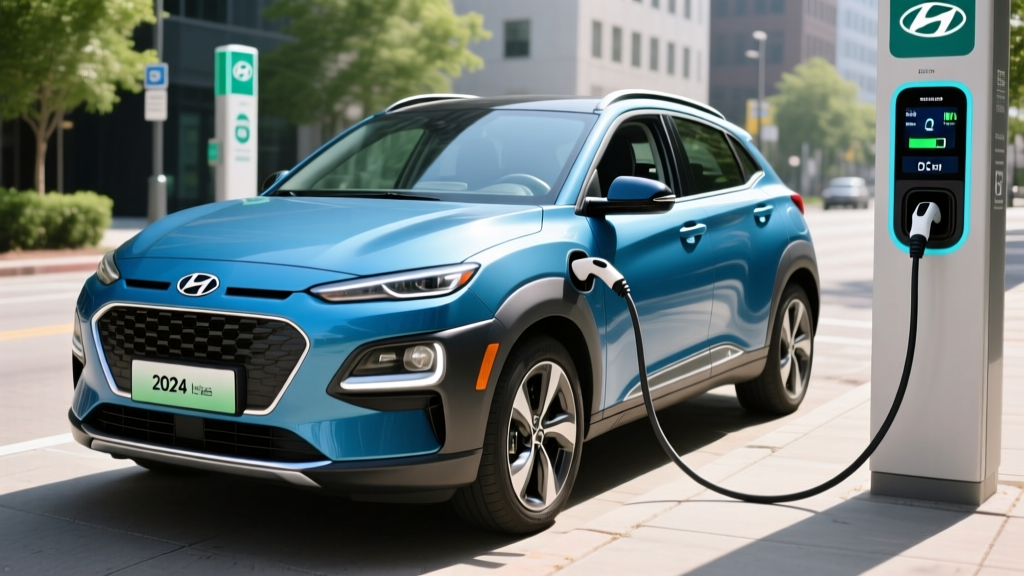
The 2024 Hyundai Kona Electric arrived as a complete redesign — larger, more refined, and packed with tech compared to its first-generation predecessor. For budget-conscious EV shoppers, the Kona Electric's starting price under $33,000 makes it one of the most accessible all-electric crossovers on the market. But affordability only matters if the range, charging, and daily usability hold up in real-world conditions. This review dissects every spec that matters — from the 2024 Hyundai Kona Electric MSRP across all trims to its actual highway range and DC fast-charging behavior.
2024 Hyundai Kona Electric MSRP and Trim Pricing
The 2024 Kona Electric is offered in three trims: SE, SEL, and Limited. Pricing below reflects the original MSRP at launch (destination charge included). Note that the Limited trim crosses the $45,000 threshold relevant to certain state rebate programs.
| Trim | MSRP (incl. destination) | Federal §30D Credit Potential | Effective Price (if eligible) |
|---|---|---|---|
| SE | $32,675 | Up to $7,500 | ~$25,175 |
| SEL | $36,175 | Up to $7,500 | ~$28,675 |
| Limited | $41,075 | Up to $7,500 | ~$33,575 |
Federal tax credit caveat: The §30D Clean Vehicle Credit (per IRS guidelines) can provide up to $7,500 — split into $3,750 for critical-minerals sourcing and $3,750 for battery-component sourcing. Eligibility depends on your modified adjusted gross income (AGI caps: $150K single / $300K joint), the vehicle's MSRP (must be under $80,000 for SUVs — the Kona qualifies), and the battery's mineral/component origin. Hyundai has historically sourced battery materials that partially or fully disqualify some trims from the full $7,500. Always verify current sourcing compliance on the IRS qualified-vehicle list before purchase. The credit can now be transferred to the dealer at point of sale, reducing your out-of-pocket cost immediately.
Range and Efficiency: EPA vs. Reality
Real-World Expectation: ~220–240 miles on mixed highway driving at 70 mph; ~170–190 miles in sub-30°F winter conditions; ~250+ miles in city/regen-heavy commuting.
The SE, SEL, and Limited trims all share the same 64.8 kWh battery pack. The EPA rates the Kona Electric at 129 MPGe combined (134 city / 123 highway) and an energy consumption of roughly 26 kWh per 100 miles, according to fueleconomy.gov. That efficiency figure is competitive for the compact crossover segment, though slightly behind the Chevrolet Bolt EUV (~28 kWh/100 mi) and notably less efficient than the Tesla Model Y (~28 kWh/100 mi but in a larger vehicle).
In real-world highway testing, the Kona Electric typically delivers 3.5–3.8 mi/kWh at sustained 70 mph speeds in moderate temperatures (60–80°F), translating to roughly 225–245 miles before you'd want to stop. Cold weather is the equalizer: lithium-ion chemistry loses efficiency in freezing temperatures, and without a heat pump on all trims (it's standard on Limited, optional or absent on lower trims depending on region), cabin heating draws significant energy from the pack. Expect 25–35% range reduction in sustained sub-freezing driving.
Battery Chemistry and Capacity
The 2024 Kona Electric uses a 64.8 kWh (usable) lithium-ion battery pack with NMC (nickel-manganese-cobalt) chemistry. NMC offers higher energy density than LFP, which helps Hyundai package a 261-mile range into a compact crossover footprint. The trade-off: NMC cells degrade slightly faster than LFP over many charge cycles and are less tolerant of sustained 100% state-of-charge storage.
Ownership tip: For daily driving, set your charge limit to 80% to prolong NMC battery health. Use the 100% setting only when you need the full range for a road trip. Hyundai's battery management system includes a buffer (the pack's gross capacity exceeds the usable 64.8 kWh), which helps mitigate long-term degradation.
Charging Speed: DC Fast, Level 2, and Level 1
| Charging Level | Power / Rate | Time / Range Added |
|---|---|---|
| Level 1 (120V household) | ~1.4 kW | ~4–5 miles per hour of charging |
| Level 2 (240V home/public) | ~10.9 kW (max onboard) | ~35 miles per hour; 0–100% in ~6.5 hours |
| DC Fast Charge (CCS) | Peak ~100 kW | 10–80% in ~43 minutes |
The Kona Electric's DC fast-charging capability peaks at approximately 100 kW via its CCS1 connector. This is the Kona's most significant competitive weakness. Rivals like the Hyundai Ioniq 5 (240 kW peak), Kia EV6 (239 kW), and Tesla Model Y (250 kW) can add 150+ miles in 15 minutes, while the Kona needs roughly double that time for similar replenishment.
The charge curve is relatively flat from 10% to about 60% SoC, holding near 80–100 kW. Beyond 80%, the rate tapers sharply to protect the battery — expect 80–100% to take nearly as long as 10–80%. For road-trippers, this means planning slightly longer stops (45–55 minutes total) at Electrify America, EVgo, or similar CCS-compatible networks.
At home, the 10.9 kW onboard charger is solid. A Level 2 wallbox (48-amp circuit, 60-amp breaker) will replenish the pack fully overnight in about 6.5 hours. Most Kona Electric owners will find a nightly Level 2 session more than adequate for daily commuting needs.
Performance and Drivetrain
The 2024 Kona Electric is a front-wheel-drive (FWD) vehicle powered by a single permanent-magnet synchronous motor producing 201 horsepower and 188 lb-ft of torque. Hyundai quotes a 0–60 mph time of approximately 7.2 seconds.
That's adequate for highway merging and confident city acceleration, though it trails the dual-motor Ioniq 5 (5.0 seconds) and even the discontinued Chevrolet Bolt EUV (~6.5 seconds). There is no all-wheel-drive option for the Kona Electric — if you need AWD in a Hyundai EV, you'll need to step up to the Ioniq 5 or Kona AWD (ICE/hybrid).
Regenerative braking is adjustable via steering-wheel paddles, from Level 0 (coast) to Level 3 (strong regen). Level 3 approaches one-pedal driving in city traffic but doesn't quite bring the car to a complete hold without brake input — a minor frustration compared to competitors with true one-pedal modes.
Interior Space, Cargo, and Technology
The redesigned Kona Electric is substantially larger than its predecessor. Key dimensions:
- Cargo volume (behind rear seats): 25.5 cu ft
- Cargo volume (rear seats folded): 54.2 cu ft
- Front legroom: 41.7 inches
- Rear legroom: 38.2 inches
- Front headroom: 39.9 inches
Rear-seat space is genuinely usable for adults on longer trips — a marked improvement over the first-gen Kona Electric's cramped back row. Cargo capacity is competitive with the Kia Niro EV and exceeds the Chevrolet Bolt EUV with seats up.
Tech highlights:
- Dual 12.3-inch panoramic displays (instrument cluster + infotainment) on SEL and Limited
- Wireless Apple CarPlay and Android Auto (standard all trims)
- Hyundai Digital Key 2 (NFC/BLE phone-as-key, Limited)
- Over-the-air (OTA) software updates
- Vehicle-to-load (V2L) capability via interior outlet (Limited trim)
- Hyundai SmartSense ADAS suite: forward collision-avoidance, lane-keeping assist, blind-spot monitoring, rear cross-traffic alert, highway driving assist (Level 2 driver assistance — driver must remain engaged at all times)
Notable drawbacks: The infotainment system relies on capacitive touch buttons for climate controls, which can be distracting while driving. The Kona Electric also lacks a front trunk (frunk) — that space is consumed by the motor and power electronics.
Pros and Cons
Pros
- Sub-$33K starting MSRP — one of the most affordable EV crossovers
- 261-mile EPA range is practical for most daily and weekend use
- Spacious, redesigned interior with generous rear legroom
- Strong standard safety suite (Hyundai SmartSense)
- 10-year/100,000-mile powertrain and battery warranty
- V2L capability on Limited trim
Cons
- 100 kW peak DC charging is slow for 2024-era road trips
- FWD only — no AWD option
- No frunk for additional cargo storage
- Capacitive-touch climate controls are less intuitive than physical buttons
- Cold-weather range loss is significant without standard heat pump on lower trims
- Federal tax credit eligibility varies by battery sourcing — may not qualify for full $7,500
Who Should Buy the 2024 Kona Electric?
Choose the Kona Electric if: You want an affordable, practical EV crossover primarily for commuting and city/suburban driving. You can charge at home (Level 2) and don't road-trip frequently. Rear-seat space and cargo versatility matter, and you want a long warranty for peace of mind.
Look elsewhere if: You regularly take 300+ mile road trips (the 100 kW charging will frustrate you), need AWD for snow-belt winters, or want the fastest charging in the segment (consider the Ioniq 5, EV6, or Tesla Model Y).
Key Specifications at a Glance
| Specification | Value |
|---|---|
| EPA Range | 261 miles (SEL/Limited) |
| Battery (usable) | 64.8 kWh, NMC chemistry |
| Motor / Drivetrain | Single motor, FWD |
| Horsepower / Torque | 201 hp / 188 lb-ft |
| 0–60 mph | ~7.2 seconds |
| MPGe (combined) | 129 MPGe |
| Energy Consumption | ~26 kWh / 100 mi |
| DC Fast Charge (peak) | ~100 kW (CCS1) |
| 10–80% DC Charge Time | ~43 minutes |
| Level 2 Onboard Charger | 10.9 kW |
| Cargo (seats up / folded) | 25.5 / 54.2 cu ft |
| Base MSRP | $32,675 (SE) |
| Battery/Powertrain Warranty | 10 years / 100,000 miles |
| ADAS Level | SAE Level 2 (driver must supervise) |
Frequently Asked Questions
What is the real-world range of the 2024 Hyundai Kona Electric?
The EPA rates it at 261 miles, but expect roughly 220–240 miles in real-world highway driving at moderate temperatures. In freezing conditions, that can drop to 170–190 miles. City driving with regenerative braking can push range closer to or slightly above the EPA estimate.
How fast does the Kona Electric charge?
On a DC fast charger, it peaks at ~100 kW, reaching 10–80% in about 43 minutes. At home on a Level 2 (240V) charger, the 10.9 kW onboard charger fills the battery from empty in roughly 6.5 hours, adding about 35 miles of range per hour of charging.
Does the 2024 Kona Electric qualify for the federal EV tax credit?
It may qualify for up to $7,500 under IRS §30D, but the actual amount depends on battery critical-mineral sourcing and component manufacturing requirements, which change periodically. The vehicle's MSRP is well under the $80,000 SUV cap, and most buyers fall within income limits. Check the current IRS qualified vehicles list before purchasing, and consult a tax professional for your specific situation.
How much does the Kona Electric cost after tax credits?
If you qualify for the full $7,500 federal credit (and your state offers additional incentives), the SE trim could effectively cost around $25,175 — potentially less with state rebates. However, battery sourcing rules may reduce the federal credit to $3,750 or $0 for certain production batches. Always verify before signing.
Is the Kona Electric worth buying vs. competitors?
Against the Kia Niro EV (239 miles, ~$39,600 MSRP), the Kona offers more range and a lower starting price. Against the Chevrolet Bolt EUV (discontinued after 2023), the Kona is more modern but pricier. The Tesla Model Y starts significantly higher (~$44,000+) but offers far superior DC charging (250 kW), AWD, and Supercharger access. The Kona Electric's sweet spot is value-oriented buyers who prioritize home charging and daily commuting over road-trip speed.
Does the Kona Electric have all-wheel drive?
No. The 2024 Kona Electric is front-wheel drive only. If AWD is essential, consider the Hyundai Ioniq 5 (AWD available) or the Kia EV6.
What is the battery warranty?
Hyundai covers the Kona Electric's battery and powertrain for 10 years or 100,000 miles, whichever comes first. The battery warranty guarantees a minimum capacity retention (typically 70% of original capacity). The basic vehicle warranty is 5 years / 60,000 miles. Full warranty details are available from Hyundai USA.