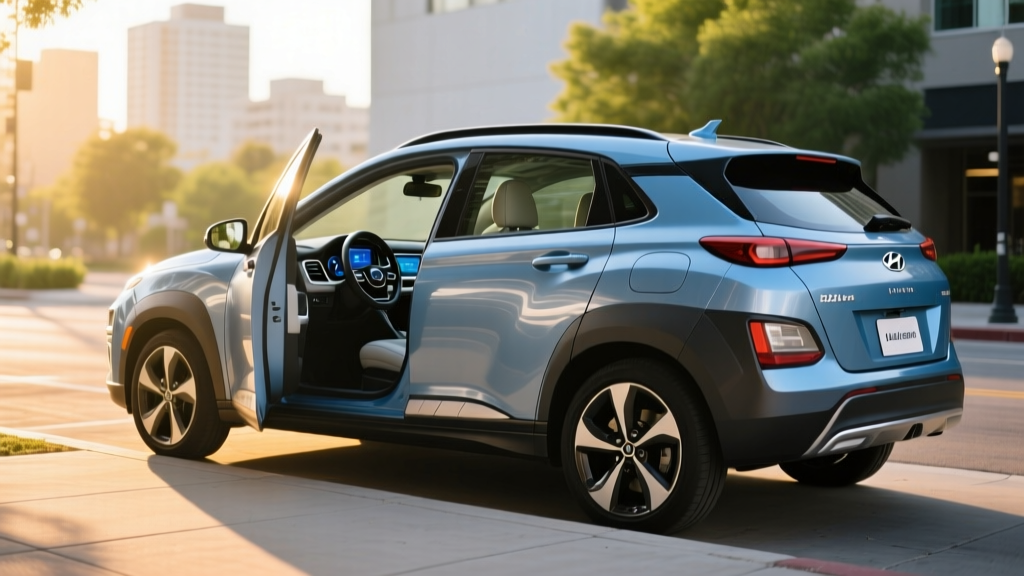
The 2024 Hyundai Kona Electric arrived as a complete redesign, growing in nearly every exterior dimension over its predecessor. If you've been searching for the 2024 Hyundai Kona Electric length in inches, the answer is 174.6 inches — a full 5.9 inches longer than the outgoing model. That extra length translates directly into usable interior and cargo space, making this subcompact crossover a far more practical daily driver than the first-generation Kona Electric.
But dimensions are just the starting point. With a 261-mile EPA-estimated range, a 64.8 kWh battery, and a starting price around $32,675, the redesigned Kona Electric positions itself as one of the most accessible long-range EVs on the market. Here's everything you need to know before you buy.
2024 Hyundai Kona Electric: Key Specs at a Glance
| Specification | Value |
|---|---|
| Overall Length | 174.6 inches |
| Wheelbase | 104.7 inches |
| Width | 71.9 inches |
| Height | 62.2 inches |
| EPA Range | 261 miles (SE/SEL trims, 18" wheels) |
| Battery Capacity | 64.8 kWh (usable) |
| Battery Chemistry | NMC (Nickel Manganese Cobalt) |
| Motor Output | 201 hp / 188 lb-ft torque |
| Drivetrain | FWD (single front motor) |
| 0–60 mph | ~6.8 seconds |
| MPGe (Combined) | 105 MPGe |
| Max DC Fast Charge | ~100 kW (peak) |
| 10–80% DC Fast Charge | ~43 minutes |
| Level 2 Home Charging | 10.9 kW (~37 miles/hr) |
| Cargo Volume (rear seats up) | 25.5 cu ft |
| Cargo Volume (rear seats folded) | 56.8 cu ft |
| Base MSRP (SE trim) | $32,675 |
| Battery Warranty | 8 years / 100,000 miles |
Dimensions and Packaging: Why the 2024 Kona Electric's Length Matters
The jump from 168.7 inches to 174.6 inches in overall length is the single most impactful change in the Kona Electric's redesign. Hyundai stretched the wheelbase to 104.7 inches (up 2.4 inches), and the results are tangible. Rear-seat legroom now measures 38.3 inches, which is competitive with compact crossovers a size class above. Two adults can sit comfortably on longer drives without feeling cramped.
Cargo capacity also benefits substantially. With 25.5 cubic feet behind the rear seats, you'll fit a week's worth of groceries or a couple of roll-aboard suitcases without folding anything. Drop the 60/40 split rear seatbacks and you get 56.8 cubic feet — enough for a bicycle with the front wheel removed or a full load of camping gear.
One packaging note: unlike some EVs built on dedicated electric platforms, the Kona Electric shares its architecture with the gasoline Kona. That means no front trunk (frunk). The absence of a frunk is a minor miss for storing charging cables, but the cargo area itself is well-shaped with a low load floor.
Range, Efficiency, and Real-World Expectations
EPA Estimate: 261 miles (SE/SEL with 18" wheels) | 226 miles (Limited with 19" wheels)
Real-World Highway (70 mph, moderate climate): Expect ~210–235 miles
Real-World Cold Weather (below 32°F, mixed driving): Expect ~175–200 miles
Real-World City/Commuter (mild climate): ~240–260 miles — near EPA sticker
The Kona Electric's 64.8 kWh NMC battery delivers an EPA-estimated 261 miles on the SE and SEL trims equipped with 18-inch wheels and all-season tires. Step up to the Limited trim with its 19-inch alloy wheels, and the EPA figure drops to 226 miles due to increased rolling resistance and unsprung weight. According to fueleconomy.gov, the SE/SEL trims achieve 105 MPGe combined, which translates to roughly 32 kWh per 100 miles of driving.
In practice, the Kona Electric's efficiency is respectable but not class-leading. Highway driving at sustained speeds of 70–75 mph will pull range down to roughly 210–235 miles depending on temperature, elevation changes, and wind. Cold weather is the bigger penalty — lithium-ion batteries lose efficiency below freezing, and cabin heating draws significant power without a heat pump (the Kona Electric uses a resistive PTC heater on most trims). Budget-conscious buyers in northern climates should plan for a 25–30% range reduction in winter months.
For city commuters and suburban drivers, the Kona Electric is genuinely efficient. Regenerative braking recovers energy effectively in stop-and-go traffic, and the one-pedal driving mode (activated via steering-wheel paddles) lets you modulate regen strength from coasting to near-complete stops.
Charging Speeds: DC Fast Charging and Home Level 2
| Charging Level | Power | Time / Rate | Connector |
|---|---|---|---|
| Level 1 (120V household) | ~1.4 kW | ~4 miles per hour | J1772 |
| Level 2 (240V home/public) | 10.9 kW (max) | ~37 miles per hour; full charge ~7 hours | J1772 (NACS adapter available) |
| DC Fast Charge | ~100 kW peak | 10–80% in ~43 minutes | CCS1 (NACS adapter available) |
The Kona Electric's DC fast-charging capability is where the 2024 model draws its most criticism. At a peak of roughly 100 kW, it falls well behind competitors like the Hyundai Ioniq 5 (which peaks at 240 kW on its 800V architecture) and the Kia EV6 (also 800V). On a typical road trip, you'll spend about 43 minutes charging from 10% to 80% at a compatible DC fast charger.
The charging curve is relatively flat, which is a double-edged sword. The Kona sustains around 70–80 kW for much of the session rather than hitting a sharp peak and tapering. That consistency is predictable, but the ceiling is low. For frequent road-trippers, this is a meaningful limitation. For commuters who charge at home overnight and only fast-charge a handful of times per year, it's less of a concern.
At home on a Level 2 charger (240V, 48-amp circuit), the Kona Electric's onboard charger accepts up to 10.9 kW, adding roughly 37 miles of range per hour. A full charge from near-empty takes about 7 hours — easily achievable overnight. Hyundai offers a NACS (North American Charging Standard) adapter, giving Kona Electric owners access to Tesla's Supercharger network, which dramatically expands DC fast-charging options for road trips. Check Hyundai's official specs for the latest adapter compatibility details.
Performance and Driving Impressions
A single front-mounted electric motor produces 201 horsepower and 188 lb-ft of torque, driving the front wheels. The 0–60 mph sprint takes approximately 6.8 seconds, which feels brisk in daily driving. Electric motors deliver peak torque from 0 RPM, so the Kona Electric pulls away from stoplights with an immediacy that a gasoline Kona can't match.
There is no all-wheel-drive option. If you live in an area with heavy snow or want the traction security of dual motors, you'll need to look at competitors like the Kia EV6 (AWD available) or the Hyundai Ioniq 5 (AWD available). For most dry and wet pavement driving, the FWD setup is perfectly adequate, and the low center of gravity from the floor-mounted battery pack keeps body roll well-controlled through corners.
Ride quality leans firm, which is typical for subcompact crossovers with heavy battery packs. The 19-inch wheels on the Limited trim amplify road imperfections; the 18-inch wheels on SE and SEL trims offer a noticeably smoother ride. Road noise is moderate — better than the previous generation but not as hushed as the Ioniq 5.
Interior, Technology, and Driver Assistance
Hyundai equipped the 2024 Kona Electric with a modern dual-screen setup: a 12.3-inch digital instrument cluster and a 12.3-inch infotainment touchscreen housed in a single panoramic panel. Wireless Apple CarPlay and Android Auto are standard on all trims — a welcome feature that avoids the cable clutter of wired connections.
The center console features a column-type shifter (freeing up console storage), physical climate-control buttons (a practical choice over touch-only panels), and available features like a heated steering wheel, ventilated front seats (Limited), and a power liftgate. Over-the-air (OTA) software updates keep the infotainment system current without dealer visits.
Hyundai's SmartSense driver-assistance suite is standard and includes:
- Forward Collision-Avoidance Assist with pedestrian and cyclist detection
- Lane Keeping Assist and Lane Following Assist
- Blind-Spot Collision-Avoidance Assist
- Rear Cross-Traffic Collision-Avoidance Assist
- Highway Driving Assist (on SEL and above, with navigation-based speed control)
- Adaptive Cruise Control with stop-and-go
These features constitute an SAE Level 2 driver-assistance system. The driver must remain fully engaged, keep hands on the wheel, and monitor the road at all times. This is not autonomous or self-driving capability.
Pricing, Trims, and Federal Tax Credit Eligibility
| Trim | Base MSRP | Key Additions |
|---|---|---|
| SE | $32,675 | 18" wheels, dual 12.3" screens, SmartSense suite, heated front seats |
| SEL | $34,175 | Highway Driving Assist, wireless phone charging, roof rails, proximity key |
| Limited | $39,175 | 19" wheels, ventilated seats, leather, sunroof, HUD, Highway Driving Assist 2 |
The Kona Electric's pricing makes it one of the most affordable long-range EVs available. The SE trim at $32,675 is the value sweet spot — you get the full 261-mile range, the complete SmartSense suite, and the faster-charging 18-inch wheels. The SEL at $34,175 adds useful driver-assist upgrades. The Limited at $39,175 is well-equipped but sacrifices 35 miles of range for its 19-inch wheels and premium features.
Federal Tax Credit: Does the Kona Electric Qualify?
- Maximum credit: Up to $7,500 (split between battery components and critical minerals)
- MSRP cap: Vehicle must be under $80,000 (SUVs/crossovers) — Kona Electric qualifies on all trims
- Buyer income cap: AGI must not exceed $150,000 (single), $225,000 (head of household), $300,000 (joint)
- Battery sourcing: Credit amount depends on battery component manufacturing and critical mineral sourcing requirements, which tighten annually
- Point-of-sale transfer: Eligible buyers can transfer the credit to the dealer at purchase for an immediate price reduction
Consult the IRS official guidance or a tax professional to confirm your personal eligibility, as battery sourcing rules change frequently.
As of current IRS guidance, the Kona Electric's eligibility for the full $7,500 credit depends on battery-sourcing compliance, which Hyundai has been working to meet through its U.S. and allied-nation supply chains. The vehicle's MSRP falls well below the $80,000 crossover cap, so price is not a barrier. Your personal income is the other gating factor. If you qualify and the battery sourcing requirements are met, the effective price of an SE trim drops to approximately $25,175 — exceptional value for a 261-mile EV.
Who Should Buy the 2024 Hyundai Kona Electric?
- Commuters and city drivers who charge at home and rarely road-trip more than 200 miles
- Budget-conscious EV buyers who want 250+ miles of range without spending over $35,000
- Small households needing a practical daily driver with decent cargo flexibility
- First-time EV adopters who want a familiar crossover form factor with strong warranty coverage
- You need AWD for snow or off-pavement driving
- You road-trip frequently and want sub-20-minute fast-charging stops
- You need more than 56.8 cu ft of cargo space for family hauling
- You want a dedicated EV platform with a frunk and flat floor
Pros and Cons
- 261-mile EPA range at an accessible price point
- Significantly larger interior and cargo space vs. predecessor
- Comprehensive standard driver-assist suite
- Wireless Apple CarPlay/Android Auto on all trims
- Strong 8-year/100,000-mile battery warranty
- NACS adapter unlocks Tesla Supercharger access
- Federal tax credit eligible (subject to sourcing rules)
- DC fast charging capped at ~100 kW (43 min 10–80%)
- No AWD option
- No front trunk (frunk)
- Limited trim's 19" wheels cut range to 226 miles
- Resistive cabin heater (no heat pump) hurts cold-weather range
- FWD only — not ideal for heavy snow regions
Competitive Comparison: Kona Electric vs. the Field
The Kona Electric competes in the subcompact/compact EV crossover segment. Its closest rivals include the Chevrolet Equinox EV (up to 319 miles EPA, starting ~$33,000), the Kia Niro EV (239 miles EPA, similar platform philosophy), and the Volvo EX30 (264 miles EPA, starting ~$36,000 but smaller interior). Hyundai's own Ioniq 5 is a step up in price and size but offers dramatically faster charging (800V architecture, 240 kW peak, ~18 min 10–80%).
The Kona Electric's advantage is its combination of range, price, and practicality. Few EVs offer 261 miles of EPA range for under $33,000. Its disadvantage is charging speed — if you regularly drive 300+ mile routes, the 43-minute fast-charge stop is noticeably longer than what the Ioniq 5 or EV6 deliver.
Frequently Asked Questions
What is the exact length of the 2024 Hyundai Kona Electric in inches?
The 2024 Hyundai Kona Electric measures 174.6 inches in overall length, 71.9 inches in width, and 62.2 inches in height, with a 104.7-inch wheelbase.
What is the real-world range of the 2024 Kona Electric?
The EPA estimates 261 miles for SE/SEL trims and 226 miles for the Limited. In real-world highway driving at 70 mph in moderate temperatures, expect 210–235 miles. In freezing weather, range can drop to 175–200 miles due to battery chemistry limitations and resistive cabin heating.
How fast does the Kona Electric charge at home and on the road?
On a Level 2 home charger (240V), the Kona Electric charges at up to 10.9 kW, adding roughly 37 miles per hour and reaching a full charge in about 7 hours. On DC fast chargers, it peaks at approximately 100 kW, reaching 10–80% in about 43 minutes.
Does the 2024 Kona Electric qualify for the $7,500 federal EV tax credit?
The Kona Electric's MSRP falls below the $80,000 SUV/crossover cap, so it passes the price test. Eligibility for the full credit depends on your income (AGI limits apply) and on battery-sourcing compliance, which is subject to change. The point-of-sale transfer option lets qualified buyers apply the credit as an immediate discount. Always verify current rules at irs.gov and consult a tax professional.
Is the 2024 Kona Electric worth buying over competitors?
If you prioritize affordability, range, and a proven warranty, the Kona Electric SE at $32,675 is one of the best values in the segment. If fast-charging speed or AWD is essential, the Hyundai Ioniq 5 or Kia EV6 are stronger choices at a higher price. The Kona Electric is best suited as a commuter-focused EV with occasional road-trip capability.
What is the battery warranty on the 2024 Kona Electric?
Hyundai covers the high-voltage battery for 8 years or 100,000 miles (whichever comes first), with a capacity retention threshold typically set at 70% of original capacity. The limited vehicle warranty is 5 years/60,000 miles.