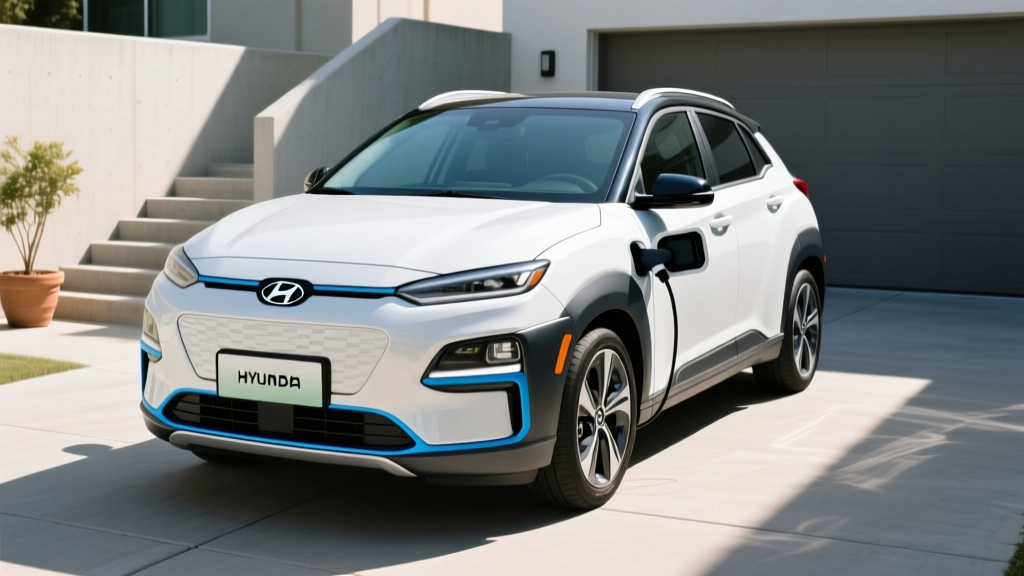
Why the 2024 Hyundai Kona Electric Still Matters in 2026
If you're researching a 2024 Hyundai Kona Electric lease in 2026, you're likely weighing whether a slightly older model year still makes financial sense compared to newer, pricier EVs. The answer depends on the math — not the marketing. The second-generation Kona Electric (introduced for 2024) brought a larger 64.8 kWh battery, a 261-mile EPA range, and DC fast charging up to 100 kW, all in a subcompact crossover that undercuts most rivals on price.
But leasing a 2024 model in 2026 introduces specific ownership economics: the federal tax credit may apply differently to leases than purchases, insurance premiums carry an EV surcharge, and depreciation curves have shifted as newer models flood the market. This guide runs every number you need before signing.
EPA Range: 261 miles (SEL trim, 17-inch wheels) | Battery: 64.8 kWh usable, NMC chemistry
DC Fast Charging: 100 kW peak, ~10–80% in 43 minutes | Level 2: 10.9 kW onboard charger
Motor: 201 hp, 188 lb-ft torque | 0–60 mph: ~7.4 seconds
MPGe: 129 city / 103 highway / 116 combined
Original MSRP: $32,675 (SE) – $39,625 (Limited)
Total Cost of Ownership: 5-Year Breakdown
The most honest way to evaluate any EV lease — including a 2024 Kona Electric — is a full 5-year total cost of ownership (TCO) analysis. This includes every dollar that leaves your pocket, not just the monthly payment.
| Category | Estimated 5-Year Cost | Notes |
|---|---|---|
| Lease payments (60 months × ~$350) | $21,000 | Varies by dealer, money factor, residual |
| Home charging (Level 2, $0.14/kWh avg) | $3,200 | 75,000 mi ÷ 3.5 mi/kWh × $0.14 |
| Public DC fast charging (15% of miles) | $1,100 | Avg $0.35/kWh at Electrify America, EVgo |
| Insurance | $10,500 | ~$2,100/yr — EV surcharge applies |
| Maintenance & repairs | $1,800 | Tire rotation, cabin filter, wipers, brake fluid |
| Depreciation (lease residual risk) | $0 | Lessor absorbs; baked into monthly payment |
| Total 5-Year Cost | ~$37,600 | ≈ $627/month all-in |
For comparison, a gasoline Hyundai Kona (2.0L, ~30 MPG combined) over the same 75,000 miles would cost roughly $9,400 in fuel at $3.75/gallon — about $5,100 more than the Kona Electric's combined charging cost. But the EV's higher insurance premiums and potentially higher lease payments partially offset those savings.
Federal Tax Credit: Does It Apply to a Lease?
The IRS §30D clean vehicle credit offers up to $7,500 for qualifying new EVs. However, leasing changes how this credit works — and this is where many buyers get confused.
When you purchase a qualifying EV, you claim the §30D credit on your personal tax return (or apply it as a point-of-sale rebate). When you lease, the leasing company (lessor) technically receives the credit — not you. Many lessors pass this savings through as a lower monthly payment or capitalized-cost reduction, but they are not legally required to do so. Always ask the dealer: "Is the $7,500 federal credit being passed through to my lease, and is it reflected in the capitalized cost?"
For the 2024 Kona Electric specifically, eligibility for the full $7,500 depends on current-year battery sourcing and critical mineral requirements, which have tightened since 2024. Hyundai manufactures the Kona Electric in South Korea, and battery cell sourcing must meet IRS thresholds for North American or free-trade-agreement partners.
- MSRP Cap: The Kona Electric (a crossover/SUV) must have an MSRP at or below $80,000 — all trims qualify.
- Buyer Income Cap: Modified AGI must not exceed $150,000 (single), $225,000 (head of household), or $300,000 (joint).
- Battery Sourcing: Critical minerals and battery components must meet phased percentage thresholds from US or FTA-partner supply chains. These thresholds increase annually.
- Point-of-Sale Transfer: As of 2024, you can transfer the credit to the dealer at purchase for an immediate price reduction. For leases, this mechanism applies to the lessor.
- Commercial Lease Loophole (§45W): Some EVs ineligible for §30D purchase credits qualify under the commercial vehicle credit when leased, as the lessor claims it differently. Ask your dealer whether the Kona Electric lease qualifies under this provision.
Bottom line: Verify current-year eligibility on fueleconomy.gov and consult a tax professional. Rules shift annually, and a model that qualified in 2024 may face different sourcing thresholds in 2026.
Charging Cost vs. Gasoline: The Per-Mile Math
This is where the Kona Electric delivers its most tangible savings. Let's run concrete numbers using real efficiency data.
| Metric | Kona Electric | Gas Kona (2.0L AWD) |
|---|---|---|
| Energy efficiency | 3.5 mi/kWh (28.6 kWh/100mi) | 30 MPG combined |
| Fuel/energy price | $0.14/kWh (home avg) | $3.75/gallon |
| Cost per mile | $0.04 | $0.125 |
| Annual cost (15,000 mi) | $600 | $1,875 |
| Annual savings | $1,275/year with home charging | |
Maintenance Savings: What You Won't Pay For
EV powertrains eliminate dozens of maintenance items that gasoline owners take for granted. The Kona Electric's permanent-magnet synchronous motor has one moving part. There's no transmission fluid, no timing belt, no exhaust system, and no spark plugs.
| Service Item | Kona Electric | Gas Kona |
|---|---|---|
| Oil changes (synthetic, every 7,500 mi) | $0 | $500 |
| Brake pads (regen extends life 2–3×) | $0 | $400 |
| Transmission fluid | $0 | $150 |
| Tire rotation (every 7,500 mi) | $250 | $250 |
| Cabin air filter | $150 | $150 |
| Coolant / brake fluid checks | $200 | $200 |
| Tire replacement (EV weight = faster wear) | $1,200 | $900 |
| 5-Year Total | ~$1,800 | ~$2,550 |
The net maintenance savings of roughly $750 over five years is real but modest. The bigger story is predictability: EV maintenance costs are flatter and more predictable, with fewer surprise repairs. Note that Hyundai's 10-year/100,000-mile powertrain warranty and 8-year/100,000-mile battery warranty (covering capacity below 70% state of health) provide substantial coverage during a typical lease and beyond.
Insurance Reality: The EV Premium
This is the cost category most EV shoppers underestimate. Insurance for the Kona Electric typically runs 15–25% higher than the gas Kona, for three structural reasons:
- Higher repair costs: EV battery packs and power electronics are expensive to replace after collision damage. Even minor rear-end impacts can trigger battery-safety inspections costing thousands.
- Specialized labor: Fewer body shops have high-voltage certification, raising labor rates for EV repairs.
- Vehicle value: The Kona Electric's higher MSRP means higher comprehensive and collision payouts.
Based on national averages, expect to pay approximately $1,800–$2,400 per year for full-coverage insurance on a Kona Electric, depending on your driving record, location, and deductible. That's roughly $300–$500 more annually than the gas equivalent. Over five years, this EV insurance premium adds $1,500–$2,500 to your total cost — partially offsetting fuel and maintenance savings.
Actionable tip: Get quotes from at least three insurers before signing the lease. Some carriers (GEICO, Progressive, State Farm) now offer specific EV discounts or telematics programs that reward low-mileage driving.
Depreciation and Resale Value Trends
EV depreciation has been volatile since 2022. Early EVs suffered steep value drops as battery technology advanced rapidly, lease returns flooded the used market, and Tesla's aggressive price cuts cascaded across the segment. According to iSeeCars and Kelley Blue Book data, average 3-year EV depreciation sits around 45–50%, compared to roughly 38% for gas vehicles.
For a 2024 Kona Electric leased in 2026, this matters in two ways:
- During the lease: Depreciation is already priced into your monthly payment via the residual value. If the lessor set a generous residual (say 55% of MSRP at 36 months), your payments are lower. If they set it conservatively (45%), payments are higher.
- Lease-end purchase option: If the residual is set above the actual market value, walking away is the smart move. If the market value exceeds the residual (rare in the current EV depreciation climate, but possible if used-EV demand rebounds), you can purchase and capture the equity.
The Kona Electric's strong warranty, competitive range, and Hyundai's brand reputation provide some depreciation floor, but subcompact EVs generally depreciate faster than midsize models due to lower used-market demand.
State, Local, and Utility Incentives
Beyond the federal §30D credit, many states, municipalities, and electric utilities offer additional rebates — but these are hyper-local and change frequently. Examples include:
- California: CVRP rebate up to $7,000 for income-qualified buyers (check energy.ca.gov for current availability)
- Colorado: State tax credit up to $5,000 for new EVs
- Utility rebates: Many utilities (PG&E, Con Edison, Xcel Energy) offer $500–$1,500 for Level 2 home charger installation, plus time-of-use rates that cut charging costs by 30–50%
- HVAC/utility panel upgrades: Some programs cover part of the $500–$2,000 cost of upgrading a 100A panel to 200A for Level 2 charging
Is the 2024 Kona Electric Lease Worth It? Decision Framework
Lease the 2024 Kona Electric if:
- You can charge at home (Level 2) and your utility rate is below $0.18/kWh
- The lessor passes through the federal tax credit as a capitalized-cost reduction
- You drive 10,000–15,000 miles/year (maximizing fuel savings without excess mileage penalties)
- You value the 10-year/100,000-mile powertrain warranty coverage during and beyond the lease
Consider alternatives if:
- You lack home charging access and must rely on $0.30–$0.48/kWh public DC fast chargers (fuel savings shrink dramatically)
- Your insurance quotes exceed $2,500/year (eroding the cost advantage)
- You need more than 261 miles of range for regular long-distance driving (consider the Ioniq 5 or a PHEV)
- The lease money factor and residual produce payments above $450/month without tax credit pass-through
Frequently Asked Questions
How much does it really cost to own a 2024 Hyundai Kona Electric over 5 years?
Based on a lease at ~$350/month with home charging, insurance, and maintenance, expect approximately $37,600 over 60 months — roughly $627/month all-in. This compares favorably to a gas Kona when you factor in $1,275/year in fuel savings, though higher insurance premiums narrow the gap by $300–$500/year.
Do I qualify for the federal EV tax credit on a lease?
On a lease, the §30D credit technically goes to the leasing company, not you. Many lessors pass it through as lower payments, but this is not guaranteed. The vehicle must still meet MSRP caps ($80,000 for SUVs), buyer income limits ($150K single / $300K joint), and battery-sourcing requirements. Always confirm with the dealer and a tax professional.
How much do I save on fuel and maintenance vs. a gas car?
With home charging at $0.14/kWh, the Kona Electric costs about $0.04/mile to "fuel" versus $0.125/mile for a 30-MPG gas Kona. That's roughly $1,275/year in fuel savings at 15,000 miles. Maintenance savings add another ~$150/year, primarily from eliminated oil changes and extended brake life via regenerative braking.
Are EVs more expensive to insure?
Yes, typically 15–25% more than equivalent gas vehicles. Higher battery replacement costs, specialized repair requirements, and greater vehicle value all contribute. Expect $1,800–$2,400/year for full coverage on a Kona Electric. Shop multiple insurers — some now offer EV-specific discounts.
How well does the Kona Electric hold its value?
EV depreciation currently averages 45–50% over three years, somewhat worse than gas vehicles at ~38%. The Kona Electric benefits from Hyundai's strong warranty and competitive range, but subcompact EVs face softer used demand. In a lease, depreciation is the lessor's risk — your concern is whether the residual value makes the lease-end purchase option attractive.
What is the Kona Electric's real-world range?
The EPA rates it at 261 miles (SEL, 17-inch wheels). In real-world mixed driving, expect 235–250 miles in mild weather, 220–235 on highway-heavy trips, and 190–210 in freezing temperatures. The 64.8 kWh NMC battery performs well in moderate climates but loses capacity in extreme cold — preconditioning via the Hyundai app before driving helps mitigate this.