Quick Verdict: The Efficiency King You Can Actually Buy
The 2024 Hyundai Ioniq 6 SEL occupies a rare sweet spot in the EV market: long range, blistering fast-charging capability, and a mid-tier price that still qualifies for the full federal tax credit. Now that we're well into 2026, the Ioniq 6 SEL has proven itself on real roads — and its 361-mile EPA range with rear-wheel drive remains one of the highest of any EV under $50,000 at launch. But efficiency numbers on a sticker don't tell the full story. This review breaks down what ownership actually looks like: real-world range in cold weather, sustained charging curves at DC fast chargers, the SEL trim's value proposition, and how the Ioniq 6 stacks up against the Tesla Model 3 and Polestar 2 in daily use.
The SEL trim — sitting above the base SE and below the Limited — adds features most buyers want (heated seats, wireless charging, Digital Key) without pushing the MSRP above the federal tax credit's $55,000 sedan cap. For buyers prioritizing range-per-dollar and road-trip charging speed over crossover practicality, this is one of the most compelling EVs from the 2024 model year still widely available as certified pre-owned or remaining new inventory in 2026.
2024 Hyundai Ioniq 6 SEL: Core Specifications
| Specification | Value |
|---|---|
| EPA Range (RWD) | 361 miles |
| EPA Range (AWD) | 316 miles (272 mi w/ 20" wheels) |
| Battery Capacity | 77.4 kWh usable (NMC lithium-ion) |
| Max DC Fast Charge | 239 kW (800V architecture) |
| 10–80% DC Charge Time | ~18 minutes (optimal conditions) |
| Level 2 Charge Rate | 10.9 kW onboard charger |
| 0–60 mph (RWD) | 6.2 seconds |
| 0–60 mph (AWD) | 5.1 seconds |
| Horsepower (RWD) | 225 hp / 258 lb-ft torque |
| Horsepower (AWD) | 320 hp / 446 lb-ft torque |
| MPGe (RWD, combined) | 140 MPGe |
| Efficiency (RWD) | 24 kWh/100 mi |
| Drivetrain | RWD standard; AWD optional (dual-motor) |
| Cargo Volume | 12.3 cu ft trunk + 0.4 cu ft frunk (RWD) |
| Base MSRP (SEL RWD) | $46,715 (incl. $1,115 destination) |
| Battery/Powertrain Warranty | 10 years / 100,000 miles |
Source: fueleconomy.gov and Hyundai USA specifications.
Range and Efficiency: EPA vs. the Real World
EPA Estimate: 361 miles
Real-World Highway (70 mph, 75°F): ~290–310 miles
Real-World Cold Weather (30°F, mixed driving): ~240–270 miles
Real-World City/Commuter (55 mph avg, mild): ~330–355 miles
The Ioniq 6 SEL RWD's 361-mile EPA rating is legitimate — and in gentle city and suburban driving at moderate speeds, you can approach or even match it. The car's 0.21 drag coefficient (one of the lowest of any production sedan) pays dividends at highway speeds, but physics still applies: sustained 75–80 mph freeway driving typically yields 290–310 miles on a full charge based on independent testing and owner reports.
Cold weather is the equalizer. In temperatures around 30°F with cabin heating active, expect a 25–35% reduction from the EPA figure, landing you in the 240–270 mile range. The Ioniq 6 does offer a heat pump (standard on all trims), which mitigates some of this loss compared to EVs relying on resistive heating. Preconditioning the battery and cabin while plugged in — using the Bluelink app — recovers meaningful range on cold mornings.
Efficiency is where this car genuinely excels. At 140 MPGe combined (24 kWh/100 mi) for the RWD model, the Ioniq 6 SEL sips electrons more frugally than almost any other EV in its class. For context, that translates to roughly 3.5–4.0 miles per kWh in mixed driving — a figure that directly reduces your charging cost per mile and extends every charge session.
Charging Speed: 800V Architecture Makes the Difference
The Ioniq 6 shares Hyundai Motor Group's E-GMP platform with its 800-volt electrical architecture — the same hardware underpinning the Ioniq 5 and Kia EV6. This is not a marketing footnote; it's the single biggest differentiator for road-trip usability. Here's what charging looks like across all three levels:
| Charging Level | Power / Voltage | Rate | Notes |
|---|---|---|---|
| Level 1 (120V outlet) | ~1.4 kW | ~3–4 mi/hr | Emergency/top-up only; full charge in 50+ hours |
| Level 2 (240V home) | 10.9 kW max | ~30–35 mi/hr | Full charge in ~8–9 hours; overnight ready |
| DC Fast Charge | Up to 239 kW (800V) | 10–80% in ~18 min | Requires 350 kW-class station; tapers above 80% |
The 239 kW peak DC charge rate is achievable at Electrify America, EVgo, or any station delivering 350 kW-class output — but only under optimal conditions. That means a battery preconditioned to roughly 75–95°F and starting at a low state of charge (10–15%). The charge curve is aggressive in the 10–55% window, where the car sustains 200+ kW, then progressively tapers. Expect 10–80% in approximately 18 minutes when conditions align. In cooler weather without adequate preconditioning, that same session can stretch to 25–28 minutes.
One critical note for 2026 buyers: the 2024 Ioniq 6 ships with a CCS1 connector. Hyundai has since transitioned to NACS (Tesla's connector) for newer model years. If you plan to use Tesla Superchargers — which now accept non-Tesla EVs at many locations — you'll need a CCS-to-NACS adapter. Hyundai has offered adapter programs; check with your dealer for availability and compatibility with your specific VIN.
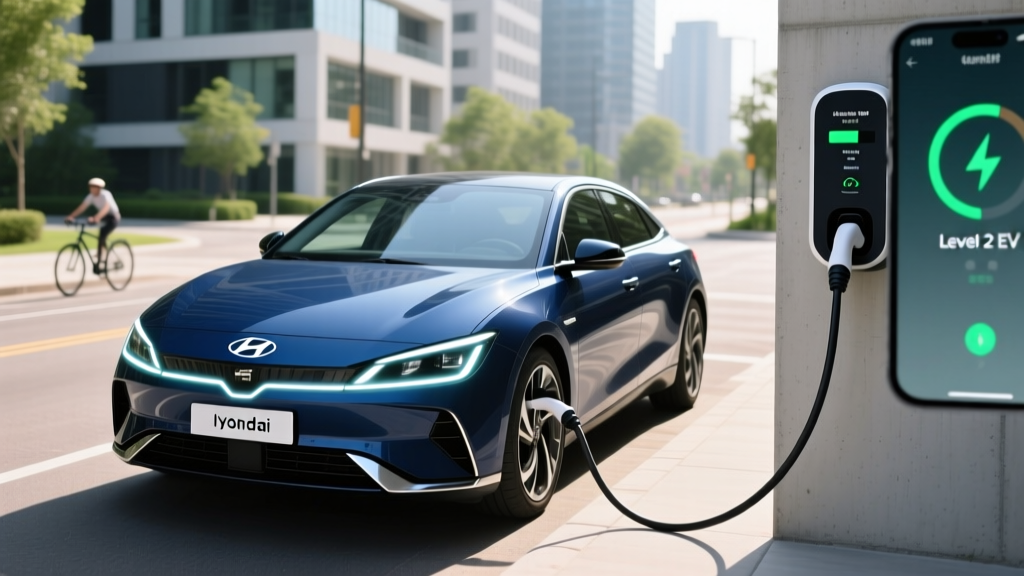
For home charging, the 10.9 kW onboard charger is competitive. On a 48-amp Level 2 circuit (the most common home installation), you'll see the full 10.9 kW, adding roughly 30–35 miles of range per hour. A full overnight charge from 20% to 100% takes about 8–9 hours — easily manageable with a standard overnight schedule. Home installation for a 240V/60A circuit typically runs $800–$2,500 depending on panel capacity and conduit run length; budget for a potential panel upgrade if your home has a 100A service.
Performance, Ride, and Daily Drivability
The SEL RWD's single rear motor produces 225 horsepower and 258 lb-ft of torque, delivering a 6.2-second 0–60 mph time. That's adequate for highway merging and passing but not thrilling. The AWD dual-motor variant bumps output to 320 hp and 446 lb-ft, dropping the sprint to 5.1 seconds — but at the cost of 45 miles of EPA range (316 miles) and a higher price that may push close to the tax credit's $55,000 sedan cap when optioned.
Ride quality is a strong point. The Ioniq 6 SEL rides on 18-inch wheels with generous sidewall, absorbing road imperfections more gracefully than the Limited trim's 20-inch setup. The steering is light and precise, though feedback is minimal — this is a grand-touring sedan, not a sports car. Cabin quietness at highway speeds is excellent, aided by the aerodynamic body and acoustic laminated glass on the front windows.
Regenerative braking offers four levels adjustable via steering-wheel paddles, including a full one-pedal driving mode (i-PEDAL) that brings the car to a complete stop without touching the brake pedal. Most owners settle on Level 2 or 3 for daily commuting — enough regen to slow meaningfully when lifting off the accelerator without the abruptness of full one-pedal mode.
Interior, Technology, and Cargo Practicality
The SEL trim's interior is a step above the base SE, adding heated front seats, a leather-wrapped steering wheel, wireless phone charging, Hyundai Digital Key (phone-as-key via NFC/UWB), and a power-adjustable driver's seat. The dual 12.3-inch displays — one for the instrument cluster, one for infotainment — run Hyundai's proven software with physical shortcut buttons below the screen, a welcome contrast to all-touchscreen competitors.
Wireless Apple CarPlay and Android Auto are standard on the SEL, along with a 64-color ambient lighting system and Hyundai's Bluelink connected services (remote start, climate preconditioning, charge scheduling, and vehicle location via smartphone).
On the driver-assistance front, the Ioniq 6 SEL includes Hyundai SmartSense as standard:
- Adaptive cruise control with stop-and-go and lane centering (Highway Driving Assist)
- Forward collision-avoidance assist with pedestrian/cyclist detection
- Blind-spot collision-avoidance assist
- Rear cross-traffic collision-avoidance assist
- Safe Exit Assist (warns of approaching traffic when opening doors)
- Navigation-based adaptive cruise (on SEL with navigation package)
Highway Driving Assist is a Level 2 driver-assistance system per SAE J3016 classification. It can steer, accelerate, and brake under certain conditions, but the driver must remain fully engaged, hands on or near the wheel, and eyes on the road at all times. This is not autonomous or self-driving capability.
The Ioniq 6's biggest practical weakness is cargo space. The trunk offers 12.3 cubic feet — less than many compact sedans — and the opening is narrow due to the sloping fastback roofline. The frunk (front trunk) in the RWD model adds just 0.4 cubic feet, enough for a charging cable bag but little else. Rear-seat legroom (35.5 inches) is adequate for adults but tighter than a Hyundai Ioniq 5 or Kia EV6. If you regularly haul cargo or rear-seat passengers on long trips, this is a meaningful trade-off versus the boxier crossover alternatives.
Pricing, Tax Credits, and Total Cost
| Trim | MSRP (incl. destination) | Est. After Federal Credit |
|---|---|---|
| SEL RWD | $46,715 | ~$39,215 (if $7,500 credit applies) |
| SEL AWD | $50,215 | ~$42,715 (if $7,500 credit applies) |
| SEL RWD w/ SEL Premium Pkg | ~$49,715 | ~$42,215 |
The 2024 Ioniq 6 SEL RWD launched at $46,715 including destination — comfortably under the IRS §30D sedan cap of $55,000. As a 2024 model-year vehicle purchased new or as remaining dealer inventory in 2026, it remains eligible for the federal EV tax credit, provided all requirements are met. The credit can now be transferred to the dealer at the point of sale, functioning as an immediate price reduction rather than a tax-year refund.
Critical eligibility requirements for the §30D credit (verify current rules at irs.gov):
- MSRP Cap: Vehicle base price must not exceed $55,000 for sedans (the Ioniq 6 qualifies)
- Buyer Income Limits: Modified AGI ≤ $150,000 (single), $225,000 (head of household), $300,000 (joint)
- Battery Sourcing: Critical minerals and battery components must meet phased-in percentage thresholds that tighten annually — verify the specific VIN's compliance at the time of purchase
- Assembly: Final assembly must occur in North America (the Ioniq 6 is assembled in South Korea — this has historically disqualified it from the full new-vehicle credit)
The Ioniq 6 is manufactured in Asan, South Korea — not in North America. Under current §30D rules, this means the Ioniq 6 does not qualify for the $7,500 new-vehicle federal tax credit based on the North American assembly requirement. However, if purchased as a used EV (model year 2024 bought in 2026 from a dealer, with fewer than the IRS mileage threshold and meeting the used-vehicle credit rules under §25E), it may qualify for up to $4,000 or 30% of the sale price (whichever is less). Hyundai has also offered competitive lease incentives that can pass through commercial credit benefits — consult your dealer and a tax professional for your specific situation.
For buyers who don't qualify for federal incentives, Hyundai has historically offered strong lease deals on the Ioniq 6 — sometimes as low as $299–$399/month with modest drive-offs — because the commercial clean vehicle credit (§45W) can apply to lessors regardless of assembly location. Lease structures change monthly; check current offers on Hyundai's website.
How the Ioniq 6 SEL Compares to Key Rivals
| Spec | 2024 Ioniq 6 SEL RWD | 2024 Tesla Model 3 Long Range RWD | 2024 Polestar 2 LRSM |
|---|---|---|---|
| EPA Range | 361 mi | 363 mi | 320 mi |
| Battery | 77.4 kWh (NMC) | ~60 kWh (LFP) / ~75 kWh (NMC LR) | 82 kWh (NMC) |
| Peak DC Charge | 239 kW | 250 kW | 205 kW |
| 10–80% DC Time | ~18 min | ~25 min | ~27 min |
| 0–60 mph | 6.2 sec | 5.8 sec | 6.9 sec |
| MPGe (combined) | 140 | 132 | 107 |
| Cargo (trunk) | 12.3 cu ft | 23 cu ft | 14.4 cu ft (hatchback) |
| Base MSRP (comparable trim) | $46,715 | $42,630 | $53,300 |
| NA Assembly (credit eligible) | No (South Korea) | Yes (Fremont/Austin) | No (China/Belgium) |
The Tesla Model 3 Long Range is the closest rival and beats the Ioniq 6 on cargo space, Supercharger network access, and — critically — North American assembly, making it eligible for the full $7,500 federal credit. However, the Ioniq 6 SEL charges faster at third-party DC stations (18 vs. 25 minutes to 80%), offers a more traditional interior with physical controls, and delivers superior efficiency (140 vs. 132 MPGe). If you don't qualify for the federal credit (income cap exceeded, or prefer leasing), the Ioniq 6's lease incentives often close the price gap.
The Polestar 2 is more premium-feeling but trails on range, efficiency, and charging speed — and at a higher price. It appeals to buyers who want Scandinavian design and a hatchback form factor but can't match the Ioniq 6 on pure EV metrics.
Pros, Cons, and Who Should Buy
- Class-leading 361-mile EPA range (RWD)
- 800V architecture enables ~18 min 10–80% DC charging
- Outstanding efficiency: 140 MPGe combined
- Strong 10-yr/100,000-mi battery warranty
- Comfortable, quiet ride with physical climate buttons
- Comprehensive Hyundai SmartSense safety suite standard
- Competitive lease pricing via commercial credit passthrough
- Tight trunk (12.3 cu ft) and tiny frunk (0.4 cu ft)
- Rear-seat headroom limited by fastback roofline
- South Korea assembly disqualifies from §30D new-vehicle credit
- CCS1 connector requires adapter for NACS Superchargers
- Infotainment learning curve; no native route planning like Tesla
- RWD acceleration (6.2 sec) is adequate, not exciting
Best fit: Efficiency-focused commuters and road-trippers who prioritize range and charging speed over cargo space. Ideal for couples or single drivers covering 30–80 miles daily with periodic 200+ mile road trips. The SEL's lease value makes it compelling for buyers who don't qualify for — or don't want to depend on — the federal purchase credit.
Look elsewhere if: You regularly carry rear-seat passengers or bulky cargo (consider the Ioniq 5 or Kia EV6), you want the simplest possible charging experience via Tesla Superchargers (Model 3), or you need the full $7,500 purchase credit and must buy rather than lease.
Frequently Asked Questions
What is the real-world range of the 2024 Hyundai Ioniq 6 SEL?
In mild conditions with mixed driving, expect 290–330 miles on a full charge. Highway-only driving at 75+ mph yields roughly 290–310 miles. In cold weather (below freezing), range drops to approximately 240–270 miles. The EPA's 361-mile rating is achievable primarily in city and low-speed suburban driving at moderate temperatures.
How fast does the Ioniq 6 SEL charge?
On a 350 kW-class DC fast charger with a preconditioned battery, the Ioniq 6 SEL charges from 10% to 80% in approximately 18 minutes, peaking at 239 kW. At home on a Level 2 (240V, 48A) charger, the 10.9 kW onboard charger adds roughly 30–35 miles of range per hour, with a full charge taking about 8–9 hours.
Does the 2024 Ioniq 6 qualify for the federal EV tax credit?
As a new vehicle, no — the Ioniq 6 is assembled in South Korea, which does not meet the §30D North American final assembly requirement. However, as a used vehicle purchased from a dealer in 2026, it may qualify for the §25E used clean vehicle credit (up to $4,000). Hyundai lease deals may also pass through commercial credit savings. Always verify eligibility at irs.gov and consult a tax professional.
Is the Ioniq 6 SEL worth buying vs. a Tesla Model 3?
It depends on your priorities. The Ioniq 6 SEL charges faster at non-Tesla DC stations, delivers better MPGe efficiency, and offers a more traditional driving experience with physical buttons. The Model 3 wins on cargo space, Supercharger convenience (no adapter needed), and federal tax credit eligibility for purchases. For lessees, the Ioniq 6 often has more competitive monthly pricing.
What battery warranty does Hyundai provide?
Hyundai covers the Ioniq 6's high-voltage battery and electric powertrain for 10 years or 100,000 miles, whichever comes first. The warranty covers defects and capacity loss below approximately 70% of original capacity. The vehicle's basic limited warranty is 5 years / 60,000 miles. This is among the strongest battery warranties in the industry.
Does the Ioniq 6 SEL have a heat pump?
Yes. A heat pump is standard on all 2024 Ioniq 6 trims, including the SEL. This system recovers waste heat from the powertrain and ambient air to warm the cabin more efficiently than resistive heating, reducing cold-weather range loss by roughly 10–15% compared to EVs without one.
For the latest EPA data, see fueleconomy.gov. For current tax credit rules, consult irs.gov. Safety ratings available at iihs.org.