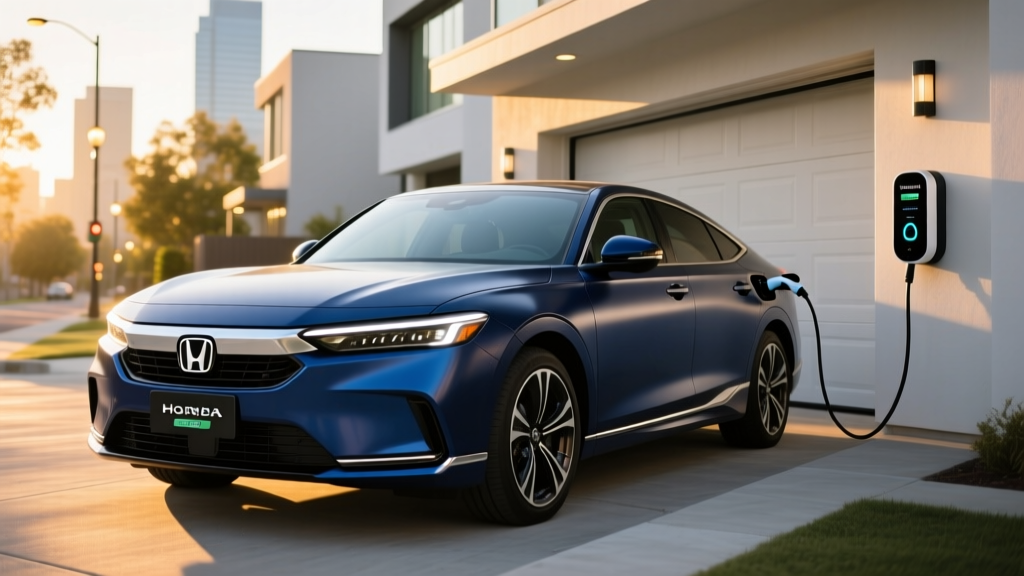
Honda's first mass-market electric vehicle arrived not with a bespoke platform, but with a borrowed one. The 2024 Honda Prologue Elite sits atop a three-trim lineup built on GM's Ultium architecture — the same bones underpinning the Chevrolet Blazer EV and Cadillac Lyriq. For buyers considering Honda's electric debut, the Elite trim at $51,900 (before incentives) promises the most complete package: dual-motor AWD, a panoramic roof, and a 11.3-inch infotainment screen. But does a GM-Honda collaboration deliver a compelling EV, or just a rebadged compromise?
We've analyzed EPA data, real-world efficiency reports, and ownership costs to give you the exact numbers you need before signing a lease or purchase agreement.
2024 Honda Prologue Elite: Core Specifications at a Glance
| Specification | 2024 Prologue Elite AWD |
|---|---|
| EPA Range | 281 miles |
| Battery (Usable) | 85 kWh, NMC lithium-ion (Ultium) |
| Drivetrain | Dual-motor AWD |
| Horsepower / Torque | 288 hp / 333 lb-ft |
| 0-60 mph | ~6.2 seconds (est.) |
| Max DC Fast Charge | 150 kW (peak) |
| 10-80% DC Charge Time | ~34 minutes |
| Level 2 Home Charging | 11.5 kW (~32 miles/hr) |
| EPA Efficiency | 93 MPGe combined (36 kWh/100 mi) |
| Cargo Volume (rear seats up/down) | 25.2 / 57.7 cu ft |
| Rear Legroom | 38.6 inches |
| Base MSRP (Elite AWD) | $51,900 |
| Battery/Powertrain Warranty | 8 years / 100,000 miles |
Real-World Range: What the EPA Sticker Doesn't Tell You
Real-World Expectation: ~240-260 miles highway at 70 mph; ~210-230 miles in sub-30°F cold weather; ~265-280 miles mixed city/suburban driving.
The Elite's dual-motor AWD configuration costs you 15 miles of EPA-rated range compared to the front-wheel-drive EX and Touring trims (296 miles EPA). According to fueleconomy.gov, the AWD Elite returns 93 MPGe combined versus 99 MPGe for FWD variants.
In practice, the Prologue's 85 kWh usable battery and 3.6 mi/kWh efficiency mean highway driving at sustained 70-75 mph will pull range down to roughly 240-260 miles before you need to find a charger. Cold weather is the bigger penalty: lithium-ion batteries lose efficiency in freezing temperatures, and without a heat pump (Honda uses a resistive PTC heater), expect a 20-30% range reduction when temperatures drop below 30°F. That puts winter highway range in the 190-220 mile bracket — adequate for commuting but tight for road trips without planning.
The Prologue does feature regenerative braking with steering-wheel paddle selectors that let you dial in regen intensity, including a one-pedal-driving mode. This helps recover energy in stop-and-go traffic and extends city range closer to the EPA sticker.
Charging Speed: DC Fast Charging and Home Setup
Charging is where Ultium-platform vehicles have drawn scrutiny, and the Prologue Elite is no exception. Here's the full picture:
| Charging Level | Power / Rate | Miles Added | Notes |
|---|---|---|---|
| Level 1 (120V household) | ~1.4 kW | ~4 miles/hr | Emergency/trickle only |
| Level 2 (240V home) | 11.5 kW | ~32 miles/hr | Full charge in ~8.5 hours |
| DC Fast Charge (peak) | 150 kW | ~130 miles in 15 min | 10-80% in ~34 min; tapers above 80% |
The DC fast-charging reality: The Prologue's 150 kW peak rate is competitive for its class but falls short of the 200+ kW speeds offered by the Hyundai Ioniq 5 and Kia EV6 on 800V architectures. At a 150 kW Electrify America or EVgo station, you'll see peak power sustained roughly between 15-50% State of Charge (SoC), after which the charge curve tapers significantly. The 10-80% fill takes approximately 34 minutes — acceptable for road-trip stops but noticeably slower than the Ioniq 5's 18-minute 10-80% sprint.
Home charging: The onboard 11.5 kW charger is a strong point. On a 48-amp Level 2 home circuit (hardwired, 60-amp breaker), you'll add roughly 32 miles of range per hour, meaning an overnight session from 20% to full takes about 8-9 hours. Honda partnered with GM to offer a home charging solution through EVgo for eligible buyers, but installation of a dedicated 240V/48A circuit typically runs $500-$1,500 depending on your electrical panel's capacity. If your panel is at or near its amperage limit (common in older homes with 100-amp service), a panel upgrade to 200 amps can add $1,500-$3,000 to the total cost.
The Prologue uses the CCS1 connector standard. Honda has confirmed that future models will adopt the NACS (Tesla) connector, and adapters for Tesla Supercharger access are expected, but as of the 2024 model year, CCS remains the native plug. This means access to Electrify America, EVgo, and ChargePoint networks but not Tesla Superchargers without an adapter (availability TBD).
Performance, Ride Quality, and Drivetrain
The Elite's dual-motor AWD powertrain produces 288 horsepower and 333 lb-ft of torque — a meaningful bump over the single-motor FWD trims (212 hp / 236 lb-ft). The 0-60 mph time of approximately 6.2 seconds won't embarrass you at a merge, though it trails sportier rivals like the Ford Mustang Mach-E Premium AWD (5.1 seconds) and Tesla Model Y Long Range (4.8 seconds).
Where the Prologue excels is ride comfort. The Ultium platform's low center of gravity and Honda's suspension tuning produce a composed, quiet highway cruiser. Road noise is well-suppressed, and the steering is weighted appropriately for a family crossover — light at parking speeds, firming up at highway velocity. This is not a performance EV; it's a comfort-first family hauler, and that's a deliberate choice.
Towing capacity is rated at 1,500 pounds — enough for a small utility trailer or a pair of dirt bikes, but not for a camper or boat. If towing is a priority, the Ford F-150 Lightning or Rivian R1S are more appropriate choices.
Interior, Tech, and Cargo Practicality
The Elite trim justifies its price premium with a well-appointed cabin: perforated leather seats (heated and ventilated up front), a heated steering wheel, a fixed panoramic glass roof, a 11.3-inch touchscreen with Google Built-In (Google Maps, Google Assistant, Play Store), wireless Apple CarPlay and Android Auto, and a 12-speaker Bose audio system.
The Google Built-In integration is the standout tech feature. Native Google Maps with EV-aware routing considers battery state and suggests charging stops — a genuine convenience for road trips. However, the infotainment system is GM-sourced, not Honda's proprietary interface, and some owners report occasional sluggishness and a learning curve if you're accustomed to Honda's older systems.
Cargo and space: With 25.2 cubic feet behind the second row and 57.7 cubic feet with the 60/40 split rear seats folded, the Prologue matches midsize SUV competitors. Rear legroom at 38.6 inches is generous — adults ride comfortably on longer trips. Notably, the Prologue does not offer a front trunk (frunk); the Ultium platform's under-hood packaging in this application leaves no cargo space forward of the firewall. That's a missed opportunity competitors like the Ioniq 5 and Mach-E exploit.
Driver assistance comes via Honda Sensing, which includes adaptive cruise control with low-speed follow, lane-keeping assist, blind-spot monitoring, and rear cross-traffic alert. This is a SAE Level 2 system — it assists with steering and speed but requires the driver to remain fully engaged at all times. It is not autonomous or "self-driving." The system performs competently on well-marked highways but can be conservative in construction zones and heavy merge situations.
Pricing, Trims, and Federal Tax Credit Eligibility
| Trim | Drivetrain | MSRP | Est. After §30D Credit* |
|---|---|---|---|
| EX (base) | FWD | $48,795 | ~$41,295 |
| Touring | FWD | $50,295 | ~$42,795 |
| Elite | AWD (dual-motor) | $51,900 | ~$44,400 |
*Federal tax credit estimates assume full §30D eligibility. Actual credit depends on battery sourcing, buyer income, and MSRP caps. See details below.
The 2024 Prologue Elite at $51,900 lands below the IRS §30D MSRP cap of $80,000 for SUVs, which is the first eligibility gate. However, qualifying for the full $7,500 credit is not guaranteed and depends on several factors:
- Battery component sourcing: The Ultium battery is manufactured in the U.S. (Spring Hill, Tennessee), which satisfies the domestic assembly requirement. However, critical mineral sourcing (lithium, cobalt, nickel) must meet escalating percentage thresholds under §30D. As of 2024, partial credit ($3,750) may apply if critical-mineral thresholds aren't fully met — check the latest IRS guidance on fueleconomy.gov for the specific Prologue determination.
- Buyer income caps: Modified adjusted gross income (MAGI) must not exceed $150,000 (single), $225,000 (head of household), or $300,000 (joint filers).
- Point-of-sale transfer: As of 2024, eligible buyers can transfer the credit to the dealer at purchase, reducing the out-of-pocket price immediately rather than waiting to claim it on a tax return. The dealer must be registered with the IRS Energy Credits portal.
- Tax liability: The credit is non-refundable — you must have at least $7,500 in federal tax liability to capture the full benefit (unless transferred at point of sale, which bypasses this requirement).
Leasing loophole: If you lease the Prologue rather than purchase, the §30D commercial clean vehicle credit (§45W) may apply to the lessor, who can (but is not required to) pass savings to you as a reduced monthly payment or capitalized-cost reduction. Many Honda dealerships have advertised aggressive lease deals on the Prologue that effectively bake in the $7,500 credit — this is often the most straightforward path to the full incentive regardless of your income or the battery sourcing rules.
How the Prologue Elite Stacks Up Against Key Competitors
The midsize electric crossover segment is crowded. Here's how the Prologue Elite compares to the three vehicles most buyers cross-shop:
| Spec | Honda Prologue Elite AWD | Hyundai Ioniq 5 SEL AWD | Ford Mach-E Premium AWD | Tesla Model Y LR AWD |
|---|---|---|---|---|
| EPA Range | 281 mi | 290 mi | 290 mi | 310 mi |
| Battery | 85 kWh (NMC) | 77.4 kWh (NMC) | 91 kWh (NMC) | ~75 kWh (NMC) |
| Peak DC Charge | 150 kW | 240 kW (800V) | 150 kW | 250 kW |
| 10-80% Time | ~34 min | ~18 min | ~38 min | ~25 min |
| 0-60 mph | ~6.2 sec | ~5.1 sec | ~5.1 sec | ~4.8 sec |
| HP | 288 | 320 | 346 | 384 |
| Cargo (rear up) | 25.2 cu ft | 27.2 cu ft | 29.7 cu ft | 30.2 cu ft |
| Base MSRP (comparable trim) | $51,900 | ~$52,600 | ~$51,875 | ~$48,990 |
Choose the Hyundai Ioniq 5 if: DC fast-charging speed matters (18 min 10-80% vs 34 min), you want 800V architecture for future-proofing, and you prefer the Ioniq 5's more distinctive design and available frunk.
Choose the Tesla Model Y if: Maximum range (310 mi), Supercharger network access, over-the-air updates, and the lowest starting price in this comparison are your priorities — and you're comfortable with Tesla's minimalist interior and panel-gap variability.
Choose the Ford Mach-E if: You want the most cargo space (29.7 cu ft), the BlueCruise hands-free driving system for highway commuting, and a sportier driving feel than the Prologue offers.
Pros and Cons: An Honest Scorecard
Pros
- Comfortable, quiet ride quality — best-in-class for highway cruising refinement
- Google Built-In with EV-aware route planning is genuinely useful
- Generous rear legroom (38.6 in) for a midsize crossover
- Strong 11.5 kW Level 2 onboard charger for fast home replenishment
- 8-year/100,000-mile battery and powertrain warranty
- Honda dealer network for service accessibility in most markets
- Leasing often captures full $7,500 credit regardless of sourcing rules
Cons
- No front trunk (frunk) — a notable omission vs. rivals
- 150 kW peak DC charging is slow for the segment (Ioniq 5 does 240 kW)
- Resistive cabin heater (no heat pump) — cold-weather range suffers
- GM-sourced infotainment has a learning curve for Honda loyalists
- 281-mile EPA range (AWD) trails Model Y and Mach-E Extended Range
- Elite trim at $51,900 is premium-priced for what it offers
- Towing limited to 1,500 lbs
- First-generation product — long-term reliability data is limited
Warranty and Long-Term Ownership
Honda backs the Prologue's battery pack and electric drive components with an 8-year/100,000-mile warranty (whichever comes first), which aligns with the industry standard for EV powertrains and matches the federal minimum mandated by the EPA for emissions-related components. The battery warranty covers defects and capacity loss below a specified threshold — Honda has not published an exact State of Health (SoH) degradation floor, but GM's Ultium platform warranty (which underpins the Prologue) typically guarantees the battery will retain at least 60-70% of original capacity during the warranty period.
The limited vehicle warranty covers 3 years/36,000 miles (bumper-to-bumper). For context, Hyundai's 5-year/60,000-mile basic warranty and 10-year/100,000-mile powertrain coverage on the Ioniq 5 is more generous.
Long-term battery degradation data for the Ultium platform is still limited — the Prologue is Honda's first EV on this architecture, and GM's Ultium vehicles have only been on the road since 2022-2023. Early data from the Cadillac Lyriq and Blazer EV suggests manageable degradation (roughly 5-8% loss over the first 30,000 miles), but multi-year, high-mileage data isn't yet available. If you plan to own the Prologue for 8+ years, this uncertainty is worth noting.
Who the 2024 Honda Prologue Elite Is Actually For
The Prologue Elite is best suited for suburban families and commuters who:
- Have reliable home Level 2 charging and commute under 60 miles round-trip
- Prioritize ride comfort and cabin quietness over sporty acceleration
- Want Honda's brand familiarity and dealer proximity for service
- Can access the full federal credit through a lease or meet purchase requirements
- Don't frequently drive in extreme cold or take 300+ mile road trips without stops
It is not the right choice if you need maximum DC charging speed for frequent road trips, require a frunk for gear storage, live in a region with harsh winters where the lack of a heat pump will significantly erode range, or want a performance-oriented driving experience.
Frequently Asked Questions
What is the real-world range of the 2024 Honda Prologue Elite?
The EPA rates the Elite AWD at 281 miles. In real-world mixed driving, expect 250-270 miles. Highway driving at 70+ mph drops this to roughly 240-260 miles, and sub-30°F winter conditions can reduce range to 190-220 miles due to the resistive cabin heater and cold battery chemistry effects.
How fast does the Prologue Elite charge at home and on DC fast chargers?
At home on a 240V Level 2 charger (48 amps), the Prologue charges at 11.5 kW, adding about 32 miles of range per hour — a full charge takes roughly 8.5 hours. On a DC fast charger, it peaks at 150 kW and charges from 10-80% in approximately 34 minutes. This is slower than the Hyundai Ioniq 5 (18 minutes) but typical for 400V-architecture vehicles.
Does the 2024 Honda Prologue qualify for the $7,500 federal EV tax credit?
Eligibility depends on battery sourcing rules, buyer income, and MSRP caps. The Prologue's $51,900 Elite MSRP is below the $80,000 SUV cap, and the Ultium battery is assembled in Tennessee. However, critical-mineral sourcing thresholds under IRS §30D may limit the credit to $3,750 for some buyers. Leasing often captures the full $7,500 through the commercial credit (§45W). Consult a tax professional and check fueleconomy.gov for the latest determination.
How much does the Prologue Elite cost after incentives?
At $51,900 MSRP, a full $7,500 federal credit brings the net price to approximately $44,400. Many states and utilities offer additional rebates (e.g., California's CVRP, Colorado's state credit, various utility off-peak charging rebates) — these vary by jurisdiction, so check your state's energy office and local utility for current programs. Honda has also offered lease deals that effectively reduce the monthly cost significantly when the federal credit is applied.
Is the Honda Prologue Elite worth buying versus the Hyundai Ioniq 5 or Tesla Model Y?
It depends on your priorities. If ride comfort, cabin quietness, and Honda dealer familiarity matter most, the Prologue is compelling — especially on a strong lease. If fast DC charging, more cargo space, or longer range are higher priorities, the Ioniq 5 (240 kW charging, frunk) or Model Y (310 mi range, Supercharger network) are stronger choices on paper. Test-drive all three; the Prologue's comfort advantage is something spec sheets don't fully capture.
Does the Prologue have a heat pump for cold weather?
No. The Prologue uses a resistive PTC (positive temperature coefficient) heater for cabin warmth. This is simpler and cheaper but less energy-efficient than a heat pump, which transfers ambient heat rather than generating it electrically. The result is greater range loss in cold weather compared to EVs equipped with heat pumps (like the Ioniq 5 and Model Y).
Can I charge the Prologue at Tesla Superchargers?
Not natively. The 2024 Prologue uses the CCS1 connector. Honda has indicated future models will adopt NACS, and a CCS-to-NACS adapter may become available for Supercharger access, but this has not been confirmed or widely distributed for the 2024 Prologue as of its launch. For now, plan to use Electrify America, EVgo, ChargePoint, and other CCS-compatible networks.
What is the battery warranty on the 2024 Prologue?
Honda provides an 8-year/100,000-mile warranty on the battery pack and electric powertrain components. This covers manufacturing defects and significant capacity degradation. The standard bumper-to-bumper warranty is 3 years/36,000 miles.
Sources: U.S. EPA / fueleconomy.gov, IRS §30D Clean Vehicle Credits, Honda Newsroom (manufacturer specifications). Pricing and tax credit rules reflect 2024 model-year data; verify current incentives before purchase.