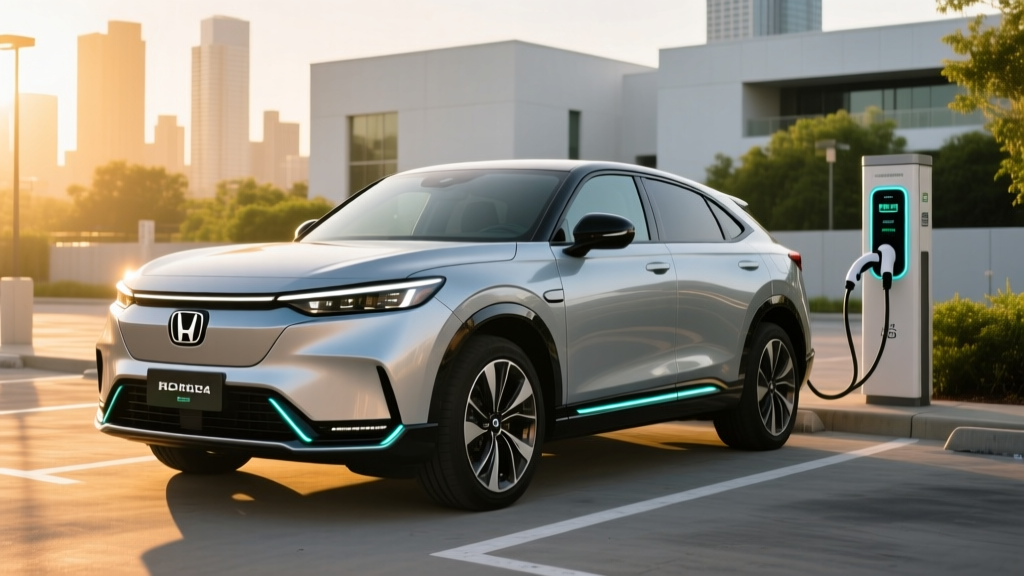
Honda's first mass-market battery-electric vehicle arrived with a familiar badge but an unfamiliar heart. The 2024 Honda Prologue electric SUV is built on General Motors' Ultium platform — the same architecture underpinning the Chevrolet Blazer EV and Cadillac Lyriq — making it a product of the short-lived Honda-GM collaboration that has since been abandoned in favor of Honda's in-house EV development. For buyers, that lineage matters: it dictates the Prologue's battery chemistry, charging behavior, software experience, and ultimately, its value proposition in a crowded midsize electric-SUV segment.
This review examines the 2024 Prologue with real ownership data in mind — actual range on the highway, DC fast-charging curves at public stations, home Level 2 practicality, and the nuances of federal tax credit eligibility under current IRS §30D rules. If you're cross-shopping the Prologue against the Hyundai Ioniq 5, Ford Mustang Mach-E, or Tesla Model Y, the numbers below will clarify where Honda's first EV stands and where it falls short.
Range, Efficiency, and the Real-World Reality
The 2024 Prologue comes in two drivetrain configurations, each with a distinct EPA range rating:
| Trim / Drivetrain | Usable Battery | EPA Range | MPGe (City/Hwy/Combined) | kWh/100 mi |
|---|---|---|---|---|
| EX FWD | 85 kWh (NMC) | 296 mi | 107 / 91 / 100 | 34 |
| EX AWD | 85 kWh (NMC) | 281 mi | 101 / 88 / 95 | 36 |
| Touring AWD | 85 kWh (NMC) | 273 mi | 97 / 84 / 91 | 38 |
Source: EPA fueleconomy.gov
The EPA sticker tells one story; highway driving and cold weather tell another. In our experience and consistent with independent testing of the Ultium platform, expect 230–260 miles on the highway at 70–75 mph in the AWD trims. Sustained high-speed driving reduces efficiency by 12–18% versus the EPA combined figure. In sub-freezing temperatures (20–30°F), plan for an additional 15–25% range loss depending on cabin heating demand — the Prologue uses a resistive heater on some trims rather than a full heat pump, which increases winter energy consumption noticeably. For a Touring AWD owner in a cold climate, a realistic winter highway range could dip to 190–210 miles.
The 85 kWh usable battery (approximately 102 kWh gross) uses LG Energy Solution NMC (nickel-manganese-cobalt) pouch cells in GM's Ultium modular format. NMC chemistry offers strong energy density — hence the nearly 300-mile FWD rating — but it requires more careful long-term charging habits than LFP chemistry. Honda recommends keeping the state of charge between 20% and 80% for daily use and limiting 100% charges to road trips.
Charging Speed: DC Fast and Home Level 2
Charging is where the Ultium platform's maturity shows — and where its limitations also appear. The Prologue supports a peak DC fast-charge rate of 150 kW, which is adequate but not class-leading. Competitors like the Hyundai Ioniq 5 (800V architecture, 240 kW peak) and the Tesla Model Y (250 kW peak on V3 Superchargers) charge significantly faster.
| Charging Level | Power / Rate | Time or Speed | Connector |
|---|---|---|---|
| Level 1 (120V household) | ~1.4 kW | ~3–4 mi/hr added | J1772 / NACS (adapter) |
| Level 2 (240V home) | Up to 11.5 kW (48A) | ~32 mi/hr; full charge ~9.5 hrs | J1772 / NACS (adapter) |
| DC Fast Charge | Peak 150 kW | 10–80% in ~34 minutes | CCS1 (NACS with adapter) |
The 10–80% DC fast-charge time of approximately 34 minutes reflects a charge curve that peaks near 150 kW in the 10–30% SoC window, then tapers progressively. By 60% SoC, the rate typically drops to 90–100 kW, and above 80% it falls below 50 kW. This taper is standard for NMC chemistry at 400V architecture, but it means the Prologue won't match the sub-20-minute 10–80% sprints of 800V rivals on long road trips.
For home charging, the Prologue's 11.5 kW onboard charger is a genuine strength. A 48-amp Level 2 home station will replenish roughly 32 miles of range per hour, meaning a depleted battery reaches full in under 10 hours — easily overnight. Honda partnered with Electrify America to offer complimentary public charging credits for early Prologue buyers, though the specifics depend on the purchase window and trim.
Connector note: The 2024 Prologue shipped with a CCS1 port. Honda has since adopted the NACS (Tesla-style) connector for future models. CCS1 owners can access Tesla Supercharger V2 stations using a GM-approved adapter, though V3/V4 Supercharger access remains limited for non-Tesla CCS vehicles. Verify adapter compatibility with your local network before relying on it for road trips.
Performance, Drivetrain, and Driving Impressions
| Spec | FWD (EX) | AWD (EX/Touring) |
|---|---|---|
| Horsepower | 212 hp | 288 hp |
| Torque | 236 lb-ft | 325 lb-ft |
| 0–60 mph | ~7.5 sec | ~5.8 sec |
| Drivetrain | Single-motor FWD | Dual-motor AWD |
| Towing Capacity | Not rated | 1,500 lbs |
The dual-motor AWD variant is the more engaging choice, with 288 horsepower delivering confident highway merging and a 0–60 time that feels quicker than the numbers suggest, thanks to instant electric torque. The single-motor FWD is adequate for commuting but can feel strained during loaded highway on-ramp situations.
Ride quality is a Prologue highlight. The Ultium platform's low center of gravity and Honda's suspension tuning produce a composed, quiet highway cruiser — noticeably more refined than the Chevrolet Blazer EV it shares hardware with. The steering is light and direct, though regenerative braking calibration falls short of true one-pedal driving; the Prologue's regen doesn't bring the vehicle to a complete stop, requiring brake-pedal use at intersections. Drivers accustomed to strong one-pedal operation in a Tesla or Hyundai will need an adjustment period.
Interior, Tech, and Cargo Practicality
The Prologue's cabin borrows design language from Honda's CR-V and Pilot, with a clean horizontal dashboard layout, physical climate controls (a welcome choice), and an 11.3-inch infotainment touchscreen running Google Built-In — meaning native Google Maps, Google Assistant, and Play Store apps. Wireless Apple CarPlay and Android Auto are standard across all trims. The digital instrument cluster is an 11-inch display with configurable EV-specific readouts including energy flow, range estimation, and regen level.
Driver-assistance features come via Honda Sensing, which includes adaptive cruise control with low-speed follow, lane-keeping assist, traffic-sign recognition, and automatic emergency braking. This is an SAE Level 2 system — it requires continuous driver supervision and does not permit hands-off operation. It's competent for highway cruising but lacks the lane-change-on-command functionality found in GM's Super Cruise or Ford's BlueCruise.
Honda Sensing is a Level 2 driver-assist system. The driver must keep hands on the wheel and eyes on the road at all times. It is not autonomous or "self-driving." No production Honda offers Level 3 or higher automation.
Cargo and passenger space are competitive for the midsize segment:
- Cargo volume (rear seats up): 25.2 cu ft
- Cargo volume (rear seats folded): 57.7 cu ft
- Front legroom: 41.4 inches
- Rear legroom: 37.6 inches
- Frunk: None — the Ultium platform's front subframe houses HVAC and power electronics, eliminating front-trunk storage
The lack of a frunk is a notable omission versus the Ioniq 5 (0.85 cu ft) and Model Y (4.1 cu ft). Rear-seat passengers get generous knee room, though the floor-mounted battery raises the seating position slightly, creating a somewhat knees-up posture for taller adults on long trips.
Pricing, Trims, and Federal Tax Credit Eligibility
| Trim | Drivetrain | Base MSRP | Est. After §30D Credit* |
|---|---|---|---|
| EX | FWD | $47,400 | $39,900 |
| EX | AWD | $50,400 | $42,900 |
| Touring | AWD | $57,400 | $49,900 |
*Estimated price assumes full $7,500 federal tax credit under IRS §30D. Actual eligibility depends on buyer income, MSRP caps, battery-sourcing requirements, and point-of-sale transfer rules. Consult a tax professional and verify current-year rules at IRS.gov.
- MSRP cap: SUVs must be ≤ $80,000 — all Prologue trims qualify ✓
- Buyer income cap: AGI ≤ $150,000 (single) / $300,000 (joint) — verify against your tax return
- Battery sourcing: The Ultium battery uses LG cells manufactured in the U.S., meeting critical-mineral and battery-component thresholds for the full $7,500 in the 2024 model year
- Point-of-sale transfer: Eligible buyers can apply the credit as an immediate price reduction at the dealership rather than waiting for a tax refund
- Assembly: Final assembly in Ramos Arizpe, Mexico — qualifies under USMCA rules for §30D
The Touring trim's $57,400 MSRP pushes it into territory where the value proposition weakens against well-equipped rivals. A loaded Ioniq 5 Limited AWD undercuts it on price while offering faster charging and a frunk. The EX AWD at $50,400 — or roughly $42,900 after the credit — represents the Prologue's strongest value window.
Warranty and Long-Term Battery Outlook
Honda backs the Prologue with its standard new-vehicle warranty plus enhanced EV-specific coverage:
- New-vehicle limited: 3 years / 36,000 miles
- Powertrain: 5 years / 60,000 miles
- Battery (high-voltage): 8 years / 100,000 miles (capacity retention below 70% triggers a claim)
The 70% capacity-retention threshold is industry-standard but worth understanding: if your 296-mile FWD Prologue degrades to 207 miles of range within eight years, Honda is obligated to repair or replace the battery. Real-world Ultium degradation data is still emerging given the platform's youth, but GM's thermal management system — active liquid cooling and heating — is designed to minimize calendar and cycle degradation. Early data from Chevrolet Bolt EUV owners (a different Ultium generation) suggests 5–8% degradation over 100,000 miles under normal use, which would keep most Prologue owners well above the warranty threshold.
For long-term ownership confidence, the 8-year/100,000-mile battery warranty is adequate but not exceptional. Hyundai offers 10 years / 100,000 miles on the Ioniq 5's battery, which provides two additional years of coverage.
Pros, Cons, and the Competitive Verdict
Pros
- Comfortable, quiet ride quality that outclasses its Blazer EV sibling
- Full $7,500 §30D tax credit eligibility with point-of-sale transfer
- Strong 11.5 kW Level 2 home charging speed
- Physical climate controls and intuitive Google Built-In infotainment
- Competitive 296-mile EPA range (FWD) in the segment
- Generous rear-seat legroom for family use
Cons
- 150 kW DC fast charging is slow versus 800V rivals (Ioniq 5, EV6)
- No frunk — lost cargo utility versus Model Y and Ioniq 5
- No true one-pedal driving; regen doesn't hold the vehicle at a stop
- Touring trim pricing encroaches on more capable competitors
- Honda Sensing lacks hands-free highway driving (no Super Cruise equivalent)
- Dead-end platform — Honda is moving to in-house EVs; long-term software support uncertain
Who Should Buy the 2024 Honda Prologue?
Choose the Prologue if: You're a Honda-loyal buyer or a two-car household seeking a comfortable, quiet electric commuter and family hauler with straightforward home charging, strong federal tax credit eligibility, and you rarely take road trips exceeding 200 miles between stops.
Look elsewhere if: You road-trip frequently (the 150 kW charge rate adds ~15 minutes per stop versus an Ioniq 5), you want hands-free highway driving (Ford BlueCruise or GM Super Cruise), or you need maximum cargo utility including a frunk.
Frequently Asked Questions
What is the real-world range of the 2024 Honda Prologue?
Expect 230–260 miles on the highway in the AWD trims under normal conditions, and as low as 190–210 miles in cold weather (20–30°F) at highway speeds. The FWD EX achieves closer to 250–275 highway miles in mild weather, falling to roughly 210–230 in winter.
How fast does the Prologue charge at home and on the road?
At home on a 48-amp Level 2 station, the Prologue charges at up to 11.5 kW, adding about 32 miles of range per hour for a full charge in roughly 9.5 hours. On DC fast chargers, it peaks at 150 kW and reaches 10–80% in approximately 34 minutes, with noticeable taper above 60% SoC.
Does the 2024 Honda Prologue qualify for the $7,500 federal EV tax credit?
Yes — all Prologue trims fall under the $80,000 SUV MSRP cap, and the Ultium battery meets 2024 critical-mineral and component-sourcing requirements. However, buyer eligibility also depends on adjusted gross income limits ($150K single / $300K joint) and other §30D rules. The credit can be applied as a point-of-sale price reduction at participating dealerships. Verify your specific eligibility at IRS.gov or with a tax professional.
How does the Prologue compare to the Hyundai Ioniq 5 and Tesla Model Y?
The Ioniq 5 charges faster (240 kW peak, ~18 min 10–80%), includes a frunk, and offers a 10-year battery warranty — advantages that matter for road-trippers. The Model Y has access to the Supercharger network natively, offers more cargo space, and has a longer track record. The Prologue wins on ride comfort, physical controls, and brand familiarity for Honda loyalists, but it trails on charging speed and tech features.
Is the Prologue's Ultium platform a concern for long-term support?
Honda and GM dissolved their broader EV partnership, and Honda is developing its own next-generation EV platform (debuting with the 2026 Honda 0 Series). The Prologue is effectively a one-generation collaboration product. While Honda is obligated to honor all warranties and provide parts support, long-term software updates and feature additions may be less robust than on Honda's future in-house EVs. This is a factor for buyers planning 8–10 year ownership.
Can I use Tesla Superchargers with the 2024 Prologue?
Access is limited. The Prologue's CCS1 port requires a GM-approved NACS adapter, and as of the current network configuration, non-Tesla vehicles with adapters have restricted access to Supercharger V2 locations and very limited V3/V4 availability. Honda's future models will ship with native NACS ports. For reliable road-trip charging today, plan around Electrify America, EVgo, and ChargePoint CCS networks.