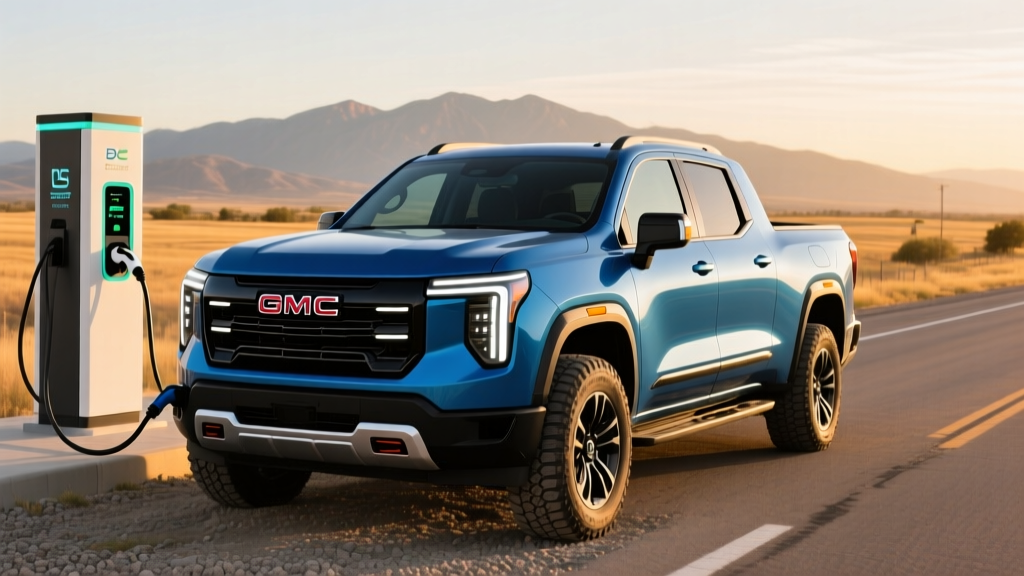
The 2024 GMC Sierra EV arrived as General Motors' flagship electric pickup, launching exclusively in the fully loaded Denali Edition 1 trim. Built on GM's Ultium platform with a massive battery and serious towing credentials, it targets buyers who want electric daily driving without sacrificing truck utility. But with a base price near $100,000 and real-world range that shifts dramatically under load, the Sierra EV demands a hard look at the numbers before you sign.
Range and Efficiency: The 440-Mile Promise Meets Reality
Real-World Expectation: Plan for 350–380 miles in mixed driving; 280–320 miles at sustained 75 mph highway speeds; as low as 200–250 miles when towing a 7,000-lb trailer in cold weather.
The Sierra EV Denali Edition 1 carries a 200+ kWh usable Ultium battery using GM's NMC (nickel manganese cobalt) pouch cells — the same chemistry found in the Hummer EV and Cadillac Escalade IQ. This is one of the largest battery packs in any production passenger vehicle, which directly explains both the impressive EPA figure and the truck's substantial curb weight of approximately 8,900 lbs.
On the EPA combined cycle, the Sierra EV Denali Edition 1 returns an estimated 63 MPGe, translating to roughly 53 kWh per 100 miles. That efficiency figure is competitive with the Ford F-150 Lightning Extended Range (66 MPGe) but trails the Rivian R1T Dual-Motor Large (73 MPGe) due to the Sierra's heavier platform and larger frontal area.
In practice, the NMC chemistry delivers strong energy density but is more temperature-sensitive than LFP. Expect 15–25% range loss in sub-freezing conditions without preconditioning, and significant efficiency penalties when towing — a physics reality that applies to every electric truck on the market. GM's thermal management system includes active liquid cooling and heating, and preconditioning the battery before DC fast charging is essential to hit peak charge rates.
Charging Speed: 350 kW Peak, But the Curve Matters
| Charging Level | Power / Rate | Time / Miles Added |
|---|---|---|
| Level 1 (120V) | ~1.4 kW | ~3 miles per hour |
| Level 2 (240V, 48A) | 11.5 kW | ~22 miles per hour; full charge ~18 hrs |
| Level 2 (240V, 80A) | 19.2 kW | ~37 miles per hour; full charge ~11 hrs |
| DC Fast Charge (peak) | 350 kW | 10–80% in approximately 35 minutes |
The Sierra EV supports DC fast charging at up to 350 kW on compatible CCS stations (and NACS via adapter, as GM transitioned to the Tesla-standard connector for 2025+ models — 2024 models ship with CCS1). At a 350 kW charger, GM estimates roughly 100 miles of range in 10 minutes under optimal conditions.
However, the charging curve is the critical detail. The 350 kW peak is only sustained at low states of charge (roughly 10–30% SoC). Above 50%, the rate tapers significantly — by 80% SoC, you're likely seeing 80–120 kW. This is standard behavior for large NMC packs protecting cell longevity, but it means the 10–80% time of approximately 35 minutes is achieved on high-power infrastructure only. On a 150 kW Electrify America or EVgo station, expect 10–80% in closer to 55–65 minutes.
For home charging, the Sierra EV's onboard charger supports up to 19.2 kW on Level 2 (requiring a 100-amp dedicated circuit). Most residential installations use a 48-amp Level 2 charger (11.5 kW), which adds about 22 miles per hour — sufficient for overnight replenishment if your daily drive is under 150 miles. A 200 kWh battery from near-empty on a 48A charger takes roughly 18 hours, so planning your charging routine matters.
Performance and Drivetrain
| Specification | 2024 Sierra EV Denali Edition 1 |
|---|---|
| Drivetrain | Dual-motor AWD (e4WD) |
| Horsepower | 754 hp |
| Torque | 785 lb-ft |
| 0–60 mph | ~4.5 seconds |
| Max Towing Capacity | 9,500 lbs (10,000 lbs with max tow package on future trims) |
| Payload Capacity | ~1,300 lbs |
| Battery (usable) | 200+ kWh, NMC Ultium |
| EPA Range | 440 miles |
| MPGe (combined) | 63 MPGe |
The dual-motor all-wheel-drive powertrain produces 754 horsepower and 785 lb-ft of torque, launching this nearly 9,000-lb truck to 60 mph in approximately 4.5 seconds. That's supercar territory from a decade ago, delivered in a full-size crew cab. The instantaneous torque delivery makes highway merging and passing effortless, and the low center of gravity from the underfloor battery pack reduces body roll compared to any gas Sierra.
Towing is where the Sierra EV shows its truck credentials — and its limitations. The 9,500-lb max towing rating is competitive with half-ton gas trucks, and the torque-rich electric motors handle heavy loads without strain. But towing at capacity will cut your range roughly in half. If you're pulling a 7,000-lb camper on a 70-mph interstate in 35°F weather, plan your charging stops carefully — 200–250 miles between stops is realistic.
Pricing, Trims, and Federal Tax Credit Eligibility
| Trim | Base MSRP | As-Tested (typical) | §30D Credit Eligibility |
|---|---|---|---|
| Denali Edition 1 | $99,495 (incl. destination) | $101,000–$105,000 with options | Not eligible (exceeds $80,000 truck MSRP cap) |
| Elevation (2025+) | ~$55,000–$70,000 (announced) | TBD | May qualify, subject to income + sourcing rules |
The 2024 Sierra EV launched exclusively as the Denali Edition 1 at $99,495, a price that positions it against the Cadillac Escalade IQ and Hummer EV rather than mainstream truck buyers. This is a critical point for tax credit shoppers: under IRS §30D rules, pickup trucks must have an MSRP at or below $80,000 to qualify for the up-to-$7,500 federal tax credit. The Denali Edition 1 exceeds this cap and is not eligible.
Additionally, §30D imposes buyer income limits ($150,000 single / $300,000 joint modified AGI), critical minerals and battery component sourcing requirements, and North American final assembly rules. The Sierra EV is assembled at GM's Factory ZERO in Detroit-Hamtramck, satisfying the assembly requirement, but the battery sourcing requirements vary by production date and are subject to change. Always verify current eligibility on fueleconomy.gov and consult a tax professional before relying on the credit.
GM has announced more affordable trims (Elevation, AT4) for 2025 and beyond, with MSRPs potentially within the $80,000 cap. If those trims meet all §30D criteria, they could qualify — but the 2024 Denali Edition 1 does not.
Interior, Cargo, and Technology
The Sierra EV Denali Edition 1 features a 16.8-inch diagonal infotainment touchscreen running GM's latest Ultifi software, paired with an 11-inch digital instrument cluster and a 14-inch heads-up display. The cabin materials match the premium Denali brand — open-pore wood, aluminum accents, and full-grain leather. Rear-seat legroom in the crew cab configuration is generous at approximately 43.4 inches, comparable to the gas Sierra crew cab.
Cargo versatility is a standout. The Sierra EV features:
- eTrunk (front trunk): Approximately 10.7 cubic feet of lockable, weather-sealed storage — large enough for a full-size cooler or multiple carry-on bags, with a powered tonneau-style cover.
- Bed: 5-foot-11-inch bed (shorter than a standard gas Sierra due to cab proportions), with available MultiPro Tailgate (six-position configurable) and a mid-gate that folds down to extend the load floor into the cabin, accommodating items up to approximately 10 feet long with the tailgate down.
- Bed volume: Approximately 55 cubic feet (behind cab, with mid-gate closed).
The ProGrade Trailering System includes integrated trailer brake control, trailer camera integration, and up to 10 camera views. On the driver-assistance front, the Sierra EV offers Super Cruise — GM's hands-free highway driving system on over 400,000 miles of compatible roads. Super Cruise is a Level 2 SAE system, meaning the driver must remain attentive; an infrared camera monitors eye gaze and will issue escalating alerts if you look away.
Additional tech highlights include:
- ProPower-style onboard power: up to 7.2 kW of off-board power (120V and 240V outlets in the bed), enough to run power tools at a job site or power a camper's essentials.
- Available four-wheel steering (CrabWalk-lite), enabling tighter turning circles and diagonal movement at low speeds.
- Adaptive air suspension with up to 2 inches of ride-height adjustment.
- Over-the-air update capability for powertrain, infotainment, and ADAS improvements.
Warranty and Battery Longevity
GM backs the Sierra EV with:
- Battery & Propulsion Limited Warranty: 8 years / 100,000 miles (whichever comes first), covering defects and capacity loss below approximately 60% of original capacity.
- Bumper-to-Bumper: 3 years / 36,000 miles.
- Powertrain (non-battery): 5 years / 60,000 miles.
The 8-year/100,000-mile battery warranty is standard for the segment and matches Ford's F-150 Lightning coverage. NMC cells in the Ultium platform have shown competitive degradation rates in early Hummer EV data — typically 5–8% capacity loss over the first 50,000 miles, then tapering. For a truck this heavy, avoiding frequent DC fast charging above 200 kW when unnecessary and keeping daily SoC between 20–80% will help preserve long-term State of Health. GM's active thermal management runs even while parked in extreme temperatures to protect the pack.
Sierra EV vs. the Competition
The 2024 Sierra EV Denali Edition 1 competes in a narrow band of premium electric trucks:
| Spec | GMC Sierra EV Denali Ed. 1 | Ford F-150 Lightning Platinum | Rivian R1T Tri-Motor Max | Chevrolet Silverado EV RST |
|---|---|---|---|---|
| EPA Range | 440 mi | 300 mi | 420 mi | 440 mi |
| Battery | ~200 kWh NMC | 131 kWh NMC | 149 kWh NMC | ~200 kWh NMC |
| 0–60 mph | ~4.5 sec | ~3.8 sec | ~3.0 sec | ~4.5 sec |
| Peak DC Charge | 350 kW | 150 kW | 220 kW | 350 kW |
| Max Tow | 9,500 lbs | 10,000 lbs | 11,000 lbs | 10,000 lbs |
| Base MSRP | $99,495 | ~$96,875 | ~$99,900 | ~$105,900 |
The Sierra EV's closest sibling is the Chevrolet Silverado EV RST, which shares the Ultium platform, battery size, and powertrain. The Sierra differentiates with more premium interior materials, Super Cruise as standard, and GMC's Denali branding. The F-150 Lightning is lighter, quicker in a straight line, and charges slower (150 kW peak), but offers a more proven track record with two model years of real-world data. The Rivian R1T is the performance benchmark with its Tri-Motor Max configuration and best-in-class towing, but at a similarly high price and without Super Cruise-level highway assist.
Choose the F-150 Lightning if: You want a proven platform with broader dealer support, faster 0–60, and a lower starting price for work-oriented trims.
Choose the Rivian R1T if: You prioritize performance, off-road capability, and the most advanced quad-motor options, and don't need hands-free highway driving.
Pros and Cons
- 440-mile EPA range — best-in-class for full-size electric trucks (tied with Silverado EV RST)
- 350 kW DC fast charging with ~100 miles in 10 minutes at peak
- Super Cruise hands-free driving on 400,000+ miles of mapped highways
- Massive eTrunk adds 10.7 cu ft of secure front storage
- Mid-gate extends bed into cabin for long-haul versatility
- 7.2 kW off-board power for job-site or camping use
- Premium Denali interior with 16.8" touchscreen and HUD
- $99,495 starting price — no affordable trim for 2024
- Not eligible for §30D federal tax credit (exceeds $80K truck MSRP cap)
- Towing at capacity cuts range roughly in half (~200–250 mi realistic)
- ~8,900-lb curb weight impacts tire wear and efficiency
- 5'11" bed is shorter than many gas truck buyers expect
- Only 2024 trim is the fully loaded Denali — no work-truck option yet
- Charging curve tapers significantly above 50% SoC
Who Should Buy the 2024 GMC Sierra EV?
The 2024 Sierra EV Denali Edition 1 is best suited for high-income truck buyers who commute long distances on mapped Super Cruise highways, need occasional towing or bed utility, and want a premium daily driver that happens to be a truck. It's a strong fit for:
- Highway commuters: 440 miles of range means charging once or twice a week for most drivers, and Super Cruise reduces fatigue on long interstate stretches.
- Luxury truck upgraders: If you're coming from a Denali diesel or a Range Rover, the Sierra EV delivers comparable refinement with dramatically lower fuel costs.
- Job-site professionals with home charging: The 7.2 kW off-board power and eTrunk make this a capable mobile workspace.
It is not ideal for budget-conscious truck buyers (wait for the 2025+ Elevation trim), heavy daily towers (range loss makes frequent DC stops necessary), or those without reliable home charging access (a 200 kWh battery is painful to fill on public infrastructure alone).
Frequently Asked Questions
What is the real-world range of the 2024 GMC Sierra EV?
The EPA rates the Sierra EV Denali Edition 1 at 440 miles. In real-world mixed driving, expect 350–380 miles. Sustained highway driving at 75 mph reduces that to roughly 280–320 miles, and towing a heavy trailer in cold weather can drop range to 200–250 miles. Battery preconditioning and moderate speeds help maximize range.
How fast does the Sierra EV charge at home and on the road?
On a DC fast charger, the Sierra EV peaks at 350 kW, adding roughly 100 miles in 10 minutes and reaching 10–80% in about 35 minutes on compatible infrastructure. At home on a 48-amp Level 2 charger (11.5 kW), it adds approximately 22 miles per hour, taking about 18 hours for a full charge from near-empty. A higher-amperage 80A home charger (19.2 kW) cuts that to roughly 11 hours.
Does the 2024 GMC Sierra EV qualify for the federal EV tax credit?
No. The 2024 Sierra EV Denali Edition 1 has an MSRP of $99,495, which exceeds the IRS §30D MSRP cap of $80,000 for trucks, vans, and SUVs. Future lower-priced trims (Elevation, AT4) may qualify if they fall under the cap and meet buyer income limits ($300,000 joint / $150,000 single MAGI), critical minerals sourcing, and battery component requirements. Always verify on fueleconomy.gov and consult a tax professional.
Is the Sierra EV worth buying vs. the Ford F-150 Lightning or Rivian R1T?
It depends on your priorities. The Sierra EV wins on EPA range (440 vs. 300–420 miles) and offers Super Cruise for hands-free highway driving. The F-150 Lightning is more proven, slightly quicker, and has broader trim availability at lower prices. The Rivian R1T offers superior performance (3.0 sec 0–60 in Tri-Motor Max) and off-road capability but lacks a comparable Level 2 highway assist system. If range and premium comfort are your top criteria, the Sierra EV is compelling. If budget or performance matter more, look at the Lightning or R1T.
How does towing affect the Sierra EV's range?
Towing at or near the 9,500-lb max capacity will reduce range by approximately 40–55%, depending on trailer aerodynamics, speed, terrain, and temperature. A 7,000-lb travel trailer at 65–70 mph in moderate weather typically yields 220–280 miles of range. Plan charging stops accordingly and use the truck's built-in trailering range estimator, which factors in trailer weight and route elevation.
What is the battery warranty on the Sierra EV?
GM provides an 8-year / 100,000-mile battery and propulsion limited warranty, covering defects and capacity degradation below approximately 60% of original capacity. The bumper-to-bumper warranty is 3 years / 36,000 miles. This coverage is standard for the EV truck segment.